Down Payment Requirements for Home Loans
1. Why Your Down Payment Matters More Than Most Buyers Realize
A down payment is the money you pay upfront toward the purchase price of a home. If you buy a $300,000 home and put $15,000 down, your down payment is 5%, and your mortgage starts at about $285,000 before closing costs and other adjustments.
Down payment requirements matter because they affect more than how much cash you need on closing day. They influence the type of mortgage you can use, whether you pay mortgage insurance, how much you borrow, how much equity you start with, and how much financial breathing room you have after moving in.
This guide is written for first-time home buyers, repeat buyers, borrowers comparing FHA vs. conventional loans, eligible veterans considering VA loans, rural buyers looking at USDA loans, and anyone wondering whether the old “20% down” rule is still true. The simple answer is that many buyers do not need 20% down, but choosing a smaller down payment comes with trade-offs that should be understood before you sign a purchase contract.
The goal is not to push you toward the lowest possible down payment or the biggest possible home. The goal is to help you choose a down payment that protects your budget, improves your approval odds, and supports long-term homeownership.
2. What Is a Down Payment on a Home Loan?
A down payment is the portion of the home purchase price you pay from your own eligible funds or approved assistance sources instead of borrowing from the lender. It reduces the loan amount and creates immediate equity in the property.
In mortgage language, your down payment is closely connected to the loan-to-value ratio, often called LTV. LTV compares the loan amount to the property value. A 5% down payment usually means a 95% LTV. A 20% down payment usually means an 80% LTV.
2.1 Concise Definition
A home loan down payment is the upfront amount a buyer contributes toward a home purchase. Most mortgage programs require a minimum down payment based on loan type, credit profile, property use, and lender rules. Common minimums range from 0% for eligible VA and USDA borrowers to 3%, 3.5%, 5%, 10%, or 20% depending on the loan.
3. How Down Payment Requirements Work
Lenders use down payment requirements to manage risk. When you put more money down, you borrow less and begin with more equity. When you put less down, the lender has less protection if home values fall or if the loan goes into default. That is why lower down payments often come with mortgage insurance, stricter underwriting, or higher total loan costs.
3.1 The Basic Formula
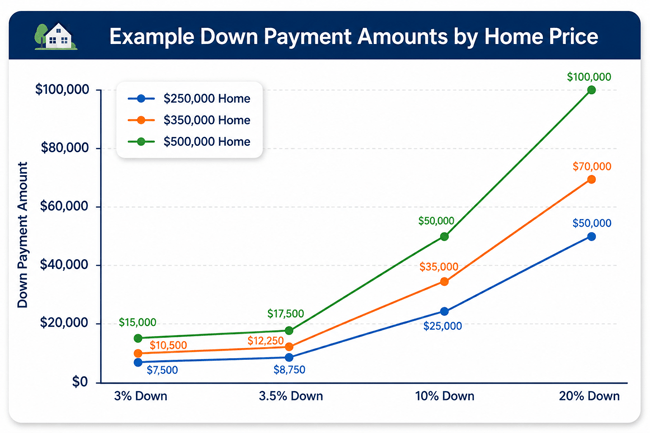
Down payment amount = home price x down payment percentage.
| Home price | 3% down | 3.5% down | 5% down | 10% down | 20% down |
|---|---|---|---|---|---|
| $250,000 | $7,500 | $8,750 | $12,500 | $25,000 | $50,000 |
| $350,000 | $10,500 | $12,250 | $17,500 | $35,000 | $70,000 |
| $500,000 | $15,000 | $17,500 | $25,000 | $50,000 | $100,000 |
These examples show only the down payment. Your total cash to close may also include closing costs, prepaid taxes, homeowners insurance, escrow deposits, inspection costs, appraisal fees, and moving expenses.
4. Typical Minimum Down Payment Requirements by Loan Type
The required down payment depends heavily on the mortgage program. The table below summarizes common U.S. home loan options. Exact requirements can vary by lender, property type, occupancy, credit score, automated underwriting findings, and local assistance rules.
| Loan type | Common minimum down payment | Best fit | Important notes |
|---|---|---|---|
| Conventional conforming | As low as 3% for some qualified first-time or income-eligible borrowers; often 5% for many buyers | Borrowers with solid credit and stable income | PMI is typically required below 20% down. Some programs have income or first-time buyer rules. |
| Fannie Mae HomeReady | As low as 3% | Low-income creditworthy borrowers | Income limits and education requirements may apply. |
| Freddie Mac Home Possible / HomeOne | As low as 3% | Low- to moderate-income buyers or qualified first-time buyers | Program rules vary by product and property. |
| FHA loan | As low as 3.5% for eligible borrowers | Buyers with limited savings or more flexible credit needs | FHA mortgage insurance applies; 10% down may be required at lower credit scores. |
| VA loan | Often 0% for eligible borrowers with sufficient entitlement | Eligible service members, veterans, and certain surviving spouses | No PMI, but a VA funding fee may apply unless exempt. |
| USDA guaranteed loan | Often 0% for eligible rural and income-qualified buyers | Low- to moderate-income buyers in eligible rural areas | Income and property location limits apply. |
| Jumbo loan | Often 10% to 20% or more | Higher-priced homes above conforming loan limits | Stronger credit, reserves, and documentation are usually required. |
| Investment property loan | Often 15% to 25% or more | Real estate investors | Higher risk means higher down payment and stricter underwriting. |
| Second home loan | Often 10% or more | Vacation or seasonal home buyers | Not the same as a primary residence; lender rules can be stricter. |
5. Do You Really Need 20% Down to Buy a House?
No. Many buyers can qualify for a mortgage with less than 20% down. The 20% figure remains important because it often helps conventional borrowers avoid private mortgage insurance, reduce the loan amount, and start with stronger equity. But it is not a universal requirement.
The better question is not “Can I avoid 20% down?” but “What down payment gives me the safest balance between approval, monthly affordability, emergency savings, and long-term cost?”
5.1 20% Down vs. Low Down Payment: Comparison
| Factor | 20% down | Low down payment |
|---|---|---|
| Upfront cash needed | Much higher | Lower |
| Mortgage insurance | Usually avoided on conventional loans | Often required unless VA or certain special programs apply |
| Loan amount | Lower | Higher |
| Monthly payment | Usually lower | Usually higher |
| Cash left after closing | May be lower if savings are drained | May preserve more cash for emergencies |
| Time to buy | May take longer to save | May allow earlier purchase |
| Risk if home value falls | Lower risk of being underwater | Higher risk of low or negative equity |
6. Why Down Payment Requirements Matter
- Approval odds: Meeting the minimum is only the starting point. A stronger down payment can help offset other risks in your file.
- Monthly payment: A larger down payment reduces the amount borrowed, which can lower principal, interest, and sometimes mortgage insurance.
- Total interest paid: Borrowing less can reduce lifetime interest, especially on long-term fixed-rate mortgages.
- Mortgage insurance: Conventional loans with less than 20% down typically require PMI, while FHA and USDA loans have their own mortgage insurance or guarantee-fee structures.
- Equity and flexibility: More equity can make it easier to refinance, sell, or handle a market downturn.
- Cash reserves: Putting too much down can leave you house-poor if you have no emergency fund left.
7. Down Payment Requirements for Major Home Loan Programs
7.1 Conventional Loans
A conventional loan is not insured by the federal government. It may follow Fannie Mae or Freddie Mac guidelines or be held by a private lender. Some conventional programs allow down payments as low as 3% for eligible buyers, while many borrowers use 5%, 10%, or 20% down.
Conventional loans can be attractive for borrowers with stronger credit because mortgage insurance may be cancellable once enough equity is built, unlike some government-backed mortgage insurance structures. However, the lowest down payment options may have income limits, first-time buyer rules, or stricter underwriting conditions.
7.2 FHA Loans
FHA loans are insured by the Federal Housing Administration. HUD states that FHA down payments can be as low as 3.5% of the purchase price on eligible 1- to 4-unit properties. FHA loans are often used by buyers who need more flexible credit or have limited savings.
FHA loans include mortgage insurance premiums. This can make the monthly payment higher than buyers expect, so compare the full payment, not only the down payment.
7.3 VA Loans
VA loans are available to eligible service members, veterans, and certain surviving spouses. The U.S. Department of Veterans Affairs says VA purchase loans often do not require a down payment or private mortgage insurance. This can be a major benefit for eligible borrowers.
A zero-down VA loan is not automatically the cheapest loan in every case. Buyers should still review the VA funding fee, interest rate, seller concessions, closing costs, property requirements, and cash reserves after closing.
7.4 USDA Loans
USDA Rural Development offers home loan programs for eligible buyers in eligible rural areas. Its Single Family Housing Guaranteed Loan Program supports 100% financing for eligible rural homebuyers, which means no money down for those who qualify.
USDA loans can be helpful when the main obstacle is upfront cash, but they are not available everywhere. Income limits, property eligibility, occupancy rules, and lender standards still apply.
7.5 Jumbo Loans
A jumbo loan is a mortgage that exceeds the conforming loan limit for the area. Because jumbo loans are larger and not eligible for standard conforming sale to Fannie Mae or Freddie Mac, lenders often require larger down payments, stronger credit, lower debt-to-income ratios, and significant reserves. Requirements vary widely by lender.
7.6 Investment Property and Second Home Loans
Down payment requirements are usually higher when the home is not your primary residence. Lenders see investment properties and second homes as riskier because borrowers may prioritize their primary home during financial stress. Expect stricter reserve, credit, and documentation requirements.
8. Down Payment vs. Cash to Close: Do Not Confuse Them
Your down payment is only one part of the money you may need to close. The Consumer Financial Protection Bureau’s home loan materials explain that “cash to close” includes the down payment plus closing costs. This distinction is critical because a buyer who saves exactly the minimum down payment may still be short at closing.
| Cost category | What it means | Example items |
|---|---|---|
| Down payment | Your upfront equity contribution | 3%, 3.5%, 5%, 10%, or 20% of purchase price |
| Loan costs | Fees tied to getting the mortgage | Origination, underwriting, appraisal, credit report |
| Title and settlement costs | Costs to transfer and protect ownership | Title search, title insurance, settlement/escrow fee |
| Prepaids and escrow | Money collected for future expenses | Homeowners insurance, property taxes, prepaid interest |
| Inspections and moving | Often paid outside closing | Home inspection, pest inspection, movers, utility deposits |
9. Where Can Your Down Payment Money Come From?
Lenders must verify that your down payment funds are acceptable, documented, and not undisclosed borrowed money. The rules differ by loan program, but common eligible sources may include:
- Checking and savings accounts
- Investment or retirement account withdrawals, if allowed and documented
- Gift funds from eligible donors
- Employer assistance programs
- Approved down payment assistance grants or second mortgages
- Proceeds from selling another property
- Documented sale of personal assets
Do not move large amounts of money around without documentation. If a family member gives you money, your lender may require a gift letter and proof that the money is not a loan you must repay.
10. Down Payment Assistance Programs
Down payment assistance, often called DPA, can help eligible buyers cover part of the down payment or closing costs. Programs may be offered by state housing finance agencies, local governments, employers, nonprofits, or community development organizations.
10.1 Common Types of Down Payment Assistance
| Type | How it works | Key caution |
|---|---|---|
| Grant | Money that may not need to be repaid if requirements are met | Program rules can be strict; funds may run out |
| Forgivable second mortgage | Second loan forgiven after you occupy the home for a required period | Selling or refinancing too soon may trigger repayment |
| Deferred-payment loan | Second loan with payments delayed until sale, refinance, or payoff | You still owe the money later |
| Low-interest second mortgage | A smaller loan used with the first mortgage | Adds another payment or lien |
| Matched savings program | Program matches buyer savings after education or contribution requirements | Takes planning and documentation |
11. How Mortgage Insurance Changes the Down Payment Decision
Mortgage insurance protects the lender, not the borrower, if the borrower defaults. The CFPB explains that PMI may be required on conventional loans when the down payment is less than 20% of the purchase price. Mortgage insurance can help buyers qualify with less cash upfront, but it increases the cost of the loan.
Different programs use different terms. Conventional loans use private mortgage insurance. FHA loans use mortgage insurance premiums. USDA loans generally use guarantee fees. VA loans do not require PMI but may include a funding fee unless the borrower is exempt.
| Loan program | Mortgage insurance / fee issue | Can it go away? |
|---|---|---|
| Conventional | PMI often required below 20% down | Often cancellable when equity requirements are met, subject to rules |
| FHA | Upfront and annual mortgage insurance premiums may apply | Depends on down payment, loan term, and current FHA rules; often requires refinance for removal |
| USDA | Guarantee-related fees may apply | Generally built into program cost structure |
| VA | No PMI; funding fee may apply | Funding fee is generally upfront/financed unless exempt |
12. Step-by-Step Process: How to Decide How Much to Put Down
- Estimate your realistic home price range before choosing a down payment percentage.
- Check which loan programs you may qualify for: conventional, FHA, VA, USDA, or local assistance.
- Calculate your down payment and your full cash to close, not just the minimum down payment.
- Compare monthly payments at different down payment levels, including mortgage insurance and taxes.
- Protect your emergency fund. Avoid using every dollar of savings to increase the down payment.
- Ask lenders for Loan Estimates so you can compare interest rates, mortgage insurance, closing costs, and cash to close.
- Confirm acceptable fund sources before depositing gifts, assistance money, or large transfers.
- Review the appraisal and underwriting conditions before assuming final approval.
- Before closing, compare the Closing Disclosure with your most recent Loan Estimate and ask questions about changes.
- Choose the down payment that balances affordability, approval strength, and post-closing safety.
13. Real-World Examples
13.1 Example 1: First-Time Buyer With Limited Savings
A buyer wants a $280,000 starter home and has $18,000 saved. A 3% conventional down payment would be $8,400, while a 3.5% FHA down payment would be $9,800. Either option might leave money for closing costs and reserves, but the buyer needs to compare mortgage insurance, credit requirements, and total monthly payment. The lowest down payment is not automatically the best option if one loan has a much higher long-term cost.
13.2 Example 2: Eligible Veteran Choosing Between VA and Conventional
An eligible veteran can buy with 0% down using a VA loan but also has enough savings for 5% down on a conventional loan. The VA option may preserve emergency savings and avoid PMI, but the buyer should compare the VA funding fee, interest rate, seller concessions, and the monthly payment. The right choice depends on total cost and cash safety after closing.
13.3 Example 3: Buyer Trying to Avoid PMI
A buyer has saved 15% down and is considering delaying purchase until reaching 20%. Waiting could reduce mortgage insurance costs, but home prices, rent, and interest rates could change. The buyer should calculate the monthly PMI cost, expected time to reach 20% equity, and risk of draining cash reserves. Sometimes paying temporary PMI is reasonable; sometimes waiting is safer.
13.4 Example 4: Rural Buyer Using USDA
A household has steady income but limited savings and wants a home in an eligible rural area. A USDA guaranteed loan may allow no-money-down financing if the household and property qualify. However, the buyer still needs money for inspections, moving, possible repairs, and any closing costs not covered by seller credits or assistance.
14. Benefits of a Larger Down Payment
- Lower loan amount and potentially lower monthly payment
- Less interest paid over time
- Possibility of avoiding PMI on a conventional loan
- More equity from day one
- Stronger offer in some competitive markets
- More refinance or selling flexibility if home values decline
15. Benefits of a Smaller Down Payment
- Allows qualified buyers to purchase sooner
- Preserves cash for emergencies, repairs, furniture, and moving
- May be the only realistic path in high-cost markets
- Can pair with assistance programs or gift funds
- May help avoid delaying homeownership for years while saving for 20%
16. Risks of Putting Too Little Down
- Higher monthly payment because you borrow more
- Mortgage insurance or guarantee fees may increase the cost
- Less equity if home prices fall
- Harder to refinance if values decline
- More pressure on your budget if taxes, insurance, or repairs rise
- Potential bidding disadvantage if sellers prefer larger down payments
17. Risks of Putting Too Much Down
- Draining your emergency fund
- Having no cash for repairs after moving in
- Missing better uses for cash, such as paying high-interest debt
- Becoming house-poor even with a lower mortgage payment
- Reducing flexibility if income drops soon after closing
18. Common Mistakes to Avoid
- Assuming 20% down is always required. Many programs allow less, but you must understand the trade-offs.
- Saving only for the down payment and forgetting closing costs.
- Using undocumented cash deposits that create underwriting problems.
- Taking a personal loan for the down payment without telling the lender.
- Choosing the lowest down payment without comparing mortgage insurance and total payment.
- Draining all savings to avoid PMI.
- Ignoring property eligibility rules for USDA, VA, FHA, condos, manufactured homes, and multi-unit properties.
- Relying on online calculators without getting lender-specific Loan Estimates.
- Changing jobs, opening new credit, or making large purchases before closing.
- Assuming down payment assistance is free money without repayment or occupancy conditions.
19. Expert Tips for Choosing the Right Down Payment
- Compare at least two or three loan options using the same home price and estimated closing date.
- Ask for the full monthly payment: principal, interest, taxes, insurance, mortgage insurance, HOA dues, and any second-lien assistance payment.
- Keep a separate emergency fund after closing. A home needs repairs even when the inspection looks clean.
- Ask when and how mortgage insurance can be removed before choosing a low-down-payment conventional loan.
- Check assistance programs early. Some require homebuyer education before closing.
- Do not waive inspections just to compensate for a small down payment unless you fully understand the risk.
- Use gift funds correctly. Get the lender’s documentation requirements before money changes hands.
- Remember that approval is not the same as affordability. Your real budget should include maintenance, utilities, transportation, and life goals.
20. Quick Action Checklist
- Write down your target home price range.
- Calculate 3%, 3.5%, 5%, 10%, and 20% down payment amounts for that price.
- Estimate closing costs separately from the down payment.
- Check whether you may qualify for FHA, VA, USDA, conventional 3% down, or local assistance.
- Review your credit reports and avoid new debt before applying.
- Ask lenders for Loan Estimates, not just rate quotes.
- Confirm whether mortgage insurance applies and when it can be removed.
- Document all down payment funds for at least the period your lender requires.
- Keep enough cash after closing for emergencies and repairs.
- Choose the loan and down payment that fit your complete financial life, not only the minimum requirement.
21. Pros and Cons of Low Down Payment Home Loans
| Pros | Cons |
|---|---|
| You may buy sooner instead of waiting years to save 20%. | Monthly payment is usually higher because the loan amount is larger. |
| You can keep cash for repairs, moving, and emergencies. | Mortgage insurance or program fees may increase total cost. |
| Some programs support first-time, rural, military, or moderate-income buyers. | Less starting equity can make selling or refinancing harder if values fall. |
| Gift funds and assistance may help bridge the gap. | Underwriting and documentation requirements can be strict. |
22. Frequently Asked Questions About Down Payment Requirements for Home Loans
22.1 What is the minimum down payment for a home loan?
It depends on the loan type. Eligible VA and USDA buyers may qualify with 0% down. Some conventional loans allow 3% down. FHA loans may allow 3.5% down for eligible borrowers. Jumbo, investment, and second-home loans often require more.
22.2 Do I need 20% down to buy a house?
No. Many buyers purchase with less than 20% down. However, 20% down can help conventional borrowers avoid PMI and reduce the loan amount.
22.3 What happens if I put less than 20% down?
You may still qualify, but you may pay mortgage insurance or program fees, borrow more, and have less starting equity.
22.4 Is a 3% down conventional loan better than an FHA loan?
Not always. Conventional may be better for stronger-credit borrowers, especially if PMI can be cancelled. FHA may be better for borrowers who need more flexible credit rules. Compare total monthly payment and long-term cost.
22.5 Can I use gift money for a down payment?
Often yes, if the loan program allows it and the gift is properly documented. Your lender may require a gift letter and proof of transfer.
22.6 Can I borrow my down payment?
You generally cannot use undisclosed borrowed funds as a down payment. Some approved second mortgages or assistance programs may be allowed, but they must be disclosed and meet program rules.
22.7 Are closing costs included in the down payment?
No. The down payment is separate from closing costs. Your cash to close usually includes both.
22.8 Can seller credits cover my down payment?
Usually no. Seller credits can often help with allowable closing costs, but they generally cannot replace the buyer’s required minimum investment.
22.9 What is PMI?
Private mortgage insurance is insurance that protects the lender if a borrower defaults on a conventional loan. It is commonly required when the down payment is less than 20%.
22.10 Is it better to put more money down or keep cash?
It depends on your risk tolerance, emergency savings, monthly payment, and total loan cost. A larger down payment can reduce costs, but keeping reserves can protect you from repairs or income shocks.
22.11 Can down payment assistance help with closing costs too?
Many programs can help with both, but rules vary. Some assistance is a grant, some is forgivable, and some must be repaid later.
22.12 Do first-time buyers get lower down payment requirements?
Sometimes. Certain conventional programs and assistance programs target first-time buyers, but eligibility depends on income, property type, location, and credit profile.
22.13 Does a higher down payment guarantee mortgage approval?
No. Lenders also review credit, income, debt-to-income ratio, employment, assets, property condition, appraisal, and documentation.
22.14 Should I wait until I have 20% down?
Maybe, but not always. Waiting can reduce PMI and borrowing costs, but it may also mean paying rent longer or facing changing home prices and rates. Compare scenarios with real numbers.
22.15 Can I buy a house with no money saved?
Even with 0% down programs, you usually need money for inspections, earnest money, closing costs, moving, repairs, and emergency reserves unless assistance or seller credits cover allowable items.
23. Conclusion: The Best Down Payment Is the One That Keeps the Home Affordable
Down payment requirements for home loans are not one-size-fits-all. Some qualified buyers can purchase with 0%, 3%, or 3.5% down, while others may need 5%, 10%, 20%, or more depending on the loan program and property type. The important point is to understand the full picture: down payment, closing costs, mortgage insurance, monthly payment, reserves, and long-term risk.
A low down payment can be a smart tool when it helps a prepared buyer enter homeownership without draining savings. A larger down payment can be a smart tool when it lowers total cost and creates more stability. The best decision is the one that leaves you with an affordable payment, documented funds, emergency savings, and confidence that you can maintain the home after the keys are yours.
23.1 Sources Consulted
- Information checked June 25, 2026. CFPB: What is private mortgage insurance? https://www.consumerfinance.gov/ask-cfpb/what-is-private-mortgage-insurance-en-122/
- CFPB: Mortgage insurance explainer. https://www.consumerfinance.gov/ask-cfpb/what-is-mortgage-insurance-and-how-does-it-work-en-1953/
- CFPB: Your home loan toolkit and Loan Estimate resources. https://www.consumerfinance.gov/owning-a-home/explore/home-loan-toolkit/ and https://www.consumerfinance.gov/owning-a-home/loan-estimate/
- HUD: Let FHA Loans Help You. https://www.hud.gov/helping-americans/loans
- VA: VA Home Loans and Buyer’s Guide. https://www.benefits.va.gov/homeloans/ and https://www.benefits.va.gov/homeloans/documents/docs/VA_Buyers_Guide.pdf
- USDA Rural Development: Single Family Housing Guaranteed Loan Program. https://www.rd.usda.gov/programs-services/single-family-housing-programs/single-family-housing-guaranteed-loan-program
- Fannie Mae: HomeReady Mortgage. https://singlefamily.fanniemae.com/originating-underwriting/mortgage-products/homeready-mortgage
- Freddie Mac: Home Possible and HomeOne. https://sf.freddiemac.com/working-with-us/origination-underwriting/mortgage-products/home-possible and https://sf.freddiemac.com/working-with-us/origination-underwriting/mortgage-products/home-one
Reader Advice: This article is written for educational purpose only and should not be taken as personalized financial, legal, tax, or mortgage advice. Mortgage rules, lender overlays, interest rates, assistance programs, and eligibility standards can change. Always verify details with licensed mortgage professionals, official program sources, and your lender before making a home-buying decision. Borrowers should compare current lender offers and consult qualified professionals before making a decision.