Merchant Cash Advance: Pros, Cons, Costs, and Alternatives
A merchant cash advance can feel like a lifeline when a business needs money quickly and cannot qualify for a traditional loan. The approval process is often faster, the paperwork is lighter, and funding may be based more on sales activity than on perfect credit. For a restaurant, retail shop, salon, online store, or service business with card sales, that speed can be attractive.
But speed has a price. A merchant cash advance, often called an MCA, is usually one of the more expensive forms of small-business financing. Instead of charging a familiar interest rate, many providers use a factor rate and collect repayment through daily or weekly withdrawals from future sales or bank deposits. That structure can make the real cost hard to compare with a loan, line of credit, or invoice financing.
This matters because an MCA can either solve a short-term cash crunch or create a repayment cycle that strains cash flow. Business owners who are already behind on bills, dealing with seasonal revenue, or trying to cover payroll may be especially vulnerable to confusing offers. The goal of this guide is to help you understand how MCAs work, what they cost, when they may make sense, when they are dangerous, and which alternatives to compare first.
Please note that this article is educational, not legal, tax, or personalized financial advice. Merchant cash advance rules vary by state, contract design, and provider. Business owners should compare written offers and consult a qualified advisor before signing.
1. What Is a Merchant Cash Advance?
A merchant cash advance is a type of business financing in which a provider gives a business a lump sum of cash upfront in exchange for a portion of the business’s future sales or revenue. Repayment is commonly collected through a percentage of card receipts, automated bank withdrawals, or fixed daily or weekly payments until the agreed repayment amount is satisfied.
Unlike a traditional business loan, an MCA is often marketed as a purchase of future receivables rather than a loan. In practical terms, however, many businesses experience it like debt because money is advanced today and repaid from future cash flow. The Consumer Financial Protection Bureau describes MCA arrangements as financing in which merchants receive cash and promise to repay through future revenue, often using a holdback percentage or automated withdrawals. Source: CFPB Small Business Lending Rule FAQs.
| Term | Plain-English meaning |
|---|---|
| Advance amount | The cash your business receives upfront. |
| Purchased amount / repayment amount | The total amount you must remit to the MCA provider. |
| Factor rate | A multiplier used to calculate total repayment, such as 1.20, 1.30, or 1.45. |
| Holdback percentage | The percentage of daily or weekly sales taken for repayment. |
| ACH withdrawals | Automatic debits from your business bank account. |
| Reconciliation | A contract feature that may adjust payments if sales fall, depending on terms. |
| Confession of judgment | A legal clause that can let a provider obtain judgment more quickly if allowed; it is a serious red flag. |
2. How a Merchant Cash Advance Works
The basic MCA process is simple, but the contract details matter a lot.
- You apply with recent bank statements, card processing statements, business information, and sometimes owner identification.
- The provider reviews your sales volume, deposit history, time in business, industry, and negative balances or overdrafts.
- You receive an offer showing the advance amount, factor rate, repayment amount, payment method, estimated term, and fees.
- If you sign, the provider sends funds to your business bank account.
- Repayment begins quickly, often the next business day or within a few days.
- The provider collects a percentage of sales or a fixed daily or weekly amount until the purchased amount is fully remitted.
2.1. Simple MCA Cost Formula
Total repayment = Advance amount x factor rate
Dollar cost = Total repayment - Advance amount + fees
Example: If a business receives $50,000 with a 1.30 factor rate, total repayment is $65,000. The base cost is $15,000 before any origination, processing, or administrative fees.
3. Why Merchant Cash Advances Matter for Small Businesses
Merchant cash advances matter because they sit at the intersection of speed, access, and risk. Many small businesses need working capital before they qualify for bank financing. An MCA may be available when a business has weak credit, limited collateral, or inconsistent profitability. That access can help with inventory, emergency repairs, marketing campaigns, tax obligations, or short-term payroll gaps.
At the same time, regulators have warned about deceptive or unfair practices in parts of the MCA market. The Federal Trade Commission has brought enforcement actions involving MCA providers accused of misleading small businesses, overcharging, unauthorized debits, or abusive collection practices. Source: FTC enforcement releases on Yellowstone Capital, RCG Advances, and related MCA cases. California’s Department of Financial Protection and Innovation has also invited small businesses to report unfair, deceptive, or abusive practices involving MCAs. Source: California DFPI advisory, April 2025.
4. Merchant Cash Advance vs Business Loan: Key Differences
| Feature | Merchant cash advance | Traditional business loan |
|---|---|---|
| Legal structure | Often structured as a purchase of future receivables or sales-based financing. | Structured as debt with principal, interest, and repayment terms. |
| Pricing method | Factor rate, fees, and repayment amount. | Interest rate, APR, fees, amortization schedule. |
| Repayment | Daily/weekly sales percentage or ACH withdrawals. | Usually monthly payments, sometimes weekly. |
| Speed | Often fast. | Can be slower, especially with banks or SBA loans. |
| Qualification focus | Sales volume and cash flow often matter heavily. | Credit, revenue, collateral, profitability, time in business, DSCR. |
| Cost transparency | Can be harder to compare unless converted to estimated APR and cash-flow impact. | Generally easier to compare using APR and payment schedule. |
| Best fit | Short-term, urgent, high-margin need with predictable sales. | Planned borrowing, growth projects, refinancing, equipment, working capital. |
5. Pros of a Merchant Cash Advance
| Benefit | Why it may help | Best-fit scenario |
|---|---|---|
| Fast access to cash | Some MCA providers can make decisions quickly because they rely heavily on recent sales data. | Emergency repairs, inventory opportunity, short-term cash gap. |
| Flexible approval standards | Businesses with lower credit scores may still qualify if revenue is strong. | A business recovering from credit issues but showing steady deposits. |
| No traditional collateral in many cases | Some offers do not require equipment, property, or inventory as collateral. | Service businesses or restaurants without major hard assets. |
| Payments may move with sales | A true percentage-of-sales model can reduce payments when sales fall. | Seasonal businesses with card-based revenue. |
| Useful for short-term opportunities | The speed can support a profitable opportunity that must be funded immediately. | Buying discounted inventory that will sell quickly at healthy margins. |
6. Cons and Risks of a Merchant Cash Advance
| Risk | Why it matters | How to reduce the risk |
|---|---|---|
| High effective cost | Factor rates can make the dollar cost much higher than many loans or lines of credit. | Compare total repayment, fees, payment frequency, and estimated APR. |
| Cash-flow pressure | Daily or weekly withdrawals can drain operating cash. | Stress-test payments under slower sales months. |
| Hard-to-compare pricing | A factor rate is not the same as an interest rate. | Ask for APR-style disclosure where available and calculate effective cost. |
| Stacking risk | Taking multiple MCAs can trap a business in overlapping withdrawals. | Avoid using a new MCA to pay an old MCA unless under advisor-guided restructuring. |
| Aggressive contract terms | Some contracts include broad default triggers, personal guarantees, or harsh collection provisions. | Have a lawyer review the agreement before signing. |
| Not always sales-flexible | Some offers use fixed ACH payments even if sales fall. | Confirm reconciliation rights and payment-adjustment process in writing. |
7. How Much Does a Merchant Cash Advance Cost?
MCA cost is usually expressed through a factor rate, not a traditional interest rate. A factor rate is a multiplier applied to the amount advanced. Common examples in the market may look like 1.10, 1.25, 1.40, or higher, but the exact rate depends on the provider, sales profile, perceived risk, industry, repayment method, and contract terms. Because pricing changes by provider and applicant, do not rely on a generic average. Always compare written offers.
7.1. MCA Cost Example
| Item | Example amount |
|---|---|
| Advance received | $50,000 |
| Factor rate | 1.30 |
| Total repayment | $65,000 |
| Base financing cost | $15,000 |
| Origination or processing fee | Example: $1,000 if charged |
| Total dollar cost with fee | $16,000 |
| Estimated collection period | 6 months in this example |
| Cash-flow reality | The shorter the payoff period, the higher the effective annualized cost can feel. |
7.2. Why Factor Rate Can Be Misleading
A factor rate looks smaller than an interest rate, but it does not work the same way. If you repay $65,000 on a $50,000 advance in six months, the $15,000 cost is paid over a short period. That is very different from paying $15,000 over several years. This is why businesses should look beyond the factor rate and evaluate the dollar cost, repayment speed, fees, and cash-flow impact.
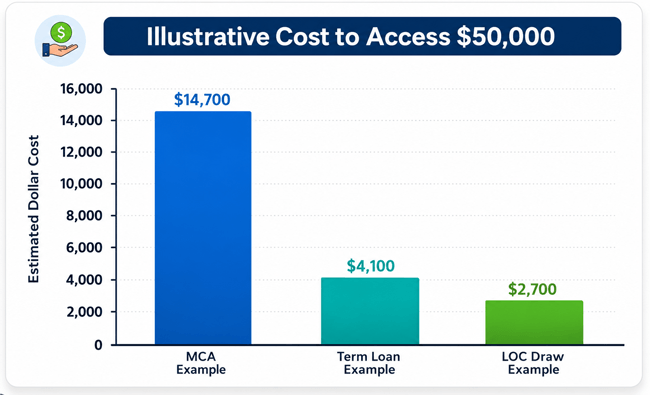
Chart: Illustrative cost comparison only. Actual offers vary by provider, credit profile, revenue, repayment period, fees, and state disclosure rules.
7.3. Merchant Cash Advance Fees to Watch For
Origination fee or funding fee
Broker fee or referral fee
Underwriting or administrative fee
ACH debit fee
Early payoff fee or lack of discount for early payoff
Late payment or default-related fees
Renewal fees when rolling into another advance
8. How to Estimate the True Cost of an MCA
- Write down the exact advance amount you will receive after all fees are deducted.
- Write down the total repayment amount, also called purchased amount or receivables purchased amount.
- Add every fee that is not already included in the repayment amount.
- Estimate the repayment period based on realistic sales, not optimistic projections.
- Calculate the dollar cost: total repayment plus fees minus net cash received.
- Compare the cost with a business line of credit, term loan, invoice financing, equipment financing, SBA loan, credit union loan, and supplier terms.
- Stress-test the daily or weekly payment under a slow month, a normal month, and a strong month.
9. Real-World Examples
9.1. Example 1: A restaurant uses an MCA for emergency equipment repair
A restaurant’s walk-in cooler fails before a busy holiday weekend. The owner needs $20,000 quickly. A bank loan will take too long. The restaurant accepts an MCA with a fixed repayment amount. The repair allows the business to stay open, but daily withdrawals reduce cash available for food purchases and payroll. This may be a reasonable emergency use only if the restaurant has enough margin and a clear plan to absorb repayments.
9.2. Example 2: A retailer uses an MCA for discounted inventory
A boutique can buy inventory at a large discount and expects to sell it within 45 days. The owner compares the gross profit from the inventory with the MCA cost. If the expected profit is comfortably higher than the financing cost and the business has steady sales, the MCA may support a profitable short-term opportunity. If the profit margin is thin, the advance may erase the benefit.
9.3. Example 3: A service business uses an MCA to cover payroll
A marketing agency takes an MCA because a large client is late paying an invoice. If the agency has a signed receivable from a reliable client, invoice financing or a short-term line of credit may be safer. Using a high-cost MCA for payroll without a clear incoming payment can create a cycle where tomorrow’s revenue is consumed by yesterday’s emergency.
10. When a Merchant Cash Advance May Make Sense
The need is urgent and time-sensitive.
The business has strong, predictable sales volume.
The use of funds has a clear return that exceeds the MCA cost.
The repayment period is short and manageable.
Lower-cost options are unavailable or too slow.
The contract allows payment adjustment if sales fall.
The owner fully understands total repayment, fees, default triggers, and legal terms.
11. When to Avoid a Merchant Cash Advance
You need money because existing debt payments are already unaffordable.
The provider will not clearly disclose total repayment, fees, or payment schedule.
The contract includes harsh default clauses you do not understand.
You must take a second advance to pay the first one.
Your margins are too low to absorb daily or weekly withdrawals.
Your sales are declining or highly unpredictable.
You have access to a cheaper line of credit, invoice financing, term loan, or supplier financing.
12. Merchant Cash Advance Qualification Requirements
MCA qualification standards vary, but providers commonly look at business cash flow more than traditional collateral. Requirements may include:
Recent business bank statements, often several months.
Credit and debit card processing statements if repayment is tied to card receipts.
Minimum monthly revenue or deposit volume.
Time in business.
Owner identification and business formation details.
Business tax ID, bank account, and sometimes a business lease or merchant processing agreement.
Review of overdrafts, negative balances, returned payments, existing advances, liens, or bankruptcies.
A lower credit score may not automatically disqualify a business, but weak credit can still affect pricing, advance amount, and contract terms. Strong revenue does not make an offer safe by itself. The repayment structure must fit cash flow.
13. Step-by-Step Process Before Taking an MCA
- Define the exact business problem. Do not borrow unless you know what the money will fix.
- Calculate the return on the use of funds. Estimate how the advance will increase revenue, protect revenue, or reduce costs.
- Gather your recent bank statements, sales reports, tax records, accounts receivable, and debt schedule.
- Compare at least three financing options, not just three MCA providers.
- Ask each provider for the advance amount, net funding, total repayment, factor rate, fees, payment frequency, holdback percentage, and estimated payoff period.
- Convert the offer into a cash-flow forecast.
- Read the default section carefully.
- Ask whether payments can be reconciled if sales drop and how to request it.
- Have an attorney, accountant, or small-business advisor review the agreement.
- Sign only if the expected benefit clearly outweighs the total cost and risk.
14. Merchant Cash Advance Alternatives
| Alternative | Best for | Potential advantage over MCA | Watch out for |
|---|---|---|---|
| Business line of credit | Recurring working capital needs | Borrow only what you need; often lower cost. | May require stronger credit and revenue. |
| Short-term business loan | One-time cash need with set payoff | Clear repayment schedule and fixed term. | Can still be expensive online. |
| SBA loan | Large, planned financing needs | Often competitive terms for qualified borrowers. | Slower and documentation-heavy. |
| Invoice financing | B2B businesses with unpaid invoices | Funding tied to receivables rather than card sales. | Fees and customer concentration matter. |
| Equipment financing | Buying equipment or vehicles | Equipment may serve as collateral. | Only fits equipment purchases. |
| Business credit card | Small short-term purchases | Grace period and rewards if paid in full. | High interest if balance revolves. |
| Supplier/vendor terms | Inventory or materials | May be low-cost if negotiated well. | Late payment can damage supplier relationships. |
| Community lender or CDFI | Businesses underserved by banks | May offer coaching and fairer terms. | Funding may be slower or limited. |
15. MCA vs Revenue-Based Financing
Merchant cash advances and revenue-based financing overlap because both can be tied to future revenue. The key difference is in structure, transparency, payment flexibility, and legal terms. Some revenue-based financing products are designed with clearer payment caps and flexible payments, while some MCA contracts operate more like short-term daily-debit financing. Do not rely on the product name. Read the actual agreement.
16. Red Flags in Merchant Cash Advance Offers
The provider pressures you to sign immediately.
The contract is described as “not debt” but includes debt-like collection terms.
You cannot identify the total repayment amount.
Fees are deducted before funding but not clearly shown.
The provider discourages you from asking a lawyer or accountant.
The offer includes a confession of judgment or unusually broad default triggers.
Payments are fixed even though the product is marketed as tied to sales.
The provider tells you to hide existing financing or open a new bank account to avoid other creditors.
You are encouraged to stack multiple advances.
17. Common Mistakes to Avoid
17.1. Mistake 1: Confusing factor rate with interest rate
A 1.30 factor rate does not mean 30% APR. It means you repay 1.30 times the advance amount, and the effective annualized cost depends heavily on how quickly you repay.
17.2. Mistake 2: Looking only at the advance amount
The amount deposited into your account is not the only number that matters. Focus on net funding, total repayment, fees, payment frequency, and repayment period.
17.3. Mistake 3: Assuming payments will automatically drop when sales fall
Some contracts allow reconciliation; others do not, or the process may be difficult. Get the adjustment process in writing.
17.4. Mistake 4: Using an MCA for long-term problems
An MCA may cover an urgent gap, but it usually does not fix weak margins, declining sales, poor pricing, or chronic cash-flow shortages.
17.5. Mistake 5: Stacking advances
Using one advance to pay another can cause daily withdrawals to consume operating cash. If you are already stacking, speak with a qualified business debt advisor before signing another contract.
18. Expert Tips Before You Sign
Ask for a one-page offer summary showing net funding, total repayment, all fees, payment frequency, estimated term, and payment-adjustment rights.
Compare the MCA to at least one non-MCA alternative, even if you think you will not qualify.
Run a 13-week cash-flow forecast before accepting daily or weekly withdrawals.
Calculate the break-even return: how much new gross profit must the advance produce to justify its cost?
Avoid borrowing for expenses that will not create or protect revenue unless it is a true emergency.
Do not sign a contract you cannot explain in plain English.
Keep copies of all offers, contracts, payment histories, and communications.
19. Quick Action Checklist
Identify the exact funding need and amount.
Calculate the cost of doing nothing.
Calculate the expected benefit of using the funds.
Request written offers from multiple providers.
Compare net funding, total repayment, fees, holdback, payment frequency, and estimated term.
Estimate cash flow under slow, normal, and strong sales scenarios.
Search for cheaper alternatives such as a line of credit, invoice financing, supplier terms, or community lender.
Review default clauses, personal guarantees, reconciliation rights, and collection provisions.
Ask an attorney or accountant to review the agreement.
Sign only if the math works and the repayment is survivable.
20. Frequently Asked Questions About Merchant Cash Advances
20.1. What is a merchant cash advance?
A merchant cash advance is business financing where a provider gives cash upfront in exchange for a share of future sales or revenue. It is often repaid through daily or weekly card-sales deductions or bank withdrawals.
20.2. Is a merchant cash advance a loan?
It depends on the contract and applicable law. Many MCAs are marketed as purchases of future receivables, not loans. However, many businesses experience them like debt because they receive money now and remit more money later from future revenue.
20.3. How is an MCA repaid?
Repayment may be collected as a percentage of card sales, a percentage of revenue, or fixed ACH withdrawals from the business bank account until the agreed repayment amount is satisfied.
20.4. What is a factor rate?
A factor rate is a multiplier used to calculate total repayment. For example, a $50,000 advance with a 1.30 factor rate requires $65,000 in total repayment before fees.
20.5. Why can merchant cash advances be expensive?
They can be expensive because the repayment amount is fixed by a factor rate and often collected over a short period. Short repayment periods can create a high effective annualized cost.
20.6. Do MCAs require good credit?
Not always. Many providers focus heavily on sales volume and bank deposits. However, credit, existing debt, overdrafts, and business stability can still affect approval and pricing.
20.7. Can an MCA hurt cash flow?
Yes. Daily or weekly withdrawals can reduce the cash available for payroll, rent, inventory, taxes, and other operating expenses.
20.8. What is a holdback percentage?
A holdback percentage is the share of daily or weekly sales withheld for repayment. A higher holdback can speed repayment but may strain cash flow.
20.9. What is reconciliation in an MCA contract?
Reconciliation is a process that may adjust payments if sales are lower than expected. The right is only useful if it is clearly written, practical, and honored by the provider.
20.10. Can I pay off a merchant cash advance early?
Sometimes, but early payoff may not reduce the total repayment amount unless the contract provides a discount. Ask before signing.
20.11. Is stacking MCAs dangerous?
Yes. Stacking means taking multiple advances at the same time. It can cause overlapping withdrawals that consume operating cash and increase default risk.
20.12. What are better alternatives to an MCA?
Possible alternatives include a business line of credit, short-term loan, invoice financing, equipment financing, SBA loan, supplier terms, business credit card, or community lender.
20.13. When should a business consider an MCA?
An MCA may be considered only for a short-term, urgent need where the expected business benefit clearly exceeds the total cost and repayments are manageable.
20.14. What should I ask an MCA provider?
Ask for net funding, total repayment, factor rate, fees, payment frequency, holdback percentage, estimated term, reconciliation rights, default triggers, and whether early payoff reduces cost.
20.15. Where can I report unfair MCA practices?
In the United States, businesses may report deceptive or unfair practices to the Federal Trade Commission. Some states also have financial regulators or attorneys general that accept complaints.
20.16. Sources Consulted
Consumer Financial Protection Bureau, Small Business Lending Rule resources and FAQs: describes merchant cash advance repayment structures and small-business finance data rules.
Federal Trade Commission enforcement releases: documents enforcement actions involving deceptive or unfair practices by some merchant cash advance providers.
California Department of Financial Protection and Innovation advisory, April 2025: asks small businesses to report unfair, deceptive, or abusive MCA practices.
New York Department of Financial Services commercial financing disclosure regulation: includes disclosure requirements for commercial financing offers, including merchant cash advances where applicable.
State commercial financing disclosure laws: several states have adopted or considered disclosure rules for small-business financing. Requirements vary by state and change over time.
21. Conclusion: Should You Use a Merchant Cash Advance?
A merchant cash advance can provide fast access to money when a business has strong sales but limited traditional financing options. That speed can be valuable in a real emergency or a time-sensitive opportunity. But an MCA can also be costly, confusing, and risky if the business does not understand the repayment structure or cannot absorb daily or weekly withdrawals.
The best approach is to treat an MCA as a last-resort or short-term tool, not a default financing strategy. Compare alternatives first, calculate the true dollar cost, stress-test cash flow, read the contract carefully, and get professional review before signing. A good financing decision should help your business become stronger after repayment, not leave it dependent on another advance.
Reader Advice: This article is for general educational and informational purposes only and does not constitute individualized financial, legal, tax, accounting, or investment advice. Loan rates, APRs, fees, eligibility, underwriting standards, credit reporting practices, and applicable laws may vary by lender, loan type, borrower profile, location, and current regulations.
Always review the official loan agreement and disclosures, compare offers based on APR, fees, monthly payments, and total repayment cost, and verify current terms with the lender, loan servicer, StudentAid.gov, the SBA, or other relevant official sources when applicable.
If you need advice for your specific situation, especially involving debt disputes, lawsuits, foreclosure, wage garnishment, bankruptcy, or tax matters, consult a qualified financial professional, nonprofit credit counselor, tax adviser, accountant, consumer attorney, or legal aid organization.