Coast FIRE Explained: Meaning, Formula, Benefits and Risks
1. Introduction: Why Coast FIRE Appeals to Many Beginners
Coast FIRE is a flexible version of the Financial Independence, Retire Early movement. It is popular because it gives people a way to reduce financial pressure before they are fully retired. Instead of saving aggressively until the day you quit work, Coast FIRE focuses on building enough invested money early so that compound growth can carry your retirement portfolio toward your future goal.
The idea is simple: invest early, give your money time to grow, and eventually reach a point where you may not need to contribute much more toward retirement. You still need income for today’s bills, but your future retirement savings may already be on track.
For readers comparing Coast FIRE with a normal retirement plan, the key difference is timing: Coast FIRE depends on building a strong invested base early, then allowing compounding to do more of the later work while you keep covering current expenses.
Important: Coast FIRE is a planning concept, not a guarantee. Investment returns, inflation, taxes, personal expenses, and life events can change the outcome. Use it as a decision-making tool, not as permission to ignore your finances.
| Quick Answer | What It Means |
|---|---|
| Coast FIRE meaning | You have enough invested today that, without additional retirement contributions, your portfolio could grow to your retirement target by your chosen retirement age. |
| What you still need | Income to cover current living expenses until retirement. |
| Main formula | Coast FIRE Number = Future Retirement Goal ÷ (1 + Expected Annual Return)^Years Until Retirement |
| Main benefit | More flexibility to work less, switch careers, reduce stress, or pursue meaningful work. |
| Main risk | Your assumptions may be wrong, especially expected returns, inflation, retirement age, and future spending. |
2. What Is Coast FIRE?
Coast FIRE, sometimes called Coast FI, means you have invested enough for retirement that your current portfolio is expected to grow to your full financial independence number by a future retirement date, even if you stop making new retirement contributions.
In other words, your retirement portfolio has reached a point where it can “coast” on compound growth. You are not fully financially independent yet because you still need to pay for current living expenses. But your long-term retirement savings may no longer need the same level of attention or sacrifice.
A Simple Coast FIRE Example
Imagine a 35-year-old wants $1,000,000 by age 60. If they already have about $184,000 invested and the portfolio grows at an average annual rate of 7%, it could grow to roughly $1,000,000 over 25 years without any new contributions. That person has reached a version of Coast FIRE based on those assumptions.
Coast FIRE Is Not the Same as Quitting Work
A common misunderstanding is that Coast FIRE means you can retire immediately. Usually, it does not. Coast FIRE means your retirement savings may be on track. You still need income for housing, food, transport, healthcare, insurance, family costs, taxes, and everyday life until your actual retirement date.
3. How Coast FIRE Works Step by Step
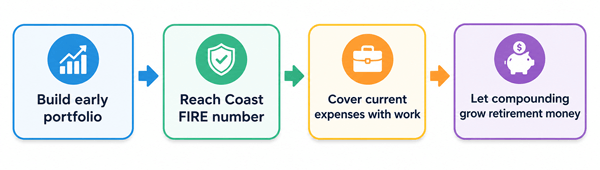
- Estimate your future retirement goal, also called your financial independence number.
- Choose a target retirement age and calculate how many years your investments have to grow.
- Estimate a reasonable long-term annual return after considering inflation, fees, and taxes where relevant.
- Use the Coast FIRE formula to calculate how much you need invested today.
- Compare the result with your current investment balance.
- If your current investments are equal to or higher than the Coast FIRE number, you may be at Coast FIRE based on your assumptions.
- Keep working enough to cover current expenses and review your plan regularly.
4. The Coast FIRE Formula
The basic Coast FIRE formula is:
Coast FIRE Number = Future Retirement Goal ÷ (1 + Expected Annual Return)^Years Until Retirement
This formula discounts your future retirement goal back to today. It answers a practical question: How much do I need invested now for compound growth to reach my future target?
For a more realistic calculation, separate nominal returns from real, inflation-adjusted returns. A 7% nominal return may be much lower after inflation, fund fees, taxes, and investment costs. Running several assumptions helps avoid overconfidence.
| Formula Input | Meaning | Practical Guidance |
|---|---|---|
| Future Retirement Goal | The amount you want invested by retirement. | Often estimated as annual retirement spending multiplied by 25, using the 4% rule as a rough starting point. |
| Expected Annual Return | The annual growth rate you assume for your investments. | Use conservative assumptions. Many people run multiple scenarios such as 4%, 5%, 6%, and 7%. |
| Years Until Retirement | How long your portfolio has to grow. | The longer the time period, the lower your Coast FIRE number usually is. |
| Current Investments | The money already invested for retirement. | Include appropriate retirement accounts, brokerage investments, and other long-term assets. Do not include emergency cash needed soon. |
Example Calculation: Finding a Coast FIRE Number
| Input | Amount |
|---|---|
| Target retirement portfolio | $1,000,000 |
| Current age | 30 |
| Target retirement age | 60 |
| Years until retirement | 30 |
| Expected annual return | 6% |
| Formula | $1,000,000 ÷ (1.06)^30 |
| Estimated Coast FIRE number | About $174,000 |
In this example, a 30-year-old with about $174,000 invested could potentially reach $1,000,000 by age 60 if the portfolio grows at an average rate of 6% per year and no withdrawals are made. If the person has less than $174,000 invested, they have not reached Coast FIRE yet. If they have more, they may have a margin of safety.
Important calculation note: the example assumes no withdrawals, no taxes on annual growth, and a steady average return. Real investment performance will vary from year to year.
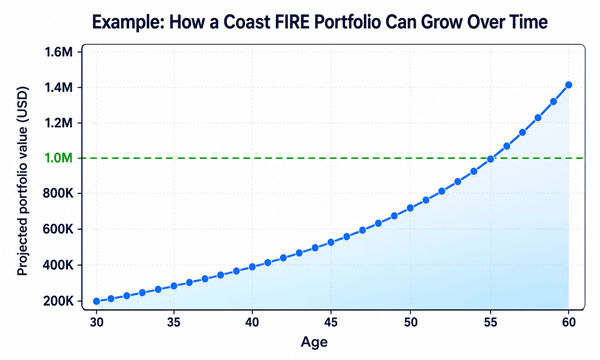
5. Chart: Coast FIRE Growth Example
The chart below shows a simple example of $185,000 invested at age 30 growing at 7% annually until age 60. It illustrates the power of time and compounding, but it should not be treated as a guaranteed forecast.
6. How to Estimate Your Future Retirement Goal
Before calculating Coast FIRE, you need a retirement goal. A common beginner shortcut is to estimate annual retirement spending and multiply it by 25. This comes from the idea that a portfolio may support roughly a 4% first-year withdrawal rate under certain historical conditions. However, the 4% rule is only a guideline, not a promise.
| Annual Retirement Spending | Estimated FI Number Using 25x Rule |
|---|---|
| $30,000 | $750,000 |
| $40,000 | $1,000,000 |
| $50,000 | $1,250,000 |
| $75,000 | $1,875,000 |
| $100,000 | $2,500,000 |
A better estimate considers housing, healthcare, taxes, dependents, travel, inflation, location, and whether you expect pensions, Social Security, business income, rental income, or other retirement income. If your retirement expenses are uncertain, calculate several scenarios instead of relying on one number.
For international readers, replace Social Security with any relevant local state pension, employer pension, provident fund, gratuity, or government retirement benefit available in your country.
7. Coast FIRE vs Other FIRE Types
| FIRE Type | Main Idea | Best For | Key Limitation |
|---|---|---|---|
| Traditional FIRE | Save and invest aggressively until your portfolio can cover expenses. | People who want full financial independence as early as possible. | Requires high savings and strong discipline. |
| Coast FIRE | Invest enough early so future growth can fund retirement later. | People who want career flexibility before full retirement. | Still requires income for current expenses. |
| Lean FIRE | Retire early with a very low-cost lifestyle. | Minimalists with low expenses. | Less margin for emergencies and lifestyle changes. |
| Fat FIRE | Retire early with a high-spending lifestyle. | High earners or business owners who want more comfort. | Requires a much larger portfolio. |
| Barista FIRE | Partially retire and use part-time work to cover some expenses or benefits. | People who want semi-retirement before full FI. | Depends on continued ability to work. |
■ Benefits of Coast FIRE
1. More Career Flexibility
Once your retirement portfolio is on track, you may not need to choose jobs only for maximum income. Some people use Coast FIRE to move into lower-stress work, change industries, start freelancing, teach, work part-time, or build a small business.
2. Less Pressure to Save Aggressively Forever
Traditional FIRE often requires a very high savings rate for many years. Coast FIRE can reduce that pressure after you build a strong early portfolio. You may still save, but you may not need to save at the same intense level.
3. Better Work-Life Balance
Coast FIRE can create room for family, health, travel, caregiving, creative projects, or education. The main advantage is not always retiring early. For many people, the bigger benefit is having more control over how they spend their working years.
4. Strong Use of Compound Growth
Coast FIRE works best when money is invested early and left alone. Compound interest means your investment gains can generate their own gains over time. This is why time is one of the most valuable assets in retirement planning.
5. More Psychological Freedom
Knowing that your future retirement savings may be on track can reduce anxiety. It can also help you make decisions based on values rather than fear, such as declining toxic work, negotiating better hours, or taking a calculated career risk.
■ Risks and Limitations of Coast FIRE
1. Investment Returns Are Not Guaranteed
A spreadsheet can show smooth growth, but real markets are uneven. A portfolio may rise sharply in some years and fall in others. If returns are lower than expected, you may need to resume contributions, delay retirement, reduce spending, or adjust your plan.
2. Inflation Can Raise Your Retirement Target
Inflation reduces purchasing power. If your future expenses rise faster than expected, your original retirement goal may become too low. This is especially important for healthcare, housing, education support for family, insurance, and long retirement periods.
3. Lifestyle Inflation Can Break the Plan
Coast FIRE assumes your future spending goal is realistic. If your lifestyle becomes much more expensive over time, your old Coast FIRE number may no longer be enough. A bigger house, private schooling, luxury travel, or frequent car upgrades can change the calculation quickly.
4. You May Still Need to Work for Many Years
Coast FIRE is not full retirement. It can give flexibility, but it does not remove the need to earn income for today’s expenses. Anyone considering Coast FIRE should have a realistic plan for health insurance, housing, debt payments, and daily living costs.
5. Taxes and Account Rules Matter
Retirement accounts, taxable brokerage accounts, pensions, and other assets may be taxed differently. Some accounts also have withdrawal rules or penalties. A Coast FIRE plan should consider where money is invested, not just how much is invested.
6. Life Events Can Change the Math
Marriage, divorce, children, illness, caregiving, relocation, job loss, business failure, or supporting relatives can change both income and expenses. A Coast FIRE plan should be flexible enough to survive real life.
■ Practical Coast FIRE Scenarios
| Scenario | What Coast FIRE Could Allow | What to Watch |
|---|---|---|
| Burned-out professional | Move from a high-paying stressful job to a moderate-paying healthier role. | Do not quit before confirming healthcare, emergency savings, and monthly cash flow. |
| Young parent | Reduce work hours to spend more time with children. | Childcare, education, housing, and insurance costs may change the plan. |
| Career changer | Take a lower-paying entry-level role in a more meaningful field. | Keep skills and employability strong in case income needs rise later. |
| Freelancer or entrepreneur | Use a strong retirement base to tolerate variable income. | Maintain larger cash reserves because income may be unpredictable. |
| Late starter | Use Coast FIRE as a partial goal, not a full solution. | May still need ongoing contributions and a later retirement age. |
8. How to Reach Coast FIRE: A Beginner-Friendly Action Plan
Step 1: Know Your Current Net Worth and Investment Balance
List your investment accounts, retirement accounts, taxable brokerage accounts, and any long-term assets that are truly available for retirement. Keep emergency savings separate. Do not count money you plan to spend soon.
Step 2: Estimate Annual Retirement Spending
Start with today’s spending, then adjust for costs that may change in retirement. Housing may be paid off or may increase. Healthcare may rise. Commuting may fall. Travel may increase. Taxes may change. Build a realistic range, not a perfect number.
Step 3: Calculate Your Full FI Number
A common shortcut is annual retirement spending multiplied by 25. For example, if you expect to spend $50,000 per year, a rough FI number is $1,250,000. Conservative planners may use 28x, 30x, or more, especially for long retirements or uncertain healthcare costs.
Step 4: Calculate Your Coast FIRE Number
Tip: Use a spreadsheet or Coast FIRE calculator to compare conservative, moderate, and optimistic scenarios. Keep your assumptions visible so you can update them later.
Use the Coast FIRE formula. Run multiple scenarios with different returns and retirement ages. Do not build your entire life plan around one optimistic assumption.
| Future FI Goal | Years to Retirement | 4% Return | 5% Return | 6% Return | 7% Return |
|---|---|---|---|---|---|
| $1,000,000 | 20 | $456,000 | $377,000 | $312,000 | $258,000 |
| $1,000,000 | 30 | $308,000 | $231,000 | $174,000 | $131,000 |
| $1,500,000 | 30 | $462,000 | $347,000 | $261,000 | $197,000 |
| $2,000,000 | 30 | $616,000 | $463,000 | $348,000 | $262,000 |
Step 5: Build a Margin of Safety
A margin of safety means not stopping contributions the moment a calculator says you can. You might continue investing smaller amounts, use a lower return assumption, plan for higher expenses, or wait until your portfolio is 10% to 25% above the calculated Coast FIRE number.
Step 6: Review the Plan Every Year
Coast FIRE is not a one-time calculation. Review your investment balance, expenses, debt, insurance, family needs, and retirement age at least once a year. If the plan drifts, adjust early.
9. Common Coast FIRE Mistakes to Avoid
| Mistake | Why It Hurts | Better Practice |
|---|---|---|
| Using overly high returns | Makes your Coast FIRE number look easier than it is. | Run conservative and moderate scenarios. |
| Ignoring inflation | Future expenses may be much higher. | Estimate spending in today’s dollars and revisit often. |
| Counting emergency savings as investments | Leaves you vulnerable to unexpected expenses. | Keep emergency funds separate from retirement money. |
| Stopping all saving too early | Reduces flexibility if assumptions fail. | Consider smaller ongoing contributions or periodic top-ups. |
| Not considering taxes | After-tax income may be lower than expected. | Understand account types and withdrawal rules. |
| Assuming Coast FIRE means retirement | Can lead to quitting work without enough income. | Separate retirement readiness from current cash-flow needs. |
| Forgetting insurance and healthcare | Medical and insurance costs can be major budget items. | Include them in long-term planning. |
10. Coast FIRE Pros and Cons
| Pros | Cons |
|---|---|
| Can reduce pressure to chase high income forever. | Depends heavily on assumptions about returns and expenses. |
| Creates more freedom before traditional retirement age. | Does not remove the need to earn money for current expenses. |
| Rewards early investing and long time horizons. | Less useful for late starters without a large portfolio. |
| May support healthier career choices. | Market downturns can require plan changes. |
| Can be combined with part-time work, freelancing, or entrepreneurship. | Taxes, healthcare, and account access can complicate planning. |
11. Who Coast FIRE Is Best For
- People who start investing early and have many years until retirement.
- High savers who want to reduce intensity later.
- Workers who want career flexibility but are not ready to stop working.
- Parents or caregivers who want more time without abandoning retirement planning.
- People who value optionality more than immediate early retirement.
12. Who Should Be Careful With Coast FIRE
- People with high-interest debt and no emergency fund.
- Anyone planning to quit work immediately without current income coverage.
- Late starters who have fewer years for compounding.
- People with unstable spending or rapidly rising lifestyle costs.
- Anyone using very optimistic investment return assumptions.
- People with complex tax, healthcare, family, or business situations who have not sought professional guidance.
13. A Practical Coast FIRE Checklist
| Question | Why It Matters |
|---|---|
| Do I have a separate emergency fund? | Prevents forced investment withdrawals during bad markets or personal emergencies. |
| Is high-interest debt under control? | Debt interest can work against your wealth-building plan. |
| Have I estimated retirement spending realistically? | Your Coast FIRE number is only as good as your spending estimate. |
| Have I used conservative return assumptions? | Reduces the chance of overconfidence. |
| Do I understand my investment mix? | Portfolio risk affects long-term results. |
| Have I planned for healthcare and insurance? | These costs can affect both current and retirement budgets. |
| Will I review the plan yearly? | Keeps the plan aligned with real life. |
14. Coast FIRE and Investing: Basic Principles
Coast FIRE usually depends on long-term investing, not short-term speculation. The goal is not to guess the next hot stock or time the market. The goal is to build a diversified portfolio that has a reasonable chance of growing over decades.
Because Coast FIRE often involves a long time horizon, the investment mix should match your risk tolerance, time horizon, and ability to stay invested during downturns.
- Diversify across investments instead of relying on one company or asset.
- Keep costs low because high fees reduce long-term growth.
- Use tax-advantaged accounts when appropriate and available.
- Avoid withdrawing retirement investments early unless absolutely necessary.
- Rebalance periodically so your investment risk stays aligned with your plan.
- Understand that risk cannot be eliminated; it can only be managed.
15. Mini Case Study: From Aggressive Saving to Coast FIRE
Sara is 32 and earns a solid income. She has been saving aggressively since age 24 and now has $210,000 invested. She wants to retire at 60 with about $1,200,000 in today’s dollars. Assuming a 6% annual return for 28 years, her Coast FIRE number is approximately $234,000. She is close, but not quite there.
Instead of quitting her job immediately, Sara decides to continue investing for two more years, but she also reduces overtime and improves her work-life balance. By age 34, her portfolio has grown and she reaches her Coast FIRE target with a small margin of safety. She then switches to a lower-stress job that covers her current expenses while her retirement portfolio continues to compound.
This example shows the practical value of Coast FIRE. The goal is not always to retire tomorrow. Sometimes the goal is to create enough financial strength to make better life choices sooner.
■ Frequently Asked Questions About Coast FIRE
1. What does Coast FIRE mean?
Coast FIRE means you have enough invested today that your portfolio could grow to your retirement target by your chosen retirement age without major additional retirement contributions.
2. Can I stop working after reaching Coast FIRE?
Usually no. You still need income to pay current living expenses. Coast FIRE means your retirement savings may be on track, not that you can immediately retire.
3. How do I calculate my Coast FIRE number?
Divide your future retirement goal by one plus your expected annual return raised to the number of years until retirement. The formula is: Future Retirement Goal ÷ (1 + Return)^Years.
4. Is Coast FIRE realistic?
It can be realistic for people who invest early, keep expenses reasonable, and use conservative assumptions. It is less realistic if the plan depends on very high returns or ignores inflation.
5. What is the difference between Coast FIRE and regular FIRE?
Regular FIRE means having enough assets to cover your living expenses now. Coast FIRE means your future retirement savings may be on track, but you still need current income.
6. Should I stop investing once I reach Coast FIRE?
Not necessarily. Many people continue investing smaller amounts to create a margin of safety. Stopping completely may be risky if assumptions change.
7. What return should I use for Coast FIRE calculations?
There is no perfect number. Many planners test several scenarios, such as 4%, 5%, 6%, and 7%. A conservative assumption can help reduce overconfidence.
8. Does Coast FIRE include my home equity?
Usually, Coast FIRE calculations focus on investable assets that can grow and support retirement. Home equity may matter, but it should be treated carefully because it is not always easy to spend or invest.
9. Is Coast FIRE good for late starters?
It can still be useful as a planning framework, but late starters have less time for compounding. They may need higher contributions, a later retirement age, lower spending, or a smaller goal.
10. What is the biggest Coast FIRE risk?
The biggest risk is relying on assumptions that turn out to be wrong, especially expected returns, inflation, future expenses, and retirement age.
■ Final Thoughts: Is Coast FIRE Worth Considering?
Coast FIRE is worth considering if you want financial independence with more flexibility and less all-or-nothing pressure. It gives you a practical way to measure whether your retirement savings are far enough ahead that time and compound growth can do much of the remaining work.
The best Coast FIRE plans are conservative, flexible, and reviewed regularly. They include emergency savings, realistic spending estimates, diversified investments, tax awareness, insurance planning, and a willingness to adjust when life changes. If you use Coast FIRE wisely, it can become more than a retirement calculation. It can become a tool for designing a calmer, more intentional financial life.
Sources Consulted:
- Investor.gov by the U.S. Securities and Exchange Commission: Compound Interest Calculator and investor education resources.
- FINRA: Investor education material on asset allocation, diversification, investment risk, and concentration risk.
- Retirement withdrawal research including the Trinity Study and later safe-withdrawal-rate discussions. Withdrawal rules are planning guidelines, not guarantees.
Reader Advice: This article is for educational and informational purposes only and should not be taken as personalized financial, investment, tax, or legal advice. Please check the latest information from official sources or a qualified professional, because rules, policies, returns, taxes, and personal circumstances can change over time.