Fat FIRE: Meaning, Benefits, Risks and Examples
Quick Answer: What Is Fat FIRE?
Fat FIRE is a version of the FIRE movement, which stands for Financial Independence, Retire Early. The difference is lifestyle. Fat FIRE means reaching financial independence with enough invested assets to support a comfortable or high-spending lifestyle, rather than retiring on a very lean budget.
In simple terms, Fat FIRE is for people who want freedom from mandatory work without giving up conveniences such as frequent travel, a larger home, private health insurance, family support, hobbies, dining out, or a generous margin of safety.
Key Takeaways
- Fat FIRE is not a fixed net-worth number; it depends on your desired after-tax spending, location, family needs, healthcare costs, and risk tolerance.
- The 25x rule is a simple starting point, but many early retirees test more conservative assumptions such as 28x, 30x, or 33x.
- A strong Fat FIRE plan separates essential expenses from flexible lifestyle expenses so spending can adjust during weak markets.
- Because Fat FIRE involves investment, tax, insurance, and estate questions, official rules and professional guidance matter.
| Concept | Simple meaning |
|---|---|
| FIRE | Having enough assets or passive income that work becomes optional. |
| Lean FIRE | Retiring early with a low-cost, minimalist lifestyle. |
| Traditional FIRE | Retiring early with a moderate lifestyle similar to normal household spending. |
| Fat FIRE | Retiring early with a higher budget and more lifestyle flexibility. |
1. How Fat FIRE Works
Fat FIRE works by building a large enough investment portfolio to pay for your annual spending without depending on a traditional job. The portfolio may include stock index funds, bond funds, real estate, business equity, cash reserves, and other income-producing assets. Once the portfolio can reasonably support your desired lifestyle, you may choose to retire early, work part-time, start a business, volunteer, or keep working because you enjoy it.
Most Fat FIRE plans start with one core question: how much would your ideal annual lifestyle cost if you were not working full-time? This number should include ordinary spending, taxes, health insurance, travel, home maintenance, gifts, dependents, inflation, and unexpected expenses.
The Basic Fat FIRE Formula
A common beginner estimate is based on the 25x rule:
Fat FIRE number = Annual retirement spending x 25
This formula comes from a 4% withdrawal-rate idea: if you withdraw about 4% of your portfolio in the first retirement year and then adjust for inflation, a diversified portfolio has historically had a reasonable chance of lasting through a 30-year retirement. For early retirees, especially Fat FIRE seekers who may need assets to last 40, 50, or more years, many planners use more conservative assumptions such as 3%, 3.25%, or 3.5%.
Important planning caveat: the 25x rule usually refers to portfolio spending before considering the full impact of taxes, investment fees, healthcare shocks, and country-specific retirement rules. For that reason, it should be treated as a quick estimate, not a final retirement decision.
| Annual spending goal | 25x estimate (4% rule) | 33x estimate (about 3% rule) | What this may represent |
|---|---|---|---|
| $100,000 | $2.5 million | $3.3 million | Comfortable lifestyle in many areas |
| $150,000 | $3.75 million | $5.0 million | Higher travel, housing, healthcare, or family support |
| $200,000 | $5.0 million | $6.6 million | Very comfortable lifestyle, especially in costly cities |
| $300,000 | $7.5 million | $10.0 million | Luxury travel, expensive housing, private education, or high taxes |
2. Fat FIRE vs Lean FIRE vs Traditional FIRE
Fat FIRE is easiest to understand when compared with other FIRE approaches. The main difference is not the desire for freedom; it is the spending level and safety margin built into the plan.
| Type of FIRE | Typical lifestyle goal | Possible annual spending range | Portfolio pressure | Best fit |
|---|---|---|---|---|
| Lean FIRE | Simple, low-cost lifestyle | $25,000-$50,000 | High pressure because the margin is small | Minimalists, low-cost areas, flexible spenders |
| Traditional FIRE | Moderate lifestyle | $50,000-$100,000 | Moderate pressure | People who want normal comfort but can budget carefully |
| Fat FIRE | Comfortable or premium lifestyle | $100,000-$300,000+ | Lower lifestyle pressure but larger target | High earners, business owners, professionals, or investors who want more flexibility |
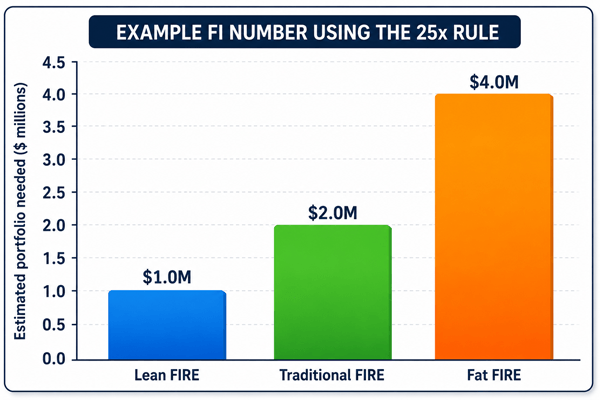
3. Visual Example: How Spending Changes the FIRE Number
The chart below shows how much larger the financial independence target becomes as annual spending rises. It uses the simple 25x rule, so it is only a starting estimate.
4. Fat FIRE Examples
The following examples are simplified. They are not recommendations, but they show how different households might define Fat FIRE in practical terms.
Example 1: High-earning couple in a costly city
A couple wants to retire at age 48 in a high-cost city. They estimate annual retirement spending of $180,000, including housing costs, health insurance, taxes, travel, and support for aging parents. Using the 25x rule, their Fat FIRE target is $4.5 million. Using a more conservative 33x rule, the target is about $6 million.
A practical plan might include maxing out retirement accounts, investing in taxable brokerage accounts, keeping a cash buffer, and avoiding lifestyle inflation that grows faster than income.
Example 2: Business owner who wants optional work
A business owner enjoys work but wants the option to stop if the business becomes stressful. The household spends $220,000 a year and wants a large safety margin. A 3.25% withdrawal rate would require about $6.77 million, calculated as $220,000 divided by 0.0325.
This person may not fully retire. Fat FIRE may simply mean the business owner can choose projects, hire more help, sell the company, or take long breaks without fear.
Example 3: Family with private school and travel goals
A family wants early financial independence but expects several expensive years while children are in school. Their long-term annual spending may be $150,000, but for the next decade it could be $230,000. A smart Fat FIRE plan would separate temporary costs from permanent lifestyle costs instead of multiplying the highest temporary spending by 25 forever.
For example, the family might keep a separate education fund, then calculate the core Fat FIRE number from long-term spending after school costs end.
5. Benefits of Fat FIRE
- More lifestyle flexibility: You can build a plan that includes travel, hobbies, family help, better housing, and comfort instead of extreme frugality.
- Larger safety margin: A higher target may make it easier to handle market downturns, inflation, health costs, or unexpected family needs.
- Work becomes truly optional: Fat FIRE can give you the ability to leave a stressful job, negotiate better terms, take a sabbatical, or work only on projects you enjoy.
- Less dependence on perfect budgeting: Lean plans can fail if spending rises slightly. Fat FIRE gives more room for real life.
- Better planning for taxes and healthcare: Higher savings can help cover health insurance, long-term care planning, tax changes, and location changes.
- Ability to give or support others: Some Fat FIRE households want to help parents, children, charities, or their community without putting their own independence at risk.
6. Risks and Downsides of Fat FIRE
Fat FIRE sounds attractive, but it is not risk-free. In some ways, the larger target creates its own challenges.
| Risk | Why it matters | How to reduce it |
|---|---|---|
| Very high target | A $5 million to $10 million goal can take many years and may feel discouraging. | Use milestones such as debt freedom, Coast FIRE, basic FI, and work-optional FI. |
| Lifestyle inflation | Rising income can lead to rising spending, pushing the Fat FIRE number higher every year. | Decide which upgrades truly matter and save a fixed percentage of income first. |
| Burnout | People may work extremely stressful jobs for too long to reach a luxury target. | Balance wealth-building with health, relationships, and time. |
| Market risk | A large portfolio can still fall sharply during a bear market. | Diversify, keep cash reserves, and use flexible withdrawals. |
| Sequence-of-returns risk | Poor returns early in retirement can hurt long-term sustainability. | Consider a lower withdrawal rate, spending guardrails, or part-time income. |
| Tax complexity | Large portfolios may create capital gains, estate, and withdrawal-order issues. | Plan with tax professionals before retirement, not after. |
| Identity risk | After years of intense saving, some people struggle to enjoy retirement. | Build a life you want before leaving work completely. |
7. How Much Money Do You Need for Fat FIRE?
There is no official Fat FIRE number. For one household, Fat FIRE might mean $2.5 million. For another, it may mean $10 million or more. The number depends on spending, taxes, location, family size, healthcare, investment mix, and retirement age.
Step 1: Estimate your real annual spending
Start with your current annual spending, then adjust it for the life you want after financial independence. Include categories that beginners often forget:
- Income taxes and capital gains taxes
- Health insurance and out-of-pocket medical costs
- Home repairs, property taxes, insurance, and major replacements
- Travel, hobbies, dining, and entertainment
- Children, education, parents, or other family support
- Cars, technology, gifts, charity, and professional services
- Inflation and a margin for surprise expenses
Step 2: Choose a withdrawal-rate assumption
The withdrawal rate is the percentage of your portfolio you plan to spend in the first year of retirement. A 4% starting withdrawal is a common rule of thumb for a 30-year retirement, but early retirees often choose a lower rate because their retirement may last longer.
| Withdrawal rate | Multiplier | Portfolio for $150,000 annual spending | Comment |
|---|---|---|---|
| 4.0% | 25x | $3.75 million | Common starting rule of thumb; may be aggressive for very early retirement. |
| 3.5% | 28.6x | $4.29 million | More conservative and often used by early retirees. |
| 3.25% | 30.8x | $4.62 million | Adds more cushion for long retirements. |
| 3.0% | 33.3x | $5.00 million | Very conservative, but may require much longer saving. |
Step 3: Separate core expenses from luxury expenses
A strong Fat FIRE plan does not treat every expense the same. Core expenses are the costs you must cover. Lifestyle expenses are the costs you can reduce if markets perform poorly.
| Core expenses | Flexible lifestyle expenses |
|---|---|
| Housing, food, healthcare, insurance, taxes, utilities | Luxury travel, dining out, upgraded vehicles, large gifts, premium hobbies |
| Should be covered with a conservative plan | Can be adjusted during weak markets or high-inflation years |
Step 4: Test your plan with real-world scenarios
Before calling yourself Fat FIRE, ask what happens if stocks fall 30%, inflation stays high for several years, healthcare costs rise, a parent needs financial help, or you decide to move. A plan that works only in perfect conditions is not a strong plan.
A stronger approach is to run several scenarios: a normal market case, a bad first-decade case, a high-inflation case, and a reduced-spending case. This helps show whether your plan has real flexibility rather than relying on a single perfect forecast.
■ Practical Steps to Pursue Fat FIRE
- Increase income before obsessing over tiny expenses. Fat FIRE usually requires a strong income engine, such as a high-paying career, business ownership, equity compensation, real estate, or scalable skills.
- Track your true savings rate. A high income does not create wealth unless a meaningful percentage is invested consistently.
- Invest in diversified assets. Many Fat FIRE households use broad stock index funds, bond funds, real estate, and cash reserves rather than relying on one concentrated bet.
- Use tax-advantaged accounts where available. Retirement accounts, health savings accounts, pensions, and employer benefits can improve long-term results depending on your country and situation.
- Build a taxable brokerage account. Early retirees often need accessible money before traditional retirement age, so not all wealth should be locked away.
- Control lifestyle inflation. Choose the upgrades that improve your life, but avoid turning every raise into a permanent expense.
- Create a written investment policy. Decide your target asset allocation, rebalancing rules, cash buffer, and withdrawal plan before emotions take over.
- Plan for healthcare and insurance. Early retirement can expose gaps in employer benefits, disability coverage, health insurance, and long-term care planning.
- Review taxes before retiring. Withdrawal order, capital gains, Roth conversions, charitable giving, and business-sale timing can materially affect a Fat FIRE plan.
- Design your post-FIRE life early. Freedom is more satisfying when you already know what you are retiring to, not only what you are escaping from.
■ Common Fat FIRE Mistakes
- Using gross income instead of after-tax spending to calculate the FIRE number.
- Forgetting that taxes, health insurance, and home maintenance continue after retirement.
- Assuming a fixed 4% rule is safe for every age, portfolio, country, and market condition.
- Leaving a career too soon without a cash buffer or backup income plan.
- Keeping too much wealth in one employer stock, one business, or one property market.
- Setting the Fat FIRE target so high that life becomes joyless before retirement.
- Ignoring spouse, partner, or family expectations about location, spending, work, and risk.
- Retiring from work but not planning how to spend time meaningfully.
8. Fat FIRE Withdrawal Strategies
The withdrawal strategy is how you turn assets into spending money. Fat FIRE households often have more flexibility than lean retirees, but they still need a disciplined plan.
| Strategy | How it works | Pros | Cons |
|---|---|---|---|
| Fixed percentage | Withdraw a set percentage of the portfolio each year. | Adjusts down after market losses. | Income can fluctuate widely. |
| Inflation-adjusted rule | Withdraw an initial amount, then raise it with inflation. | Predictable spending. | Can be risky after poor early returns. |
| Guardrails | Increase or reduce spending when portfolio crosses set bands. | Flexible and practical. | Requires annual monitoring. |
| Bucket strategy | Hold short-term cash, medium-term bonds, and long-term growth assets. | Can reduce panic selling. | Needs rebalancing discipline. |
| Core-plus-luxury | Protect essential spending and vary luxury spending. | Works well for Fat FIRE lifestyles. | Requires knowing what is truly flexible. |
9. Who Is Fat FIRE Best For?
Fat FIRE may be a good fit if you want financial freedom but do not want extreme frugality to be the center of your life. It is especially relevant for people with high incomes, business owners, professionals with equity compensation, real estate investors, or dual-income households that can save aggressively while still living well.
Fat FIRE May Not Be the Best Fit If...
- You would need to stay in a harmful job for many extra years only to fund luxury spending.
- Your target keeps rising because of comparison, status pressure, or fear.
- You value time freedom more than a premium lifestyle.
- You have not built basic financial stability, such as emergency savings, debt control, and insurance.
- You are using Fat FIRE as an excuse to delay living a meaningful life today.
10. Fat FIRE Checklist
| Question | Why it matters |
|---|---|
| Do I know my annual spending goal after tax? | Your FIRE number depends on spending, not income. |
| Have I included healthcare, taxes, home repairs, and inflation? | These are common planning gaps. |
| Is my withdrawal rate realistic for my retirement length? | Early retirees may need assets to last longer than 30 years. |
| Do I have flexible expenses I can cut in bad markets? | Flexibility improves plan durability. |
| Is my portfolio diversified? | Concentration can create unnecessary risk. |
| Do I have a cash buffer? | Cash can help avoid selling investments during downturns. |
| Have I planned what I will do with my time? | Financial independence is also a life-design decision. |
| Have I reviewed tax, estate, and insurance issues? | Higher net worth often creates more complexity. |
11. Myths and Misconceptions About Fat FIRE
Myth 1: Fat FIRE is only for millionaires with inherited money
Inheritance can help, but many Fat FIRE paths are built through high income, ownership, investing, business exits, real estate, or long periods of disciplined saving. The bigger issue is not where someone starts; it is whether the target is realistic for their income, timeline, and risk tolerance.
Myth 2: Fat FIRE means never working again
Many people who reach Fat FIRE still work. The difference is that work becomes optional. They may consult, teach, invest, write, serve on boards, start a smaller business, or work part-time because they want to, not because bills require it.
Myth 3: The 4% rule guarantees success
No withdrawal rule guarantees success. The 4% idea is based on historical market data and assumptions. Future returns, taxes, inflation, personal spending, investment fees, and retirement length can all change the outcome.
Myth 4: Fat FIRE is automatically better than Lean FIRE
Better depends on personal values. Fat FIRE offers comfort and margin, but it may require more years of intense work. Lean FIRE may offer freedom sooner, but with less spending flexibility. The right version is the one that supports a healthy, realistic life.
■ Frequently Asked Questions About Fat FIRE
1. What does Fat FIRE mean?
Fat FIRE means reaching financial independence with enough assets to support a comfortable or high-spending lifestyle. It is a more expensive version of the FIRE movement.
2. How much money is considered Fat FIRE?
There is no official number. Many people use the term for portfolios of $2.5 million, $5 million, $10 million, or more, depending on location and spending. The better question is how much annual spending you want to support.
3. Is $3 million enough for Fat FIRE?
It can be for some households and not for others. At a 4% starting withdrawal rate, $3 million supports about $120,000 before taxes and fees. At a 3% rate, it supports about $90,000. Whether that is Fat FIRE depends on your costs and lifestyle.
4. Is Fat FIRE realistic?
Fat FIRE is realistic for some high earners, business owners, investors, and disciplined savers, but it is not easy. The target is often large, so income growth, consistent investing, and lifestyle control matter.
5. What is the difference between Fat FIRE and Chubby FIRE?
Chubby FIRE usually sits between traditional FIRE and Fat FIRE. It aims for more comfort than average FIRE, but not necessarily a luxury lifestyle. Fat FIRE generally implies a larger portfolio and higher annual spending.
6. Can you Fat FIRE with real estate?
Yes, some people use rental property income, real estate appreciation, or business-owned property as part of a Fat FIRE plan. However, real estate has risks such as vacancies, repairs, leverage, taxes, and lack of diversification.
7. Should I use the 25x rule for Fat FIRE?
The 25x rule is useful for a rough estimate, but it may be too simple for very early retirement. Consider testing 28x, 30x, or 33x, especially if you want a longer retirement or a larger safety margin.
8. What is the biggest risk of Fat FIRE?
One major risk is chasing a target that keeps moving. If lifestyle expectations rise every year, financial independence can feel permanently out of reach even with a high income.
9. Do I need a financial advisor for Fat FIRE?
Not always, but professional guidance can be helpful when you have tax complexity, equity compensation, business ownership, estate planning needs, concentrated investments, or a multi-million-dollar portfolio.
10. What should I do first if I want Fat FIRE?
Start by calculating your current net worth, annual spending, savings rate, and realistic Fat FIRE number. Then build a plan to increase income, invest consistently, control permanent expenses, and reduce major risks.
11. What annual spending level is usually considered Fat FIRE?
Many readers use Fat FIRE to describe annual retirement spending above a standard FIRE budget, often around $100,000 to $300,000 or more. However, the real definition is personal: Fat FIRE means your portfolio can support the lifestyle you consider comfortable, with enough cushion for taxes, healthcare, inflation, and surprises.
■ Final Thoughts: Is Fat FIRE Worth It?
Fat FIRE can be a powerful goal for people who want both freedom and comfort. It can create room for travel, family support, better healthcare choices, generosity, and a life that does not depend on a paycheck. But it also requires honesty. A bigger lifestyle needs a bigger portfolio, and a bigger portfolio usually requires more income, more time, more risk management, or all three.
The healthiest Fat FIRE plan is not just a large number on a spreadsheet. It is a balanced plan that protects your future without sacrificing your present life, relationships, and health. Use Fat FIRE as a tool for freedom, not as a never-ending race for more.
Sources and Further Reading
- Cooley, Hubbard, and Walz, “Retirement Savings: Choosing a Withdrawal Rate That Is Sustainable” / Trinity-style withdrawal-rate research, available via research databases and summaries.
- Investor.gov, U.S. Securities and Exchange Commission: Compound Interest Calculator and investor education tools.
- Consumer Financial Protection Bureau: Emergency savings and financial security resources.
- General retirement-planning concepts including withdrawal rates, diversification, sequence-of-returns risk, inflation risk, and tax planning.
- Official tax, retirement, pension, and financial-regulator websites in your country for current rules and limits.
- Professional financial-planning, tax, and estate-planning resources where personal circumstances are complex.
Reader Advice:
This article is for educational and informational purposes only and should not be taken as personalized financial, tax, legal, or investment advice. Please check the latest information from official sources and qualified professionals, as rules, policies, tax limits, and financial conditions can change over time.
Fat FIRE is not a promise, shortcut, or guaranteed retirement plan. It is a planning framework. Your actual result depends on income, savings rate, investment returns, taxes, inflation, health costs, family needs, location, and your ability to adjust when life changes. This article is educational and should not replace advice from a qualified financial planner, tax professional, or estate attorney.