Financial Independence Calculator Guide: How to Estimate Your FI Number
1. Introduction: Why Your FI Number Matters
Financial independence means reaching a point where your investments and other reliable income sources can support your living costs without depending on a traditional paycheck. Your FI number is the estimated amount of invested assets you need to cover those costs for the long term.
A financial independence calculator helps turn a vague goal, such as “I want to stop needing a job,” into a concrete target. Instead of guessing, you estimate your yearly spending, choose a reasonable withdrawal rate, adjust for taxes and inflation, and calculate the portfolio size that may support your lifestyle.
The result is not a promise. It is a planning estimate. Markets change, inflation changes, personal spending changes, and life rarely follows a perfect spreadsheet. Still, a carefully built FI number can help you decide how much to save, how aggressively to invest, when you may be able to reduce work, and what trade-offs are worth making.
2. What Is an FI Number?
Your FI number is the amount of wealth you need invested so that you can pay your annual expenses from portfolio withdrawals and other income sources. It is usually based on annual spending rather than salary. This is important because someone earning $150,000 but spending $50,000 may need much less to become financially independent than someone earning $90,000 but spending $85,000.
The simplest FI number formula is: Annual portfolio-funded expenses divided by your chosen withdrawal rate equals your FI number.
For example, if you need $40,000 per year from investments and use a 4% withdrawal rate, the calculation is $40,000 ÷ 0.04 = $1,000,000. If you use a more conservative 3.5% withdrawal rate, the calculation is $40,000 ÷ 0.035 = about $1,142,857.
Important context: The FI number is usually a portfolio target, not a total net-worth target. Cash reserved for emergencies, home equity you do not plan to access, and illiquid business value should be handled separately from investable assets.
Featured snippet answer
To estimate your FI number, calculate your expected annual expenses in financial independence, subtract dependable non-portfolio income, then divide the remaining amount by a realistic withdrawal rate. Example: if you need $50,000 per year from investments and use a 4% withdrawal rate, your FI number is $1.25 million.
3. The Basic FI Number Formula
The core formula is simple:
| FI Number Formula |
|---|
| FI number = Annual expenses that must come from investments ÷ Withdrawal rate |
The words “that must come from investments” matter. If part of your spending will be covered by a pension, rental income, Social Security, annuity income, or a reliable business distribution, your portfolio may not need to cover every dollar.
| Annual spending from investments | Withdrawal rate | Estimated FI number |
|---|---|---|
| $30,000 | 4.0% | $750,000 |
| $40,000 | 4.0% | $1,000,000 |
| $50,000 | 4.0% | $1,250,000 |
| $60,000 | 4.0% | $1,500,000 |
| $80,000 | 4.0% | $2,000,000 |
4. Step-by-Step: How to Use a Financial Independence Calculator
Step 1: Estimate your annual spending
Start with what you spend today. Review bank statements, credit card statements, budgeting apps, or a simple spreadsheet. Separate essential spending from lifestyle spending. Include housing, food, insurance, transportation, utilities, healthcare, travel, gifts, subscriptions, taxes, and irregular costs such as car repairs or home maintenance.
Step 2: Adjust spending for your FI lifestyle
Your future spending may not match your current spending. You may pay off a mortgage, move to a lower-cost area, travel more, buy private health insurance, support family, or spend more on hobbies. Build the calculator around the life you actually expect, not a fantasy budget.
Step 3: Subtract reliable income sources
Subtract income that is likely to continue during financial independence. Examples include pension payments, expected Social Security or state benefits, rental net income after expenses, royalties, annuity income, or part-time work you genuinely want to keep doing. Be conservative with income that is uncertain.
Conservative planning tip: For Social Security, state benefits, pensions, or rental income, use current official benefit estimates, vacancy assumptions, maintenance costs, and taxes rather than best-case figures.
Step 4: Choose a withdrawal rate
A withdrawal rate is the percentage of your portfolio you plan to withdraw in the first year. Many FI calculators use 4% as a starting benchmark because it is widely associated with historical retirement withdrawal research, but it is not a law. A lower rate such as 3% to 3.5% creates a larger target and may provide more cushion. A higher rate creates a smaller target but usually adds more risk.
Early-FI caution: A 40- to 60-year FI timeline normally deserves more stress testing than a traditional 30-year retirement plan, especially when spending is fixed and healthcare costs are uncertain.
Step 5: Calculate your FI number
Divide portfolio-funded annual expenses by the withdrawal rate. For example, $45,000 ÷ 0.04 = $1,125,000. At 3.5%, the same spending target becomes $1,285,714.
Step 6: Estimate years to FI
Once you know your target, compare it with your current invested assets and annual savings. A good calculator lets you enter your current investments, annual contributions, expected real return, and future spending goal. This gives you a rough estimate of how long it may take to reach your FI number.
Step 7: Stress-test the result
Run several versions. Test higher spending, lower returns, higher inflation, lower withdrawal rates, and healthcare surprises. The goal is not to predict the future perfectly. The goal is to understand how sensitive your FI plan is to different assumptions.
Best practice: Save at least three calculator versions: base case, cautious case, and flexible-spending case. This makes the final number more useful than a single optimistic estimate.
| Input | What to enter | Beginner tip |
|---|---|---|
| Current invested assets | Money already invested for long-term goals | Do not count emergency cash you need soon. |
| Annual expenses | Expected yearly spending in FI | Use after-tax spending, then add taxes separately if needed. |
| Withdrawal rate | 3% to 4.5% is a common planning range | Use lower rates for longer retirements or more caution. |
| Expected return | Projected investment growth | Use a real return if you are already accounting for inflation. |
| Annual contributions | How much you invest each year | Include employer matches if applicable. |
| Inflation | Expected rise in prices | Inflation affects future spending and purchasing power. |
| Taxes | Expected tax cost on withdrawals or income | Often underestimated by beginners. |
Chart: The lower the withdrawal rate, the higher the FI number
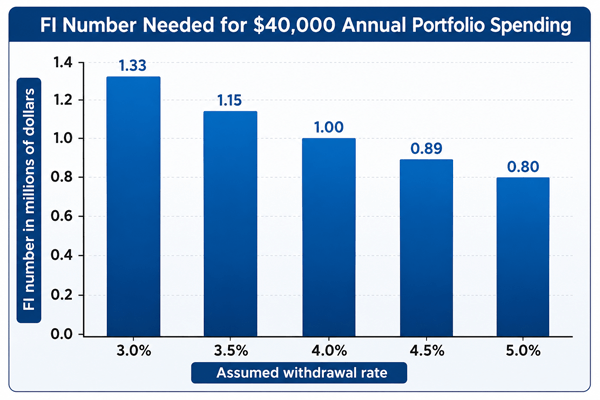
This chart uses $40,000 of annual portfolio-funded spending. It shows why withdrawal-rate assumptions have a major effect on the final target.
5. Withdrawal Rate: The Biggest Assumption in an FI Calculator
A withdrawal rate is not the same as an investment return. If your portfolio earns 7% in one year, that does not automatically mean you can safely withdraw 7% forever. Investment returns are uneven. Some years are excellent, some are flat, and some are deeply negative. The danger is that large withdrawals during bad market years can permanently weaken a portfolio.
The popular 4% rule is best understood as a historical planning guideline, not a guarantee. It generally means withdrawing 4% of the starting portfolio in year one and then adjusting that dollar amount for inflation in later years. Many retirement researchers and investment firms now encourage using the 4% rule as a starting point and then adapting it to time horizon, asset mix, market valuation, taxes, flexibility, and personal risk tolerance.
For early financial independence, your retirement could last 40, 50, or even 60 years. That is longer than the 30-year period often discussed in traditional retirement planning. For that reason, many conservative FI planners use 3% to 3.5%, especially if they want a high margin of safety.
6. Common Withdrawal Rate Ranges
| Withdrawal rate | FI multiplier | What it means | Best suited for |
|---|---|---|---|
| 3.0% | 33.3x annual spending | Very conservative; requires a larger portfolio | Long FI timelines, low flexibility, high caution |
| 3.5% | 28.6x annual spending | Conservative middle ground | Early retirement, moderate flexibility |
| 4.0% | 25x annual spending | Common benchmark | Traditional 30-year planning or flexible FI |
| 4.5% | 22.2x annual spending | More aggressive | Shorter retirements, strong backup income, flexible spending |
| 5.0% | 20x annual spending | Higher risk if spending is fixed | Part-time income, pensions, or very flexible budgets |
7. How to Calculate Your FI Number: Practical Examples
Example 1: Single person with simple expenses
Maya spends $36,000 per year and expects no pension or rental income. At a 4% withdrawal rate, her FI number is $36,000 ÷ 0.04 = $900,000. At a 3.5% withdrawal rate, it is about $1,028,571. If Maya wants more safety because she plans to stop working at 42, the 3.5% estimate may be a better planning target.
Example 2: Couple with rental income
Omar and Sara expect to spend $60,000 per year. They own a rental property that produces $12,000 per year after vacancies, repairs, insurance, and taxes. Their portfolio only needs to cover $48,000. At 4%, their FI number is $48,000 ÷ 0.04 = $1.2 million.
Example 3: Coast FI
Coast FI means you may already have enough invested that, if left to grow, it could reach your traditional retirement target later without further contributions. You may still need to work to cover today’s bills, but you may not need to save as aggressively. A calculator can estimate whether your current investments, time horizon, and expected real return are enough to “coast.”
Example 4: Lean FI vs Fat FI
Lean FI uses a lower-spending lifestyle, such as $30,000 per year. At 4%, that requires about $750,000. Fat FI uses a higher-spending lifestyle, such as $120,000 per year. At 4%, that requires about $3 million. Neither is automatically better; the right target depends on the life you want and the risks you are willing to accept.
| Scenario | Annual expenses | Reliable non-portfolio income | Portfolio-funded spending | FI number at 4% |
|---|---|---|---|---|
| Single renter | $36,000 | $0 | $36,000 | $900,000 |
| Couple with pension | $70,000 | $20,000 | $50,000 | $1,250,000 |
| Family with paid-off home | $55,000 | $0 | $55,000 | $1,375,000 |
| Semi-retired freelancer | $60,000 | $15,000 | $45,000 | $1,125,000 |
| Higher-cost lifestyle | $120,000 | $0 | $120,000 | $3,000,000 |
8. What Expenses Should You Include in Your FI Calculator?
Include every major category that will continue after you leave full-time work. Beginners often calculate food, housing, and utilities but forget irregular and long-term costs. A better estimate includes monthly bills, annual bills, repairs, insurance premiums, healthcare, taxes, travel, family support, technology replacement, hobbies, giving, and a cushion for surprises.
Healthcare deserves special attention. If you leave a job before qualifying for government healthcare benefits, private insurance premiums and out-of-pocket costs can be significant. Homeowners should include maintenance and eventual replacements such as roofs, appliances, heating systems, and vehicles. Parents should consider education support, childcare, or adult-child assistance if relevant.
Country-specific reminder: Healthcare, pension, tax, and retirement-account rules vary widely by country and can change. Always check the latest official sources for your location before relying on calculator results.
9. Expenses Beginners Often Forget
- Income taxes on withdrawals or investment income
- Health insurance premiums and medical deductibles
- Home repairs and replacement costs
- Vehicle replacement, not just fuel and insurance
- Travel during the early FI years
- Inflation in rent, food, utilities, and insurance
- Support for parents, children, or extended family
- Professional fees, tax preparation, estate planning, and legal documents
- Emergency fund replenishment after major expenses
10. Pre-Tax vs After-Tax FI Number
Many FI calculators ask for annual expenses. Beginners often enter after-tax spending and forget that withdrawals may create taxable income. If your portfolio is mostly in taxable brokerage accounts, tax-deferred retirement accounts, or tax-free accounts, your tax picture may differ. The safer approach is to estimate the gross withdrawals needed to support your after-tax lifestyle.
For example, if you need $50,000 for living expenses and expect to pay $5,000 in taxes related to withdrawals, your calculator should use $55,000 of portfolio-funded spending. At 4%, that increases the FI number from $1.25 million to $1.375 million.
Tax-planning note: The order in which you withdraw from taxable, tax-deferred, and tax-free accounts can affect your real FI number. A tax professional can help model this more accurately than a simple calculator.
11. Inflation and Real Returns
Inflation reduces the buying power of money over time. If your annual spending is $50,000 today, it may require much more dollars 20 years from now to buy the same lifestyle. A good FI calculator should either inflate future expenses or use real returns, which are investment returns after inflation.
Be consistent. Do not mix nominal returns with today’s expenses unless the calculator is designed to handle inflation. If you use a real return assumption, such as 4% after inflation, your future dollars are being modeled in today’s purchasing power.
Common calculator setting: If the calculator asks for nominal return and inflation separately, enter both. If it asks for real return, use an after-inflation return and keep expenses in today’s purchasing power.
12. How Current Savings and Contributions Affect Years to FI
Your FI number tells you the destination. Your current savings rate tells you the speed. The three biggest drivers of time to FI are current invested assets, annual savings, and investment returns. A high savings rate can dramatically shorten the journey because it works from both sides: you invest more and you learn to live on less.
A person earning $80,000 and saving $8,000 per year is saving 10%. A person earning the same income and saving $32,000 is saving 40%. The second person is not just investing four times as much; they may also need a smaller FI number because their lifestyle costs less.
13. Pros and Cons of Using a Financial Independence Calculator
| Benefits | Limitations |
|---|---|
| Turns a vague goal into a measurable target | Depends heavily on assumptions |
| Shows how spending affects required wealth | Cannot predict future market returns |
| Helps compare lean FI, regular FI, and fat FI | May underestimate taxes, healthcare, or emergencies |
| Makes savings-rate decisions easier | Can create false confidence if used too precisely |
| Useful for scenario planning | May ignore behavioral risks such as panic selling |
14. Common FI Calculator Mistakes and How to Avoid Them
The most common mistake is treating the calculator output as a guaranteed date or exact dollar amount. It is not. It is a model. A second mistake is using optimistic investment returns and aggressive withdrawal rates at the same time. That can make financial independence look closer than it really is.
Another common mistake is using current spending without asking whether FI spending will be different. Some people spend less after leaving work because commuting, work clothing, and payroll taxes fall. Others spend more because travel, healthcare, hobbies, and free time increase. A useful estimate should reflect realistic future behavior.
- Ignoring taxes and healthcare
- Counting home equity as spendable portfolio money without a plan to access it
- Using a 4% withdrawal rate for a very long early-retirement period without stress testing
- Assuming side income will continue forever
- Forgetting inflation
- Mixing nominal returns with real spending assumptions
- Failing to update the FI number when life changes
- Investing too conservatively for a multi-decade goal
- Investing too aggressively without an emergency fund or risk plan
15. How Often Should You Recalculate Your FI Number?
Recalculate your FI number at least once a year or after major life changes. Examples include marriage, divorce, having children, moving, buying a home, paying off a mortgage, changing careers, receiving an inheritance, starting a business, or developing a new health situation.
You do not need to obsess over the number every week. Markets move constantly, and daily portfolio changes can create unnecessary stress. Annual reviews are usually enough for long-term planning, while quarterly check-ins can be useful if you are close to leaving full-time work.
16. A Practical FI Calculator Worksheet
Use the worksheet below to build your own estimate. Replace the sample numbers with your own. Keep a conservative version, a base-case version, and an optimistic version so you can compare outcomes.
| Line item | Example | Your number |
|---|---|---|
| Expected annual spending in FI | $60,000 | |
| Minus reliable annual non-portfolio income | -$10,000 | |
| Portfolio-funded annual spending | $50,000 | |
| Chosen withdrawal rate | 4.0% | |
| Estimated FI number | $1,250,000 | |
| Current invested assets | $250,000 | |
| Remaining gap | $1,000,000 | |
| Annual new investments | $30,000 | |
| Assumed real return | 4.0% | |
| Estimated years to target | Calculator output |
17. Best Practices for a More Reliable FI Estimate
Use three scenarios instead of one. A base-case plan might use 4%, a cautious plan might use 3.5%, and a very conservative plan might use 3%. This helps you understand the trade-off between retiring earlier and building a larger safety margin.
Separate essential spending from flexible spending. If markets perform poorly, you may be able to reduce travel, gifts, dining out, or home upgrades for a few years. Flexible spending can make a FI plan stronger because you are not forced to withdraw the same amount during every market environment.
Keep an emergency fund outside your investment portfolio. The FI number is usually about long-term invested assets. Short-term cash for emergencies, near-term spending, and insurance deductibles should not be treated as money available for long-term withdrawals.
Consider getting professional advice before making irreversible decisions. Leaving a career, selling a business, changing countries, or relying on a portfolio for life are major decisions. A qualified fiduciary financial planner or tax professional can help review taxes, insurance, estate planning, and withdrawal strategy.
Trust signal for readers: Keep your assumptions visible: spending, withdrawal rate, inflation, taxes, expected returns, and reliable income. Transparent assumptions make the calculator easier to review, update, and improve.
18. Bottom Line
A financial independence calculator is one of the simplest tools for turning a dream into a plan. The basic formula is easy: estimate the annual spending your investments must cover, then divide that amount by a realistic withdrawal rate. But the quality of the answer depends on the quality of your assumptions.
For beginners, the best approach is to start with a simple 25x annual spending estimate, then improve it by adding taxes, healthcare, inflation, reliable income, and multiple withdrawal-rate scenarios. Your FI number should guide your decisions, not control your life. Review it regularly, stay flexible, and treat financial independence as a planning process rather than a single magic number.
■ Frequently Asked Questions
1. What is a financial independence calculator?
A financial independence calculator estimates how much invested wealth you may need to cover your expenses without relying on a paycheck. It typically uses annual spending, current investments, savings rate, expected return, inflation, and withdrawal rate.
2. What is a good FI number?
A good FI number is one that can reasonably support your expected spending with a margin of safety. A common starting point is 25 times annual portfolio-funded expenses, based on a 4% withdrawal rate. More conservative planners may use 28 to 33 times expenses.
3. Is the 4% rule safe for early retirement?
The 4% rule is a useful benchmark, but early retirement can last longer than traditional retirement. People planning for very long retirements often test lower withdrawal rates such as 3% to 3.5%, especially if their spending is not flexible.
4. Should I include my house in my FI number?
Usually, do not include the value of your primary home unless you have a realistic plan to sell it, downsize it, rent part of it, or borrow against it. A paid-off home can reduce expenses, but it does not automatically pay for groceries, healthcare, or travel.
5. Should I include Social Security, pensions, or rental income?
Yes, but only if the income is reasonably reliable and you estimate it conservatively. Subtract dependable non-portfolio income from annual expenses before calculating the portfolio amount you need.
6. How do taxes affect my FI number?
Taxes increase the amount your portfolio may need to produce. If you need $50,000 to spend and expect $5,000 of taxes, calculate based on $55,000 of withdrawals, not $50,000.
7. How often should I update my FI number?
Update it at least once per year and whenever major life changes occur. Your number should evolve as your spending, family situation, income, investments, location, and goals change.
8. Can I reach FI without retiring early?
Yes. Financial independence does not require early retirement. Many people pursue FI to gain flexibility, reduce stress, switch careers, work part-time, start a business, care for family, or simply have more choices.
9. What is the difference between FI number and net worth?
Net worth includes everything you own minus everything you owe. Your FI number usually focuses on income-producing or spendable assets that can support your lifestyle. A high net worth tied up in a primary home or illiquid business may not fully fund living expenses.
10. What is the easiest way to estimate my FI number today?
Add up your expected annual FI expenses, subtract reliable annual income, and multiply the result by 25 for a 4% estimate. For a more conservative estimate, multiply by about 29 for a 3.5% rate or 33 for a 3% rate.
Sources and Notes
- The 4% rule discussion is based on common retirement withdrawal research, including the Trinity Study framework and later retirement-income research that treats 4% as a guideline rather than a guarantee.
- Investor.gov tools from the U.S. Securities and Exchange Commission were consulted for calculator concepts related to compound interest and savings goals.
- Recent retirement-income commentary from major investment firms, including Vanguard, Schwab, and Morningstar, was reviewed to reflect current caution around withdrawal rates, time horizon, market risk, and flexible spending.
- This article is educational and does not provide personalized financial, tax, legal, or investment advice. Readers should consider professional guidance before making major financial decisions.
- Morningstar retirement-income research and Vanguard retirement spending guidance were considered for current withdrawal-rate context and the limits of the 4% rule.
- SEC Investor.gov calculator concepts were considered for compound growth, savings goals, and investor education.
Reader Advice: This article is for educational and informational purposes only and should not be taken as personal financial, tax, legal, or investment advice. Please check the latest official sources and consider qualified professional guidance, as rules, information, and policies can change over time.