FIRE Movement Explained: Financial Independence, Retire Early Guide
1. What Is the FIRE Movement?
The FIRE movement stands for Financial Independence, Retire Early. It is a personal finance approach built around saving a high percentage of your income, investing consistently, lowering unnecessary expenses, and building enough wealth that paid work becomes optional.
FIRE does not always mean quitting work forever at age 35. For many people, it means having enough financial security to choose better work, reduce hours, start a business, care for family, travel, volunteer, or take a break without depending completely on a paycheck.
At its core, FIRE asks one simple question: how much money would you need invested so your living expenses could be covered without traditional full-time work?
This beginner-friendly guide also explains common FIRE search questions such as what the FIRE movement means, how to calculate a FIRE number, how the 4% rule works, and why early retirement planning must consider taxes, healthcare, inflation, and market risk.
2. The Two Parts of FIRE
| Part | Meaning | Beginner-friendly explanation |
|---|---|---|
| Financial independence | Your assets can support your lifestyle | You have enough invested or passive income-producing assets to cover essential and lifestyle expenses. |
| Retire early | Work becomes optional earlier than normal retirement age | You may stop working, work part time, switch careers, or continue working because you want to, not because you must. |
3. How FIRE Works in Simple Terms
FIRE is based on a gap: the difference between what you earn and what you spend. The larger the gap, the more you can save and invest. Over time, your investments may grow through compounding. Eventually, your portfolio may become large enough to fund your annual expenses.
- You earn income from work, business, freelancing, or other sources.
- You spend less than you earn and avoid lifestyle inflation.
- You invest the difference in diversified assets such as index funds, retirement accounts, or other suitable investments.
- Your investments grow over time, although markets will rise and fall.
- When your portfolio can reasonably support your expenses, you reach financial independence.
4. A Simple FIRE Formula
A common beginner estimate is: FIRE number = annual expenses x 25. This comes from the idea of withdrawing about 4% of your portfolio in the first year of retirement. For example, if your annual expenses are $40,000, a rough FIRE number is $1,000,000.
| Annual spending | Estimated FIRE number using 25x rule | First-year withdrawal at 4% |
|---|---|---|
| $25,000 | $625,000 | $25,000 |
| $40,000 | $1,000,000 | $40,000 |
| $60,000 | $1,500,000 | $60,000 |
| $80,000 | $2,000,000 | $80,000 |
Important: this is only a starting estimate. Your real number should consider taxes, healthcare, housing, family needs, inflation, investment fees, country-specific rules, and how long your retirement could last.
For readers outside the United States, the 25x estimate should also be adjusted for local tax rules, currency risk, investment access, inflation history, pension systems, and healthcare costs. FIRE is a planning framework, not a universal guarantee.
5. The 4% Rule and Why It Matters
The 4% rule is a retirement planning guideline often used in FIRE discussions. It suggests that a retiree may start by withdrawing about 4% of an investment portfolio in the first year, then adjust the dollar amount for inflation each year. The idea became popular after research by William Bengen and later the Trinity Study, which tested historical U.S. stock and bond returns over retirement periods.
The rule is useful because it gives beginners a simple way to estimate a target number. But it is not a promise. Future market returns, inflation, taxes, health costs, and a retirement period longer than 30 years can all change the result.
One key risk is sequence-of-returns risk: poor market returns early in retirement can hurt a portfolio more than the same poor returns later, because withdrawals are being taken while the portfolio is down.
When a Lower Withdrawal Rate May Be Safer
- You plan to retire very early and may need the money to last 40 to 60 years.
- Your expenses are hard to reduce during market downturns.
- You live in a country with high inflation, currency risk, or limited investment options.
- You expect major healthcare, education, family support, or housing costs.
- Your portfolio is concentrated in one asset, one employer, one property, or one country.
Many conservative FIRE planners use 3% to 3.5% as a rough planning range for very long retirements. Others use a flexible withdrawal strategy, spending less after poor market years and more after strong years.
6. Types of FIRE
There is no single FIRE lifestyle. Different people adapt the idea to their income, values, family situation, and risk tolerance.
Modern FIRE planning is usually more flexible than extreme frugality. Many people use FIRE principles to buy time freedom, reduce financial stress, or create part-time work options even if they never fully retire in their 30s or 40s.
| Type of FIRE | What it means | Best suited for | Main caution |
|---|---|---|---|
| Lean FIRE | Reaching independence with a very low annual spending level. | Minimalists and people with low fixed costs. | Too little flexibility for healthcare, family, inflation, or emergencies. |
| Regular FIRE | A balanced lifestyle funded by a moderate portfolio. | People who want comfort without high luxury spending. | Requires realistic expense tracking and disciplined investing. |
| Fat FIRE | Financial independence with a higher spending lifestyle. | High earners or business owners who want more comfort. | Needs a much larger portfolio and careful tax planning. |
| Coast FIRE | You have enough invested that it may grow to FI by traditional retirement age without adding much more. | People who want to reduce savings pressure later. | You may still need active income for current expenses. |
| Barista FIRE | Part of expenses come from investments and part from flexible work. | People who want semi-retirement or benefits from part-time work. | Part-time income may not be stable or available. |
| Slow FIRE | A more gradual path that balances today’s life with long-term independence. | Families and moderate earners. | Progress may feel slower, so consistency matters. |
7. Why People Pursue FIRE
People are attracted to FIRE for different reasons. Some want to leave stressful jobs. Others want more family time, creative freedom, travel, health flexibility, or simply the peace that comes from not living paycheck to paycheck.
Common Benefits of FIRE
- More control over your time and career choices.
- Less dependence on one employer or one paycheck.
- Stronger savings habits and lower financial stress.
- More flexibility during layoffs, recessions, illness, or family changes.
- Freedom to choose meaningful work, even if it pays less.
Potential Downsides and Trade-Offs
- Extreme saving can create burnout or make life feel too restrictive.
- Market downturns can delay the plan or reduce safe spending.
- Early retirees must solve healthcare, taxes, insurance, and long-term inflation challenges.
- Friends and family may not understand the lifestyle choices.
- Leaving work early can affect identity, social life, professional skills, and future employability.
8. How to Calculate Your FIRE Number Step by Step
Your FIRE number is the amount of invested assets you likely need before work becomes optional. Here is a practical beginner process.
Step 1: Estimate Your Annual Spending
Start with your real spending, not your income. Review at least 3 to 12 months of expenses. Include housing, food, utilities, transport, insurance, healthcare, education, debt payments, travel, subscriptions, gifts, taxes, and irregular costs.
Step 2: Separate Essential and Lifestyle Expenses
| Expense type | Examples | Why it matters |
|---|---|---|
| Essential | Rent/mortgage, groceries, utilities, basic transport, insurance, healthcare. | These are harder to cut during a downturn. |
| Lifestyle | Restaurants, travel, hobbies, upgrades, premium subscriptions. | These can often be adjusted when markets are weak. |
| Irregular | Car repairs, home maintenance, medical bills, family support. | These are often forgotten but can break a plan. |
Step 3: Choose a Withdrawal Rate
A withdrawal rate is the percentage of your portfolio you plan to spend each year. A 4% withdrawal rate means multiplying annual expenses by 25. A 3.5% withdrawal rate means multiplying expenses by about 28.6. A 3% rate means multiplying expenses by about 33.3.
| Withdrawal rate | Multiplier | Example with $50,000 annual expenses |
|---|---|---|
| 4.0% | 25x | $1,250,000 |
| 3.5% | 28.6x | $1,430,000 |
| 3.0% | 33.3x | $1,665,000 |
Step 4: Add a Safety Margin
A realistic FIRE plan usually includes extra room for taxes, health insurance, family changes, market downturns, and inflation. A simple approach is to add 10% to 25% to your calculated number, especially if your expenses are uncertain.
Step 5: Subtract Current Investments
If your target is $1,250,000 and you already have $250,000 invested, your remaining gap is $1,000,000. That gap determines how much you need to save and how long the journey may take.
9. Example: A Beginner FIRE Calculation
Assume Sara is 32, spends $42,000 per year, has $90,000 invested, and wants a balanced FIRE plan.
| Calculation item | Amount |
|---|---|
| Annual spending | $42,000 |
| FIRE number using 25x rule | $1,050,000 |
| Extra safety margin of 15% | $157,500 |
| Adjusted FIRE target | $1,207,500 |
| Current investments | $90,000 |
| Remaining gap | $1,117,500 |
Sara does not need to panic about the large number. FIRE is a long-term system. Her next job is to improve her savings rate, invest consistently, avoid high-interest debt, and review her plan every year.
10. Savings Rate: The Engine of FIRE
Your savings rate is the percentage of your income that you save and invest. It is one of the biggest drivers of FIRE because it affects your plan in two ways: you invest more money, and you learn to live on less.
| Savings rate | What it may mean in practice | FIRE impact |
|---|---|---|
| 10% | Common starting point for beginners. | Useful, but early retirement may take a long time. |
| 20% to 30% | Strong personal finance habit. | Can build serious wealth over time. |
| 40% to 50% | Aggressive but possible for some households. | Can significantly shorten the path to FI. |
| 60%+ | Very aggressive and often requires high income or low expenses. | Fast path, but not realistic or healthy for everyone. |
The best savings rate is not the highest number you can tolerate for two months. It is the highest number you can sustain without damaging your health, relationships, or basic quality of life.
A sustainable plan should protect essentials such as health, relationships, insurance, emergency savings, and professional development. FIRE should improve life choices, not turn money into constant stress.
11. Where Do FIRE Followers Invest?
Most FIRE plans rely on long-term investing rather than holding all savings in cash. The specific investments depend on country, tax rules, risk tolerance, and available accounts. Many FIRE followers prefer diversified, low-cost index funds because they are simple, transparent, and less dependent on picking individual winners.
A strong FIRE portfolio is usually diversified across assets, accounts, and time horizons. Beginners should understand risk, rebalance when needed, and avoid copying an online portfolio without considering their own country, age, income stability, taxes, and goals.
Common Investment Building Blocks
- Broad stock market index funds or ETFs for long-term growth.
- Bond funds, fixed-income assets, or cash reserves for stability and short-term spending needs.
- Tax-advantaged retirement accounts where available.
- Real estate, rental property, or REITs for people who understand the risks and management needs.
- Emergency savings in cash or high-liquidity accounts for unexpected costs.
What Beginners Should Avoid
- Putting all FIRE money into one stock, one crypto asset, one property, or one business.
- Confusing speculation with investing.
- Using high-interest debt to invest.
- Ignoring fees, taxes, inflation, and currency risk.
- Changing the whole plan after every market headline.
12. FIRE Budgeting: Spend Less Without Feeling Deprived
FIRE is not about cutting every joy from life. It is about spending intentionally. The goal is to keep what truly improves your life and reduce what does not.
High-Impact Expense Areas
| Expense area | Why it matters | Practical FIRE approach |
|---|---|---|
| Housing | Often the largest monthly cost. | Avoid buying or renting more space than you need; consider location carefully. |
| Transport | Cars can create loan, fuel, insurance, and maintenance costs. | Buy used when sensible, avoid long loans, use public transport if practical. |
| Food | Small daily habits add up quickly. | Meal plan, cook more, reduce waste, keep intentional restaurant spending. |
| Subscriptions | Easy to forget and repeat monthly. | Audit every quarter and cancel what you do not use. |
| Debt interest | High-interest debt slows compounding. | Prioritize paying off expensive debt before aggressive investing. |
Debt and FIRE: What Comes First?
High-interest debt and FIRE usually do not work well together. Credit card balances, payday loans, and expensive personal loans can grow faster than most realistic investment returns. Paying them off is often a guaranteed improvement to your financial position.
Low-interest debt, such as some mortgages or student loans, can be more nuanced. The decision depends on interest rate, risk tolerance, tax rules, liquidity, and emotional comfort. Beginners should usually build an emergency fund, pay off high-interest debt, and then invest consistently.
13. Emergency Fund Before FIRE
An emergency fund protects your FIRE plan from unexpected expenses. Without cash reserves, you may be forced to sell investments during a market downturn or take on high-interest debt.
- Starter emergency fund: one month of essential expenses.
- Standard emergency fund: three to six months of essential expenses.
- Larger fund: six to twelve months if income is unstable, you have dependents, or you are near retirement.
Keep emergency money separate from long-term investments so short-term surprises do not force you to sell assets at the wrong time.
14. The FIRE Timeline: How Long Does It Take?
The answer depends on your income, expenses, savings rate, current net worth, investment returns, taxes, and life events. Two people with the same salary can have very different FIRE timelines because spending and savings rate matter so much.
Instead of focusing on an exact date, track these milestones: positive cash flow, emergency fund completed, high-interest debt eliminated, first $10,000 invested, first $100,000 invested, half-FI, coast-FI, and full-FI.
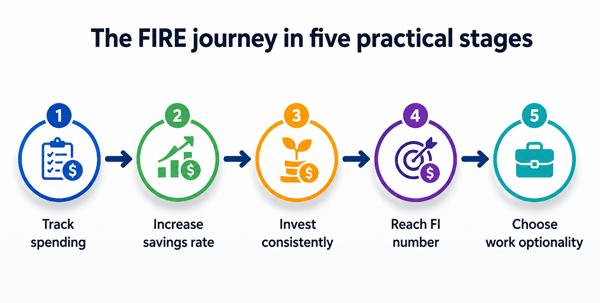
Image: The FIRE journey usually starts with measuring current spending, then increasing the savings rate, investing consistently, reaching a target FI number, and finally choosing how much paid work you want in your life. This visual supports readers who prefer a quick step-by-step overview.
15. FIRE Movement Pros and Cons
| Pros | Cons |
|---|---|
| Encourages saving, investing, and long-term thinking. | Can become too extreme if saving turns into deprivation. |
| Builds resilience against job loss and financial shocks. | Depends on market performance and future assumptions. |
| Creates more career and lifestyle flexibility. | Healthcare, taxes, and inflation can be difficult for early retirees. |
| Helps people question lifestyle inflation. | May be harder for low-income households or people supporting family. |
| Can reduce dependence on debt. | Retiring very early can create social and identity challenges. |
■ Common FIRE Mistakes to Avoid
1. Using the 25x Rule Without Adjustments
The 25x rule is helpful, but it may be too simple for real life. Adjust for taxes, healthcare, children, aging parents, housing repairs, insurance, and the length of your retirement.
2. Ignoring Healthcare and Insurance
Early retirement often means leaving employer benefits. Health insurance, disability protection, life insurance, and long-term care needs should be reviewed before making major career decisions.
3. Becoming Too Frugal
Saving money is powerful, but extreme deprivation can lead to stress, resentment, and quitting the plan. A sustainable FIRE plan includes joy, relationships, health, and flexibility.
4. Chasing High Returns
Trying to speed up FIRE through risky bets can destroy years of progress. A boring, diversified, low-cost investment plan is often more reliable than chasing trends.
5. Forgetting Taxes
Taxes affect how much money you can actually spend. Taxable accounts, retirement accounts, real estate income, dividends, capital gains, and withdrawals may all be taxed differently depending on where you live.
6. Retiring From Something, Not To Something
Leaving a bad job is not the same as building a good life. Plan what you want your days to look like after reaching FI: routines, health, relationships, hobbies, purpose, and community.
■ FIRE for Different Life Situations
1. FIRE for Beginners With Average Income
You do not need a six-figure income to benefit from FIRE principles. Start by tracking spending, building an emergency fund, paying off expensive debt, and increasing your savings rate one step at a time. Even if you never retire extremely early, these habits can create major financial stability.
2. FIRE for Families
Families need more flexibility. Childcare, education, healthcare, housing, and parental support can change quickly. A family FIRE plan should include larger emergency savings, insurance, realistic housing costs, and ongoing conversations between partners.
3. FIRE for High Earners
High earners may reach FIRE faster, but high income can hide high spending. The biggest risk is lifestyle inflation. A high earner who saves 10% may be less financially independent than a moderate earner who saves 35%.
4. FIRE for Self-Employed People
Self-employed people need to plan for irregular income, taxes, business risk, health coverage, retirement contributions, and cash flow. A larger emergency fund and separate tax savings account can make the FIRE path more stable.
■ A Practical FIRE Starter Plan
Here is a beginner-friendly plan you can start without making extreme decisions.
- Track your spending for 30 days. Do not judge it yet; just measure it.
- Calculate your annual spending and rough FIRE number using annual spending x 25.
- Build a starter emergency fund, then work toward three to six months of essential expenses.
- Pay off high-interest debt as a priority.
- Increase your savings rate by 1% to 5% at a time.
- Invest automatically in diversified assets that match your risk tolerance and local rules.
- Review your insurance, taxes, and estate basics.
- Recalculate your FIRE number once or twice a year.
- Avoid comparing your timeline to influencers or online forums.
- Design a life you want before and after financial independence.
■ FIRE Checklist
| Question | Why it matters |
|---|---|
| Do I know my annual spending? | Your expenses drive your FI number. |
| Do I have an emergency fund? | Prevents forced selling or debt during surprises. |
| Have I paid off high-interest debt? | Expensive debt works against compounding. |
| Do I understand my investment mix? | Risk and return must match your timeline. |
| Have I planned for taxes? | Tax drag can reduce spendable income. |
| Have I planned for healthcare and insurance? | Early retirement often changes benefits. |
| Is my withdrawal rate realistic? | Very early retirement may need a lower rate. |
| Do I have a post-FI life plan? | Money alone does not create purpose. |
■ FAQs About the FIRE Movement
1. What does FIRE stand for?
FIRE stands for Financial Independence, Retire Early. It is a movement focused on building enough wealth that paid work becomes optional earlier than traditional retirement age.
2. How much money do I need for FIRE?
Related question: What is a FIRE number? A FIRE number is the estimated investment portfolio or asset base you may need before work becomes optional. It is usually based on annual spending, a chosen withdrawal rate, and a safety margin.
A common estimate is annual expenses multiplied by 25. For example, $40,000 in annual spending suggests a rough FIRE number of $1,000,000. A more conservative plan may use 28x to 33x annual expenses.
3. Is the FIRE movement only for rich people?
No, but income matters. Higher income can make FIRE easier, but the principles of saving, avoiding high-interest debt, investing, and reducing wasteful spending can help many people. Early retirement may be harder for lower-income households, especially with dependents or high living costs.
4. Is FIRE the same as being rich?
Not exactly. FIRE is about having enough assets to support your chosen lifestyle. A person with modest expenses may reach FI with much less money than someone with luxury spending.
5. Can I do FIRE with debt?
You can start learning and saving while you have debt, but high-interest debt should usually be paid off before aggressive investing. Low-interest debt requires a more personalized decision.
6. What is the difference between FIRE and normal retirement planning?
Traditional retirement planning often targets retirement in the 60s. FIRE usually aims for financial independence earlier, which means a longer time horizon, higher savings rate, and more attention to healthcare, taxes, and withdrawal risk.
7. What happens if the market crashes after I retire early?
A market crash early in retirement can be dangerous because withdrawals reduce a falling portfolio. FIRE planners manage this risk with cash reserves, flexible spending, part-time income, lower withdrawal rates, and diversified portfolios.
8. Do I have to stop working after reaching FIRE?
No. Many people keep working after FI because they enjoy it. The difference is that work becomes a choice rather than a financial necessity.
9. What is the best age to start FIRE?
The best time to start is when you are ready to track your money and make consistent choices. Starting earlier gives compounding more time, but people can improve their financial independence at almost any age.
10. Is FIRE realistic?
FIRE can be realistic for some people and difficult for others. It depends on income, expenses, family responsibilities, health, location, investment access, and discipline. Even partial FIRE can be valuable because it improves financial security and options.
■ Final Thoughts
The FIRE movement is not simply about quitting work early. It is about using money as a tool to buy freedom, flexibility, and peace of mind. The most useful parts of FIRE are practical for almost everyone: spend intentionally, avoid high-interest debt, invest for the long term, protect yourself from emergencies, and build a life that does not depend entirely on your next paycheck.
A good FIRE plan is not extreme, copied from someone else, or based on perfect market conditions. It is realistic, flexible, personal, and reviewed regularly. Start with your current spending, calculate a rough FI number, improve your savings rate, and build steadily from there.
Sources and Notes
References for further reading include Google Search Central guidance on helpful, people-first content, William P. Bengen’s withdrawal-rate research, the Trinity Study, Investor.gov investor education tools, CFPB consumer finance guidance, and official tax or retirement authorities in the reader’s own country.
This educational article references widely discussed retirement planning concepts, including William P. Bengen’s withdrawal-rate research, the Trinity Study, Investor.gov education tools, and CFPB consumer finance guidance. It is for general education only and is not personalized financial, tax, legal, or investment advice.
Reader Advice: This article is for educational and information purposes only and should not be taken as personal financial, tax, legal, or investment advice. Please check the latest information from official sources or a qualified professional, as rules, policies, costs, and investment conditions can change over time.