Financial Independence for Beginners: Complete Guide
Financial independence means having enough income, savings, and investments to support your life without being fully dependent on a paycheck. For some people, it means retiring early. For others, it means having the freedom to change jobs, start a business, work fewer hours, support family, travel, or handle emergencies without panic.
The idea can sound complicated at first, but the basic path is simple: spend less than you earn, save the difference, invest consistently, manage risk, and repeat the process for many years. You do not need to be rich to start. You need a clear plan, good habits, patience, and a realistic understanding of your numbers.
This complete guide explains financial independence from the ground up. You will learn what it is, how it works, how to calculate your financial independence number, what habits matter most, which mistakes to avoid, and how to build a practical plan even if you are starting with debt, a modest income, or little experience.
For best results, treat the examples as educational illustrations and adjust every number to your own country, tax rules, income stability, healthcare costs, family responsibilities, and risk tolerance.
1. What Is Financial Independence?
Financial independence is the point where your assets, passive income, and financial systems can cover your living costs without requiring you to rely on active employment forever. Active employment means income you earn by trading time for money, such as a salary, hourly wage, freelancing, or self-employment income. Passive or portfolio income may come from investments, retirement accounts, rental property, business ownership, dividends, interest, or other assets.
A financially independent person is not necessarily wealthy in a flashy way. Many people who reach financial independence live normal, modest lives. The difference is that their money choices are intentional. They know their expenses, avoid unnecessary debt, save and invest regularly, and build enough margin so money does not control every decision.
A simple definition
Financial independence means your money can support your basic and chosen lifestyle needs without you being forced to keep working only to survive.
Beginner note: passive income is rarely completely hands-off. Investments, rental property, and businesses can still require monitoring, record keeping, maintenance, tax planning, and risk management.
2. Financial independence vs. being rich
| Concept | What it means | Beginner-friendly example |
|---|---|---|
| Being rich | Having a high income, expensive assets, or a high net worth. | Someone earns a large salary but spends almost all of it on housing, cars, and lifestyle. |
| Financial independence | Having enough assets and cash flow to cover expenses sustainably. | Someone earns a moderate income, lives below their means, invests for years, and eventually has enough assets to cover annual living costs. |
| Financial security | Having enough stability to handle normal emergencies and bills. | An emergency fund, manageable debt, and steady income. |
| Financial freedom | A broader personal feeling of choice and flexibility. | The ability to take a lower-stress job, move, travel, or care for family without immediate financial fear. |
3. Why Financial Independence Matters
Financial independence is not just about quitting work. It is about building options. Money affects where you live, how you work, how you respond to emergencies, and how much stress you carry. When you improve your financial position, you often improve your decision-making power.
Key benefits of financial independence
- Less financial stress because you have savings, lower debt, and a plan.
- More career flexibility because you are not trapped by every paycheck.
- Better emergency preparedness when unexpected expenses happen.
- More time freedom if your investments eventually cover part or all of your expenses.
- More confidence in long-term goals such as home ownership, travel, family support, or retirement.
- Greater ability to make values-based choices instead of only survival-based choices.
Important limitations
Financial independence does not remove every risk. Markets can fall, inflation can rise, health expenses can increase, and life plans can change. That is why a good financial independence plan should include emergency savings, insurance, diversification, flexible spending, and regular reviews. The goal is not perfection. The goal is resilience.
4. How Financial Independence Works
Financial independence works by increasing the gap between what you earn and what you spend, then using that gap to build assets. The larger your savings rate and the more consistently you invest, the faster you can move toward independence. Time and compounding are powerful because invested money can potentially generate returns, and those returns can generate more returns.
The basic formula
Income - Expenses = Savings and investment capacity
The money you do not spend can be used to pay off debt, build emergency savings, buy investments, start a business, or increase your future choices. If your income rises but your spending rises just as fast, your progress may stay slow. If your income rises and you keep expenses controlled, your financial independence timeline can improve significantly.
The financial independence cycle
- Earn income through work, business, or other sources.
- Spend intentionally on needs and meaningful wants.
- Avoid or reduce high-interest debt.
- Save cash for emergencies and short-term goals.
- Invest for long-term growth and income.
- Protect your progress with insurance, planning, and regular reviews.
- Repeat consistently over many years.
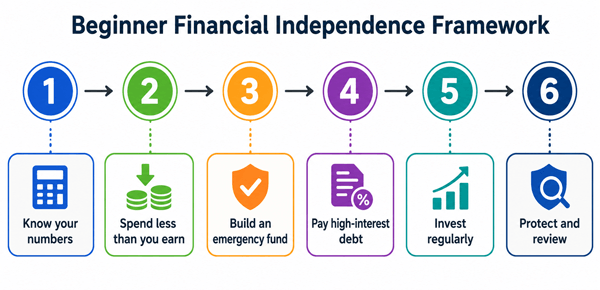
Figure: A beginner financial independence framework. The steps are simple, but they work best when repeated consistently over time.
5. The Main Stages of Financial Independence
Beginners often think financial independence is one big finish line, but it is more helpful to view it in stages. Each stage gives you more stability and freedom than the last.
| Stage | What it looks like | Main focus |
|---|---|---|
| Stage 1: Financial awareness | You know your income, expenses, debts, and basic net worth. | Track money and understand your starting point. |
| Stage 2: Financial stability | Bills are current, debt is controlled, and you have a small emergency fund. | Stop the financial bleeding and create breathing room. |
| Stage 3: Financial security | You have a stronger emergency fund, manageable debt, and regular investing habits. | Build protection and consistency. |
| Stage 4: Financial flexibility | Investments and savings give you choices, such as changing jobs or taking time off. | Increase assets and reduce dependence on one income source. |
| Stage 5: Financial independence | Your assets and income can cover your lifestyle without full-time work. | Preserve wealth, manage risk, and live intentionally. |
6. How Much Money Do You Need for Financial Independence?
Your financial independence number is the amount of invested assets or income-producing assets you may need to cover your annual expenses. There is no single number that works for everyone because your target depends on your lifestyle, location, family needs, taxes, healthcare, inflation, investment returns, and risk tolerance.
A common beginner estimate: annual expenses multiplied by 25
A popular rough estimate is to multiply your annual expenses by 25. This is connected to the idea of withdrawing about 4% of a portfolio in the first year of retirement, then adjusting later withdrawals for inflation. The 4% idea is based largely on historical market research and often assumes a long retirement period, but it is only a starting estimate, not a guarantee. A conservative person, an early retiree, or someone facing high healthcare costs may want more than 25 times annual expenses, while someone with a pension, rental income, part-time work, or lower spending may need less invested capital.
| Annual spending | 25x estimate | What it means |
|---|---|---|
| $30,000 | $750,000 | A lean lifestyle or low-cost area may require a smaller portfolio. |
| $50,000 | $1,250,000 | A moderate lifestyle may require a larger but realistic long-term goal. |
| $80,000 | $2,000,000 | A higher-cost lifestyle needs more assets or additional income sources. |
| $120,000 | $3,000,000 | High spending requires a much larger portfolio unless expenses decrease. |
Why expenses matter more than beginners expect
Your spending affects financial independence in two ways. First, lower expenses mean you can save more now. Second, lower expenses mean you need a smaller portfolio later. For example, reducing annual spending by $10,000 may increase your current savings and may also reduce your estimated financial independence target by about $250,000 using the 25x rule. That is why controlling lifestyle inflation is one of the most powerful financial independence strategies.
A practical formula
Financial independence number = annual expenses x target multiple
Example: If you expect to spend $48,000 per year and use a 25x multiple, your estimated target is $1,200,000. If you prefer a more cautious 30x multiple, the target becomes $1,440,000.
Practical reminder: include taxes, insurance premiums, healthcare, housing repairs, dependents, and occasional large purchases in your annual spending estimate. Underestimating expenses can make the FI number look easier than it really is.
7. Step-by-Step Financial Independence Plan for Beginners
The best financial independence plan is not built from one dramatic decision. It is built from small repeatable actions. Use the following steps as a practical roadmap.
Step 1: Understand your current financial position
Before you can improve your money situation, you need to know where you stand. This does not require complicated software. A simple spreadsheet, notebook, or budgeting app can work.
- List all income sources after tax.
- List monthly fixed expenses such as rent, utilities, insurance, minimum debt payments, and subscriptions.
- Estimate variable expenses such as groceries, transport, entertainment, clothing, and gifts.
- Write down every debt balance, interest rate, and minimum payment.
- Add up savings, investments, retirement accounts, and other assets.
- Calculate your net worth: assets minus liabilities.
Beginner example: Sara earns $3,500 per month after tax. Her monthly expenses are $3,000, and she has $8,000 in credit card debt. Her first goal is not to retire early. Her first goal is to create a $500 monthly gap, build a small emergency fund, and attack high-interest debt.
Step 2: Build a simple budget that you can actually follow
A budget is not a punishment. It is a plan for your money before life spends it for you. The best budget is one you will use consistently.
| Budget method | How it works | Best for |
|---|---|---|
| 50/30/20 budget | About 50% needs, 30% wants, 20% savings and debt payoff. | Beginners who want simple categories. |
| Zero-based budget | Every dollar gets a job: bills, savings, debt, giving, or spending. | People who want detailed control. |
| Pay-yourself-first budget | Savings and investments happen first, then you spend what remains. | People who overspend when money sits in checking. |
| Envelope or category budget | Money is divided into categories for groceries, fuel, entertainment, and other expenses. | People who need spending boundaries. |
The right budget is not the one that looks perfect on paper. It is the one that helps you make better decisions in real life. Start with broad categories, then adjust after one or two months of actual spending data.
Step 3: Create a starter emergency fund
An emergency fund protects you from turning every surprise into debt. For beginners, a starter emergency fund of $500 to $1,000 can help with urgent car repairs, medical bills, or income delays. After high-interest debt is under control, many people aim for three to six months of essential expenses. People with unstable income, dependents, or higher job risk may want more.
Step 4: Pay off high-interest debt
High-interest debt can slow financial independence because interest charges work against you. Credit cards, payday loans, and expensive personal loans often deserve priority. Paying them off can create a guaranteed improvement in cash flow and reduce stress.
| Debt payoff method | How it works | Pros | Cons |
|---|---|---|---|
| Debt snowball | Pay the smallest balance first while making minimum payments on the rest. | Builds motivation with quick wins. | May cost more interest if larger debts have higher rates. |
| Debt avalanche | Pay the highest interest rate first while making minimum payments on the rest. | Usually saves the most interest mathematically. | Progress may feel slower if the highest-rate debt has a large balance. |
| Debt consolidation | Combine multiple debts into one loan or balance transfer when terms are better. | Can simplify payments and lower interest. | Can create more debt if spending habits do not change. |
A practical rule: if the debt interest rate is very high, prioritize paying it down before aggressive investing. If the debt is low-interest and manageable, you may choose to invest while making scheduled payments. The right decision depends on interest rate, risk tolerance, employer retirement matches, taxes, and cash flow.
Step 5: Increase your savings rate
Your savings rate is the percentage of income you keep instead of spending. A higher savings rate usually means faster progress toward financial independence. Beginners can start with 5% or 10%, then increase it over time. The goal is not to feel deprived; the goal is to direct more money toward what gives you lasting freedom.
- Automate transfers on payday so saving happens before spending.
- Increase savings when you receive a raise, bonus, tax refund, or side income.
- Cancel unused subscriptions and redirect the money to savings or debt payoff.
- Use a waiting period before large purchases.
- Keep housing, transportation, and food costs reasonable because these usually drive the budget.
Step 6: Start investing for long-term growth
Saving cash is important for emergencies and short-term goals, but long-term financial independence usually requires investing. Inflation reduces the purchasing power of cash over time. Investing gives your money a chance to grow, although returns are not guaranteed and values can fall in the short term.
Beginner-friendly long-term investments often include diversified index funds, retirement accounts, employer-sponsored plans, broad stock and bond funds, and sometimes real estate. The best choice depends on your country, tax system, employer benefits, investment options, and risk tolerance.
- Start with diversified investments rather than trying to pick hot stocks.
- Understand fees because high fees reduce long-term returns.
- Use tax-advantaged accounts when available and suitable.
- Invest regularly through automatic contributions.
- Keep short-term money out of volatile investments if you may need it soon.
- Avoid investments you do not understand.
- Match your investments to your time horizon: money needed within the next few years usually belongs in safer, liquid accounts, while long-term money may be invested with a diversified strategy that can tolerate market ups and downs.
Step 7: Grow your income
Cutting expenses helps, but income growth can speed up financial independence. There is a limit to how much you can cut, but income can often be improved through skills, negotiation, career moves, business, freelancing, or additional income streams.
- Ask for raises with evidence of results and market value.
- Learn practical skills that increase earning power.
- Consider changing jobs if your current role has limited growth.
- Build a side income carefully without risking your main stability.
- Use extra income to invest instead of automatically upgrading lifestyle.
Step 8: Protect your progress
Financial independence is not only about growth. It is also about protection. One uninsured emergency, lawsuit, disability, or major mistake can damage years of progress. Protection may include appropriate insurance, an emergency fund, estate planning basics, cybersecurity habits, and avoiding concentrated risk.
- Keep adequate health, auto, home or renters, disability, and life insurance where relevant.
- Use strong passwords and protect financial accounts with multi-factor authentication.
- Avoid putting all your wealth into one stock, one business, or one property without understanding the risk.
- Keep beneficiary information updated on retirement and insurance accounts.
- Create basic estate documents when your situation requires them.
- Keep written records of key accounts, passwords recovery methods, insurance details, and beneficiaries so trusted family members can handle essentials in an emergency.
Step 9: Track progress and adjust yearly
Your financial independence plan should evolve as your life changes. Review your budget, net worth, investment contributions, debt, insurance, and goals at least once a year. A simple annual review can show whether you are moving in the right direction and help you make adjustments before small problems become large ones.
■ Financial Independence Strategies That Work for Beginners
There are many strategies, but beginners should focus on the few that produce the biggest results. The most useful strategies are simple, repeatable, and realistic.
1. Automate good behavior
Automation reduces the need for willpower. Set automatic transfers to savings, retirement accounts, investment accounts, and debt payments. When good choices happen automatically, your plan becomes easier to maintain.
2. Keep lifestyle inflation under control
Lifestyle inflation happens when spending rises every time income rises. Some lifestyle improvement is normal and healthy, but upgrading everything at once can trap you. A practical rule is to save or invest part of every raise before increasing spending.
3. Focus on the big three expenses
Housing, transportation, and food often make up a large share of the budget. Small savings matter, but major progress often comes from keeping rent or mortgage payments manageable, avoiding expensive car decisions, and planning food spending.
4. Use simple diversified investing
Many beginners lose time trying to find the perfect investment. A simple diversified portfolio often beats a complicated plan that is never started. Learn the basics of asset allocation, risk, fees, and time horizon before making major decisions.
5. Build multiple layers of financial security
Financial independence is stronger when it has layers: cash reserves, low debt, investments, insurance, useful skills, and flexible spending. If one layer fails, another layer can help protect you.
■ Real-World Examples
Example 1: Starting with debt
Ahmed earns $2,800 per month after tax and has $6,000 in credit card debt. He tracks spending and finds $300 per month in avoidable expenses. He builds a $1,000 starter emergency fund, then pays $500 per month toward the card. Once the card is paid off, he redirects that $500 into retirement investing and a larger emergency fund. His first year is mostly about stability, but it creates the foundation for financial independence.
Example 2: Moderate income, high savings rate
Maya earns $4,500 per month after tax and spends $3,000. She saves and invests $1,500 per month, or about 33% of her take-home income. She lives in a modest apartment, drives a reliable used car, and invests automatically. She is not doing anything extreme. Her main advantage is consistency and avoiding lifestyle inflation.
Example 3: High income but little progress
Daniel earns $9,000 per month after tax but spends $8,800. He has a luxury car payment, expensive rent, frequent travel, and several subscriptions. Even with a high income, his savings rate is very low. His financial independence plan begins with reducing fixed costs and saving future raises instead of increasing spending.
These examples are simplified. In real life, taxes, rent changes, family support, medical expenses, currency inflation, and investment volatility can change the timeline, so each person should review their plan regularly.
■ Common Financial Independence Mistakes to Avoid
| Mistake | Why it hurts progress | Better approach |
|---|---|---|
| Waiting until income is high enough | Delays habit building and compounding. | Start with small amounts and increase over time. |
| Ignoring high-interest debt | Interest charges can grow faster than savings. | Create a debt payoff plan and stop adding new debt. |
| Investing without an emergency fund | A surprise expense may force you to sell investments at a bad time. | Keep short-term safety money in cash. |
| Trying to get rich quickly | Speculation can cause large losses. | Use a patient, diversified, long-term approach. |
| Copying someone else’s FI number | Different lives require different targets. | Base your number on your own expenses and risks. |
| Never reviewing the plan | Old assumptions may become wrong. | Review at least annually and after major life changes. |
■ Financial Independence Myths and Misconceptions
Myth 1: You need a huge income to become financially independent
A higher income helps, but it is not enough by itself. Many high earners live paycheck to paycheck because their spending rises with income. Financial independence depends on the relationship between income, spending, saving, investing, and time.
Myth 2: Financial independence means never working again
Some people stop working, but many continue working because they enjoy it. The difference is choice. Financial independence gives you the option to work on better terms, not necessarily the obligation to retire permanently.
Myth 3: Investing is only for experts
Investing requires education, but it does not require predicting the future. Many beginners start with simple diversified funds, automatic contributions, and long-term discipline. Complex strategies are not always better.
Myth 4: Extreme frugality is required
Some people pursue financial independence through very low spending, but that is not the only path. A sustainable plan balances saving with a life you can actually maintain. The best plan is one that supports both present well-being and future freedom.
■ Pros and Cons of Pursuing Financial Independence
| Pros | Cons or challenges |
|---|---|
| More freedom and flexibility. | Requires patience and long-term consistency. |
| Lower money stress over time. | May require saying no to some short-term spending. |
| Better preparation for emergencies. | Investment values can fluctuate. |
| Improved career and life choices. | Progress may feel slow at the beginning. |
| Clearer priorities and intentional spending. | Family, health, inflation, and life events can change the plan. |
■ Beginner Checklist for Financial Independence
- Calculate your monthly income and expenses.
- Create a realistic budget.
- Build a starter emergency fund.
- List debts by balance, interest rate, and minimum payment.
- Choose a debt payoff method if you have high-interest debt.
- Automate savings and investment contributions.
- Learn the basics of diversified investing.
- Increase your savings rate gradually.
- Protect yourself with appropriate insurance.
- Review your net worth and goals at least once a year.
■ A Simple 12-Month Financial Independence Starter Plan
| Month | Main action | Goal |
|---|---|---|
| 1 | Track all income, expenses, debts, and assets. | Know your starting point. |
| 2 | Build a simple budget and cut obvious waste. | Create monthly cash flow. |
| 3 | Save a starter emergency fund. | Avoid new debt from small emergencies. |
| 4 | Choose a debt payoff strategy. | Reduce high-interest debt. |
| 5 | Automate bill payments and savings. | Make progress consistent. |
| 6 | Review insurance and financial risks. | Protect your foundation. |
| 7 | Start or increase retirement contributions. | Begin long-term investing. |
| 8 | Learn basic investing terms and fees. | Avoid expensive mistakes. |
| 9 | Look for income growth opportunities. | Increase savings potential. |
| 10 | Review spending on housing, transport, and food. | Improve the biggest budget categories. |
| 11 | Calculate a rough FI number. | Connect daily habits to long-term goals. |
| 12 | Review progress and set next-year targets. | Turn the plan into a repeatable system. |
■ Frequently Asked Questions
1. What is financial independence in simple words?
Financial independence means you have enough money, assets, or passive income to cover your living costs without depending completely on a regular paycheck.
2. How do I start financial independence with no money?
Start by tracking your spending, making a simple budget, avoiding new high-interest debt, building a small emergency fund, and increasing income where possible. Even small savings matter because the first goal is to build habits and cash flow.
3. How much should I save for financial independence?
A common target is 25 times annual expenses, but it is only an estimate. Your real number depends on lifestyle, age, location, taxes, healthcare, investment risk, family needs, and whether you will have other income sources.
4. Is financial independence the same as retirement?
No. Retirement usually means leaving the workforce. Financial independence means work becomes optional or more flexible because your finances can support your life. Many financially independent people still work by choice.
5. Should I pay off debt or invest first?
High-interest debt usually deserves priority because it can be expensive and stressful. At the same time, some people invest enough to receive an employer match or maintain retirement habits. The right balance depends on interest rates, cash flow, risk, and available benefits.
6. Can average-income people become financially independent?
Yes, but the path may require patience, a strong savings rate, controlled spending, income growth, and consistent investing. Financial independence is harder with a low income and high expenses, but progress can still begin with small steps.
7. What is the fastest way to reach financial independence?
The fastest realistic path is to increase income, keep major expenses controlled, avoid lifestyle inflation, pay off high-interest debt, and invest a large percentage of income consistently. Be careful with shortcuts that promise quick wealth because they often involve high risk.
8. Where should beginners keep emergency savings?
Emergency savings should usually be kept somewhere safe, liquid, and easy to access, such as a savings account or similar cash account. Money needed soon should not usually be invested in volatile assets.
9. How often should I check my financial independence progress?
Monthly check-ins are useful for budgeting and debt payoff. A deeper review once or twice a year is usually enough for net worth, investment allocation, insurance, and long-term goals.
10. How long does it take to reach financial independence?
The timeline depends on your income, savings rate, starting debt, investment returns, expenses, and lifestyle goals. A high savings rate can shorten the journey, but beginners should focus first on building stable habits that can last for years.
■ Final Thoughts
Financial independence is not a secret formula. It is the result of repeated practical choices: know your numbers, spend intentionally, avoid harmful debt, save cash for emergencies, invest for the long term, grow your income, and protect your progress. Beginners do not need to master everything at once. Start with the next best step.
The most important lesson is that financial independence is personal. Your target, timeline, and lifestyle may look different from someone else’s. Focus on building a plan that is realistic, flexible, and sustainable. Small actions repeated consistently can become life-changing over time.
Reader Advice: This article is for educational and information purposes only and should not be taken as personal financial, tax, legal, or investment advice. Please check the latest information from official sources or a qualified professional, as rules, policies, rates, and personal circumstances can change over time.