Financial Independence: Meaning, Benefits and Strategies
Financial independence means having enough income, savings, investments, and financial flexibility to cover your living costs without being completely dependent on a job, another person, or emergency borrowing. For some people, it means retiring early. For others, it simply means having enough security to change jobs, start a business, care for family, work less, or handle emergencies without panic.
This guide explains financial independence in simple language, including how it works, why it matters, the stages involved, practical strategies, common mistakes, and beginner-friendly examples.
Quick answer: Financial independence is reached when your savings, investments, assets, or other dependable income sources can cover your necessary living expenses with a safety margin. The exact target is different for every person because expenses, family needs, taxes, inflation, healthcare costs, and risk tolerance are different.
Key takeaway: Financial independence is not only about being rich. It is about building a life where your money supports your choices instead of constantly limiting them.
| Section | What You Will Learn |
|---|---|
| Meaning | What financial independence is and how it differs from being wealthy or debt-free |
| Benefits | How it improves security, choices, stress, and long-term planning |
| Strategies | Budgeting, debt reduction, saving, investing, income growth, and risk protection |
| Examples | Realistic scenarios for beginners, families, employees, and self-employed people |
| Mistakes | Common traps that slow progress and how to avoid them |
1. What Is Financial Independence?
Financial independence is the point where your financial resources can support your essential lifestyle without relying only on active work income. Active work income is money you earn by trading time for pay, such as a salary, wages, commissions, or freelance work.
A financially independent person may still choose to work. The difference is that work becomes a choice, not a survival requirement. They have enough financial stability to make decisions from a place of confidence rather than fear.
| Term | Simple Meaning | Example |
|---|---|---|
| Financial stability | You can pay bills and handle normal expenses | You pay rent, utilities, food, and transport on time. |
| Financial security | You have savings and protection against emergencies | A medical bill or car repair does not force you into high-interest debt. |
| Financial independence | Your assets or income streams can cover your lifestyle | Investments, rental income, business income, or savings can support your needs. |
| Financial freedom | You have enough flexibility to design life around your values | You can reduce work hours, travel, volunteer, or start a business. |
Important: Financial independence is personal. A single person with modest expenses may need much less than a family living in a high-cost city. The goal depends on your expenses, responsibilities, risk tolerance, and desired lifestyle.
A useful way to estimate your starting target is: annual essential expenses × the number of years you want your assets to support you, adjusted for taxes, inflation, expected returns, and safety margin. Some retirement discussions use withdrawal-rate shortcuts, but these are only rough planning tools and are not guarantees.
2. How Financial Independence Works
Financial independence usually works through a combination of controlled expenses, consistent savings, smart investing, manageable debt, and multiple sources of income. The basic idea is simple: you build assets that can eventually help pay for your life.
The Basic Formula
Financial independence = enough assets and reliable income to cover your regular expenses with an acceptable level of risk.
A beginner can think about it in four steps:
- Know how much your life costs each month and each year.
- Spend less than you earn so you create a surplus.
- Use the surplus to pay down harmful debt, build savings, and invest.
- Over time, let assets and income streams reduce your dependence on active work.
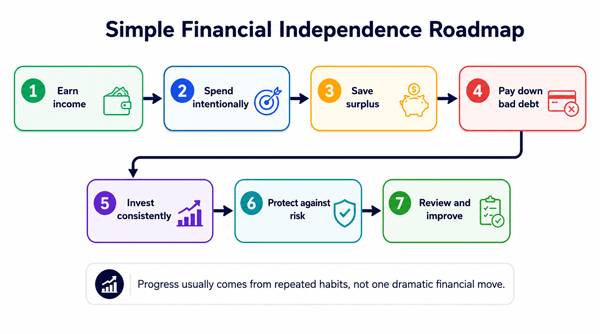
Simple Financial Independence Roadmap
| 1. Earn Income | 2. Spend Intentionally | 3. Save Surplus | 4. Pay Down Bad Debt |
|---|---|---|---|
| 5. Invest Consistently | 6. Protect Against Risk | 7. Increase Freedom | Repeat and Improve |
Financial independence is usually built through repeated habits, not one big financial move.
3. Stages of Financial Independence
| Stage | What It Looks Like | Main Goal |
|---|---|---|
| Stage 1: Awareness | You know your income, expenses, debts, and net worth. | Stop guessing and start measuring. |
| Stage 2: Stability | Bills are paid on time and spending is under control. | Avoid new financial damage. |
| Stage 3: Emergency readiness | You have starter savings and a plan for unexpected costs. | Avoid relying on credit cards or payday loans. |
| Stage 4: Debt control | High-interest debt is reduced or eliminated. | Free up cash flow and reduce stress. |
| Stage 5: Wealth building | You invest regularly and grow assets over time. | Build long-term independence. |
| Stage 6: Work optional | Your assets and income streams can support your lifestyle. | Choose work based on purpose, not pressure. |
■ Benefits of Financial Independence
Financial independence can improve both your money situation and your quality of life. The benefits are practical, emotional, and long term.
1. More control over your time
When you are not completely dependent on one paycheck, you have more room to make choices about work, family, education, travel, or rest.
2. Less financial stress
Savings, lower debt, and predictable cash flow can reduce the constant pressure of living paycheck to paycheck.
3. Better career choices
You may be able to leave a toxic job, negotiate better pay, change industries, or start a business with less fear.
4. Stronger emergency protection
A financially independent plan includes savings and insurance, making unexpected events less damaging.
5. Ability to help others
Financial strength can make it easier to support family, give to causes, mentor others, or build generational wealth.
6. Greater retirement flexibility
You may be able to retire earlier, semi-retire, work part time, or choose meaningful work later in life.
■ Financial Independence vs Being Rich
Many beginners confuse financial independence with being rich. They are related, but not the same.
| Comparison Point | Financial Independence | Being Rich |
|---|---|---|
| Main focus | Enough resources to support your desired lifestyle | High income, high net worth, or visible wealth |
| Depends on | Expenses, assets, cash flow, and discipline | Income, assets, business success, inheritance, or investment growth |
| Can someone earn a lot and not be independent? | Yes. High spending and debt can trap a high earner. | Yes. A rich lifestyle can still be financially fragile. |
| Can someone with modest income become independent? | Yes, if expenses are controlled and savings are consistent. | Possibly, but it may take longer. |
| Best measure | Can your resources support your life? | How much money or assets do you have? |
■ Practical Strategies to Achieve Financial Independence
There is no single path to financial independence. Most people make progress by combining several practical strategies over many years.
1. Define What Financial Independence Means for You
Also decide whether your goal is basic independence, work-optional living, early retirement, or full financial freedom. These goals sound similar, but they require different levels of savings, risk protection, and income planning.
Start with your life goals. Do you want to retire early, work part time, become debt-free, travel, support family, or simply feel safe? A clear goal helps you choose the right strategy.
Example: If your goal is to leave a stressful job within five years, your plan may focus on emergency savings, lower expenses, and building a side income. If your goal is retirement in 25 years, investing consistently may matter more.
2. Track Your Income and Expenses
Include irregular expenses such as annual insurance, school fees, home repairs, taxes, medical costs, gifts, and travel. Many budgets fail because they only track normal monthly bills and ignore predictable but occasional expenses.
You cannot improve what you do not measure. Track how much comes in, where it goes, and which expenses are fixed, flexible, necessary, or optional.
Example: A person earning $3,000 per month may discover that $450 goes to food delivery, subscriptions, and impulse shopping. Redirecting even $250 per month can create $3,000 per year for debt payoff or investing.
3. Build a Realistic Budget
A budget is not a punishment. It is a spending plan that tells your money where to go. A good budget covers needs, debt payments, savings, investing, and some enjoyable spending.
Practical tip: Use broad categories such as housing, food, transport, debt, savings, giving, and personal spending. Keep it simple enough to follow.
4. Create an Emergency Fund
An emergency fund protects you from relying on expensive debt when life goes wrong. Start with a small goal, then build toward several months of essential expenses.
Example: A starter emergency fund of $500 to $1,000 can cover many small emergencies. Later, a fund covering three to six months of essential expenses can provide stronger protection.
5. Pay Down High-Interest Debt
High-interest debt can slow or destroy progress because interest keeps growing. Credit card balances, payday loans, and expensive personal loans should usually be prioritized.
Practical tip: Use the debt avalanche method to save the most interest, or the debt snowball method if you need motivation from quick wins.
6. Increase Your Savings Rate
Your savings rate is the percentage of income you keep instead of spend. A higher savings rate usually shortens the path to financial independence.
Example: Saving 5% is a start. Moving from 5% to 15% or 20% can make a major difference over time, especially when invested consistently.
7. Invest for Long-Term Growth
For beginners, long-term investing usually works best when it is diversified, low-cost, consistent, and aligned with your time horizon. Avoid promises of guaranteed high returns, because legitimate investments always carry some level of risk.
Savings protect you in the short term, but investing helps money grow over the long term. Common options include retirement accounts, diversified funds, bonds, real estate, and business ownership.
Beginner tip: Avoid putting all your money into one stock, one property, one trend, or one speculative asset. Diversification helps reduce risk.
8. Grow Your Income
Cutting expenses has limits, but income growth can expand your options. You can grow income through skills, certifications, negotiation, freelancing, business, or career changes.
Example: A $300 monthly raise or side income can become $3,600 per year. Used wisely, that money can speed up debt payoff or investment growth.
9. Protect Your Progress
Protection also includes keeping records, naming beneficiaries where appropriate, using strong passwords, avoiding suspicious investment offers, and reviewing any financial product before committing money.
Financial independence is not only about growth. It is also about protection. Insurance, estate planning, emergency savings, and avoiding scams help protect what you build.
Examples include health insurance, disability insurance, life insurance if others depend on your income, a will, and careful review before signing financial contracts.
10. Review and Adjust Your Plan
Life changes. Income, family needs, inflation, interest rates, health, and goals can shift. Review your plan at least once or twice a year.
Ask: Are expenses rising too fast? Is debt shrinking? Are savings growing? Are investments still aligned with your timeline and risk tolerance?
■ Chart: How Savings Rate Affects Progress
This simplified chart shows why saving a higher share of income can speed up financial independence. It does not guarantee results because investment returns, inflation, taxes, and life events vary.
| Savings Rate | What It Means | Likely Impact |
|---|---|---|
| 5% | You save $5 from every $100 earned. | Good starting habit, but progress may be slow. |
| 10% | You save $10 from every $100 earned. | Builds discipline and creates room for emergencies and investing. |
| 20% | You save $20 from every $100 earned. | Can significantly speed up wealth building if sustained. |
| 30%+ | You save $30 or more from every $100 earned. | Aggressive progress, but must still allow a realistic lifestyle. |
■ Financial Independence Examples
Example 1: The Paycheck-to-Paycheck Beginner
Sara earns a steady income but has no savings and uses a credit card for emergencies. Her first step is not investing aggressively. Her first step is stability: track expenses, build a small emergency fund, and stop adding new credit card debt.
Best first moves: create a basic budget, save a starter emergency fund, pay minimums on all debts, then focus extra money on the highest-interest balance.
Example 2: The High Earner With High Spending
Ali earns a strong salary but spends heavily on rent, dining out, travel, and car payments. Even with high income, he feels trapped because expenses rise with every raise.
Best first moves: calculate net worth, reduce lifestyle inflation, increase savings rate, automate investing, and avoid taking on new consumer debt.
Example 3: The Family Planning for Long-Term Freedom
A couple with children wants security, education savings, and retirement flexibility. Their path requires emergency savings, insurance, debt control, retirement investing, and clear family priorities.
Best first moves: protect income, build a family emergency fund, avoid unnecessary debt, invest regularly, and review goals annually.
■ How Much Money Do You Need for Financial Independence?
A simple starting estimate is to calculate your annual essential expenses and compare them with dependable income or assets that may support those expenses. For example, a person who needs $30,000 per year for essentials will need a different plan from someone who needs $100,000 per year. This estimate should be reviewed regularly because inflation, family needs, healthcare, taxes, and market returns can change over time.
There is no universal number. The amount depends mainly on your annual expenses, desired lifestyle, investment returns, inflation, taxes, healthcare costs, dependents, and how much risk you can tolerate.
A common planning shortcut is to estimate annual expenses and compare them with the income your assets may reasonably produce. For example, someone who needs $30,000 per year has a very different target from someone who needs $100,000 per year.
| Question | Why It Matters |
|---|---|
| What are my essential annual expenses? | This shows the minimum income you need for basic independence. |
| What lifestyle do I want? | A modest lifestyle requires less than a luxury lifestyle. |
| How stable are my income sources? | Guaranteed income is different from risky or irregular income. |
| What major costs could increase later? | Healthcare, children, housing, elder care, and inflation can change the target. |
| How long must the money last? | A 10-year plan is different from a 40-year retirement plan. |
■ Risks and Limitations of Financial Independence Planning
Financial independence plans should be realistic, flexible, and reviewed over time. The goal is not to predict the future perfectly, but to build enough margin so your plan can survive normal changes in life and markets.
Investment risk
Markets can fall, returns are not guaranteed, and poor diversification can increase losses.
Inflation risk
The cost of living may rise faster than expected, which means your target may need to increase.
Healthcare and family risk
Medical needs, caregiving, children, or family emergencies can change your financial plan.
Overly aggressive assumptions
Assuming high investment returns or ignoring taxes can make a plan look better than it really is.
Burnout from extreme saving
Saving too aggressively can create stress, relationship tension, or an unsustainable lifestyle.
■ Common Financial Independence Mistakes to Avoid
- Chasing financial independence without knowing your actual expenses.
- Ignoring high-interest debt while trying to invest aggressively.
- Copying someone else’s goal without considering your income, family, country, taxes, or cost of living.
- Relying on one income source, one investment, or one employer.
- Confusing frugality with deprivation and creating a plan you cannot maintain.
- Keeping too much money idle in low-return accounts for long-term goals.
- Taking excessive risks because you want to reach financial independence quickly.
- Forgetting insurance, emergency savings, taxes, and estate planning.
- Letting lifestyle inflation absorb every raise or bonus.
- Waiting for the perfect time instead of starting with small consistent actions.
■ Beginner Action Plan: How to Start This Month
- List all income sources and monthly expenses.
- Calculate total debt, interest rates, minimum payments, and due dates.
- Build a starter emergency fund before taking unnecessary risks.
- Choose one debt payoff strategy if you have high-interest debt.
- Automate a small savings or investment amount, even if it is modest.
- Increase your income by improving skills, asking for fair pay, or adding a realistic side income.
- Review your progress every month and make one small improvement at a time.
■ Pros and Cons of Pursuing Financial Independence
| Pros | Cons or Challenges |
|---|---|
| More freedom and flexibility | Requires patience and discipline |
| Lower dependence on a single paycheck | May require lifestyle changes |
| Better emergency readiness | Investment returns are uncertain |
| Improved long-term planning | Can feel slow at the beginning |
| More choices in work and retirement | Extreme saving can become unhealthy if taken too far |
■ Frequently Asked Questions About Financial Independence
1. Is financial independence the same as early retirement?
No. Early retirement is one possible result of financial independence, but many financially independent people continue working because they enjoy it or want to stay active.
2. Can I become financially independent with an average income?
Yes, but the path may require careful spending, steady saving, debt control, and income growth. Your expenses matter as much as your income.
3. Do I need to be debt-free to be financially independent?
Not always. Some people carry manageable low-interest debt, such as a mortgage. However, high-interest consumer debt usually makes independence much harder.
4. What is the first step toward financial independence?
The first step is awareness. Know your income, expenses, debts, savings, and net worth. Without those numbers, it is difficult to make a realistic plan.
5. How long does financial independence take?
It depends on your income, expenses, savings rate, debt, investment returns, and goals. For most people, it is a long-term process built through consistent habits.
6. Should I save or invest first?
Start with basic emergency savings and debt control. Then invest for long-term goals once you have enough short-term protection. The right balance depends on your situation.
7. What if I start late?
Starting late is not ideal, but it is still valuable. Focus on reducing debt, increasing income, saving more aggressively where realistic, and avoiding major financial mistakes.
8. Can financial independence reduce stress?
It can, because savings, lower debt, and flexible income reduce financial pressure. However, money is only one part of well-being, so balance matters.
9. What is a good financial independence number?
A good financial independence number is the amount of savings, investments, and reliable income you need to support your essential lifestyle with a safety margin. It is usually based on annual expenses, risk tolerance, dependents, inflation, taxes, healthcare, and how long the money may need to last.
■ Final Thoughts: Financial Independence Is Built Step by Step
Financial independence is not a magic number, a trend, or a lifestyle reserved only for wealthy people. It is a practical financial goal that gives you more control over your time, choices, and future.
The most reliable path starts with simple actions: understand your money, spend intentionally, build emergency savings, reduce harmful debt, invest for the long term, grow income, and protect your progress. You do not need to do everything perfectly. You need to start, stay consistent, and adjust as life changes.
Reader Advice: This article is for educational and informational purposes only and should not be taken as personal financial, investment, tax, retirement, or legal advice. Please check the latest official sources or speak with a qualified professional before making important financial decisions, as rules, policies, rates, and information can change over time.