How Much Money Do You Need for Financial Independence?
1. Quick Answer: How Much Money Do You Need for Financial Independence?
Most beginners can estimate their financial independence number with this simple formula:
Annual expenses you need from investments ÷ safe withdrawal rate = Financial independence number
A common starting point is the 4% rule, which means multiplying annual investment-funded expenses by 25. For example, if you need $40,000 per year from investments, your estimated FI number is about $1,000,000. If you want a more conservative plan, using 3.5% means multiplying expenses by about 28.6. If your annual investment-funded expenses are $40,000, that would be about $1,143,000.
This is only a starting estimate. Your real number depends on your cost of living, location, taxes, healthcare, debt, family needs, investment mix, retirement age, inflation, expected income sources, and how flexible your spending can be.
For the most accurate estimate, calculate only the annual spending your portfolio must cover after subtracting reliable outside income. Treat your answer as a planning range, not a single fixed number.
| Annual spending needed from investments | 25x expenses (4% rule) | 28.6x expenses (3.5% rule) | 33.3x expenses (3% rule) |
|---|---|---|---|
| $25,000 | $625,000 | $714,000 | $833,000 |
| $40,000 | $1,000,000 | $1,143,000 | $1,333,000 |
| $60,000 | $1,500,000 | $1,714,000 | $2,000,000 |
| $80,000 | $2,000,000 | $2,286,000 | $2,667,000 |
| $100,000 | $2,500,000 | $2,857,000 | $3,333,000 |
2. What Financial Independence Really Means
Financial independence means you have enough reliable resources to pay for your lifestyle without depending on a regular paycheck. It does not always mean you stop working forever. It means work becomes optional, not mandatory.
For some people, financial independence means retiring early. For others, it means switching to part-time work, starting a small business, caring for family, traveling, or choosing a lower-stress career. The exact number is personal because the cost of the life you want is personal.
A beginner should think of financial independence as a math problem plus a life-design problem. The math asks, “How much annual spending must my assets support?” The life-design part asks, “What kind of life am I actually trying to fund?”
3. The Core Formula for Your Financial Independence Number
The most useful beginner formula is:
FI number = annual expenses covered by investments ÷ withdrawal rate
The withdrawal rate is the percentage of your investment portfolio you expect to withdraw in the first year of financial independence. After that, many retirement-income models assume withdrawals rise with inflation. For example, with a 4% starting withdrawal rate, a $1,000,000 portfolio would support about $40,000 in first-year withdrawals before taxes and fees.
The famous 4% rule comes from historical retirement withdrawal research, including William Bengen’s 1994 work and later research often called the Trinity Study. These studies examined how different stock-and-bond portfolios survived past market periods with regular withdrawals. They are useful guides, but they are not guarantees.
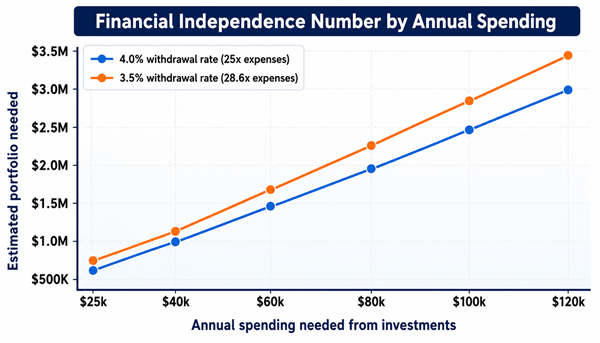
Chart: The more you spend each year, the larger your investment portfolio usually needs to be. A lower withdrawal rate requires a larger portfolio but may provide more safety.
4. Step-by-Step: How to Calculate How Much Money You Need
A good financial independence estimate starts with your spending, not your income. Income matters because it helps you save, but expenses determine how large your portfolio must be.
Important: use realistic after-tax spending where possible, and do not forget expenses that happen only once or twice a year, such as insurance premiums, repairs, travel, medical bills, or school costs.
Step 1: Estimate Your Annual Spending
Start by listing what you spend in a normal year. Include housing, food, transportation, insurance, healthcare, utilities, debt payments, taxes, travel, gifts, entertainment, home maintenance, childcare, education, and irregular expenses.
Do not use one unusually cheap or unusually expensive month. Use a realistic average. If you do not track spending yet, review 6 to 12 months of bank and card statements and group expenses into categories.
Step 2: Adjust for the Life You Want After Financial Independence
Your future spending may not match today’s spending. Some expenses may fall, such as commuting, work clothes, payroll taxes, and retirement contributions. Others may rise, such as travel, hobbies, healthcare, home repairs, or support for family.
Ask yourself whether your financial independence lifestyle will be lean, comfortable, or luxury. A lean plan may cover basics with limited extras. A comfortable plan covers normal life plus modest travel and hobbies. A luxury plan requires a much larger portfolio because discretionary spending is higher.
Step 3: Subtract Reliable Income That Is Not From Your Portfolio
You only need investments to cover the gap between your annual spending and dependable outside income. This may include pensions, annuities, rental net income, royalties, business income, or government benefits. Be careful not to overestimate income that is uncertain, seasonal, or highly dependent on your labor.
Example: If you expect to spend $60,000 per year and have $15,000 of reliable net rental income, your portfolio only needs to fund $45,000 per year. At a 4% withdrawal rate, the estimate is $45,000 ÷ 0.04 = $1,125,000.
Step 4: Choose a Withdrawal Rate
The withdrawal rate has a huge effect on the answer. A higher withdrawal rate requires less money but increases the risk of running out. A lower withdrawal rate requires more money but adds a margin of safety.
| Withdrawal rate | Expense multiplier | What it means | Best suited for |
|---|---|---|---|
| 5% | 20x | Aggressive; smaller portfolio needed but higher risk | Flexible spenders, later retirement, other income sources |
| 4% | 25x | Popular rule of thumb based on historical research | Traditional 30-year retirement planning starting point |
| 3.5% | 28.6x | More conservative than 4% | Early retirees or people wanting extra safety |
| 3% | 33.3x | Very conservative; large portfolio needed | Very long retirement, low flexibility, legacy goals |
Step 5: Add a Safety Margin
After calculating your base number, consider adding a buffer for taxes, healthcare, inflation surprises, market downturns, family obligations, major repairs, or lifestyle upgrades. Many people add 10% to 25% to their FI number, especially if they want to retire early or avoid returning to work.
5. Financial Independence Examples
The following examples show how different lifestyles can lead to very different financial independence numbers.
| Scenario | Annual spending | Outside income | Portfolio-funded spending | FI number at 4% | FI number at 3.5% |
|---|---|---|---|---|---|
| Single renter, simple lifestyle | $35,000 | $0 | $35,000 | $875,000 | $1,000,000 |
| Couple, paid-off home | $50,000 | $10,000 pension | $40,000 | $1,000,000 | $1,143,000 |
| Family with children | $85,000 | $0 | $85,000 | $2,125,000 | $2,429,000 |
| High-cost city household | $120,000 | $20,000 rental income | $100,000 | $2,500,000 | $2,857,000 |
Mini Case Study: $50,000 Annual Lifestyle
Imagine a beginner named Sara wants financial independence. She estimates her future annual spending at $50,000. She expects no pension and wants a simple portfolio-based plan.
- Using the 4% rule: $50,000 ÷ 0.04 = $1,250,000.
- Using a 3.5% withdrawal rate: $50,000 ÷ 0.035 = about $1,429,000.
- Adding a 15% safety margin to the 4% estimate: $1,250,000 × 1.15 = $1,437,500.
Sara may decide her target range is roughly $1.25 million to $1.45 million, not one perfect number. Thinking in ranges is often more realistic than pretending the future can be calculated exactly.
6. Factors That Change How Much Money You Need
- Your annual expenses: This is the biggest driver. Cutting annual expenses by $10,000 can reduce your FI number by about $250,000 under the 4% rule.
- Taxes: Withdrawals from taxable, tax-deferred, and tax-free accounts may be taxed differently. Your portfolio may need to be larger if taxes are not included in your spending estimate.
- Healthcare and insurance: Healthcare can be one of the most underestimated costs, especially for early retirees who are not yet eligible for public or employer-related coverage.
- Debt: High-interest debt increases required cash flow and reduces flexibility. Paying off expensive debt before financial independence often lowers risk.
- Inflation: Inflation reduces purchasing power over time. A sustainable plan should assume costs rise, not stay fixed forever.
- Investment returns and asset allocation: A portfolio that is too conservative may not grow enough to fight inflation. A portfolio that is too aggressive may create large short-term losses.
- Retirement length: Someone who becomes financially independent at 40 may need money to last 50 years or more. Someone retiring at 67 may be planning for a shorter period.
- Spending flexibility: People who can reduce spending during bad markets may need a smaller safety margin than people with fixed expenses and no backup income.
- Location: Housing, taxes, healthcare, transportation, and food costs vary widely by country, city, and lifestyle.
- Dependents and family support: Children, aging parents, education costs, and family obligations can materially change the number.
- Currency and local rules: The examples use U.S. dollars for simplicity, but the same formula works in any currency. Local tax law, inflation, pension rules, healthcare systems, and investment fees can change the result.
7. Different Types of Financial Independence Numbers
| Type of FI | What it means | Typical calculation approach |
|---|---|---|
| Lean FI | Covers basic needs with a modest lifestyle | Lower annual expenses × chosen multiplier |
| Coast FI | You have enough invested that future growth could fund retirement later, even if you stop adding new money | Current investments projected to retirement age |
| Barista FI | Investments cover part of expenses; part-time work or flexible income covers the rest | Annual expenses minus part-time income, then apply withdrawal rate |
| Regular FI | Investments can cover your normal lifestyle without paid work | Full annual expenses minus reliable income |
| Fat FI | Investments cover a high-comfort or luxury lifestyle | Higher annual expenses plus larger safety margin |
8. Is the 4% Rule Still Useful?
The 4% rule is useful because it gives beginners a simple starting point: multiply annual portfolio-funded spending by 25. But it should not be treated as a promise. It was built from historical market data, not future certainty. It also assumes a specific style of retirement spending and portfolio behavior.
Recent retirement-income research often suggests using a rate near, but not always exactly, 4% depending on market valuations, bond yields, inflation, retirement length, fees, and how flexible the retiree can be. For example, Morningstar’s 2025 retirement-income research for 2026 retirees estimated a 3.9% safe starting withdrawal rate for a 30-year retirement with a 90% probability of funds remaining. Other approaches may support different rates depending on assumptions, spending flexibility, taxes, and investment costs.
| Strengths of the 4% rule | Limitations of the 4% rule |
|---|---|
| Easy for beginners to understand | Not customized to your taxes, country, or healthcare costs |
| Based on historical market stress periods | No guarantee future markets will match the past |
| Gives a clear savings target | May be too aggressive for very early retirement |
| Helps compare lifestyle choices | May be too conservative for people with flexible spending or other income |
9. A Practical FI Calculation Worksheet
| Line item | Example | Your number |
|---|---|---|
| Estimated annual spending in FI | $65,000 | |
| Minus reliable outside income | -$10,000 | |
| Annual spending needed from investments | $55,000 | |
| Divide by withdrawal rate | ÷ 4% | |
| Base FI number | $1,375,000 | |
| Add safety margin | + 15% | |
| Target FI number | $1,581,250 |
10. How to Lower the Amount You Need for Financial Independence
There are two main ways to reduce your FI number: reduce the annual spending your portfolio must cover, or add reliable income outside your portfolio. The goal is not to live a miserable life. The goal is to spend intentionally on what matters and avoid locking yourself into expenses that do not improve your life.
- Pay off high-interest debt before relying on investments for freedom.
- Lower housing costs if housing consumes too much of your income.
- Choose vehicles and transportation costs carefully because they repeat for years.
- Build skills that allow part-time, freelance, consulting, or remote income if desired.
- Avoid lifestyle inflation when your income rises.
- Invest consistently in diversified assets instead of trying to time the market.
- Keep investment fees low because high fees reduce long-term returns.
- Create a cash cushion so you are not forced to sell investments during a market downturn.
11. Common Mistakes When Calculating Your FI Number
- Using income instead of expenses: Financial independence is based on what you need to spend, not what you currently earn.
- Ignoring taxes: If you need $60,000 after tax, you may need to withdraw more than $60,000 depending on your accounts and tax rules.
- Forgetting irregular expenses: Home repairs, car replacement, medical costs, weddings, family support, and travel can break a plan if excluded.
- Assuming investment returns are smooth: Markets can fall for years. Sequence-of-returns risk matters most near the start of retirement.
- Relying on one exact number: A range is more honest. Your number should be reviewed as your life changes.
- Copying someone else’s target: A $1 million target may be plenty for one person and not enough for another.
- Retiring with no flexibility: A rigid plan is fragile. Flexible spending, part-time income, or a larger cash reserve can reduce stress.
12. Why Market Timing Matters: Sequence-of-Returns Risk
Two investors can earn the same average return but have very different outcomes depending on when good and bad returns happen. If your portfolio falls sharply in the first years after you stop working and you are also withdrawing money, your portfolio may have less capital left to recover. This is called sequence-of-returns risk.
Practical ways to reduce this risk include keeping 6 to 24 months of essential spending in cash or short-term reserves, reducing discretionary spending after bad market years, delaying major purchases, maintaining some part-time income, and avoiding an overly aggressive withdrawal rate.
A simple bucket approach can also help: keep near-term spending needs in cash or short-term reserves, medium-term needs in more stable assets, and long-term money invested for growth.
13. How Long Will It Take to Reach Financial Independence?
The time required depends mainly on your savings rate, investment returns, and starting balance. Savings rate means the percentage of your income that you invest. A higher savings rate helps in two ways: you invest more, and you learn to live on less, which lowers your FI number.
| Savings rate | What it generally means | Potential impact on FI journey |
|---|---|---|
| 10% | You save $10 of every $100 earned | Progress is real but usually slow |
| 20% | You save $20 of every $100 earned | Stronger long-term progress |
| 30%+ | You save at least $30 of every $100 earned | Can significantly shorten the timeline |
| 50%+ | You live on half or less of income | Often associated with aggressive FI plans |
There is no universal required savings rate. A person with a modest income and low expenses may reach FI faster than a high earner with expensive habits. The key is the gap between what you earn and what you spend, invested consistently over time.
14. Best Practices for Building Toward Your FI Number
- Track your spending for at least three months, then estimate a full-year spending baseline.
- Separate essential expenses from lifestyle expenses so you know what can be reduced if needed.
- Calculate your FI number using at least two withdrawal rates, such as 4% and 3.5%.
- Include taxes, healthcare, insurance, and irregular expenses in your plan.
- Invest in a diversified portfolio that matches your risk tolerance and time horizon.
- Keep an emergency fund separate from your long-term investments.
- Review your FI number once or twice per year, not every day.
- Plan for flexibility: part-time work, lower spending, delaying retirement, or reducing withdrawals during bad markets.
- Avoid comparing your number to social media claims. Your life, location, and responsibilities are different.
- Consider getting advice from a qualified, fee-only financial planner if your situation includes complex taxes, business ownership, international issues, inheritance, or early retirement healthcare questions.
- Keep the plan updated with current rules, tax brackets, pension or Social Security changes, and healthcare costs before making major life decisions.
15. Simple Diagram: The FI Number Calculation
| Start | Subtract | Divide | Adjust | Result |
|---|---|---|---|---|
| Future annual spending | Reliable non-portfolio income | Chosen withdrawal rate | Taxes and safety margin | Target FI number |
Example: $70,000 spending - $10,000 outside income = $60,000 portfolio-funded spending. $60,000 ÷ 4% = $1,500,000. Add a 10% buffer and the target becomes $1,650,000.
■ FAQs About How Much Money You Need for Financial Independence
1. How much money do I need to be financially independent?
A common estimate is 25 times the annual expenses your investments must cover. If you need $50,000 per year from investments, the 4% rule suggests about $1.25 million. A more conservative 3.5% rate suggests about $1.43 million.
2. Is $1 million enough for financial independence?
$1 million may be enough if your annual portfolio-funded spending is around $40,000 or less under the 4% rule. It may not be enough if you live in a high-cost area, have high healthcare costs, support dependents, carry debt, or want a luxury lifestyle.
3. Can I be financially independent with less than $1 million?
Yes, if your expenses are low or you have reliable income from other sources. For example, $25,000 of annual portfolio-funded spending equals $625,000 using the 4% rule.
4. What is the 25x rule?
The 25x rule says you may need about 25 times your annual investment-funded expenses. It is another way of expressing a 4% withdrawal rate because 1 ÷ 0.04 = 25.
5. Should I use 3%, 3.5%, or 4%?
Use 4% as a common starting estimate, 3.5% for more caution, and 3% for a very conservative plan. Early retirees, people with low spending flexibility, or those planning for 40 to 50 years may prefer a lower rate.
6. Does my house count toward financial independence?
Your home can reduce expenses if it is paid off, but it does not directly pay bills unless you rent part of it, sell it, downsize, or borrow against it. For FI calculations, focus first on income-producing or withdrawable assets.
7. Do I include Social Security, pensions, or rental income?
Include only reliable net income and be conservative about timing and taxes. If income starts later, you may need a bridge plan to cover the years before it begins.
8. How often should I recalculate my FI number?
Review it at least once a year or after major life changes such as marriage, children, relocation, job changes, health changes, large inheritance, or major market shifts.
9. What is the biggest factor in reaching FI faster?
Your savings rate is usually the biggest factor because it increases the money you invest and often lowers the lifestyle cost your portfolio must support.
10. Should beginners hire a financial advisor?
Many beginners can calculate a rough FI number on their own. Professional advice becomes more useful when taxes, business income, pensions, estate planning, early retirement healthcare, or cross-border finances are involved.
11. What assets should I include in my FI number?
Include assets that can realistically produce income or be sold to fund living expenses, such as investment accounts, retirement accounts, cash reserves beyond your emergency fund, and income-producing assets. Be cautious with personal-use assets that do not help pay bills.
12. What is a good financial independence number for beginners?
A good beginner target is a range based on annual portfolio-funded expenses. Start with 25x expenses for a simple estimate, then compare it with 28.6x and 33.3x to understand how a more conservative withdrawal rate changes the target.
■ Final Takeaway
The amount of money you need for financial independence is not based on a magic number. It is based on the annual spending your investments must support. For a quick estimate, multiply annual portfolio-funded expenses by 25. For a more cautious range, multiply by 28 to 33. Then adjust for taxes, healthcare, inflation, debt, retirement length, and spending flexibility.
A good FI plan does not require perfect prediction. It requires honest spending estimates, consistent investing, realistic assumptions, and room to adapt. The best number is not the biggest number you can imagine. It is the number that can support the life you actually want with a level of risk you can live with.
Sources and Notes
This article is educational, not personalized financial, tax, or investment advice. The examples use U.S. dollar amounts for simplicity, but the same formulas can be adapted to any currency. Readers should adjust for local tax law, inflation, healthcare systems, investment fees, and personal circumstances.
- William P. Bengen, “Determining Withdrawal Rates Using Historical Data,” Journal of Financial Planning, 1994.
- Philip L. Cooley, Carl M. Hubbard, and Daniel T. Walz, “Retirement Savings: Choosing a Withdrawal Rate That Is Sustainable,” AAII Journal, 1998.
- Morningstar, 2025 retirement-income research for 2026 retirees, including its 3.9% safe starting withdrawal-rate estimate for a 30-year retirement with a 90% probability of funds remaining.
- Fidelity Viewpoints, “How much do I need to retire?” including its 10x income by age 67 guideline and 4% to 5% sustainable withdrawal-rate discussion.
Reader Advice: This article is for educational and informational purposes only and should not be taken as personal financial, tax, legal, or investment advice. Please check the latest information from official sources or a qualified professional, as rules, policies, rates, and personal circumstances can change over time.