Lean FIRE Explained: Meaning, Benefits, Risks and Examples
Lean FIRE is a version of the FIRE movement - Financial Independence, Retire Early - built around reaching financial independence with a modest, low-cost lifestyle. Instead of aiming for a large retirement portfolio that supports high spending, Lean FIRE focuses on keeping annual expenses low enough that a smaller investment portfolio can cover them.
For some people, Lean FIRE means retiring much earlier than normal. For others, it means gaining enough financial freedom to leave a stressful job, work part time, start a small business, move to a lower-cost area, or choose work based on meaning rather than money. The core idea is simple: the less you need to spend, the less money you need to become financially independent.
This guide explains Lean FIRE in beginner-friendly terms, including the formula, examples, benefits, risks, planning steps, common mistakes, and practical ways to decide whether it fits your life.
Editorial note: The examples below are simplified for education. Real Lean FIRE planning should also account for local tax rules, account withdrawal rules, healthcare systems, currency, inflation, family responsibilities, and changing regulations in your country.
Short: Quick answer: Lean FIRE means reaching financial independence by combining high savings, low expenses, simple living, and a smaller retirement portfolio than traditional FIRE. A common starting estimate is: Lean FIRE number = annual expenses x 25, based on a 4% withdrawal-rate rule of thumb. However, Lean FIRE needs extra caution because small budgets leave less room for market downturns, inflation, healthcare costs, taxes, and unexpected life changes.
1. What Is Lean FIRE?
Lean FIRE is a financial independence strategy where you save and invest enough money to cover a deliberately lean annual budget. Once your investments can reasonably support that budget, you are considered financially independent under the Lean FIRE approach.
The word "lean" does not mean poor, deprived, or miserable. Ideally, it means intentional. A Lean FIRE lifestyle removes spending that does not add much value and keeps the spending that genuinely improves your life. For example, someone may happily live in a small apartment, cook at home, bike instead of owning two cars, travel slowly instead of taking luxury vacations, and avoid lifestyle inflation.
Lean FIRE is different from traditional retirement planning because it usually aims for independence decades before the standard retirement age. That longer time horizon makes the plan more sensitive to investment returns, inflation, taxes, and unexpected costs.
Lean FIRE in One Sentence: Lean FIRE means building enough invested assets to support a simple, low-cost lifestyle without needing full-time work.
2. How Lean FIRE Works
Lean FIRE works through four connected ideas:
- Reduce annual expenses without sacrificing the parts of life that matter most.
- Increase the gap between income and spending so you can save and invest aggressively.
- Invest consistently so compound growth can work over many years.
- Use a sustainable withdrawal plan once your portfolio can support your lean spending.
The strategy depends heavily on the relationship between spending and required portfolio size. If you need $30,000 per year and use a 4% withdrawal assumption, your basic target is about $750,000. If you need $60,000 per year, the target doubles to about $1.5 million. That is why expense control is so powerful in Lean FIRE planning.
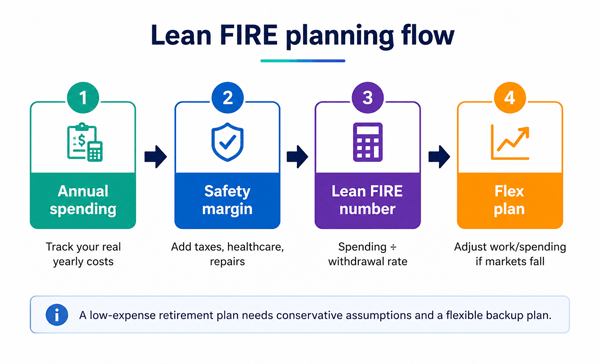
Figure: A simple Lean FIRE planning flow from annual expenses to a flexible backup plan.
3. The Lean FIRE Formula
The basic Lean FIRE formula is:
Lean FIRE number = Annual expenses ÷ Safe withdrawal rate
A common shortcut is:
Lean FIRE number = Annual expenses x 25
The x25 shortcut comes from using a 4% starting withdrawal rate, because 1 divided by 0.04 equals 25. This is a rule of thumb, not a guarantee. The original withdrawal-rate research often associated with the 4% rule studied historical market data and 30-year retirement periods. Lean FIRE plans may need to last longer than 30 years, so many people use a more conservative rate such as 3.25% to 3.75%, add a larger cash buffer, or plan for flexible part-time income.
| Annual spending | Target at 4% rule | Target at 3.5% | Target at 3.25% |
|---|---|---|---|
| $20,000 | $500,000 | $571,429 | $615,385 |
| $25,000 | $625,000 | $714,286 | $769,231 |
| $30,000 | $750,000 | $857,143 | $923,077 |
| $35,000 | $875,000 | $1,000,000 | $1,076,923 |
| $40,000 | $1,000,000 | $1,142,857 | $1,230,769 |
Practical tip: For Lean FIRE, calculate at least three numbers: your bare-minimum budget, your realistic comfortable lean budget, and your conservative budget with healthcare, taxes, repairs, insurance, and inflation cushions included.
Lean FIRE calculator steps: 1) total your realistic annual expenses, 2) add a safety margin, 3) subtract any dependable part-time or passive income only if you are comfortable relying on it, 4) divide the portfolio-funded amount by your chosen withdrawal rate, and 5) stress-test the result against inflation, taxes, healthcare, and weak market years.
4. Lean FIRE Example: A Simple Calculation
Suppose Maya spends $2,500 per month, or $30,000 per year. Using the x25 rule, her Lean FIRE number is $30,000 x 25 = $750,000. If she wants a more conservative 3.5% withdrawal rate, her target becomes $30,000 ÷ 0.035 = about $857,000.
If Maya has $200,000 invested already, she is not starting from zero. She needs to grow from $200,000 to somewhere between $750,000 and $857,000, depending on her assumptions. If she can also earn occasional part-time income after leaving full-time work, her required portfolio may be lower, but that would be closer to Barista FIRE or semi-retirement than pure Lean FIRE.
5. What Counts as a Lean FIRE Budget?
There is no universal dollar amount that qualifies as Lean FIRE. A "lean" budget depends on your country, city, family size, housing costs, healthcare system, taxes, dependents, and personal values. A single person in a low-cost area may live comfortably on far less than a family in a high-cost city.
Instead of chasing someone else’s number, define Lean FIRE by these questions:
- Can the budget cover housing, food, utilities, transportation, healthcare, insurance, taxes, and maintenance?
- Does it include irregular expenses such as car repairs, dental care, family support, home repairs, gifts, and travel?
- Would the lifestyle still feel acceptable after five, ten, or twenty years?
- Is there room to adjust if markets perform poorly or inflation rises?
- Do you have a plan for aging, caregiving, and changes in family circumstances?
| Budget category | Too lean / risky | Healthier Lean FIRE approach |
|---|---|---|
| Housing | Assumes rent or mortgage never rises | Includes rent increases, repairs, property tax, insurance, or relocation options |
| Food | Cuts food spending to an unrealistic minimum | Uses a sustainable grocery and eating-out budget |
| Healthcare | Assumes perfect health | Includes insurance, deductibles, dental, vision, medication, and emergency care |
| Transportation | Ignores repairs or replacement | Plans for maintenance, replacement, fuel, fares, or bike costs |
| Fun and travel | Removes all enjoyment | Includes modest hobbies, trips, social life, and gifts |
| Emergency margin | No buffer | Keeps cash reserves and flexible spending categories |
6. Lean FIRE vs Regular FIRE, Fat FIRE, Coast FIRE and Barista FIRE
| FIRE type | Main idea | Typical lifestyle | Main risk |
|---|---|---|---|
| Lean FIRE | Reach FI with low annual expenses | Simple and low-cost | Budget may be too tight for surprises |
| Regular FIRE | Build enough assets for a moderate lifestyle | Balanced lifestyle | Requires a larger portfolio and more time |
| Fat FIRE | Reach FI with high spending ability | Comfortable or luxury | Very large portfolio target |
| Coast FIRE | Invest enough early so growth can carry you to FI later | Keep working to cover current expenses | Depends on future growth and continued income |
| Barista FIRE | Use investments plus part-time income | Semi-retired or flexible work | Still depends on work and benefits |
Lean FIRE is best understood as the most minimalist version of the FIRE spectrum. It can be powerful, but it is not automatically better. A smaller portfolio target can help you reach independence sooner, but it also gives you less room for error.
■ Benefits of Lean FIRE
1. You may reach financial independence faster
Because Lean FIRE reduces the annual spending target, it can dramatically reduce the portfolio needed for independence. Someone who can live on $30,000 a year may need roughly half the portfolio of someone who needs $60,000 a year, using the same withdrawal-rate assumption.
2. It encourages intentional spending
Lean FIRE forces you to ask what actually improves your life. Instead of cutting randomly, you identify high-value and low-value spending. This can make your finances simpler and your lifestyle more deliberate.
3. It reduces dependence on a paycheck
Even before full Lean FIRE, a high savings rate and low expenses can create options. You may be able to change jobs, take a sabbatical, leave a toxic workplace, start a business, or negotiate from a stronger position.
4. It can lower financial stress
When your monthly expenses are low, you need less income to stay afloat. This can make job loss, income changes, or career transitions easier to manage.
5. It can support a simpler, values-based life
Many Lean FIRE followers are not trying to escape work forever. They want more time, freedom, health, family connection, creativity, travel, community, or control over their schedule.
■ Risks and Limitations of Lean FIRE
1. A tight budget can break under real life
The biggest Lean FIRE risk is underestimating future expenses. A budget that works at age 35 may not work at age 55 or 70. Housing, insurance, healthcare, family responsibilities, and personal priorities can change.
2. Healthcare costs can be difficult to predict
Healthcare is one of the hardest expenses to estimate, especially for early retirees who may not have employer coverage. Even healthy people need to plan for insurance premiums, deductibles, prescriptions, dental care, vision care, and unexpected medical events.
3. The 4% rule may be too simple for early retirement
The 4% rule is a useful starting point, but it is not a promise. It depends on assumptions about market returns, inflation, asset allocation, time horizon, taxes, and spending flexibility. Lean FIRE retirements can last 40, 50, or even 60 years, which is longer than the 30-year horizon often discussed in traditional withdrawal-rate research.
4. Inflation hurts low-margin plans
Inflation affects everyone, but it can be especially painful when your budget has little slack. If rent, insurance, food, energy, or healthcare rise faster than expected, a lean plan can become uncomfortable.
5. Market downturns early in retirement are dangerous
A bad market in the first years after leaving work can damage a retirement plan because you may be selling investments while prices are down. This is called sequence-of-returns risk. Lean FIRE plans need a strategy for market downturns, such as cash reserves, flexible spending, part-time income, or a lower withdrawal rate.
6. Social isolation and identity issues are real
Leaving full-time work early can affect your daily structure, social life, and sense of purpose. A good Lean FIRE plan should include not only money, but also meaningful routines, relationships, health habits, and projects.
■ Who Is Lean FIRE Best For?
Lean FIRE may fit people who genuinely enjoy simple living and are comfortable making trade-offs. It is usually better suited to people who:
- Have naturally low spending needs.
- Are flexible about housing, location, transportation, and travel.
- Can handle uncertainty without panicking.
- Have strong budgeting and investing habits.
- Are willing to earn some income later if needed.
- Value freedom more than luxury consumption.
Lean FIRE may not be ideal for people who expect high lifestyle spending, have unpredictable healthcare needs, support multiple dependents, dislike budgeting, or would feel deprived by a very modest budget.
■ How to Build a Lean FIRE Plan Step by Step
- Track your real spending for 6 to 12 months: Use actual bank and card data, not guesses. Separate essential expenses from optional expenses.
- Design a sustainable lean budget: Do not build your plan around a fantasy budget. Include fun, repairs, insurance, taxes, healthcare, gifts, and irregular costs.
- Calculate your Lean FIRE number: Use annual expenses divided by your chosen withdrawal rate. Run the numbers at 4%, 3.75%, 3.5%, and 3.25%.
- Build an emergency fund: A cash cushion can prevent you from selling investments during a bad market or using debt for emergencies.
- Invest consistently: Use a diversified, low-cost investment approach that matches your risk tolerance and time horizon.
- Increase income where possible: Lean FIRE is easier when you control both sides: spending and income. Higher income can speed up your savings without forcing extreme cuts.
- Plan for taxes and healthcare: Estimate after-tax spending needs, insurance options, and how withdrawals may be taxed.
- Create a backup plan: Decide in advance what you will do if markets fall, inflation rises, or expenses increase.
- Test your lifestyle before retiring: Try living on the Lean FIRE budget for a full year while still working. Invest the difference.
- Review the plan every year: Update assumptions, portfolio value, spending, insurance, tax rules, and personal goals.
■ Practical Lean FIRE Examples
Example 1: Single renter in a low-cost city
Annual expenses: $24,000. Estimated Lean FIRE number at 4%: $600,000. At 3.5%: about $686,000. This plan may work if rent is stable, healthcare is covered, and the person has a flexible lifestyle. Main risks include rent increases, medical costs, and boredom if the plan removes too much social spending.
Example 2: Couple with a paid-off small home
Annual expenses: $36,000. Estimated Lean FIRE number at 4%: $900,000. At 3.5%: about $1.03 million. Their housing cost is low, which helps. However, they still need to budget for property tax, insurance, maintenance, healthcare, and replacing appliances or vehicles.
Example 3: Parent with one child
Annual expenses: $45,000. Estimated Lean FIRE number at 4%: $1.125 million. At 3.5%: about $1.286 million. This plan needs more caution because child-related costs can change quickly. Education, healthcare, housing, food, activities, and family needs may grow over time.
Example 4: Lean FIRE plus part-time work
Annual expenses: $32,000. Expected part-time income: $10,000. Portfolio-funded expenses: $22,000. Estimated target at 4%: $550,000. This is not pure Lean FIRE because the plan still relies on income, but it may be more realistic and psychologically comfortable for many people.
| Scenario | Annual expenses | Extra income | Portfolio-funded need | Target at 4% |
|---|---|---|---|---|
| Single renter | $24,000 | $0 | $24,000 | $600,000 |
| Couple, paid-off home | $36,000 | $0 | $36,000 | $900,000 |
| Parent with child | $45,000 | $0 | $45,000 | $1,125,000 |
| Part-time work plan | $32,000 | $10,000 | $22,000 | $550,000 |
■ Lean FIRE Withdrawal Strategies
The simplest withdrawal method is to withdraw a fixed percentage or inflation-adjusted amount each year. But Lean FIRE often works better with flexible rules because the budget is tight and the retirement period may be long.
| Strategy | How it works | Best for | Watch out for |
|---|---|---|---|
| Fixed 4% rule | Withdraw 4% of initial portfolio, then adjust for inflation | Simple planning estimate | May be too rigid for very early retirement |
| Lower starting rate | Start around 3.25% to 3.75% | Longer retirement horizons | Requires a larger portfolio |
| Flexible spending | Cut optional spending after bad market years | People with adjustable expenses | Needs discipline and clear rules |
| Guardrails | Raise or lower withdrawals based on portfolio performance | Data-oriented planners | More complex to manage |
| Part-time income buffer | Use small income to reduce withdrawals | People open to flexible work | Not fully work-optional |
■ Common Lean FIRE Mistakes to Avoid
- Using a fantasy budget that ignores real spending patterns.
- Forgetting taxes, insurance, healthcare, repairs, and replacement costs.
- Assuming the 4% rule is guaranteed.
- Retiring with no cash buffer or backup income option.
- Cutting spending so deeply that life becomes joyless.
- Ignoring relationships, purpose, health, and daily structure.
- Failing to update the plan after marriage, children, relocation, illness, or market changes.
- Comparing your Lean FIRE number to people in very different countries, cities, or family situations.
■ How to Know If Your Lean FIRE Number Is Realistic
A realistic Lean FIRE number should pass several stress tests:
- You have lived on the budget for at least 6 to 12 months.
- The budget includes irregular and surprise expenses.
- You have modeled lower withdrawal rates, not only 4%.
- You understand how taxes affect your withdrawals.
- You have a healthcare plan.
- You can reduce spending during market downturns.
- You have a cash reserve or other buffer.
- You are willing to earn income later if the plan needs support.
- Your lifestyle still feels meaningful, not just cheap.
A good rule: If your Lean FIRE plan only works when everything goes perfectly, it is not strong enough yet.
■ Lean FIRE Checklist for Beginners
- Track your current annual spending.
- Choose a realistic lean annual budget.
- Add a safety margin of at least 10% to 25% for planning.
- Calculate targets at 4%, 3.75%, 3.5%, and 3.25%.
- Build an emergency fund before relying on investments.
- Use diversified investments rather than concentrated bets.
- Plan for healthcare and taxes early.
- Keep housing costs sustainable.
- Avoid high-interest debt.
- Practice the lifestyle before leaving work.
- Write a clear backup plan for bad markets and unexpected expenses.
■ Is Lean FIRE Worth It?
Lean FIRE can be worth it if you value freedom, simplicity, and control more than higher consumption. It can help you reach financial independence faster and build a life around your priorities. But it is not a shortcut that removes risk. In fact, the lower your budget, the more carefully you must plan.
The best Lean FIRE plans are not built on extreme deprivation. They are built on clear values, realistic numbers, diversified investments, flexible spending, and honest backup plans. For many people, the healthiest version of Lean FIRE is not "never work again." It is having enough financial strength to choose better work, fewer hours, more meaningful projects, or a slower life.
Before making major decisions, consider discussing your plan with a qualified financial planner or tax professional, especially if your plan involves early retirement, cross-border living, dependents, rental property, pensions, or complex investment accounts.
■ Frequently Asked Questions About Lean FIRE
1. What does Lean FIRE mean?
Lean FIRE means reaching financial independence with a low-cost lifestyle and a smaller investment portfolio than traditional FIRE. It focuses on modest spending, high savings, and simple living.
2. How much money do you need for Lean FIRE?
A common estimate is annual expenses x 25. For example, $30,000 in annual expenses suggests a $750,000 target at a 4% withdrawal rate. More conservative planners may use 3.25% to 3.75%, which requires a larger portfolio.
3. Is Lean FIRE realistic?
Lean FIRE can be realistic for people with naturally low expenses, flexible lifestyles, strong savings habits, and good backup plans. It is less realistic when the budget ignores healthcare, taxes, dependents, inflation, or unexpected costs.
4. Is Lean FIRE the same as being frugal?
No. Frugality is a spending habit. Lean FIRE is a financial independence strategy. Frugality can help Lean FIRE, but the full plan also includes investing, withdrawal planning, risk management, and lifestyle design.
5. Can Lean FIRE work with children?
It can, but it is harder. Children add variable and sometimes unpredictable costs, such as housing, food, healthcare, childcare, education, activities, and family travel. Parents usually need a larger safety margin.
6. What is the biggest risk of Lean FIRE?
The biggest risk is building a plan on expenses that are too low to survive real life. Healthcare, inflation, housing, repairs, taxes, family changes, and market downturns can all pressure a lean budget.
7. Should I use the 4% rule for Lean FIRE?
Use it as a starting estimate, not a guarantee. Because Lean FIRE may involve a very long retirement and a tight budget, many people use lower withdrawal rates, flexible spending rules, or part-time income buffers.
8. Can I still work after Lean FIRE?
Yes. Many people pursue Lean FIRE to make work optional, not forbidden. Part-time work, consulting, seasonal work, freelancing, or passion projects can reduce portfolio withdrawals and add purpose.
9. What is a safe Lean FIRE budget?
A safe budget is one you have tested in real life and that includes essentials, irregular costs, healthcare, taxes, inflation, enjoyment, and emergency margin. A budget that only covers bare survival is usually too fragile.
10. Is Lean FIRE better than regular FIRE?
Not necessarily. Lean FIRE can be faster, but regular FIRE usually provides more lifestyle flexibility. The better choice depends on your values, family situation, health, location, risk tolerance, and desired lifestyle.
Sources and Notes
These sources are provided for background education and verification of broad concepts such as compound growth, retirement planning tools, and historical withdrawal-rate research.
- Investor.gov, U.S. Securities and Exchange Commission: compound interest education and calculator.
- FINRA: retirement planning tools and calculators for estimating savings needs.
- William P. Bengen, "Determining Withdrawal Rates Using Historical Data," Journal of Financial Planning, originally published 1994 and reprinted by the Financial Planning Association.
- Safe withdrawal rate research commonly called the Trinity study: retirement withdrawal-rate analysis based on historical portfolio data.
Reader Advice: This article is for educational and information purposes only and should not be taken as financial, tax, investment, legal, or retirement advice. Please check the latest information from official sources or qualified professionals, as rules, policies, costs, and regulations can change over time.