How to Retire Early: Steps, Strategies, Risks and Best Practices
1. Introduction: What Does It Mean to Retire Early?
Early retirement means becoming financially independent enough to stop relying on a traditional full-time job before the usual retirement age. For some people, that means retiring in their 50s. For others, it means reaching financial independence in their 40s or even earlier. It does not always mean never working again. Many early retirees still consult, run small businesses, volunteer, care for family, travel, or work part-time by choice.
The main idea is simple: you build enough savings, investments, and income sources so your lifestyle can be funded without a paycheck. The difficult part is making the math work while protecting yourself from risks such as inflation, market crashes, medical costs, taxes, and a retirement that may last 40 to 60 years.
This guide explains how to retire early step by step, including how much money you may need, how to invest, how to control spending, how to plan for healthcare, and which mistakes to avoid.
Short Answer: To retire early, estimate your annual spending, build an emergency fund, pay down high-interest debt, invest consistently, calculate your financial independence number, create a tax-efficient withdrawal plan, and protect the plan with healthcare, insurance, inflation, and market-risk safeguards.
Key takeaway: The most important early retirement number is not income alone; it is the gap between what you earn and what you keep.
Key takeaway: A very early retirement may need a lower withdrawal rate than the traditional 4% rule, especially if the portfolio must last 40 to 60 years.
Key takeaway: Healthcare, taxes, inflation, and sequence-of-returns risk should be planned before leaving full-time work.
2. What Is Early Retirement?
Early retirement is the point where your assets and reliable income can cover your living costs before the standard retirement age. In the United States, Social Security retirement benefits can start as early as age 62, but claiming before full retirement age permanently reduces monthly benefits. Full retirement age is 67 for people born in 1960 or later. Medicare is generally available at age 65 for people who qualify, so retiring before 65 usually requires a separate health insurance plan.
Because early retirees may need to fund many more years without employment income, the plan usually needs a lower withdrawal rate, more flexibility, and a larger margin of safety than a traditional retirement plan.
| Term | Simple meaning | Why it matters |
|---|---|---|
| Financial independence | Your assets can cover your expenses without work income. | This is the foundation of early retirement. |
| FI number | The amount of invested assets you need to support your lifestyle. | It gives you a target to save toward. |
| Withdrawal rate | The percentage of your portfolio you withdraw in a year. | A lower rate usually improves long-term safety. |
| Savings rate | The percentage of income you save and invest. | This is one of the biggest drivers of early retirement speed. |
| Bridge period | The years between leaving work and access to pensions, Social Security, Medicare, or retirement accounts. | This period often creates the biggest planning challenges. |
3. How Much Money Do You Need to Retire Early?
A common starting point is the 25x rule: multiply your expected annual retirement spending by 25. This comes from the idea of withdrawing about 4% of a portfolio in the first year of retirement, then adjusting withdrawals for inflation. However, the 4% rule was based mainly on 30-year retirement periods, so someone retiring very early may want to use a more conservative assumption, such as 3% to 3.5%, or keep flexible spending rules.
Basic FI Number Formula
Financial independence number = Annual retirement spending / planned withdrawal rate
| Annual spending | At 4% withdrawal rate | At 3.5% withdrawal rate | At 3% withdrawal rate |
|---|---|---|---|
| $40,000 | $1,000,000 | $1,142,857 | $1,333,333 |
| $60,000 | $1,500,000 | $1,714,286 | $2,000,000 |
| $80,000 | $2,000,000 | $2,285,714 | $2,666,667 |
| $120,000 | $3,000,000 | $3,428,571 | $4,000,000 |
These numbers are starting estimates, not guarantees. Your real target depends on taxes, housing, healthcare, family needs, investment returns, inflation, location, debt, and whether you expect other income later.
4. How to Retire Early Step by Step
Step 1: Define the early retirement lifestyle you actually want
Start with lifestyle, not just a big savings number. Decide where you want to live, whether you will own or rent, how often you want to travel, what healthcare may cost, whether you will support children or parents, and whether you want to work part-time. A simple retirement plan for a modest lifestyle may require far less money than a plan built around frequent travel, private school costs, or high-cost housing.
Step 2: Calculate your current net worth
List what you own and subtract what you owe. Include bank accounts, investments, retirement accounts, real estate equity, business equity, and debts. Your net worth tells you where you are starting from. It also helps you track progress without guessing.
Step 3: Track your real annual spending
Many early retirement plans fail at the spending estimate stage. Track at least 6 to 12 months of spending, then adjust for irregular costs such as insurance, car repairs, home maintenance, medical bills, gifts, travel, and taxes. Early retirement planning should be based on real spending, not wishful thinking.
Step 4: Build an emergency fund before investing aggressively
Keep enough cash to handle job loss, urgent repairs, medical deductibles, or family emergencies. Many people use 3 to 6 months of essential expenses while working. Early retirees may keep a larger cash reserve or a bond reserve because they cannot simply replace portfolio losses with a paycheck.
Step 5: Eliminate high-interest debt
Credit card debt, payday loans, and other high-interest borrowing can destroy an early retirement plan. Paying off a 20% interest debt is often more powerful than chasing investment returns. Low-interest mortgage debt is a separate decision and depends on cash flow, risk tolerance, taxes, and emotional comfort.
Step 6: Increase your savings rate
Your savings rate is the engine of early retirement. Someone saving 10% of income may need decades to become financially independent. Someone saving 40% to 60% can shorten the timeline dramatically, especially with investment growth. The key is to raise savings without making life miserable or unsustainable.
Step 7: Invest for long-term growth
Cash alone usually cannot beat inflation over long periods. Most early retirement plans rely on diversified investments such as broad stock index funds, bond funds, cash reserves, and sometimes real estate or business income. The goal is not to get rich quickly. The goal is to build a portfolio that can grow, survive downturns, and fund decades of spending.
Step 8: Use tax-advantaged accounts strategically
Use available retirement accounts, employer matches, IRAs, HSAs, and taxable brokerage accounts in a coordinated way. In 2026, the IRS limit for employee elective deferrals to many 401(k), 403(b), most 457 plans, and the Thrift Savings Plan is $24,500, and the IRA contribution limit is $7,500. Catch-up limits can also apply for eligible older savers, including special higher catch-up amounts for some ages under SECURE 2.0. Exact limits and eligibility rules can change, so verify them each year from official sources.
Step 9: Plan the bridge years
The bridge years are the years between early retirement and access to benefits such as Social Security, Medicare, pensions, or penalty-free retirement-account withdrawals. You may need taxable investments, Roth IRA contributions, cash reserves, a Roth conversion ladder, part-time income, or rental income to fund this gap.
Step 10: Create a withdrawal strategy before quitting
Do not retire early with only an accumulation plan. Decide which accounts you will draw from first, how you will manage taxes, what you will do after a market crash, and when you will adjust spending. A flexible withdrawal plan is usually safer than blindly withdrawing the same amount every year.
Step 11: Test the plan with stress scenarios
Ask what happens if stocks fall 35%, inflation stays high, healthcare costs rise, a spouse stops working, rental income drops, or you live longer than expected. A good early retirement plan should survive imperfect conditions, not just average conditions.
Step 12: Try a retirement rehearsal
Before leaving your job, live for 6 to 12 months on your expected retirement budget while investing the difference. This reveals whether the budget feels realistic and whether you have forgotten major expenses.
■ Chart: Why Savings Rate Matters So Much
The chart below shows a simplified estimate of how savings rate can affect the time needed to reach financial independence. It assumes consistent investing, a 5% real return after inflation, and a retirement target based on roughly 25 times annual spending. Real life will vary, but the pattern is useful: higher savings rates can shorten the journey dramatically.
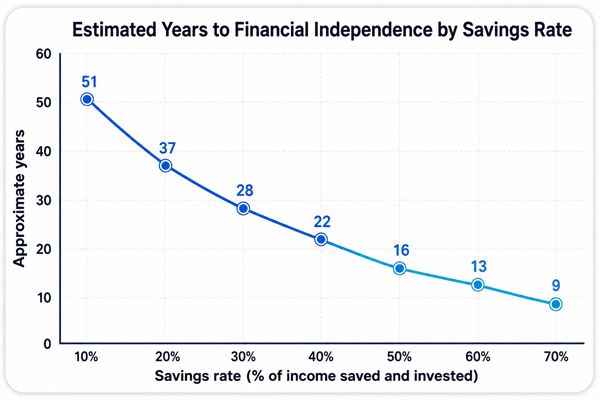
Figure: Estimated years to financial independence by savings rate. This is an educational illustration, not a personalized forecast.
■ Best Early Retirement Strategies
1. Focus on the gap between income and spending
Early retirement is less about income alone and more about the gap between what you earn and what you keep. A person earning $90,000 and saving $35,000 may be closer to early retirement than someone earning $180,000 but saving only $10,000.
2. Avoid lifestyle inflation
When income rises, it is tempting to upgrade the house, car, vacations, subscriptions, and restaurants at the same time. Some lifestyle improvement is reasonable, but uncontrolled lifestyle inflation pushes the FI number higher and delays retirement.
3. Build multiple income sources
You do not need many income streams, but extra income can improve safety. Examples include consulting, freelance work, rental property, dividends, royalties, part-time work, a small business, or seasonal work. Income after leaving a full-time job can reduce withdrawals during bad market years.
4. Use low-cost diversified investments
High fees can quietly reduce long-term returns. Many early retirees prefer broad, low-cost index funds because they are simple, diversified, transparent, and inexpensive. A common approach is a mix of stock index funds for growth, bond funds for stability, and cash for near-term needs.
5. Keep housing costs under control
Housing is often the largest household expense. Downsizing, house hacking, relocating, paying off a mortgage, or choosing a lower-cost rental can reduce the FI number. But housing choices should also consider family, schools, community, healthcare access, and quality of life.
6. Plan healthcare before you resign
Healthcare is one of the biggest early retirement planning issues, especially before age 65. Options may include a spouse’s employer plan, marketplace coverage, private insurance, continuing part-time work with benefits, health sharing arrangements where appropriate, or relocating to a country with lower healthcare costs. Compare premiums, deductibles, out-of-pocket maximums, drug coverage, and provider networks. Also check enrollment windows, subsidy rules, pre-existing-condition protections, and whether your preferred doctors and medicines are covered.
7. Keep taxes in the plan
Taxes affect how much you can safely spend. A tax-aware plan may use taxable accounts, traditional retirement accounts, Roth accounts, HSA funds, capital gains planning, Roth conversions, and charitable giving. The best order of withdrawals depends on your country, income level, account types, age, and future tax expectations.
| Strategy | Why it helps | Possible downside |
|---|---|---|
| High savings rate | Speeds up wealth building and lowers the lifestyle cost to fund. | Can become too restrictive if taken to extremes. |
| Low-cost index funds | Provides broad diversification with low fees. | Still exposed to market downturns. |
| Tax-advantaged accounts | Reduces current or future tax drag. | Rules, penalties, and access limits must be managed. |
| Taxable brokerage account | Useful for bridge years before retirement-account access. | Less tax-sheltered than retirement accounts. |
| Part-time or flexible work | Reduces portfolio withdrawals and adds purpose. | May not feel like full retirement. |
| Geographic arbitrage | Lower cost of living can reduce the FI target. | May involve moving away from family, jobs, or familiar systems. |
■ Investment Basics for Early Retirement
A beginner does not need a complicated portfolio, but every early retiree should understand the basic building blocks.
| Asset type | Role in a retirement plan | Main risk |
|---|---|---|
| Stocks / equity funds | Long-term growth and inflation protection. | Large short-term losses and volatility. |
| Bonds / bond funds | Stability, income, and rebalancing support. | Interest-rate risk, inflation risk, and lower long-term returns. |
| Cash / money market | Emergency fund and near-term spending buffer. | May lose purchasing power after inflation. |
| Real estate | Potential income, appreciation, and inflation hedge. | Vacancy, repairs, debt, taxes, concentration risk, and illiquidity. |
| Business income | Can accelerate savings and provide post-retirement income. | Income may be unstable and requires time, skill, and risk. |
Many early retirees use a “bucket” approach: keep short-term spending in cash, medium-term spending in bonds, and long-term assets in growth investments. This can make market downturns easier to handle emotionally, though it does not remove investment risk.
5. Withdrawal Planning: How to Spend From Your Portfolio
The withdrawal strategy is one of the most important parts of early retirement. A fixed 4% rule may be too simple for a 40- or 50-year retirement. A flexible plan is usually more realistic.
| Withdrawal method | How it works | Best for | Caution |
|---|---|---|---|
| 4% rule starting point | Withdraw 4% in year one, then adjust for inflation. | Traditional 30-year retirement estimates. | May be too aggressive for very early retirement. |
| 3% to 3.5% conservative rate | Withdraw a lower percentage from the portfolio. | Longer retirements or cautious planners. | Requires a larger portfolio. |
| Guardrails | Increase or reduce spending based on portfolio performance. | People with flexible spending. | Requires discipline during downturns. |
| Bucket strategy | Use cash/bonds for near-term needs and stocks for long-term growth. | People who value emotional stability. | Buckets still need rebalancing and rules. |
| Income floor | Cover essentials with guaranteed or reliable income where possible. | Risk-averse retirees. | May involve lower expected returns or insurance product complexity. |
6. Major Risks of Retiring Early
| Risk | What it means | How to reduce it |
|---|---|---|
| Sequence-of-returns risk | A major market decline early in retirement can damage the portfolio because withdrawals continue while assets are down. | Keep cash/bond reserves, use flexible spending, reduce withdrawals after losses, and consider part-time income. |
| Inflation risk | Living costs rise over time, reducing purchasing power. | Own growth assets, review spending, avoid excessive cash, and include inflation assumptions. |
| Healthcare risk | Medical costs can be much higher than expected, especially before Medicare eligibility in the U.S. | Price health insurance before retiring, keep a medical reserve, and understand deductibles and networks. |
| Longevity risk | You may live longer than expected and need money for many decades. | Use conservative withdrawal rates, diversify, delay benefits where useful, and keep earning options open. |
| Tax risk | Tax laws, account rules, and income levels can change. | Diversify account types and review plans annually with a qualified tax professional. |
| Lifestyle risk | You may become bored, isolated, or lose purpose after leaving work. | Plan your time, relationships, routines, hobbies, and contribution before retiring. |
| Family support risk | Children, aging parents, or relatives may need financial help. | Include family obligations in the budget and set boundaries early. |
| Overconfidence risk | Assuming high returns or low expenses can make the plan fragile. | Use conservative estimates and stress-test bad scenarios. |
7. Practical Early Retirement Examples
Example 1: Moderate early retirement at age 55
A couple spends $70,000 per year and wants to retire at 55. Using a 3.5% withdrawal rate, their target is about $2,000,000 before considering taxes or future income. If they expect Social Security later, the portfolio may not need to fund the full amount forever, but it still must safely cover the bridge years from 55 to their benefit-claiming age and Medicare eligibility.
Example 2: Lean early retirement with part-time work
A single person spends $36,000 per year and has $900,000 invested. At a 4% withdrawal rate, the portfolio could provide about $36,000 in the first year, but the person is only 45. To reduce risk, they plan to earn $10,000 to $15,000 per year from freelance work for the first 10 years. That lowers portfolio withdrawals and gives the investments more room to recover during market downturns.
Example 3: High-income household with lifestyle inflation
A household earns $250,000 but spends $210,000. Even with a high income, early retirement is difficult because the savings rate is low and the FI number is high. If they cut spending to $140,000 and invest the difference, they improve the plan in two ways: they save more each year and reduce the amount required to support their future lifestyle.
8. Common Early Retirement Mistakes to Avoid
- Using gross income instead of after-tax spending to estimate the FI number.
- Forgetting healthcare, dental, vision, long-term care, and insurance costs.
- Assuming the market will deliver strong returns every year.
- Ignoring taxes and withdrawal rules for different account types.
- Retiring with high-interest debt or no emergency fund.
- Counting home equity as spendable money without a realistic plan to sell, borrow, or downsize.
- Planning for a perfect life with no car repairs, family needs, recessions, or medical surprises.
- Quitting work before testing the retirement budget.
- Having no plan for time, identity, social connection, and purpose.
- Relying on online rules of thumb without adapting them to personal circumstances.
9. Best Practices Before You Retire Early
- Create a written retirement plan with income sources, expenses, taxes, healthcare, insurance, and withdrawal rules.
- Keep at least 12 to 24 months of essential spending in safer assets if that helps you avoid selling stocks during a crash.
- Use conservative return assumptions instead of assuming recent market performance will continue.
- Update your net worth and spending plan at least once or twice a year.
- Run multiple scenarios: good market, bad market, high inflation, high healthcare cost, and longer life expectancy.
- Consider a fee-only financial planner or qualified tax professional before making irreversible decisions.
- Discuss the plan with your spouse or partner so both people understand the trade-offs.
- Plan what you are retiring to, not only what you are retiring from.
10. Early Retirement Readiness Checklist
| Question | Ready? |
|---|---|
| Do you know your real annual spending, including irregular expenses? | Yes / No |
| Have you calculated your FI number using more than one withdrawal rate? | Yes / No |
| Do you have a plan for healthcare before age 65 if applicable? | Yes / No |
| Have you stress-tested market crashes and high inflation? | Yes / No |
| Do you understand how you will access money before traditional retirement age? | Yes / No |
| Do you have a tax-aware withdrawal order? | Yes / No |
| Do you have enough cash or stable assets for emergencies? | Yes / No |
| Have you tested your retirement budget for several months? | Yes / No |
| Do you have meaningful activities, relationships, and routines planned? | Yes / No |
| Have you reviewed the plan with a qualified professional if needed? | Yes / No |
11. Benefits and Drawbacks of Early Retirement
| Potential benefits | Potential drawbacks |
|---|---|
| More control over your time and daily routine. | A longer retirement requires more money and stronger planning. |
| Freedom to travel, create, volunteer, study, or spend time with family. | Healthcare can be expensive before public or employer benefits begin. |
| Less dependence on one employer or career path. | Market downturns can be more stressful without a paycheck. |
| Opportunity to leave unhealthy or high-stress work. | Some people miss structure, status, coworkers, or purpose. |
| More flexibility to design life around values. | Taxes, account access, and benefit timing can become complex. |
12. Simple Early Retirement Roadmap
Use this roadmap as a beginner-friendly sequence:
| 1. Know spending | 2. Save aggressively | 3. Invest wisely | 4. Plan withdrawals | 5. Retire flexibly |
|---|
This is not a one-time process. Early retirement planning should be reviewed regularly because expenses, markets, tax laws, health, and family needs change.
■ FAQs About How to Retire Early
1. What is the fastest way to retire early?
The fastest realistic way is to increase the gap between income and spending, invest the difference consistently, avoid high-interest debt, and keep your lifestyle target reasonable. There is no safe shortcut that removes the need for savings, time, and risk management.
2. Can I retire early with no money saved?
Not immediately in a financially secure way. The first steps are to build emergency savings, pay down expensive debt, increase income where possible, reduce unnecessary spending, and begin investing. Early retirement requires assets or reliable income that can replace a paycheck.
3. Is the 4% rule safe for early retirement?
The 4% rule is a useful starting point, but it may be too simple for very early retirement because the portfolio may need to last much longer than 30 years. Many early retirees use lower withdrawal rates, flexible spending, cash reserves, part-time income, or guardrails.
4. Should I pay off my mortgage before retiring early?
It depends. Paying off a mortgage lowers required monthly spending and can reduce emotional stress. Keeping a low-interest mortgage may preserve investment liquidity and potentially improve returns. The right answer depends on interest rate, taxes, investment plan, cash flow, and risk tolerance.
5. How do I get health insurance if I retire before 65?
Common options include a spouse’s employer plan, marketplace insurance, private insurance, part-time work with benefits, or other country-specific healthcare options. Price coverage before leaving work and compare premiums, deductibles, maximum out-of-pocket costs, and provider networks.
6. Can I access retirement accounts before traditional retirement age?
In some cases, yes, but rules vary by account and country. U.S. examples may include Roth IRA contributions, taxable brokerage accounts, Roth conversion ladders, substantially equal periodic payments, and certain age-based rules. Mistakes can trigger taxes and penalties, so get professional guidance before relying on these methods.
7. What savings rate do I need to retire early?
There is no universal number. A higher savings rate generally shortens the timeline because you invest more and learn to live on less. Many early retirement plans require saving 30% to 60% of income, but the right target depends on age, current assets, expected spending, income, and returns.
8. What if I retire early and then change my mind?
That is common. Early retirement can be flexible. Some people return to work, start a business, consult, teach, or work part-time. Keeping skills, networks, and licenses current can make re-entry easier.
9. Is early retirement only for high-income people?
High income helps, but it is not the only factor. Spending habits, savings rate, debt, housing costs, investing consistency, and lifestyle expectations matter. A high earner who spends nearly everything may be less prepared than a moderate earner who saves and invests aggressively.
10. What should I do one year before retiring early?
Review healthcare, taxes, cash reserves, withdrawal order, insurance, estate documents, debt, expected spending, and emergency plans. Test your retirement budget and consider getting a professional review before making the final decision.
■ Final Thoughts: Retire Early With Flexibility, Not Fantasy
Early retirement is possible for some people, but it requires more than a large investment account. You need a realistic spending estimate, a strong savings rate, diversified investments, a healthcare plan, a withdrawal strategy, tax awareness, and emotional readiness for life after full-time work.
The best early retirement plan is not the most aggressive plan. It is the plan you can stick with, adapt during difficult markets, and live with comfortably. Start with the math, build habits that increase your savings rate, protect yourself from the biggest risks, and review the plan regularly as your life changes.
Editorial trust note: This guide uses practical examples and official-source reminders because retirement rules, contribution limits, healthcare options, and benefit timing can change.
Sources and Notes
- IRS, 401(k) limit increases to $24,500 for 2026; IRA limit increases to $7,500, published Nov. 13, 2025.
- IRS, Retirement Topics - 401(k) and Profit-Sharing Plan Contribution Limits, updated Apr. 8, 2026.
- Social Security Administration, Starting Your Retirement Benefits Early and Retirement Benefits publication, accessed June 2026.
- Medicare.gov, official U.S. government Medicare website, accessed June 2026.
- Cooley, Hubbard, and Walz, Sustainable Withdrawal Rates from Your Retirement Portfolio, commonly known as the Trinity Study.
- RBC Wealth Management, Sustainable Withdrawal Rates in Retirement, 2026 educational overview.
- Google Search Central, Creating Helpful, Reliable, People-First Content; used for editorial quality alignment.
Reader Advice: This article is for educational and information purposes only and should not be taken as personal financial, tax, legal, investment, or healthcare advice. Please confirm the latest details from official sources and qualified professionals, as rules, information, and policies can change over time.