Breakout Trading Strategy in Forex: How to Identify, Confirm & Trade Breakouts
1. What Is a Breakout Trading Strategy in Forex?
A breakout trading strategy in forex is a method where a trader looks for the price to move beyond an important level, such as support, resistance, a trendline, a range, or a chart pattern. The idea is simple: when price has been trapped for some time and then finally breaks out, it may continue moving in the same direction because new buyers or sellers enter the market.
For a complete beginner, imagine a door that stays closed while people keep pushing from one side. When the door finally opens, people rush through. In forex, the “door” is a price level. The “push” is buying or selling pressure. The breakout is the moment price moves beyond that level.
A bullish breakout happens when price moves above resistance. A bearish breakout happens when price moves below support. Traders use breakouts because they can show the start of a strong move, but not every breakout works. Some breakouts fail, reverse, and trap traders. That is why a good forex breakout strategy is not just about entering when price crosses a line. It is about waiting for quality, confirmation, risk control, and a clear exit plan.
Simple Example
Suppose EUR/USD has moved between 1.0800 and 1.0850 for several hours. Traders see 1.0850 as resistance because price keeps failing there. Later, EUR/USD closes above 1.0850 with a strong candle. A breakout trader may look for a buy trade, but only if the trade has a logical stop loss, enough reward potential, and no major news risk.
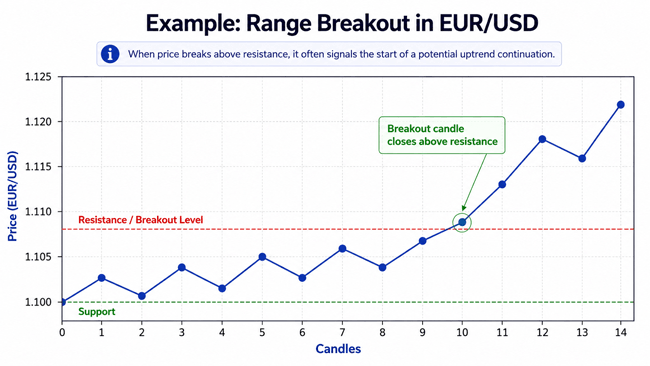
Image: Range breakout diagram showing support, resistance, breakout candle, and possible continuation.
2. Why Breakouts Happen in the Forex Market
Breakouts happen because the balance between buyers and sellers changes. A level that previously stopped price can become weak when enough orders build around it. Once price breaks the level, several things may happen at the same time: traders enter in the breakout direction, stop-loss orders are triggered, and traders who were on the wrong side rush to exit.
This order flow can create momentum. For example, if price breaks above resistance, sellers who placed stop losses above that resistance may be forced to buy back their positions. At the same time, breakout buyers enter long positions. This combined buying can push price higher.
However, forex is also a market where large players, liquidity needs, spreads, and news can create sudden spikes. Sometimes price moves beyond a level only to grab liquidity and then reverses. This is why beginners should learn both real breakouts and false breakouts.
■ Types of Forex Breakouts Beginners Should Know
1. Range Breakout
A range breakout happens when price has been moving sideways between support and resistance, then breaks above the range high or below the range low. Range breakouts are common during quiet sessions and can become stronger when London or New York opens.
2. Trendline Breakout
A trendline breakout happens when price breaks a diagonal line that has been guiding the trend. For example, in a downtrend, price may keep rejecting a falling trendline. If price finally closes above that line, traders may see it as a sign that selling pressure is weakening.
3. Chart Pattern Breakout
Breakouts can come from patterns such as triangles, wedges, flags, rectangles, and head-and-shoulders patterns. These patterns are not magic signals. They are visual ways of showing compression, hesitation, or a shift in control between buyers and sellers.
4. News Breakout
A news breakout happens when major economic data, interest rate decisions, inflation reports, employment data, or central bank comments cause price to move sharply. These breakouts can be powerful but dangerous for beginners because spreads may widen, slippage may occur, and price can move too fast to manage calmly.
5. Session Breakout
A session breakout focuses on the high or low of a trading session, such as the Asian session range. Some traders wait for London to break the Asian high or low because liquidity and volatility often increase during the London session. This approach still needs confirmation and risk control.
■ How to Identify a Good Breakout Level
The quality of the breakout level matters more than the excitement of the breakout candle. A weak level usually produces weak signals. A strong level is visible, tested, and respected by price.
Characteristics of a strong breakout level
- The level has been tested at least two or three times without being broken clearly.
- The level is easy to see on the chart without forcing it.
- The level appears on a higher timeframe, such as 1-hour, 4-hour, or daily.
- Price has compressed near the level, showing pressure building.
- The breakout candle closes beyond the level, rather than only wicking through it.
- There is enough space beyond the level for price to move before the next support or resistance area.
A beginner-friendly rule
If you need to redraw the level several times to make the setup look good, the level is probably not clean enough. Good breakout levels usually stand out quickly.
3. The Step-by-Step Forex Breakout Trading Strategy
The following strategy is simple enough for beginners but disciplined enough to avoid many common breakout mistakes. It does not guarantee profit. Its goal is to give structure, reduce emotional entries, and make every trade measurable.
Step 1: Choose a clean currency pair and timeframe
Beginners often do better with major pairs such as EUR/USD, GBP/USD, USD/JPY, AUD/USD, and USD/CAD because they usually have tighter spreads and more liquidity than exotic pairs. For timeframes, the 15-minute, 1-hour, and 4-hour charts are easier to manage than very low timeframes like the 1-minute chart.
Step 2: Mark support and resistance
Look left on the chart. Mark levels where price clearly turned several times. Do not cover the chart with too many lines. The goal is to identify the most important zones, not every tiny reaction.
Step 3: Wait for price to approach the level
A breakout trade only matters when price is near an important level. If price is in the middle of nowhere, there is no clear breakout to trade. Patience is part of the strategy.
Step 4: Wait for a candle close beyond the level
Many beginners enter the moment price touches or slightly crosses the level. That is risky because price may only be making a wick. A safer approach is to wait for the candle to close beyond support or resistance. A close shows more commitment than a quick spike.
Step 5: Check confirmation
Confirmation can come from volume where available, candle strength, retest behavior, trend direction, higher timeframe alignment, or market session activity. The more evidence you have, the less you are relying on hope.
Step 6: Plan the stop loss before entry
Never enter first and then decide where the stop loss should go. For a bullish breakout, the stop loss may go below the breakout level, below the retest low, or below the breakout candle low. For a bearish breakout, it may go above the breakout level, above the retest high, or above the breakout candle high.
Step 7: Set a realistic take profit
A target can be based on the next support or resistance level, the height of the previous range, or a fixed risk-to-reward ratio such as 1:2. A target should be realistic, not chosen only because it looks profitable.
Step 8: Record the trade
After the trade closes, write down the pair, timeframe, entry reason, stop loss, take profit, result, and screenshot. Over time, your trading journal will show whether your forex breakout strategy actually works for you.
4. Practical Breakout Trade Example
Imagine GBP/USD has been ranging between 1.2700 support and 1.2760 resistance during the Asian session. London opens, volatility increases, and price pushes above 1.2760. A beginner may feel tempted to buy immediately, but a disciplined trader follows a plan.
Trade plan
| Item | Example decision |
|---|---|
| Pair | GBP/USD |
| Timeframe | 15-minute chart for entry, 1-hour chart for context. |
| Breakout level | 1.2760 resistance. |
| Entry idea | Buy only if a 15-minute candle closes above 1.2760 or price retests 1.2760 and holds. |
| Stop loss | Below 1.2735, under the breakout candle/retest area. |
| Take profit | Near 1.2810, before the next resistance zone. |
| Risk | 1% of the account or less. |
| Reason to skip | High-impact news in the next 30 minutes, a weak candle close, a spread that is too wide, or a poor reward-to-risk ratio. |
This example shows an important point: the strategy includes reasons not to trade. Many beginners only look for reasons to enter. Experienced traders also look for reasons to stay out.
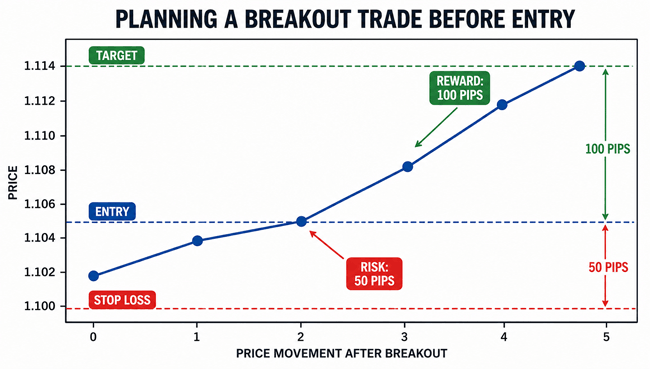
Image: Entry, stop loss, and take profit plan before placing a breakout trade.
5. Breakout Entry Methods: Which One Is Best?
There is no single best entry method for every trader. Each entry style has advantages and weaknesses. Beginners should test one method at a time instead of changing the plan after every trade.
| Entry method | How it works | Best for | Main weakness |
|---|---|---|---|
| Aggressive breakout entry | Enter as soon as price breaks the level. | Fast-moving markets and experienced traders. | Higher chance of fakeouts and emotional entries. |
| Candle close entry | Enter after a candle closes beyond the level. | Beginners who want more confirmation. | Entry may be later and the stop loss may be wider. |
| Retest entry | Wait for price to return to the broken level and hold. | Traders who prefer better risk-to-reward. | Price may not retest, so the trade can be missed. |
| Breakout plus pullback entry | Wait for the breakout, pullback, then a continuation candle. | More patient traders. | Requires discipline and can feel slow. |
Beginner recommendation
For most beginners, a candle close or retest entry is safer than jumping in the second price crosses the line. It may miss some trades, but it reduces impulsive decisions.
6. False Breakouts: The Biggest Problem for Beginners
A false breakout, also called a fakeout, happens when price moves beyond a level, attracts traders, and then reverses back inside the previous range. False breakouts are frustrating because the trade can look perfect at first.
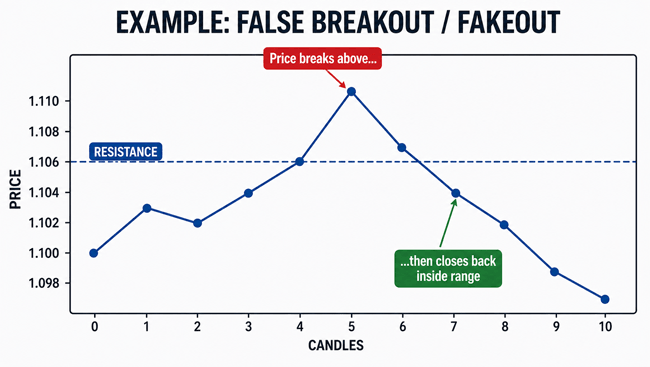
Image: False breakout where price breaks resistance but closes back inside the range.
Why false breakouts happen
- Price may be hunting liquidity above obvious highs or below obvious lows.
- News can create a quick spike without real follow-through.
- Low-volume periods can make price easier to push around.
- Traders may enter too early before the candle closes.
- A higher timeframe level may be stronger than the lower timeframe breakout.
How to reduce false breakout risk
- Wait for the candle close beyond the level.
- Use higher timeframe support and resistance for context.
- Avoid trading right before high-impact news unless you have a tested news strategy.
- Look for strong candle bodies, not only long wicks.
- Avoid breakouts that happen after price has already moved too far.
- Use a stop loss every time and accept that some breakouts will fail.
8. Best Indicators for Breakout Trading
Breakout trading does not require many indicators. In fact, too many indicators can confuse beginners. Use indicators only to support price action, not to replace it.
| Indicator | How it can help | Beginner warning |
|---|---|---|
| Moving average | Shows trend direction and whether price is trading above or below average value. | Do not buy only because price is above a moving average. |
| ATR (Average True Range) | Helps estimate normal volatility and stop-loss distance. | A very tight stop in a volatile market can be hit easily. |
| Volume / tick volume | Can show whether breakout activity is stronger than normal. | Spot forex volume is not centralized, so treat it as a clue, not proof. |
| Bollinger Bands | Can show compression before expansion. | A band break alone is not enough for entry. |
| RSI | Can show momentum or overextension. | Overbought can stay overbought during strong trends. |
Simple indicator setup for beginners
A clean beginner chart may include only support and resistance, a 20-period moving average, and ATR. The moving average gives trend context. ATR helps avoid unrealistic stop losses. Support and resistance remain the main decision points.
■ Risk Management for Forex Breakout Trading
Risk management is the part of breakout trading that protects beginners from one bad trade becoming a serious loss. The CFTC has warned that most retail OTC forex customers lose money after costs, fees, and financing charges are considered. That is why any article about forex trading should be honest: the strategy matters, but risk control matters more.
1. Risk only a small percentage
Many cautious traders risk 0.5% to 1% of their account on one trade. This means if the stop loss is hit, the account loses only that planned amount. Beginners should avoid risking 5%, 10%, or more on one breakout idea because a few losing trades can damage the account quickly.
2. Use position sizing
Position size connects your stop loss to your account risk. For example, if your account is $1,000 and you risk 1%, your maximum loss is $10. If your stop loss is 20 pips, your lot size must be small enough that 20 pips equals about $10. This is more professional than choosing a random lot size.
3. Understand leverage
Leverage allows a trader to control a larger position with a smaller deposit, but it also increases losses. High leverage can make a normal market move feel huge. A beginner should treat leverage as a risk tool, not a shortcut to fast profits.
4. Protect yourself from the “one perfect trade” mindset
No breakout is guaranteed. The goal is not to predict every move correctly. The goal is to trade a tested setup repeatedly with controlled risk, so that one loss does not create panic and one win does not create overconfidence.
■ When Not to Trade a Breakout
Knowing when not to trade is one of the most valuable skills in forex. A setup can look attractive but still be poor quality.
- Do not trade if the breakout happens right into the next major support or resistance level.
- Do not trade if the stop loss must be too wide for your account risk.
- Do not trade if the reward-to-risk ratio is poor.
- Do not trade if you are entering because of fear of missing out.
- Do not trade if spreads are unusually wide.
- Do not trade if major news is about to be released and you do not have a tested plan for news volatility.
- Do not trade if you cannot clearly explain the setup in one or two sentences.
■ Breakout Trading vs Trend Following vs Range Trading
| Strategy type | Main idea | Best market condition | Beginner difficulty |
|---|---|---|---|
| Breakout trading | Enter when price breaks an important level. | Market moving from compression to expansion. | Medium |
| Trend following | Enter in the direction of an existing trend. | Clear trending market. | Medium |
| Range trading | Buy support and sell resistance inside a range. | Sideways market. | Medium to hard because ranges can break suddenly. |
Breakout trading is attractive because it tries to catch the beginning of a new move. But it can also be emotionally difficult because false breakouts are common. Range trading is almost the opposite: it assumes support and resistance will hold. Trend following waits for direction to already be clear. A beginner should understand all three, because the market changes between range, breakout, and trend phases.
■ Common Beginner Mistakes in Forex Breakout Trading
- Entering before the candle closes beyond the breakout level.
- Trading every small line as if it is an important support or resistance zone.
- Using too much leverage because the setup “looks obvious.”
- Moving the stop loss farther away after the trade goes negative.
- Taking profit too early on winners but letting losers grow.
- Ignoring the higher timeframe trend.
- Trading during major news without understanding slippage and spread widening.
- Changing strategy after one loss instead of reviewing a proper sample of trades.
- Following forex trading signals blindly without understanding the risk plan.
- Believing a paid forex trading course, online forex trading platform, or indicator can remove risk.
■ A Beginner Breakout Trading Checklist
Use this checklist before every breakout trade. If several answers are “no,” skip the trade.
| Question | Yes/No |
|---|---|
| Is the breakout level clear and tested? | |
| Did price close beyond the level, not just wick through it? | |
| Is the higher timeframe supporting the idea? | |
| Is there enough room to the next support/resistance? | |
| Is the stop loss logical and affordable? | |
| Is the potential reward at least equal to or greater than the risk? | |
| Are spreads normal? | |
| Is there no major news risk immediately ahead? | |
| Can I explain the trade setup clearly? | |
| Am I risking only a small planned amount? |
■ Practical Trading Routine for Beginners
Before the trading session
- Check the economic calendar.
- Mark major support and resistance on higher timeframes.
- Choose only two or three pairs to watch.
- Decide your maximum daily risk before trading starts.
During the session
- Wait for price to reach a planned level.
- Let the candle close.
- Check spread, news, stop loss, and reward-to-risk.
- Enter only if the setup matches your written rules.
After the trade
- Screenshot the chart.
- Write the reason for entry and exit.
- Note whether you followed the plan.
- Review results after 20 to 50 trades, not after only one trade.
■ Frequently Asked Questions
1. Is breakout trading good for beginners?
Breakout trading can be good for beginners because the idea is easy to understand: price breaks an important level and may continue. However, beginners must learn false breakouts, stop losses, position sizing, and patience. Without those, breakout trading can become emotional chasing.
2. What is the best timeframe for forex breakout trading?
Many beginners find the 15-minute, 1-hour, and 4-hour charts easier than very low timeframes. Higher timeframes usually give cleaner levels but fewer trades. Lower timeframes give more setups but more noise.
3. Should I wait for a retest after breakout?
A retest can improve entry quality and risk-to-reward, but price will not always come back. Waiting for retests means missing some trades, but it can also reduce poor entries. The best choice depends on your tested rules and personality.
4. Can I use breakout trading with forex signals?
You can compare signals with your own breakout rules, but do not follow forex trading signals blindly. A signal without entry reason, stop loss, risk size, and exit plan is incomplete. The trader remains responsible for the risk.
5. How much money do I need to start breakout trading?
There is no ideal amount that makes trading safe. Beginners should start with education, demo practice, and very small live risk if they decide to trade. The main point is not the deposit size; it is whether the trader can control risk and follow a plan.
6. What is the biggest secret of breakout trading?
The biggest “secret” is that the breakout itself is only one part of the trade. The real edge comes from level quality, timing, confirmation, risk management, and emotional discipline.
■ Final Thoughts: Trade Breakouts Like a Risk Manager
A breakout trading strategy in forex is not about guessing which candle will explode. It is about identifying important levels, waiting for price to prove strength or weakness, planning risk before entry, and accepting that some trades will fail. The best breakout traders are not the ones who chase every move. They are the ones who can wait, enter only when conditions match their rules, and protect their account when the market proves them wrong.
For a beginner, the most helpful path is simple: learn support and resistance, practise on a demo account, study false breakouts, keep risk small, journal every trade, and review results honestly. Breakout trading can be powerful, but only when it is used with patience and responsibility.
Sources Consulted
- CFTC customer advisory: Eight Things You Should Know Before Trading Forex: https://www.cftc.gov/LearnAndProtect/AdvisoriesAndArticles/CustomerAdvisory_MustKnowForex.html
- NFA Forex Transactions Regulatory Guide: https://www.nfa.futures.org/members/member-resources/files/forex-regulatory-guide.html
- BIS Triennial Central Bank Survey of foreign exchange and OTC derivatives markets: https://www.bis.org/statistics/rpfx25.htm
- Bank of England summary of 2025 BIS FX survey UK results: https://www.bankofengland.co.uk/news/2025/september/bis-triennial-survey-of-foreign-exchange-and-over-the-counter-interest-rate-derivatives-markets
Reader Advice: This article is provided for educational and informational purposes only and should not be considered financial, investment, or trading advice. Forex trading involves risk. Before making any trading decisions, take the time to study the forex market thoroughly, understand the risks, and evaluate whether trading is appropriate for your financial situation and experience. Always make informed decisions based on your own research, and consider seeking guidance from a qualified financial professional when needed.