Forex Risk Management: A Guide to Protecting Your Trading Capital
Forex trading can look exciting from the outside. Prices move every second, charts look full of opportunity, and many beginners enter the market thinking the main goal is to find the perfect entry. But experienced traders usually learn a different lesson: the entry is only one small part of the trade. The real skill is knowing how much to risk, where to exit if wrong, and how to survive long enough to improve.
That is what forex risk management means. It is not a boring rulebook that slows you down. It is the system that protects your trading account when the market does the opposite of what you expected. In simple words, forex risk management is the way a trader limits losses, controls position size, uses stop-loss orders, manages leverage, and avoids emotional decisions.
This guide explains forex risk management in a natural, beginner-friendly way. It covers what it is, how it works, what beginners should know, how to use it in real trades, and why it is one of the most important habits for long-term trading success.
1. What Is Forex Risk Management?
Forex risk management is the process of deciding how much money you are willing to lose before you enter a trade. It includes planning your stop-loss, calculating position size, controlling leverage, setting a risk-reward ratio, and making sure one bad trade cannot destroy your account.
A beginner may think, “I believe EUR/USD will go up, so I will buy.” A risk-aware trader thinks differently: “If EUR/USD goes up, I have a plan to take profit. If it goes down, I know exactly where I will exit and how much I will lose.”
That difference is huge. The first trader is hoping. The second trader is managing risk.
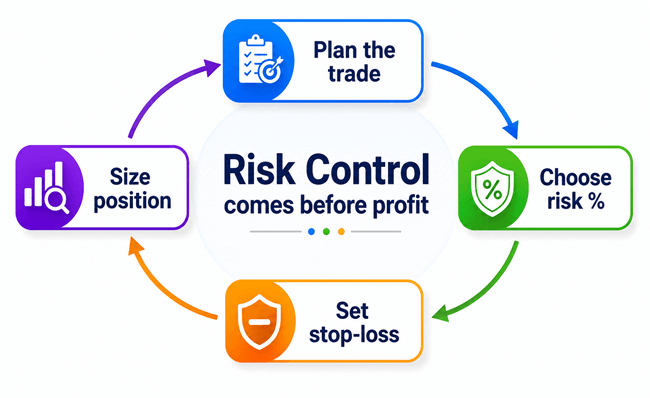
Image: A simple risk-management cycle showing plan, risk percentage, stop-loss, and position size.
2. Why Risk Management Matters More Than a “Perfect Strategy”
Many beginners search for the best forex trading strategy, best forex signals, or most profitable indicator. These searches are understandable, but they can create a dangerous belief: that success comes from always being right. In real trading, no method wins every time. Even strong traders can have losing streaks. Risk management is what keeps those losing streaks from becoming account-ending events.
Imagine two traders using the same strategy. Trader A risks 10% of the account on every trade. Trader B risks 1% per trade. After five losing trades, Trader A may be down about 41% before even considering spreads or slippage. Trader B is down about 5%. Trader B is still calm enough to review, adjust, and continue. Trader A may feel pressure to revenge trade.
This is why professional-style trading is not about avoiding every loss. It is about making losses small, planned, and emotionally manageable.
3. How Forex Risk Works in Real Life
In forex, risk comes from price movement, leverage, volatility, liquidity, news events, spreads, broker execution, and trader behavior. A trade can be technically correct but still lose because the market moves unpredictably in the short term.
Retail forex is often traded with leverage. Leverage allows a trader to control a larger position than the cash deposited. This can increase potential profit, but it also increases potential loss. Regulators such as the U.S. Commodity Futures Trading Commission warn that leverage can amplify both gains and losses, and that traders may need to add funds or close positions if the market moves against them.
For beginners, the safest mindset is simple: leverage is not free power. It is borrowed exposure. The higher the exposure, the faster your account can move up or down.
■ The Core Parts of Forex Risk Management
1. Risk Per Trade
Risk per trade means the percentage of your account you are willing to lose if the trade fails. Many cautious beginners use a small fixed percentage, such as 0.5% to 1% per trade, while learning. The exact number depends on personal situation, experience, strategy, and risk tolerance. The important point is consistency.
For example, if your account is $1,000 and you risk 1%, your maximum planned loss on one trade is $10. If your account is $5,000 and you risk 1%, your planned loss is $50. This makes risk proportional to account size.
2. Stop-Loss Order
A stop-loss is an order designed to close a trade if price moves against you. It is not a guarantee of a perfect exit in all market conditions, because fast markets can create slippage. Still, it is one of the most useful tools for controlling downside risk.
A common beginner mistake is placing the stop-loss based on how much money they want to lose without checking the chart. A better approach is to combine both ideas: place the stop-loss at a logical market level, then reduce the trade size so the money risk stays acceptable.
3. Position Sizing
Position sizing is the process of choosing how large your trade should be. This is where many beginners make mistakes. They may choose a lot size because it “feels small” or because they want a bigger profit. But correct position size should be based on account balance, risk percentage, and stop-loss distance.
The basic idea is: the wider your stop-loss, the smaller your position should be. The tighter your stop-loss, the position may be slightly larger, but only if the stop is still logical and not too close to normal market noise.
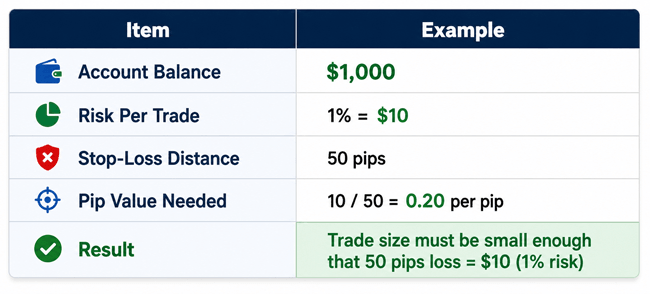
Image: A beginner-friendly position-sizing example table.
4. Risk-Reward Ratio
Risk-reward ratio compares how much you plan to risk with how much you hope to make. If you risk $10 to target $20, your risk-reward ratio is 1:2. If you risk $10 to target $10, it is 1:1.
A good risk-reward ratio does not guarantee profit, but it helps you think clearly. If your average winning trade is larger than your average losing trade, you do not need to win every trade to stay ahead. However, beginners should avoid forcing unrealistic targets. A 1:5 target sounds attractive, but if the market rarely reaches it, the setup may not be practical.
5. Leverage Control
Leverage is one of the biggest reasons beginners lose money quickly. A small price move can become a large account move when the trade size is too big. Low leverage and small position sizes may feel less exciting, but they give beginners more room to learn.
A practical rule is this: never choose a trade size just because your forex broker or trading platform allows it. The platform shows what is possible, not what is wise.
6. Daily and Weekly Loss Limits
A daily loss limit is a rule that tells you when to stop trading for the day. For example, a trader may decide to stop after losing 2% in one day or after three losing trades. A weekly limit works the same way on a bigger scale.
This protects you from the most dangerous trading state: emotional recovery mode. Many large losses do not come from one normal losing trade. They come from a trader trying to win back money quickly after feeling frustrated.
7. News and Event Risk
Major economic news can cause fast price movements, spread widening, and slippage. Examples include interest-rate decisions, inflation data, employment reports, and central-bank speeches. Beginners should be especially careful around high-impact news. Some traders avoid opening new positions shortly before major announcements because price can move sharply in both directions.
8. Broker and Platform Risk
Risk management is not only about charts. It also includes choosing a regulated forex broker, understanding spreads and commissions, knowing margin requirements, reading risk disclosures, and checking whether the trading platform provides reliable order execution. A low spread is helpful, but safety, regulation, transparency, and fair dealing matter more than flashy promotions.
■ A Practical Forex Risk Management Example
Let us say a beginner has a $1,000 trading account and wants to trade GBP/USD. They decide to risk 1% on the trade, which equals $10. Their chart idea becomes invalid if price moves 50 pips against them, so they place the stop-loss 50 pips away.
Now the question is not, “How much can I make?” The first question is, “What position size makes 50 pips equal about $10?” If 50 pips equals $10, then each pip should be worth around $0.20. This keeps the planned loss close to the risk limit.
If the trader instead chooses a position where each pip is worth $1, then a 50-pip stop would risk $50, or 5% of the account. That may not sound huge once, but a short losing streak could create serious damage. The trade idea may be the same, but the risk is completely different.
■ The Beginner’s Step-by-Step Risk Management Routine
- Check the market condition. Is the pair trending, ranging, or moving because of news?
- Write the trade idea in one sentence. For example: “I am buying EUR/USD because price rejected support and trend is still upward.”
- Choose the invalidation point. Where would the trade idea be wrong?
- Place the stop-loss near that invalidation point, not randomly.
- Decide your risk percentage before entering the trade.
- Calculate position size so the stop-loss equals your planned money risk.
- Set a realistic target or trailing plan before entering.
- Do not move the stop-loss farther away because of fear.
- Record the trade result and your emotional state in a journal.
- Review your trades weekly, not after every emotional moment.
■ Common Forex Risk Management Mistakes Beginners Make
Mistake 1: Risking Too Much Too Soon
Beginners often underestimate losing streaks. Even a strategy with a decent win rate can lose several trades in a row. Risking too much per trade makes normal losing streaks feel like disasters.
Mistake 2: Moving the Stop-Loss
Moving a stop-loss farther away is usually a sign that the trader no longer wants to accept the original plan. Sometimes the market later turns around, which teaches a bad lesson. Over time, this habit can create one very large loss.
Mistake 3: Using High Leverage Without Understanding It
High leverage can make small accounts feel powerful, but it also makes mistakes expensive. Beginners should focus on learning execution, patience, and process before increasing exposure.
Mistake 4: Averaging Down Without a Plan
Adding to a losing position can be dangerous if it is done emotionally. It increases exposure at the exact moment the market is proving the original idea wrong. Advanced traders may scale positions with a clear plan, but beginners should be very careful with this habit.
Mistake 5: Ignoring Spread and Slippage
A strategy that looks good on a clean chart may perform poorly when spreads, commissions, and slippage are included. This matters especially for short-term forex trading and scalping.
Mistake 6: Trading Too Many Pairs at Once
Many currency pairs are correlated. A beginner may think they have five different trades, but they may actually be taking the same risk five times. For example, several USD-based trades can all move together when U.S. news comes out.
■ Risk Management Tools Beginners Can Use
- Stop-loss orders: help define the maximum planned loss before entering a trade.
- Take-profit orders: help lock in planned exits instead of relying only on emotion.
- Position size calculators: help convert account risk and stop distance into trade size.
- Economic calendars: help identify high-impact events before placing trades.
- Trading journals: help track mistakes, patterns, emotions, and actual performance.
- Demo accounts: help practice forex trading risk management without risking real money.
- Broker margin calculators: help understand margin use before entering a leveraged position.
■ Comparison: Risky Beginner Behavior vs. Risk-Managed Trading
| Area | Risky beginner behavior | Risk-managed behavior |
|---|---|---|
| Trade entry | Enters because price is moving fast | Enters only when setup, risk, and stop are clear |
| Lot size | Chooses size based on desired profit | Chooses size based on acceptable loss |
| Stop-loss | Uses no stop or moves it emotionally | Sets stop before entry and respects it |
| Leverage | Uses the maximum available | Uses only enough exposure for the plan |
| Losses | Tries to win back quickly | Stops, reviews, and protects capital |
| Mindset | Wants every trade to win | Accepts losses as part of the process |
4. What Experienced Traders Often Learn the Hard Way
Many experienced traders say their biggest improvement came not from finding a secret indicator, but from reducing position size, accepting losses faster, and tracking mistakes honestly. A common real-world lesson is that a trader can be right about direction and still lose money if the position is too large, the stop is too tight, or the entry is emotionally forced.
Another lesson is that boring trading is often healthier than exciting trading. When risk is controlled, one trade does not feel like a life-changing event. This makes it easier to follow the plan. When risk is too high, every candle feels personal, and decision-making becomes emotional.
5. How Much Should a Beginner Risk Per Trade?
There is no one perfect number for everyone. A very cautious beginner may risk 0.25% to 0.5% while learning. Some traders use around 1% as a simple educational benchmark. More aggressive risk can lead to faster growth, but it can also lead to faster drawdowns and emotional mistakes.
The better question is: “Can I take ten losing trades in a row and still think clearly?” If the answer is no, the risk is probably too high. Good risk management should help you stay calm enough to keep learning.
6. Understanding Drawdown
Drawdown means the decline from a previous account high. If your account grows from $1,000 to $1,200 and then falls to $1,080, the drawdown from the high is $120, or 10%. Drawdown is normal in trading, but large drawdowns are difficult to recover from.
For example, a 10% loss needs about an 11.1% gain to recover. A 50% loss needs a 100% gain to recover. This is why protecting capital matters. The deeper the hole, the harder it is to climb out.
| Account loss | Gain needed to recover | Lesson |
|---|---|---|
| 10% | About 11.1% | Manageable if risk stays controlled |
| 25% | About 33.3% | Recovery becomes harder |
| 50% | 100% | Very difficult and emotionally stressful |
| 75% | 300% | Usually account-damaging |
7. Forex Risk Management and Trading Psychology
Risk management and psychology are connected. When position size is too big, fear increases. When fear increases, traders close winners too early, hold losers too long, and break rules. Smaller risk makes it easier to act calmly.
A good trading plan should protect you from yourself. It should define when to trade, when not to trade, how much to risk, when to stop for the day, and how to review performance. Without rules, every decision becomes emotional.
8. A Simple Forex Trading Plan Template
- Market: Which currency pairs will I trade?
- Session: What time of day will I trade?
- Setup: What exact conditions must appear before entry?
- Risk per trade: What percentage of my account will I risk?
- Maximum daily loss: When will I stop trading for the day?
- Stop-loss rule: Where will I place the stop and why?
- Take-profit rule: What is my target or exit method?
- News rule: Will I trade before major news or avoid it?
- Review rule: When will I update my journal and analyze mistakes?
9. Helpful Facts Beginners Should Know
- A stop-loss reduces risk, but it does not remove risk completely.
- Leverage can magnify both profits and losses.
- A small account should not use oversized positions just to chase large profits.
- Demo trading is useful, but real-money emotions can feel different.
- A regulated forex broker is important, but regulation does not make trading risk-free.
- No forex trading platform, course, or signal provider can honestly guarantee profits.
- Consistency comes from repeated good decisions, not one lucky trade.
■ FAQ
1. What is forex risk management in simple words?
Forex risk management means controlling how much money you can lose on a trade before you enter it. It includes stop-loss placement, position sizing, leverage control, and trading rules.
2. Why is risk management important in forex trading?
It is important because forex prices can move quickly, especially with leverage. Risk management helps protect your trading account from large losses and emotional decisions.
3. What is a good risk per trade for beginners?
Many beginners start with very small risk, such as 0.5% to 1% per trade, while learning. The right amount depends on personal risk tolerance, experience, and financial situation.
4. Can I trade forex without a stop-loss?
Some traders do, but it is risky, especially for beginners. Without a stop-loss or clear exit plan, one bad move can become a much larger loss than expected.
5. Does risk management guarantee profit?
No. Risk management does not guarantee profit. It helps limit damage, improve discipline, and keep losses small enough that a trader can continue learning and trading responsibly.
6. What is the best forex risk management strategy?
The best strategy is usually simple: risk a small fixed percentage per trade, use logical stop-loss levels, calculate position size, avoid excessive leverage, and keep a trading journal.
■ Final Thoughts: The Goal Is Survival First, Profit Second
Forex risk management is the foundation of long-term trading. Beginners often focus on how much they can make, but experienced traders first ask how much they can lose. That shift changes everything.
A strong risk management plan will not make every trade profitable. It will not remove uncertainty. It will not protect you from every market surprise. But it can help you avoid the common beginner mistake of losing too much too quickly.
If you are new to forex trading, start small, use a demo account, choose a regulated broker, learn how leverage works, and build your trading plan around capital protection. The market will always offer another opportunity, but only if your account survives long enough for you to take it.
Reader Advice: This article is provided for educational and informational purposes only and should not be considered financial, investment, or trading advice. Forex trading involves risk. Before making any trading decisions, take the time to study the forex market thoroughly, understand the risks, and evaluate whether trading is appropriate for your financial situation and experience. Always make informed decisions based on your own research, and consider seeking guidance from a qualified financial professional when needed.