Forex Trading Psychology: How to Control Fear and Greed
Forex trading psychology is the way your emotions, habits, beliefs, and discipline affect your trading decisions. Most beginners think trading is only about charts, indicators, forex brokers, trading platforms, spreads, and leverage. Those things matter, but the trader behind the screen matters even more. Fear can make you close a good trade too early, skip a valid setup, or freeze after a loss. Greed can make you overtrade, increase lot size, ignore a stop loss, or chase a move after it is already gone.
A simple way to control fear and greed is to stop making every decision in the heat of the moment. Build a written trading plan, decide your risk before entry, use stop losses responsibly, journal every trade, review patterns weekly, and take breaks when your emotions are stronger than your rules.
1. What Is Forex Trading Psychology?
Forex trading psychology means understanding what happens inside your mind while you trade currencies. It includes patience, confidence, fear, greed, discipline, frustration, hope, regret, and the ability to follow rules when money is at risk. In online forex trading, the market can move quickly. Because price changes are visible every second, beginners often feel pressure to act quickly even when doing nothing would be the better decision.
A beginner may learn how EUR/USD, GBP/USD, USD/JPY, leverage, margin, spreads, candlestick patterns, and trading apps work. But when a real trade is open, knowledge often turns into emotion. A small loss can feel personal. A winning trade can make the trader feel smarter than the market. After two wins, the trader may increase lot size. After two losses, the trader may try to recover everything in one trade. This is where psychology decides whether a trader behaves like a planner or a gambler.
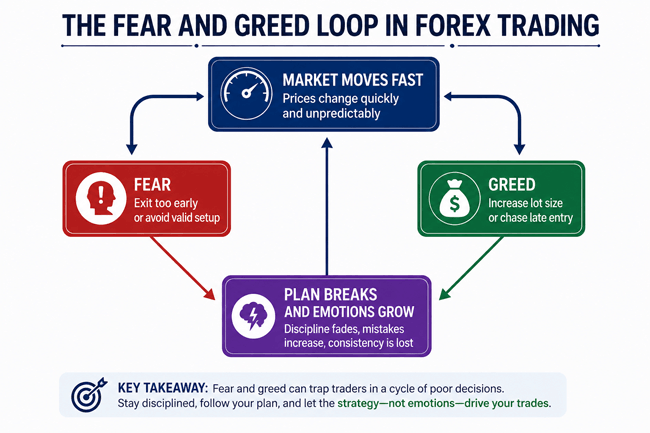
Image: The common fear-and-greed loop that pushes beginners away from their trading plan.
2. Why Psychology Matters More Than Beginners Expect
A trading strategy can be simple, but following it is not always easy. Suppose a beginner has a rule: risk 1% per trade and only enter after a confirmed setup. The rule sounds easy before the market opens. But when price moves fast, the trader sees social media posts, a forex signal group says “buy now,” and a candle jumps 40 pips. Suddenly the trader is afraid of missing out. The plan disappears, and the trade becomes emotional.
This is why experienced traders often say the hardest part is not finding a setup; it is staying consistent. Forex psychology connects directly with forex risk management. If you cannot accept a small planned loss, you may move your stop loss. If you cannot tolerate missing a trade, you may chase entries. If you become overconfident after wins, you may trade too large. In all cases, the emotional mistake is usually more expensive than the technical mistake.
■ Fear in Forex Trading: What It Looks Like
Fear is not always bad. Healthy fear reminds you that the forex market is risky and that leverage can hurt an account quickly. The problem starts when fear controls decisions instead of protecting them.
1. Fear of losing money
The trader enters correctly but closes the trade after a tiny pullback, even though the stop loss and target were planned. The trade later moves in the original direction, and the trader feels regret.
2. Fear of missing out (FOMO)
The trader sees a strong candle and enters late without a plan. The market reverses, and the trader realizes the entry was based on panic, not analysis.
3. Fear after a losing streak
After three losing trades, the trader avoids the next valid setup. That setup works, and the trader becomes even more confused.
4. Fear of being wrong
The trader refuses to close a losing trade because accepting the loss feels like admitting failure. This can lead to bigger losses.
■ Greed in Forex Trading: What It Looks Like
Greed usually feels like confidence in the beginning. A trader has a winning trade and thinks, “I should have used a bigger lot size.” Then the next trade is larger, less planned, and more emotional. Greed is dangerous because it often sounds logical while it is happening.
1. Overtrading
The trader takes too many trades because every small movement looks like an opportunity. More trades do not automatically mean more profit; often they mean more spread costs, more stress, and more mistakes.
2. Moving the take-profit too far
A trade reaches the planned target, but the trader wants more. Price reverses, and a winning trade becomes small or negative.
3. Ignoring position sizing
The trader risks 5%, 10%, or more on one trade because the setup “looks perfect.” No setup is perfect.
4. Following unrealistic promises
Greed makes beginners vulnerable to guaranteed-profit claims, fake forex signals, and “best forex trading strategy” marketing. Honest trading education should talk about risk first.
■ Fear vs Greed: Simple Comparison
| Emotion | Common thought | Typical mistake | Better response |
|---|---|---|---|
| Fear | “What if I lose?” | Close early, skip valid setups, freeze | Accept small planned losses before entry |
| FOMO | “Everyone is entering now.” | Chase late entries | Wait for your setup or skip the trade |
| Greed | “This one will make a lot.” | Risk too much or overtrade | Use fixed risk and daily trade limits |
| Revenge | “I must recover now.” | Trade without a setup after loss | Stop trading and review later |
| Overconfidence | “I cannot lose today.” | Break rules after wins | Reduce size or keep rules unchanged |
3. How Forex Psychology Works in Real Life
Think of a trade as three parts: before entry, during the trade, and after the result. Most beginners focus only on entry. They ask, “Should I buy or sell?” A better question is, “What will I do if I am wrong, what will I do if I am right, and what behavior will I not allow myself to do?”
Example 1: The fearful beginner
A beginner studies EUR/USD and decides to buy after a support bounce. The stop loss is 25 pips and the target is 50 pips. After entry, price drops 8 pips. The trader feels nervous and closes manually. Ten minutes later, the trade goes up and reaches the original target. The problem was not the setup. The problem was that the trader had not emotionally accepted the planned loss before entering.
Example 2: The greedy beginner
Another beginner wins two trades on a demo account and opens a live account. Instead of risking 1%, he risks 8% because he wants faster results. The trade loses. Now he feels pressure to recover. He doubles the next position and loses again. In a few trades, the account is damaged. The first mistake was greed, but the bigger problem was no risk system.
Example 3: The disciplined beginner
A disciplined beginner has the same emotions, but uses rules. She risks 1% per trade, sets a stop loss, writes down the reason for entry, and accepts that any single trade can lose. After a loss, she does not increase size. After a win, she does not become careless. Her goal is not to feel nothing; her goal is to behave consistently even when she feels something.
■ The Practical System: Plan, Risk, Execute, Review
The best way to control fear and greed is to create a system that reduces emotional decision-making. A beginner does not need a complicated trading course to start building discipline. They need a clear routine.
1. Plan
Write down exactly what you trade, when you trade, what setup you use, what invalidates the setup, where the stop loss goes, and when you will not trade. A plan protects you from random decisions.
2. Risk
Decide the maximum risk before entry. Many cautious beginners start by risking a very small fixed amount on a demo account or a small live account only after practice. The key is that risk is chosen by rule, not by excitement.
3. Execute
Once the trade is placed, avoid changing rules just because the candle is moving. Execution means doing what your plan already said.
4. Review
At the end of the day or week, review trades like a coach, not like an angry judge. Ask: Did I follow the plan? Was my risk correct? What emotion appeared? What will I improve next time?
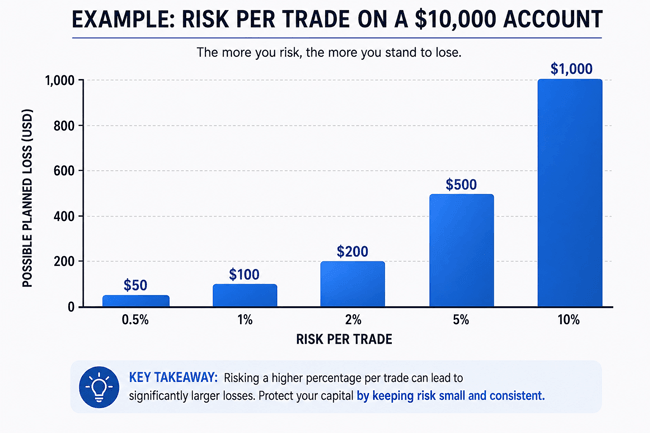
Image: Small changes in risk per trade can create large changes in account pressure.
4. Position Sizing: The Psychology Tool Most Beginners Ignore
Position sizing is not only math; it is emotional protection. If your trade size is too large, every small price movement feels stressful. If your size is reasonable, it becomes easier to follow the plan. A stop loss is not a punishment. It is the price you agree to pay if your idea is wrong.
| Account | Risk % | Planned risk | Emotional pressure | Beginner lesson |
|---|---|---|---|---|
| $1,000 | 1% | $10 | Low to moderate | Easier to accept a normal loss |
| $1,000 | 5% | $50 | High | One loss feels serious |
| $1,000 | 10% | $100 | Very high | A few losses can damage confidence |
| $10,000 | 1% | $100 | Moderate | Still manageable if planned |
| $10,000 | 5% | $500 | High | Can trigger fear, greed, and revenge trading |
5. A Beginner-Friendly Trading Plan Template
- Market/pairs: I will trade only 1-3 major pairs until I understand their behavior.
- Session: I will trade only during the time I can focus, not while working, driving, or emotionally distracted.
- Setup: I will define one setup in simple words and screenshots.
- Risk: I will choose a fixed risk rule before entry.
- Stop loss: I will place it where the trade idea is invalid, not where I emotionally hope price will turn.
- Take profit: I will plan the exit before entry.
- No-trade rules: I will not trade after a major emotional event, after my daily loss limit, or because of social media hype.
- Review: I will journal every trade and review weekly.
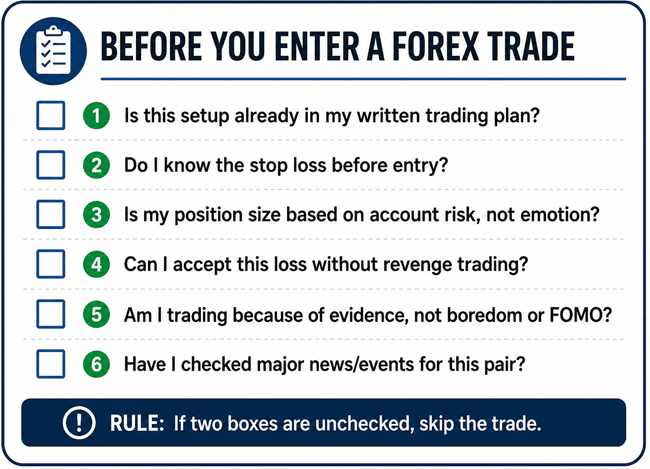
Image: A simple pre-trade checklist helps beginners slow down emotional entries.
6. How to Use a Trading Journal for Psychology
A trading journal is one of the most practical tools for improving forex trading psychology. It turns vague feelings into visible patterns. Without a journal, a trader may say, “I am unlucky.” With a journal, the trader may discover, “Most of my losses happen after I trade during news, increase size after wins, or enter late because of FOMO.”
- Date and currency pair
- Reason for entry
- Screenshot before and after
- Risk amount and lot size
- Emotion before entry: calm, excited, afraid, rushed, bored
- Did I follow the plan? Yes or no
- Mistake category: FOMO, fear, greed, revenge, overconfidence, no mistake
- Lesson for next trade
The journal should not be used to insult yourself. It should be used to find patterns. The goal is not perfection. The goal is fewer repeated mistakes.
7. Common Beginner Psychology Mistakes and Fixes
Mistake: Trying to win every trade
Fix: Accept that losses are part of trading. Judge yourself by process quality, not one result.
Mistake: Changing strategy every week
Fix: Test one simple strategy long enough to collect meaningful data. Many beginners quit a method after normal losses.
Mistake: Trading too much after watching YouTube or signal groups
Fix: Treat online content as education, not an instruction to enter. Do your own plan and risk check.
Mistake: Revenge trading
Fix: Create a rule: after two emotional trades or a daily loss limit, stop for the day.
Mistake: Moving stop loss farther away
Fix: Place the stop where the setup is invalid. If you want to move it because you are scared of losing, that is usually a warning sign.
Mistake: Believing a demo account proves live discipline
Fix: Demo trading teaches platform use and strategy practice, but live trading adds real emotion. Start small and focus on behavior, not income.
8. Healthy Use of Forex Tools Without Becoming Dependent
Forex trading platforms, charting tools, economic calendars, demo accounts, and trading apps can help beginners. But tools should support decisions, not replace responsibility. A beginner should understand what a tool does and what it cannot do.
| Tool/keyword | Helpful use | Psychology warning |
|---|---|---|
| Demo account | Practice platform use, entries, exits, journaling | Do not assume demo confidence equals live discipline |
| Forex broker / trading platform | Execute trades, manage orders, monitor margin | Choose regulated providers; avoid unrealistic bonus or profit claims |
| Stop loss | Define planned risk | Do not move it because of hope |
| Economic calendar | Avoid surprise volatility around news | Do not gamble on news if you do not understand it |
| Forex signals | Can be studied as examples | Blind copying can create dependency and hidden risk |
| Trading journal | Find emotional patterns | Be honest; do not only record winning trades |
9. How to Control Fear: Practical Exercises
Pre-accept the loss
Before entering, say in writing: “If this trade loses, I accept the planned loss and will not move the stop.” If you cannot write that honestly, your position size is probably too big.
Use smaller size until you feel bored
If every pip makes you panic, reduce size. Good risk management should feel almost boring.
Trade fewer pairs
Beginners often watch too many pairs and become mentally overloaded. One or two major pairs can be enough for learning.
Create a loss routine
After a losing trade, stand up, breathe, write what happened, and wait at least a few minutes before any new decision.
Measure rule-following
Track a “discipline score” from 1 to 5 for each trade. A losing trade with perfect discipline can be a good trade.
10. How to Control Greed: Practical Exercises
Set a maximum trades-per-day rule
For many beginners, two or three planned trades are better than ten emotional trades. Limits reduce overtrading.
Use a daily loss limit
A daily loss limit protects your account and your mindset. Once reached, stop trading. Do not negotiate with yourself.
Withdraw the word “sure”
When you hear yourself say, “This trade is surely going to win,” slow down. Markets do not owe certainty.
Keep lot size consistent
Do not increase size just because the previous trade won. Increase size only after a tested plan, stable results, and proper risk review.
Take partial profits only if planned
Partial profits can help some traders emotionally, but only if written in the plan before entry.
11. A 30-Day Beginner Routine for Better Trading Psychology
Week 1: Learn and observe
- Choose one or two major pairs.
- Watch price without trading.
- Write down what makes you feel excited or afraid.
- Learn basic terms: pip, spread, lot, leverage, margin, stop loss.
Week 2: Demo practice
- Use a demo account.
- Take only planned setups.
- Journal every trade.
- Focus on execution, not profit.
Week 3: Add rules
- Create a daily trade limit.
- Create a daily loss limit.
- Review screenshots.
- Identify your top emotional mistake.
Week 4: Simulate live discipline
- Trade demo as if the money were real.
- Do not reset the account after losses.
- Write a weekly review.
- Only consider live trading later if you can follow rules consistently.
12. Helpful Facts Beginners Should Know
- Leverage magnifies both gains and losses. A small market movement can create a large account change when position size is high.
- A stop loss does not guarantee perfect protection in every market condition, especially during gaps or extreme volatility, but it is still a key planning tool.
- High win rate does not automatically mean a profitable strategy. Risk-to-reward and loss size matter.
- A trader can lose money even with a good strategy if execution is emotional.
- A regulated broker and transparent risk disclosures matter. Avoid anyone promising guaranteed returns, secret systems, or pressure to deposit quickly.
- Forex is not suitable for everyone. Beginners should treat it as a risky skill-building activity, not a reliable income source.
■ FAQ: Forex Trading Psychology for Beginners
1. Is forex trading psychology more important than strategy?
Both matter. A weak strategy is a problem, but a good strategy can also fail if the trader overtrades, moves stops, risks too much, or cannot accept losses.
2. How do I stop being scared in forex trading?
Reduce position size, plan the loss before entry, use a journal, and stop trading when emotional. Fear often becomes smaller when risk is truly affordable.
3. How do I stop being greedy in forex trading?
Use fixed risk, daily trade limits, planned profit targets, and written rules. Greed becomes dangerous when it changes your position size or makes you ignore your plan.
4. Should beginners use forex signals?
Beginners should be careful. Signals can hide risk and create dependency. If you study signals, treat them as educational examples and still apply your own risk rules.
5. Can a demo account help with psychology?
Yes, demo trading helps you practice process and platform skills. However, live trading can feel different because real money creates stronger emotions.
6. What is the best mindset for forex trading?
The best mindset is patient, risk-aware, evidence-based, and humble. A trader should focus on repeatable process rather than quick money.
■ Final Takeaway
Forex trading psychology is not about removing emotions. It is about creating rules strong enough to guide you when emotions appear. Fear tells you to protect yourself, but too much fear makes you abandon good plans. Greed tells you to seek opportunity, but too much greed makes you ignore risk. The beginner who learns to plan, risk small, execute calmly, journal honestly, and review consistently has a stronger foundation than the beginner who only searches for the next indicator or signal.
The goal is simple: do not let one trade, one emotion, or one market move control your future decisions.
Sources and References
- CFTC Customer Advisory: Eight Things You Should Know Before Trading Forex: https://www.cftc.gov/LearnAndProtect/AdvisoriesAndArticles/CustomerAdvisory_MustKnowForex.html
- NFA Forex Regulatory Guide: https://www.nfa.futures.org/members/member-resources/files/forex-regulatory-guide.html
- CFTC/NASAA Investor Alert: Foreign Exchange Currency Fraud: https://www.nasaa.org/2801/cftcnasaa-investor-alert-foreign-exchange-currency-fraud/
- IOSCO Report on Retail OTC Leveraged Products: https://www.iosco.org/library/pubdocs/pdf/IOSCOPD613.pdf
Reader Advice: This article is provided for educational and informational purposes only and should not be considered financial, investment, or trading advice. Forex trading involves risk. Before making any trading decisions, take the time to study the forex market thoroughly, understand the risks, and evaluate whether trading is appropriate for your financial situation and experience. Always make informed decisions based on your own research, and consider seeking guidance from a qualified financial professional when needed.