Scalping vs Day Trading vs Swing Trading: Which Forex Trading Style Is Best for Beginners?
Choosing a forex trading style is one of the first big decisions a new trader faces. Many beginners open a forex trading platform, see fast-moving price charts, and think the goal is to trade as much as possible. In real life, the better question is not “Which style can make the most money?” The better question is: “Which style fits my time, patience, risk tolerance, and current skill level?”
This guide explains scalping, day trading, and swing trading in plain English. You will learn how each style works, what a beginner should know before trying it, the practical pros and cons, and which style is usually easier to learn without rushing into high-risk decisions. The goal is not to sell a dream. The goal is to help you choose a realistic path and avoid the common mistakes that make many new traders lose money.
1. Quick answer: which forex trading style is best for beginners?
For most complete beginners, swing trading is usually the most beginner-friendly forex trading style because it gives you more time to think, fewer trades to manage, and less pressure to react within seconds. Day trading can work for beginners who have several focused hours each day and strong discipline. Scalping is usually the hardest style for beginners because it requires speed, emotional control, tight execution, low trading costs, and a lot of screen time.
Beginner comparison table
| Trading style | Typical holding time | Screen time | Main skill | Main risk | Beginner fit |
|---|---|---|---|---|---|
| Scalping | Seconds to minutes | Very high | Fast execution | Overtrading, spreads, stress | Low for most beginners |
| Day trading | Minutes to hours | High | Intraday planning | Emotional decisions, news volatility | Medium |
| Swing trading | Days to weeks | Low to medium | Patience and planning | Holding through news and swaps | High for many beginners |
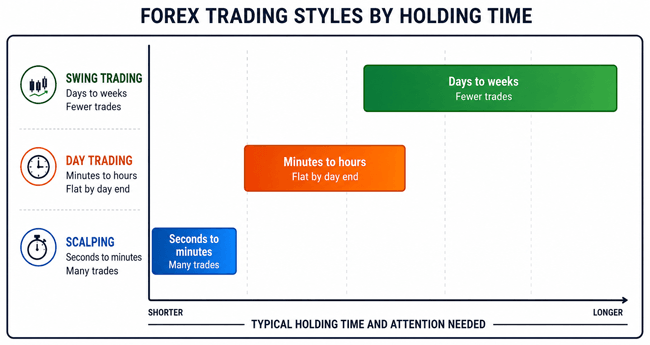
Image: A simple timeline showing how long each trading style usually holds a position.
2. What does “forex trading style” mean?
A forex trading style is the way a trader decides when to enter a trade, how long to hold it, how often to trade, and how much attention the market requires. The same currency pair, such as EUR/USD or GBP/USD, can be traded in completely different ways depending on the trader’s style.
A scalper may look for a tiny move that lasts one or two minutes. A day trader may wait for a price move during the London or New York session and close the trade before bedtime. A swing trader may hold a trade for several days because they believe the market is moving in a larger trend. None of these styles is automatically “best.” Each style has trade-offs.
The biggest beginner mistake is choosing a style because it looks exciting online. A better approach is to choose a style based on your real life. Ask: How many hours can I focus without distraction? Do I panic when a trade goes negative? Can I follow rules even after a loss? Do I understand spreads, swaps, margin, leverage, and position sizing?
3. What is scalping in forex?
Scalping is a very short-term trading style where a trader tries to capture small price movements, often within seconds or minutes. A forex scalper may place many trades in one session, aiming for small wins while cutting losses quickly. Scalping is common on lower timeframes such as 1-minute, 3-minute, or 5-minute charts.
How scalping works
Imagine EUR/USD is moving inside a small range during a busy market session. A scalper may buy near short-term support and sell a few pips higher. The trade may last three minutes. The profit target may be small, but the trader may repeat similar setups many times. Because the profit per trade is small, spreads, commissions, slippage, and execution speed matter a lot.
What beginners should know before scalping
- Scalping is not “easy money.” It is mentally demanding and can become stressful quickly.
- You need a stable internet connection, fast order execution, and a reliable forex trading platform.
- Low spreads and transparent commissions matter because trading costs can eat small profits.
- A regulated forex broker is important. Avoid brokers or influencers promising guaranteed daily returns.
- Scalping can encourage overtrading, revenge trading, and emotional decision-making.
Practical scalping example
A beginner watches GBP/USD on a 1-minute chart. The price breaks above a small consolidation area. The trader buys with a 5-pip stop-loss and an 8-pip target. The trade reaches the target in four minutes. On paper, this looks simple. In real trading, the spread may reduce the profit, the price may move too fast, or the trader may hesitate and enter late. This is why scalping is often harder than it looks in screenshots.
Who scalping may suit
Scalping may suit someone who can focus intensely, make fast decisions, accept small losses, and follow rules without hesitation. It is usually not ideal for beginners who are still learning how candles, spreads, lot sizes, stop-loss orders, and market sessions work.
4. What is day trading in forex?
Day trading means opening and closing trades within the same trading day. A forex day trader does not usually hold positions overnight. The trader may use 5-minute, 15-minute, 30-minute, or 1-hour charts and may focus on the most active market sessions.
How day trading works
A day trader usually starts with a plan. For example, they may check the economic calendar, mark important support and resistance levels, wait for the London session, and trade only if price reaches a planned area. A good day trader does not need to trade all day. They need to wait for a setup that matches their trading plan.
What beginners should know before day trading
- Day trading gives more time than scalping, but it still requires focus and discipline.
- News events can cause fast price movement, especially on major currency pairs.
- A trading journal is very helpful because day traders can quickly repeat the same mistake without noticing it.
- Day trading can become addictive if the trader treats the chart like a game.
- Beginner day traders should practice with a forex demo account before risking real money.
Practical day trading example
Suppose EUR/USD is in an uptrend on the 1-hour chart. During the London session, price pulls back to a previous support area. A day trader waits for confirmation on the 15-minute chart, enters a buy trade, sets a stop-loss below support, and targets the next resistance level. The trade lasts three hours and is closed before the end of the day. This is slower than scalping and gives the trader more time to plan.
Who day trading may suit
Day trading may suit beginners who can set aside quiet time during active market hours, follow a written plan, and avoid random trades. It may not suit someone who can only check charts while working, driving, studying, or taking care of other tasks.
5. What is swing trading in forex?
Swing trading is a slower trading style where positions are held for several days or sometimes a few weeks. A swing trader tries to catch a larger price movement, often using 4-hour, daily, or weekly charts. Compared with scalping and day trading, swing trading usually requires fewer trades and less screen time.
How swing trading works
A swing trader may identify a trend on the daily chart, wait for a pullback, and enter when price shows signs of continuing in the trend direction. The stop-loss and target are usually wider than in scalping or day trading. Because the trade is held longer, the trader must be comfortable with overnight price movement, weekend gaps, swap fees, and economic news risk.
What beginners should know before swing trading
- Swing trading is usually easier to combine with a job, business, school, or family life.
- It gives beginners more time to analyze a chart and avoid emotional clicking.
- The stop-loss may be wider, so position size must be smaller to control risk.
- Trades may go negative for some time before moving in the planned direction, so patience matters.
- Holding trades overnight may involve swap charges or credits depending on the pair and broker.
Practical swing trading example
A beginner notices USD/JPY has been trending upward on the daily chart. Price pulls back to a moving average and a support area. The trader plans a buy trade with a stop-loss below the swing low and a target near the previous high. The trade is held for five days. The trader checks it once or twice per day instead of watching every tick. This style gives more breathing room, but the trader still needs risk control and patience.
Who swing trading may suit
Swing trading may suit beginners who want a calmer learning process, cannot sit in front of charts all day, and prefer fewer but more planned trades. It is not risk-free, but it is often more realistic for a new trader than trying to scalp fast charts immediately.
6. Scalping vs day trading vs swing trading: full comparison
| Factor | Scalping | Day trading | Swing trading |
|---|---|---|---|
| Speed | Very fast. Seconds to minutes. | Moderate to fast. Minutes to hours. | Slow. Days to weeks. |
| Charts used | 1-minute to 5-minute charts. | 5-minute to 1-hour charts. | 4-hour, daily, and weekly charts. |
| Number of trades | Often many trades per day. | Usually a few trades per day or week. | Usually a few trades per week or month. |
| Stress level | High because decisions are quick. | Medium to high depending on discipline. | Lower, but patience is required. |
| Trading costs | Very important because targets are small. | Important but less intense than scalping. | Usually less affected by spread, but swaps matter. |
| Best for | Experienced, focused traders. | Traders with daily market time. | Beginners and part-time traders who can plan carefully. |
| Main danger | Overtrading and tiny losses adding up. | Chasing intraday moves and news spikes. | Oversized positions due to wider stops. |
| Beginner rating | Difficult. | Possible with structure. | Most suitable for many beginners. |
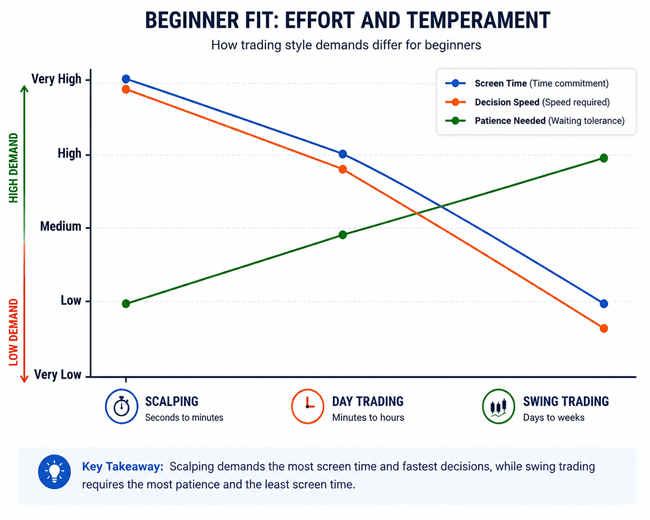
Image: A simple chart comparing screen time, decision speed, and patience needed.
7. Which style should a beginner choose?
A beginner should usually start with swing trading concepts first, then test day trading if they have enough time, and only consider scalping after they understand execution, spreads, risk, and psychology. This does not mean every beginner must become a swing trader. It means the slower style gives beginners a better environment for learning.
Why swing trading is often better for beginners
- It slows the process down. You can think before entering a trade.
- It reduces the temptation to click randomly because there are fewer setups.
- It makes journaling easier because each trade has a clear reason.
- It can be practiced around normal life responsibilities.
- It helps beginners learn market structure, trend, support, resistance, and risk-to-reward without staring at every tick.
When day trading may be better
Day trading may be better if you have dedicated time during active sessions and you do not want to hold trades overnight. Some beginners prefer day trading because each trade is finished before the day ends. This can reduce overnight uncertainty, but it increases the need for focus during the session.
When scalping may be better
Scalping may be better for a trader who already understands the market, has excellent self-control, uses a low-cost broker, and can handle fast losses without becoming emotional. For most beginners, scalping should be treated as an advanced skill, not the starting point.
■ How beginners can choose their forex trading style
Use the questions below before choosing a style. Answer honestly, because the best trading style is the one you can follow consistently.
1. How much time can you give to charts?
- Less than 1 hour per day: swing trading is usually more realistic.
- 2 to 4 focused hours per day: day trading may be possible.
- Several intense hours with full concentration: scalping may be possible later, but not ideal at the start.
2. How do you react under pressure?
If fast decisions make you panic, scalping may be a bad fit. If you become anxious when holding a trade overnight, swing trading may feel uncomfortable at first. If you hate waiting, day trading may tempt you into random trades. Your emotions matter because trading is not only about strategy; it is also about behavior.
3. Can you follow a written trading plan?
A beginner should not trade based only on feelings. A simple plan should include the currency pairs you trade, the session you trade, the setup you wait for, the risk per trade, the stop-loss rule, the target rule, and the maximum number of trades per day or week.
4. Do you understand the cost of trading?
Forex trading costs can include spread, commission, swaps, and slippage. Scalpers feel these costs the most because they aim for small moves. Swing traders may feel swap costs more because they hold trades overnight. Beginners should compare costs on a regulated forex broker before trading real money.
5. Are you practicing or gambling?
A beginner using a forex demo account to test one setup, journal results, and learn risk management is practicing. A beginner increasing lot size after a loss, copying random signals, or chasing quick profits is gambling. The difference is not the platform. The difference is the behavior.
■ Practical examples: same market, three different styles
To understand the difference, imagine EUR/USD is moving upward after positive European market momentum. A beginner sees the same chart, but each trading style reacts differently.
1. Scalper reaction
The scalper looks at the 1-minute chart, waits for a tiny pullback, enters quickly, and aims for a small target. The trade may be closed in two minutes. The scalper cares deeply about spread, execution, and immediate price movement.
2. Day trader reaction
The day trader checks the 15-minute and 1-hour charts, marks the morning high and support zone, waits for a pullback, and enters only if the setup appears. The trade may last from the London session into the New York session and is closed before the day ends.
3. Swing trader reaction
The swing trader checks the daily chart and asks whether EUR/USD is building a multi-day trend. Instead of entering immediately, the swing trader may wait for a daily candle close, place a wider stop-loss, and plan to hold the trade for several days.
The important lesson: the market can be the same, but the plan is different. Beginners often lose because they mix styles. They enter like a scalper, hold like a swing trader, and exit like a panicked gambler. Choose one style for each trade and follow the rules of that style.
■ Risk management beginners must know before using any style
Risk management is more important than choosing between scalping, day trading, and swing trading. A weak strategy with strong risk control can survive long enough to improve. A good strategy with poor risk control can fail quickly.
1. Use small risk per trade
Many cautious traders risk only a small percentage of their account on each trade. The exact amount depends on personal circumstances, but beginners should avoid risking large portions of their account on one idea. A stop-loss is not a decoration; it is part of the trade plan.
2. Understand leverage before using it
Leverage allows a trader to control a larger position with a smaller deposit, but it can also magnify losses. A small market move can become a large account move when position size is too big. Beginners should use low leverage and focus first on learning, not maximizing position size.
3. Use a stop-loss and know why it is there
A stop-loss should be placed where the trade idea becomes invalid, not randomly because the trader wants a tiny loss. Scalpers may use tight stops. Day traders use stops around intraday structure. Swing traders may use wider stops around larger market structure. Wider stops require smaller position size.
4. Keep a trading journal
A simple journal can include the pair, date, style, reason for entry, stop-loss, target, result, screenshot, and emotion. After 20 to 50 trades, patterns appear. The trader may discover that they lose when trading news, win more when waiting for pullbacks, or overtrade after one loss.
5. Avoid profit guarantees
No honest forex trading course, broker, signal group, or trading system can guarantee profits. Be careful with anyone promising fixed daily returns, secret strategies, or “risk-free” income. Honest trading education explains risk clearly.
■ Common beginner mistakes with each trading style
Scalping mistakes
- Trading during slow market hours when spreads and movement are poor.
- Taking too many trades because each target feels small.
- Moving stop-losses because the trader does not want to accept small losses.
- Ignoring commissions and spreads.
- Using large lot sizes to make small moves feel meaningful.
Day trading mistakes
- Entering before a setup is complete.
- Trading every news candle without understanding volatility.
- Staying on the chart all day and forcing trades from boredom.
- Changing strategy after one losing trade.
- Not stopping after reaching a daily loss limit.
Swing trading mistakes
- Using the same lot size as a short-term trade even though the stop-loss is wider.
- Panicking during normal pullbacks.
- Ignoring major economic events and central bank announcements.
- Holding trades without a clear target or invalidation point.
- Confusing patience with stubbornness.
■ Beginner-friendly action plan
Here is a simple 30-day learning plan for someone who wants to explore forex trading styles responsibly.
Week 1: Learn the basics
- Learn what currency pairs, pips, spreads, lot sizes, margin, and leverage mean.
- Open a forex demo account with a regulated forex broker or reputable trading platform.
- Do not focus on profit. Focus on understanding orders, stop-losses, and position size.
Week 2: Study one style
- Choose swing trading or slow day trading as your first practice style.
- Pick one or two major pairs, such as EUR/USD or GBP/USD, instead of watching everything.
- Write a simple trading plan with entry, stop-loss, target, and maximum risk rules.
Week 3: Practice and journal
- Take only trades that match the plan.
- Save screenshots before and after each trade.
- Write down emotions: fear, boredom, excitement, revenge, patience.
Week 4: Review results
- Check whether losses came from bad setups, poor timing, too much risk, or emotional decisions.
- Do not switch strategies too fast. Improve one rule at a time.
- Only consider live trading after you can follow rules consistently on demo.
■ FAQ
1. Is scalping better than day trading?
Scalping is not automatically better than day trading. Scalping is faster and may create more trading opportunities, but it also creates more stress and higher sensitivity to spreads and execution. Day trading is usually easier to plan because trades last longer.
2. Is swing trading safer than scalping?
Swing trading is not risk-free, but it is often calmer for beginners because there are fewer decisions and more time to think. However, swing trading can still lose money, especially if position size is too large or major news moves the market.
3. Can a beginner make money with forex trading?
A beginner can learn forex trading, but making consistent money is difficult and never guaranteed. Many beginners lose money because they overuse leverage, trade emotionally, ignore risk management, or follow unrealistic promises. Education, practice, and discipline come first.
4. How much money do I need to start forex trading?
The answer depends on your country, broker, account type, and personal finances. Beginners should start with a demo account and, if they later use real money, risk only an amount they can afford to lose. The goal at the start is skill-building, not income replacement.
5. Which timeframe is best for beginners?
Many beginners do better with 4-hour and daily charts because they reduce noise and give more time to make decisions. Very low timeframes like 1-minute charts can be stressful and misleading for new traders.
6. Should I copy forex signals?
Copying signals without understanding the logic is risky. If you use signals for learning, ask why the trade was taken, where the risk is, and how position size is calculated. Avoid any signal provider that promises guaranteed profit or hides losses.
7. Do I need a paid forex trading course?
A paid forex trading course is not required for everyone. Free educational material, demo practice, and a trading journal can teach a lot. If you buy a course, choose one that explains risk honestly, avoids profit guarantees, and teaches process instead of hype.
■ Conclusion: the best forex trading style for beginners
The best forex trading style for beginners is usually the style that gives them time to think, control risk, and learn from mistakes. For many people, that means starting with swing trading or slow, structured day trading. Scalping may look attractive because it is fast, but it is usually the most difficult place to begin.
A beginner does not need to trade every day to become a better trader. They need a clear plan, a regulated broker, a demo account for practice, realistic expectations, and strict risk management. The goal is not to find the most exciting style. The goal is to find the style you can follow calmly and honestly over time.
Reader Advice: This article is provided for educational and informational purposes only and should not be considered financial, investment, or trading advice. Forex trading involves risk. Before making any trading decisions, take the time to study the forex market thoroughly, understand the risks, and evaluate whether trading is appropriate for your financial situation and experience. Always make informed decisions based on your own research, and consider seeking guidance from a qualified financial professional when needed.