Trend-Following Forex Strategies: How to Trade With the Trend
1. Why trend-following feels simple, but still needs discipline
Trend-following forex strategies are built around a very human idea: when a currency pair is already moving strongly in one direction, it may keep moving that way for a while. Instead of trying to guess the exact top or bottom, a trend trader waits for evidence that buyers or sellers are in control, then looks for a sensible place to join the move.
For a beginner, this is often easier to understand than complicated prediction methods. You are not saying, “I know what EUR/USD will do tomorrow.” You are saying, “The market is showing an upward or downward pattern. If that pattern continues, I want a planned trade. If it fails, I want to exit quickly.”
That last sentence is the part many new traders miss. Trend following is not magic. It is a structured way to trade uncertainty. Good trend traders accept that some trades will fail. Their goal is to catch enough larger moves to make up for the small losses that happen when the market chops sideways or suddenly reverses.
2. What is a trend in forex?
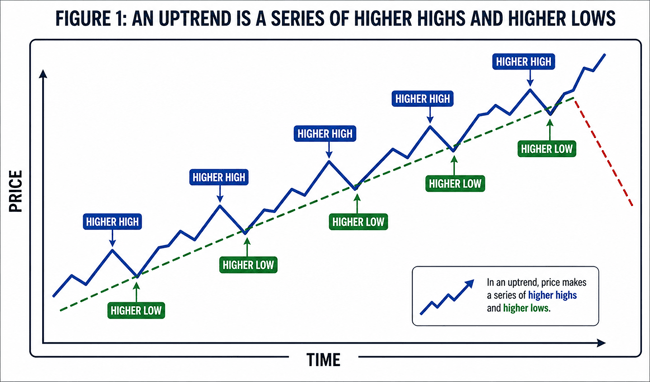
A forex trend is a sustained movement in the exchange rate of one currency pair. In an uptrend, price generally makes higher highs and higher lows. In a downtrend, price generally makes lower highs and lower lows. In a sideways market, price moves back and forth without clear direction.
Think of a trend like walking uphill or downhill. Even when you walk uphill, each step is not perfectly upward. You pause, stumble, and move slightly sideways, but the overall direction is still higher. Forex prices behave in a similar way. A clean trend usually has pushes in the trend direction and pullbacks against it.
The practical job of a trader is not to label every tiny candle. The job is to answer three questions: Is there a clear direction? Where could I enter without chasing? Where would I be wrong?
3. How trend-following forex strategies work
A trend-following strategy normally has five parts: trend filter, setup, entry trigger, stop loss, and exit plan. The trend filter tells you whether you should be looking for buys, sells, or no trade. The setup gives you a location, such as a pullback to a moving average or support area. The entry trigger gives you a specific reason to act. The stop loss defines the point where the idea is no longer valid. The exit plan decides how profit will be taken or protected.
A beginner-friendly example is: trade only in the direction of the 50-period moving average; wait for price to pull back near that average; enter only after a bullish candle closes in an uptrend or a bearish candle closes in a downtrend; place the stop beyond the recent swing; take partial profit at a planned level or trail the stop as the trend continues.
The strategy is not meant to win every time. It is meant to keep you out of random guessing and force every trade to have a reason. Experienced traders often say the biggest benefit of a trading strategy is not that it predicts the future; it reduces emotional decisions.
4. Why traders use trend-following in forex
Forex markets can trend because of interest-rate expectations, central bank policy, inflation data, economic growth differences, risk sentiment, commodity prices, and geopolitical events. When traders around the world keep adjusting to the same major theme, a currency pair can continue in one direction for days, weeks, or months.
Trend-following appeals to beginners because the basic concept is visual. You can look at a chart and see whether price is broadly rising, falling, or ranging. It also appeals to experienced traders because it naturally respects momentum. When a market is strong, trend following avoids the common beginner mistake of repeatedly selling just because the price “looks too high.”
The weakness is that trends are easiest to see after they have already started. Late entries can be painful. That is why most practical trend strategies use pullbacks, breakouts, or moving average filters instead of buying every green candle or selling every red candle.
5. The three market conditions every beginner must recognize
Before you use any forex trading strategy, learn to separate trending markets from ranging markets. A trend-following strategy usually performs best when price has direction. It usually performs worst when price is trapped between support and resistance and keeps reversing.
| Market condition | What it looks like | What a beginner should usually do |
|---|---|---|
| Uptrend | Higher highs, higher lows, price often above key moving averages. | Look for buying opportunities after pullbacks; avoid random shorts. |
| Downtrend | Lower highs, lower lows, price often below key moving averages. | Look for selling opportunities after rallies; avoid random buys. |
| Range/sideways | Price bounces between a top and bottom area. | Be careful with trend strategies; wait for a breakout or choose no trade. |
6. Common tools used in trend-following forex strategies
You do not need a screen full of indicators. Most beginners do better with a small toolkit they understand deeply. The most common trend-following tools are moving averages, trendlines, price structure, breakouts, the Average Directional Index (ADX), and multi-timeframe analysis.
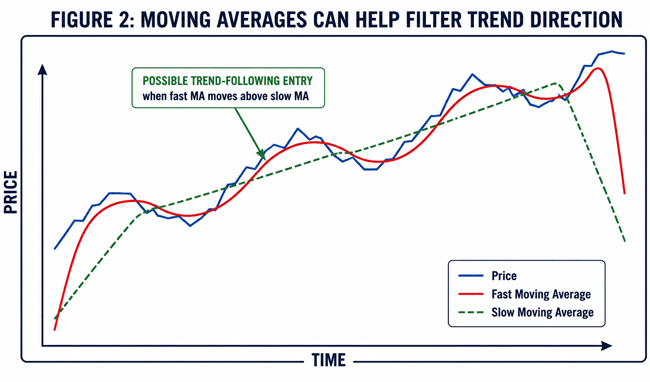
Moving averages smooth out price movement and help you see the direction more clearly. A 50-period moving average can show the medium-term direction, while a 200-period moving average is often used to identify the broader trend. These numbers are not magic; they are popular reference points. Their real value is that they make your decision process more consistent.
Trendlines connect swing lows in an uptrend or swing highs in a downtrend. They can help you see whether buyers or sellers are still defending the trend. Breakouts happen when price pushes beyond an important level. ADX can help estimate trend strength, although it does not tell you direction by itself. Multi-timeframe analysis means checking a higher timeframe first, then using a lower timeframe for a cleaner entry.
| Tool | Best use | Beginner warning |
|---|---|---|
| Moving average | Filtering direction and spotting pullbacks. | A moving average lags, so it can react late after sudden reversals. |
| Trendline | Visualizing support or resistance in a trend. | Do not force a line to fit the chart. If it needs imagination, skip it. |
| Breakout level | Joining a fresh move after price clears a key area. | False breakouts are common, especially around news. |
| ADX | Estimating whether a market has trend strength. | ADX does not say buy or sell; it only measures strength. |
| Higher timeframe | Avoiding trades against the bigger move. | A higher-timeframe trend can still have deep pullbacks. |
Strategy 1: Moving average pullback strategy
This is one of the simplest forex trend trading approaches for beginners. First, choose a timeframe, such as the 1-hour or 4-hour chart. Add a 50-period moving average. If price is above the moving average and the average is sloping upward, you only look for buys. If price is below the moving average and the average is sloping downward, you only look for sells.
The setup appears when price pulls back toward the moving average without breaking the trend structure. The entry trigger could be a bullish candle after the pullback in an uptrend, or a bearish candle after the pullback in a downtrend. The stop loss can go beyond the recent swing low for a buy or beyond the recent swing high for a sell.
A practical EUR/USD example: suppose EUR/USD has been above the 50-period moving average on the 4-hour chart and has made two higher highs. Price pulls back toward the average and then forms a strong bullish candle. A trader may enter after that candle closes, place the stop below the pullback low, and target the previous high or use a trailing stop. The key is that the trade is based on trend, pullback, trigger, and risk, not on hope.
Strategy 2: Breakout trend-following strategy
A breakout strategy tries to enter when price leaves a range and begins a new directional move. For example, GBP/USD may spend several days stuck below a resistance area. If price closes clearly above that area with strong momentum, a trend trader may treat it as a sign that buyers are taking control.
The safest beginner version is to wait for a candle close beyond the breakout level, then wait for a retest of that level. In an upside breakout, old resistance may become support. In a downside breakout, old support may become resistance. Waiting for the retest can reduce chasing, although it can also mean missing some fast moves.
False breakouts happen often. A trader should avoid entering only because price briefly spikes above a line. News releases, low-liquidity sessions, and stop-hunting moves can create breakouts that quickly reverse. A breakout trade still needs a stop loss and a position size that makes sense.
Strategy 3: Higher-timeframe trend, lower-timeframe entry
Many experienced retail traders use a top-down process. They start with a higher timeframe, such as the daily or 4-hour chart, to identify the main trend. Then they move to a lower timeframe, such as the 1-hour or 15-minute chart, to find a cleaner entry.
For example, if USD/JPY is in a clear daily uptrend, the trader may avoid selling on the 15-minute chart. Instead, they wait for a lower-timeframe pullback to finish and look for a buy signal that aligns with the daily direction. This can make the trade easier to manage because the smaller chart gives a tighter entry while the larger chart provides context.
The danger is over-analysis. Beginners sometimes keep switching timeframes until they find one that supports the trade they already want to take. A better rule is: decide the higher timeframe first, write down the direction, and do not argue with yourself after that.
Strategy 4: Trendline bounce strategy
A trendline bounce strategy uses a line drawn under higher lows in an uptrend or above lower highs in a downtrend. The idea is to join the trend when price returns to the trendline and shows signs of continuing.
In an uptrend, a beginner might draw a trendline through two or more swing lows. When price returns to the line, the trader waits for a bullish reaction instead of buying the first touch. In a downtrend, the same idea works in reverse: draw the line across lower highs, wait for price to rally into the line, and look for bearish rejection.
This strategy is simple, but it can become subjective. Two traders may draw different trendlines on the same chart. To reduce confusion, combine the line with price structure or a moving average. If the trendline, moving average, and recent swing structure all point in the same direction, the setup is usually clearer.
7. Risk management: the part that protects beginners from one bad trade
Risk management is the foundation of every honest forex trading guide. A trend-following strategy can still lose money if the trader risks too much, uses excessive leverage, widens stops emotionally, or keeps trading after a series of losses.
A simple beginner approach is to risk a small fixed percentage of account equity per trade, such as 0.5% or 1%. This does not guarantee safety, but it helps prevent one losing trade from destroying the account. The stop loss should be placed where the trade idea is invalid, not where the trader feels comfortable losing money.
Leverage deserves special attention. Forex trading platforms often make it easy to control a large position with a smaller deposit. That can magnify gains, but it also magnifies losses. A beginner should treat leverage as a risk tool, not a shortcut to becoming profitable.
| Account size | Risk per trade | Maximum planned loss on one trade | Why it matters |
|---|---|---|---|
| $500 | 1% | $5 | Keeps losses small while learning the process and platform mechanics. |
| $1,000 | 1% | $10 | Allows practice without emotional pressure from oversized trades. |
| $5,000 | 0.5% | $25 | Lower risk can help when trading volatile pairs or during news-heavy weeks. |
8. Complete practical example: trading a trend step by step
Imagine a beginner is watching EUR/USD on the 4-hour chart. The pair has been making higher highs and higher lows for two weeks. Price is above the 50-period moving average, and the moving average is sloping upward. The trader decides that only buy trades are allowed unless the structure breaks.
Step 1: Identify the trend. The trader marks the last two swing highs and swing lows. Both are rising, so the market is in an uptrend.
Step 2: Wait for a pullback. Instead of buying after a large bullish candle, the trader waits. Price pulls back toward the 50-period moving average and slows down.
Step 3: Wait for confirmation. A bullish candle closes after rejecting the pullback area. This becomes the possible entry trigger.
Step 4: Plan the stop. The recent swing low is 45 pips below the entry. The trader places the stop slightly below that area, not randomly in the middle of market noise.
Step 5: Choose the position size. If the account is $1,000 and the trader wants to risk 1%, the planned risk is $10. The position size should be small enough that a 45-pip stop equals about $10 of loss, not $50 or $100.
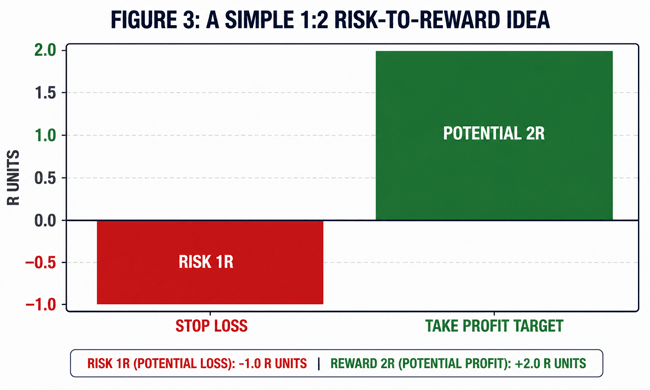
Step 6: Plan the exit. The trader may take partial profit near the previous high and trail the rest, or target a 1:2 risk-to-reward move. If the trade fails, the stop loss is accepted without revenge trading.
This example is intentionally simple. Real markets are messier, spreads differ by broker, slippage can happen, and news can change conditions quickly. But the process is what matters: direction, pullback, trigger, stop, size, exit, review.
9. How beginners can practice safely before using real money
A forex demo account can help beginners learn order types, spreads, lot sizes, stop losses, and the emotional rhythm of watching trades. Demo trading is not identical to live trading because real money creates pressure, but it is still useful for learning the mechanics before risking capital.
A practical practice plan is to choose one strategy, one or two major currency pairs, and one main timeframe. Take at least 30 to 50 demo trades using the same rules. Keep screenshots before and after each trade. Write down why you entered, where the stop was, what happened, and whether you followed your plan.
Do not judge the strategy after three trades. A small sample can be misleading. Also do not change the rules every time a trade loses. Beginners often fail because they keep rebuilding the strategy instead of collecting enough evidence to know whether the rules are actually workable.
10. The trading journal: where experience becomes useful
Many people say they learn from experience, but in trading, experience without review can simply repeat mistakes. A trading journal turns random experience into usable feedback.
At minimum, record the date, pair, timeframe, trend direction, reason for entry, stop size, risk amount, exit reason, result in R, screenshot, and emotional notes. After 20 or 30 trades, patterns become clearer. You may discover that you perform better on 4-hour charts than 5-minute charts, or that most losses happen when you trade before major news.
The journal should not be used to blame yourself. It should be used like a coach. The best question is not, “Was this trade profitable?” The best question is, “Did I follow a repeatable process?”
| Journal field | Example entry |
|---|---|
| Currency pair | EUR/USD |
| Timeframe | 4-hour trend, 1-hour entry |
| Trend direction | Uptrend: higher highs and higher lows |
| Setup | Pullback to the 50-period moving average |
| Entry trigger | Bullish rejection candle close |
| Stop-loss reason | Below the latest swing low |
| Risk | 1% of account |
| Exit plan | Take partial profits at the previous high, then trail the remainder. |
| Mistake to watch | Entered before the candle closed |
11. Trend following vs counter-trend trading vs scalping
Trend following is not the only way to trade forex. Some traders use counter-trend strategies, where they try to catch reversals. Others use scalping, where they attempt to capture very small moves quickly. Each style has different demands.
For beginners, trend following is often easier to explain and journal because it has a clear directional bias. Counter-trend trading can be tempting because reversals look profitable after they happen, but it requires excellent timing and emotional control. Scalping can look exciting, but spreads, commissions, speed, and overtrading can make it difficult for new traders.
| Style | Main idea | Beginner difficulty | Common risk |
|---|---|---|---|
| Trend following | Join an existing move | Moderate | Late entries and sideways markets |
| Counter-trend trading | Trade against the current move expecting reversal | High | Fighting strong momentum |
| Scalping | Take many quick trades for small moves | High | Overtrading, costs, fast losses |
| Swing trading with trend | Hold trades for days while following broader direction | Moderate | Overnight news and swap costs |
12. Common mistakes beginners make with trend-following forex strategies
The first mistake is chasing. A trader sees a currency pair rising quickly and enters after the easy part of the move has already happened. The better habit is to wait for a pullback or a planned breakout confirmation.
The second mistake is using too many indicators. More indicators can make a chart look professional, but they often repeat the same information. A moving average, price structure, and one confirmation tool are usually enough for a beginner.
The third mistake is moving the stop loss. When price approaches the stop, the trader widens it because they do not want to be wrong. This turns a planned small loss into an uncontrolled loss.
The fourth mistake is ignoring news. Trend strategies can be disrupted by central bank decisions, inflation reports, employment data, and unexpected geopolitical events. A beginner does not need to predict the news, but should know when major events are scheduled.
The fifth mistake is believing that a “best forex strategy” exists for everyone. The best strategy for a beginner is usually the one they can understand, test, follow, and manage emotionally.
13. How to choose currency pairs for trend following
Major currency pairs such as EUR/USD, GBP/USD, USD/JPY, USD/CHF, AUD/USD, USD/CAD, and NZD/USD are common starting points because they usually have better liquidity and tighter spreads than many exotic pairs. This does not mean they are safe, but they are often easier for beginners to observe and compare.
Beginners should avoid jumping between too many pairs. Every pair has a personality. GBP pairs can move sharply. JPY pairs may react strongly to risk sentiment and interest-rate expectations. Commodity-linked currencies such as AUD, CAD, and NZD can be influenced by commodity prices and global growth expectations.
A sensible beginner routine is to watch two or three pairs, identify their higher-timeframe trend once per day, and only look for setups that match the plan.
14. Best timeframes for beginner trend traders
Very short timeframes, such as 1-minute or 5-minute charts, can be noisy and emotionally intense. Beginners often make too many decisions too quickly. Higher timeframes, such as the 1-hour, 4-hour, and daily charts, usually give cleaner trend structure and more time to think.
A practical combination is daily chart for direction, 4-hour chart for setup, and 1-hour chart for entry. This is not the only approach, but it helps beginners avoid getting trapped in tiny market noise while still finding reasonable entry points.
The right timeframe also depends on lifestyle. A person with a full-time job may struggle with day trading but may handle swing trading better. A person who can only check charts twice per day should not use a strategy that requires constant screen time.
15. Broker, platform, and account safety considerations
A beginner should choose a regulated forex broker, understand the broker’s fees and spreads, test the trading platform, and read the risk disclosures before funding an account. A good forex trading platform should make it easy to place stop-loss orders, adjust position size, review trade history, and avoid accidental oversized trades.
Be cautious of anyone promising guaranteed profits, secret algorithms, signal groups with luxury marketing, or high-pressure account funding. Honest trading education explains risk first. It does not sell certainty.
Before opening a live account, learn the difference between spread, commission, swap/rollover, margin, leverage, slippage, and stop-out level. These are not boring details. They are the mechanics that decide what actually happens to your money when a trade moves.
16. Beginner checklist before taking a trend-following trade
Use this checklist before every trade. If you cannot answer one of these questions, the setup may not be ready.
- What is the higher-timeframe trend?
- Is the market trending or ranging?
- Am I trading with the trend, not against it?
- Where is the setup location: pullback, breakout, retest, or trendline?
- What exact signal triggers the entry?
- Where is my stop loss, and why does that level prove the trade wrong?
- How much money am I risking if the stop is hit?
- Is the reward potential reasonable compared with the risk?
- Is there major news soon that could create volatility?
- Have I written the trade idea before entering?
■ FAQs
1. What is the easiest trend-following forex strategy for beginners?
A moving average pullback strategy is often one of the easiest to understand. The trader identifies direction with a moving average, waits for price to pull back, enters after confirmation, and places a stop beyond the recent swing. It is simple enough to practice, but it still needs risk management.
2. Can trend following work in forex?
Trend following can work during directional markets, but it can lose money during sideways markets, false breakouts, and sudden reversals. It is a trading method, not a guarantee. Results depend on execution, risk control, costs, market conditions, and the trader’s discipline.
3. Which moving average is best for forex trend trading?
There is no universally best moving average. Many traders use the 50-period and 200-period moving averages because they are widely watched, but the best choice depends on timeframe and testing. Beginners should pick one simple setting and practice it consistently before changing indicators.
4. Is trend following better than scalping?
Trend following is usually easier for beginners to study because it needs fewer fast decisions. Scalping requires speed, tight execution, and strong control over costs and emotions. Neither is automatically better; they fit different personalities and schedules.
5. How much money do beginners need to start trend trading forex?
There is no single amount that makes forex trading safe. Beginners should first use a demo account, learn position sizing, and only risk money they can afford to lose. The focus should be on process and risk control, not on trying to turn a small account into a large account quickly.
6. Should beginners trade forex news with trend-following strategies?
Beginners should be careful around major news. News can accelerate an existing trend, but it can also create sharp spikes, slippage, and false moves. A safer beginner habit is to know the news calendar and avoid opening new trades right before high-impact events.
■ Final thoughts: trade the trend, but respect the risk
Trend-following forex strategies are popular because they give beginners a clear framework: identify direction, wait for a sensible setup, enter with confirmation, control risk, and review the result. The method is easy to understand, but that does not make forex easy.
A beginner should start slowly, use a demo account, keep a trading journal, and avoid anyone who promises guaranteed returns. The goal is not to predict every move. The goal is to build a repeatable decision process that protects you when you are wrong and lets you participate when a real trend develops.
The best trend traders are not the ones who are always confident. They are the ones who stay honest with the chart, honest with risk, and honest with themselves.
Reader Advice: This article is provided for educational and informational purposes only and should not be considered financial, investment, or trading advice. Forex trading involves risk. Before making any trading decisions, take the time to study the forex market thoroughly, understand the risks, and evaluate whether trading is appropriate for your financial situation and experience. Always make informed decisions based on your own research, and consider seeking guidance from a qualified financial professional when needed.