Common Forex Trading Mistakes Beginners Make and How to Avoid Them
Why beginners lose money before they understand the game
Forex trading looks simple from the outside: buy one currency, sell another, and profit if the price moves in your direction. That simple idea is exactly why many beginners enter too quickly. They see a chart moving up and down, hear that the foreign exchange market is active almost all day during the business week, open a forex trading account, and start clicking buy and sell before they understand spread, leverage, margin, news risk, or position sizing.
The most painful forex trading mistakes beginners make are usually not complicated. They are ordinary human mistakes: trading too big, trying to win back losses, copying strangers online, entering without a plan, ignoring fees, or believing that a few profitable demo trades mean they are ready for real money. The goal of this guide is to explain forex in a natural way and show practical habits that can protect a new trader from the common traps.
A good beginner does not need to predict every market move. A good beginner needs to survive long enough to learn. In forex, survival comes from risk management, patience, honesty, and a clear process.
1. What is forex trading in simple words?
Forex means foreign exchange. It is the market where currencies are exchanged. When someone changes rupees into US dollars, euros into pounds, or Japanese yen into Australian dollars, they are participating in the broad foreign exchange system. In retail forex trading, beginners usually do not exchange cash physically. They use an online forex broker or trading platform to speculate on the price movement of a currency pair.
A currency pair compares two currencies. In EUR/USD, the euro is the base currency and the US dollar is the quote currency. If EUR/USD rises, it means the euro has strengthened against the dollar, or the dollar has weakened against the euro. If EUR/USD falls, the euro has weakened against the dollar, or the dollar has strengthened against the euro.
For example, imagine EUR/USD is trading at 1.1000. This means 1 euro is worth about 1.10 US dollars. If the pair moves to 1.1050, it has moved 50 pips upward. If a trader bought EUR/USD before the move, the trade may be profitable before costs. If a trader sold EUR/USD, the trade may lose money.
How forex trading works for a beginner
- Choose a regulated forex broker or trading platform.
- Open a demo account first, or a very small live account after learning the basics.
- Choose a currency pair such as EUR/USD, GBP/USD, USD/JPY, or USD/CAD.
- Decide whether the pair may rise or fall based on a written plan, not a feeling.
- Set position size, stop-loss order, and possible take-profit level before entering.
- Enter the trade, manage it, and record the result in a trading journal.
The part many beginners miss is step five. They focus on direction: “Will the price go up or down?” Experienced traders focus just as much on risk: “How much can I lose if I am wrong?”
■ Key things every beginner should know before placing a trade
1. Spread is a real cost
The spread is the difference between the buy price and the sell price. If EUR/USD has a bid of 1.1000 and an ask of 1.1002, the spread is 2 pips. The trade starts slightly negative because of this cost. A beginner who trades too often may lose money even if their market direction is sometimes correct, simply because spread and commissions keep adding up.
2. Leverage can make small moves dangerous
Leverage lets a trader control a larger position with a smaller amount of money. This sounds attractive, but it can turn a small market movement into a large account loss. The CFTC explains that a 2% margin requirement can allow a trader to open a $100,000 position with $2,000, and that leverage amplifies both gains and losses. This is why beginners must treat leverage as a risk tool, not as free buying power.
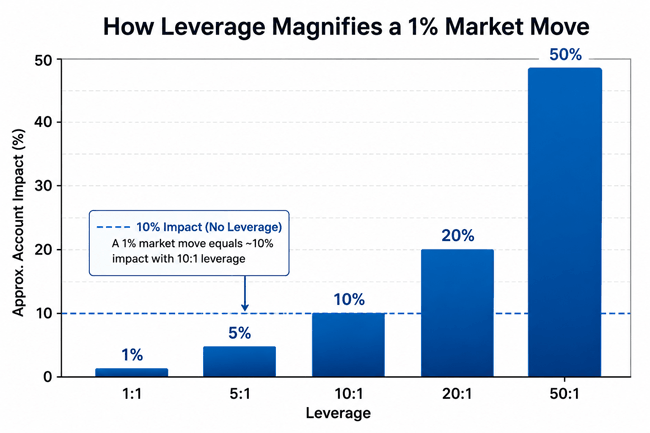
Figure: A simple illustration of how leverage can magnify a small market move. Exact results depend on position size, pair, costs, and account settings.
3. Margin is not a fee; it is money locked to hold a trade
Margin is the amount your broker requires to open and maintain a leveraged trade. If losses grow and your account does not have enough available funds, you may face a margin call or automatic position closure. Beginners often think, “I still have money in the account, so I am safe.” In reality, available margin can disappear quickly when several trades move against you at the same time.
4. A stop-loss order helps, but it is not magic
A stop-loss order is designed to close a trade if price reaches a certain level. It is one of the most useful risk management tools for forex trading for beginners. However, during fast news events, low liquidity, or market gaps, the final exit price may be worse than expected. A stop-loss is a seatbelt, not a guarantee that no injury can happen.
5. Demo trading is useful, but emotions change with real money
A forex demo account teaches platform use, order types, chart reading, and basic strategy testing. But demo trading does not fully copy real emotions. When real money is involved, beginners may close winners too early, move stop-losses, overtrade, or hesitate. Use demo trading to learn the process, then move to small live trades only when your rules are clear.
■ The biggest forex trading mistakes beginners make and how to avoid them
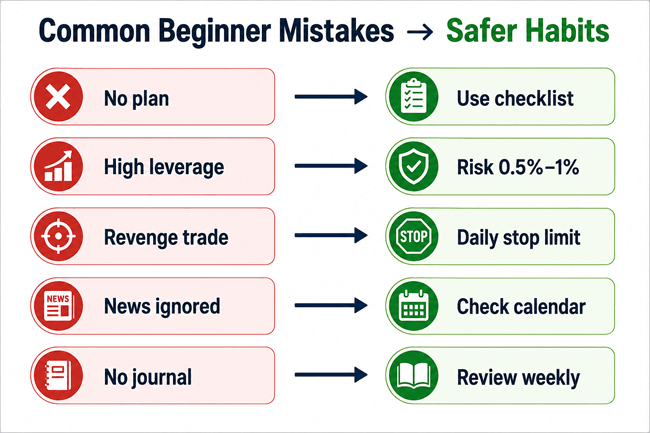
Image. Use this map as a quick reminder: every common mistake needs a safer habit attached to it.
Mistake 1: Starting without understanding what is being traded
Many beginners trade currency pairs like random numbers on a screen. They buy EUR/USD or gold-related CFDs because someone online mentioned them, not because they understand what moves them. Currency prices react to interest rates, inflation data, central bank comments, employment reports, risk sentiment, and geopolitical events.
How to avoid it
- Before trading a pair, write one sentence explaining what could move it this week.
- Learn the major sessions: Asian, London, and New York. Volatility often changes by session.
- Start with one or two major pairs instead of jumping across ten markets.
Mistake 2: Using high leverage too early
High leverage is one of the fastest ways beginners damage their accounts. A trader may think a small account can produce large income if they use enough leverage. In reality, the account becomes fragile. A normal price fluctuation can trigger a stop-out before the trade idea has time to work.
How to avoid it
- Risk a small fixed percentage per trade, commonly 0.5% to 1% while learning.
- Avoid increasing lot size just because the broker allows it.
- Think in account risk, not in potential profit.
Mistake 3: Trading without a written plan
A beginner without a trading plan is usually reacting to candles, emotions, and social media. One trade is based on a moving average, the next on a Telegram signal, the next on a random support line. This makes improvement almost impossible because there is no consistent process to review.
How to avoid it
- Write your entry reason, stop-loss, target, risk amount, and invalidation point before entering.
- Use a checklist. If the setup does not meet the checklist, skip it.
- Do not change the plan in the middle of the trade unless your original rules allow it.
Mistake 4: Moving the stop-loss because you do not want to be wrong
This is one of the most common beginner experiences. The trade goes negative, approaches the stop-loss, and the trader moves the stop farther away. The small planned loss becomes a large emotional loss. The trader was not managing risk; they were avoiding pain.
How to avoid it
- Place the stop where the trade idea is invalid, not where the loss feels comfortable.
- Accept that small losses are normal business costs in trading.
- If you move a stop, only move it to reduce risk according to your pre-written rules.
Mistake 5: Overtrading after a loss or a win
After a loss, beginners often revenge trade to get money back. After a win, they may feel powerful and take low-quality trades. Both reactions come from emotion, not edge. Many accounts are not destroyed by one bad trade; they are destroyed by the five emotional trades that follow it.
How to avoid it
- Set a daily maximum loss limit and stop trading when it is reached.
- Set a maximum number of trades per day.
- After any emotional trade, take a break and write what happened.
Mistake 6: Believing signals, gurus, and screenshots too quickly
Forex social media is full of profit screenshots, luxury images, and “copy my trade” claims. A beginner may feel that everyone is making money except them. In reality, screenshots can be edited, losing trades can be hidden, and risky systems can look profitable for a short period before failing.
How to avoid it
- Do not pay for a signal service unless you can verify long-term, transparent performance and understand the risks.
- Never give account login details to strangers.
- Avoid anyone promising guaranteed returns, fixed daily profit, or no-loss trading.
Mistake 7: Ignoring news and economic calendars
A technical setup can fail quickly during major news. Interest rate decisions, inflation reports, employment data, and central bank speeches can move currency pairs sharply. Beginners may enter a calm-looking trade minutes before high-impact news and then wonder why the spread widened or price jumped.
How to avoid it
- Check an economic calendar before trading.
- Avoid new trades shortly before major news until you understand news volatility.
- Reduce position size or stay out when conditions are unclear.
Mistake 8: Risking money needed for bills or family expenses
Trading with needed money creates pressure. A beginner who needs profit to pay rent or recover debt is more likely to overleverage, ignore stops, and chase losses. Good decisions become difficult when every pip feels personal.
How to avoid it
- Use only risk capital. If losing the money would hurt your life, do not trade it.
- Build savings before treating trading as a serious skill project.
- Separate trading money from emergency money.
Mistake 9: Choosing a broker only because of bonuses or high leverage
A low-quality broker can create problems through poor execution, withdrawal delays, unclear fees, or weak regulation. Beginners sometimes choose the broker with the biggest bonus, the highest leverage, or the flashiest marketing instead of checking safety and transparency.
How to avoid it
- Check the broker regulation and whether the regulator is reputable in your region.
- Read withdrawal rules, fees, spreads, commissions, and negative balance protection policies.
- Test customer support and withdrawals with a small amount before depositing more.
Mistake 10: Not keeping a trading journal
Without a journal, beginners repeat mistakes without seeing patterns. They may think their strategy is bad when the real problem is trading during news, increasing lot size after losses, or entering too late. A journal turns experience into feedback.
How to avoid it
- Record pair, date, setup, entry, stop, target, result, emotion, and lesson.
- Take screenshots before and after the trade.
- Review weekly: which mistakes cost the most money?
■ A practical example: how a beginner should think before entering EUR/USD
Imagine a beginner sees EUR/USD rising and wants to buy. A weak beginner process sounds like this: “It is going up, so I will buy now.” A stronger beginner process sounds like this: “EUR/USD is in an uptrend on my chosen timeframe, price has pulled back to an area I planned earlier, there is no major news in the next hour, and my stop-loss is 25 pips away. I will risk 1% of my account. If price breaks below my level, my idea is wrong and I will exit.”
| Question before trade | Example answer |
|---|---|
| What pair am I trading? | EUR/USD |
| Why am I entering? | Pullback in an existing trend, according to my written strategy |
| Where is my stop-loss? | 25 pips below entry, where the setup becomes invalid |
| How much am I risking? | 1% of account, not more |
| What can go wrong? | News surprise, spread widening, false breakout, emotional exit |
| What will I do if I lose? | Accept the planned loss, journal it, and wait for the next valid setup |
This example is not a trade recommendation. It shows the thinking process: reason, risk, invalidation, and review.
2. Beginner-friendly comparison: gambling mindset vs professional learning mindset
| Situation | Gambling mindset | Learning mindset |
|---|---|---|
| After a loss | Double the lot size to win it back | Stop, record the mistake, wait for the next valid setup |
| After a win | Increase risk because confidence is high | Keep risk stable because one win proves nothing |
| Choosing a broker | Pick the biggest bonus or highest leverage | Check regulation, costs, withdrawals, and platform quality |
| Using a strategy | Change strategy after two losses | Test enough trades to see whether the rules have value |
| Seeing social media profits | Copy the trade immediately | Ask for a verified record, understand the risk, and avoid pressure |
3. How beginners can use forex trading education safely
The safest way to use forex education is to treat it as skill-building, not as a money machine. A beginner should learn terms, practice on demo, observe how news affects pairs, test a simple strategy, and slowly build discipline. The purpose of early trading is not to get rich; it is to discover whether you can follow rules under pressure.
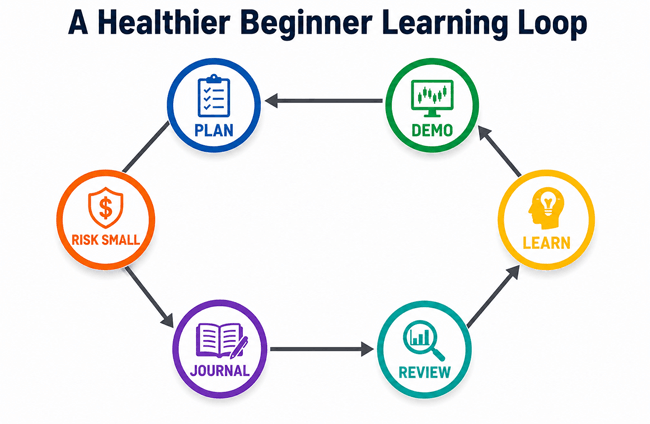
Image. A practical learning loop keeps beginners focused on process instead of random outcomes.
A simple 30-day beginner roadmap
- Days 1-3: Learn currency pairs, pips, lots, spread, leverage, margin, stop-loss, and take-profit.
- Days 4-7: Open a demo account and learn how orders work. Practice entering and closing trades without caring about profit.
- Days 8-14: Choose one simple strategy and write exact rules. Backtest or manually review past chart examples.
- Days 15-21: Demo trade only the written rules. Record every trade in a journal.
- Days 22-30: Review results. Find your biggest behavioral mistake. Do not go live unless you can follow rules consistently.
4. Broker and platform checklist for beginners
Terms like best forex broker, low spread forex broker, forex trading platform, and forex demo account are popular search terms, but beginners should not choose based on marketing alone. The best broker for a beginner is usually the one that is regulated, transparent, easy to understand, and suitable for small-risk learning.
- Regulation: Is the broker authorized by a recognized regulator? Can you verify the license on the regulator website?
- Costs: What are the spreads, commissions, overnight swap fees, deposit fees, and withdrawal fees?
- Execution: Are orders filled fairly during normal market conditions? Are there many complaints about slippage or freezes?
- Risk controls: Does the platform support stop-loss, take-profit, margin alerts, and negative balance protection where applicable?
- Withdrawals: Are withdrawal methods clear, fast, and documented?
- Education: Does the broker provide honest risk education, or does it mostly push deposits and bonuses?
- Demo account: Can you practice on the same platform before trading live?
5. Helpful facts beginners should remember
- Forex is not a salary. Results are uncertain, and losses are part of trading.
- A high win rate does not guarantee profit. A trader can win often but lose big on a few bad trades.
- A low win rate can still be profitable if average wins are larger than average losses, but this requires discipline.
- Trading costs matter more for short-term traders because they enter and exit more often.
- Leverage should be reduced when volatility increases.
- Not trading is also a trading decision. Sitting out protects capital when conditions are poor.
- Consistency means following a process, not making money every day.
■ Frequently asked questions
1. Is forex trading good for beginners?
Forex can be studied by beginners, but live leveraged trading is risky for beginners. The better approach is to learn first, demo trade, understand costs and risk, and start very small if you decide to trade live. A beginner should not treat forex as guaranteed income.
2. How much money should a beginner start with?
There is no perfect amount. The safer answer is: start with education and demo practice. If moving to live trading, use money you can afford to lose and trade small enough that a losing streak will not damage your finances or emotions.
3. What is the biggest mistake in forex trading?
The biggest mistake is usually poor risk management. Many beginners can find good trade ideas sometimes, but they lose because they risk too much, move stops, add to losing trades, or chase losses.
4. Can forex trading make you rich?
Forex marketing often makes this sound easy, but honest trading education should not promise wealth. Forex trading can lead to losses, especially with leverage. A responsible article should focus on risk, process, and realistic expectations.
5. What is the best forex strategy for beginners?
The best beginner strategy is simple, written, testable, and easy to repeat. It may use trend direction, support and resistance, moving averages, or price action. The exact strategy matters less than whether the beginner can follow rules, control risk, and review results.
■ Final checklist: what to do before your next trade
- I know what pair I am trading and why it may move.
- I checked the spread and upcoming news.
- I wrote my entry, stop-loss, target, and invalidation point.
- I calculated the position size before entering.
- I am risking only a small amount of my account.
- I am not trading because of revenge, boredom, fear of missing out, or social media pressure.
- I will accept the result and record it in my journal.
■ Conclusion
Forex trading is easy to enter but difficult to do well. The beginner who treats it like quick money usually learns expensive lessons. The beginner who treats it like a serious skill gives themselves a better chance. The core lesson is simple: protect your capital, keep your risk small, avoid dishonest promises, use regulated services, and measure yourself by process before profit.
The best traders are not the ones who never lose. They are the ones who know how much they can lose before they enter, accept small losses without panic, and keep learning without pretending the market owes them money.
Sources and editorial notes
This article was written as educational content and intentionally avoids guaranteed-profit claims, misleading income promises, or pressure-based recommendations. It follows a people-first approach: practical explanations, risk disclosure, honest limitations, and clear beginner guidance.
- CFTC Customer Advisory, “Eight Things You Should Know Before Trading Forex” - used for margin and leverage risk explanation.
- Google Search Central, “Creating helpful, reliable, people-first content” - used for editorial approach and reader-first structure.
- Investopedia, “How to Start Forex Trading” - used as a general reference for beginner terminology and market mechanics.
- Bank of America Securities, “What is forex trading and how does it work?” - used for a general definition of the foreign exchange market.
Reader Advice: This article is provided for educational and informational purposes only and should not be considered financial, investment, or trading advice. Forex trading involves risk. Before making any trading decisions, take the time to study the forex market thoroughly, understand the risks, and evaluate whether trading is appropriate for your financial situation and experience. Always make informed decisions based on your own research, and consider seeking guidance from a qualified financial professional when needed.