Fundamental Analysis in Forex Trading: A Complete Beginner's Guide
Forex trading can look confusing at first because every chart seems to move for a different reason. One day EUR/USD rises after inflation data. Another day GBP/USD drops after a central bank speech. Then gold, oil, jobs reports, elections, and interest rates all appear to matter at the same time. Fundamental analysis is the method traders use to make sense of this bigger economic story.
In simple words, fundamental analysis in forex trading means studying the real-world forces that can make one currency stronger or weaker than another. Instead of asking only, “What does the chart pattern say?”, a fundamental trader asks, “What is happening in the economy, and why would traders want to buy this currency or sell it?”
This article explains it from zero. You do not need an economics degree. You only need to understand that currencies are affected by money flow. Money usually moves toward countries where investors expect better returns, more stability, stronger growth, or safer conditions. Forex fundamental analysis helps you read those expectations.
1. What is fundamental analysis in forex trading?
Fundamental analysis is the study of economic, financial, and political factors that influence currency prices. In forex, every trade compares two currencies. If you trade EUR/USD, you are comparing the euro against the U.S. dollar. If you trade GBP/JPY, you are comparing the British pound against the Japanese yen.
That comparison is important. A currency does not need to be perfect to rise. It only needs to look stronger than the other currency in the pair. For example, if the U.S. economy is slowing but the eurozone is slowing even faster, the U.S. dollar may still rise against the euro. Beginners often miss this point. Forex is always relative.
2. How fundamental analysis works in the forex market
Fundamental analysis works by building a reasoned view of supply and demand for currencies. When investors expect higher interest rates in a country, its currency may become more attractive because money can earn better returns there. When inflation is too high, political risk increases, or economic growth weakens, traders may reduce exposure to that currency.
The Bank for International Settlements reported that OTC foreign exchange trading reached about $9.6 trillion per day in April 2025, which shows how deep and globally connected the forex market is. Most retail traders are small participants in a very large market, so the goal is not to “control” price. The goal is to understand the forces that larger market participants may already be reacting to.
A beginner-friendly way to think about it is this: fundamental analysis tells you the possible reason behind a move; technical analysis helps you decide where and when to act; risk management decides whether the trade is worth taking at all.
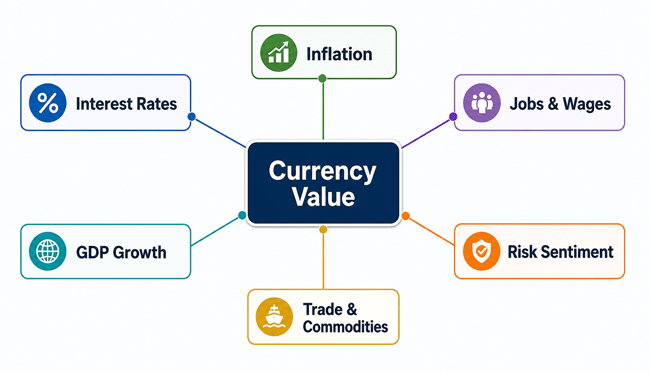
Image. Key fundamental drivers that can influence currency value.
3. The main things beginners should watch
You do not need to follow every economic number in the world. Start with the drivers that repeatedly move major currency pairs.
| Driver | Why it matters | Beginner question to ask | Common market reaction |
|---|---|---|---|
| Interest rates | Higher rates can attract capital, especially when inflation is controlled. | Is this central bank likely to raise, hold, or cut rates? | Expected rate hikes often support the currency; expected cuts often weaken it. |
| Inflation | Inflation changes central-bank policy and purchasing power. | Is inflation too hot, cooling, or below target? | Hot inflation may lift a currency if traders expect rate hikes, but can hurt it if growth is damaged. |
| Jobs data | Employment shows economic strength and wage pressure. | Are more people working and earning more? | Strong jobs can support a currency; weak jobs can increase rate-cut expectations. |
| GDP growth | Growth tells whether the economy is expanding or slowing. | Is this economy stronger than the other country in the pair? | Better growth often supports the currency if it does not create unhealthy inflation. |
| Trade balance | Countries that export more may see steady demand for their currency. | Does this country earn more from exports than it spends on imports? | A better trade outlook can help, especially for export-led economies. |
| Commodity prices | Some currencies are linked to exports such as oil, metals, or agricultural products. | Does this country benefit from rising commodity prices? | Oil strength may help oil-exporter currencies, while hurting oil-importers. |
| Political and geopolitical risk | Uncertainty can change capital flows quickly. | Are investors seeking safety or taking risk? | Safe-haven currencies may rise in stress; risk-sensitive currencies may fall. |
| Central-bank communication | Speeches and meeting statements shape expectations. | Did the central bank sound more hawkish or dovish? | Hawkish language can support a currency; dovish language can pressure it. |
4. The most important idea: interest-rate expectations
If beginners remember only one thing, remember this: forex markets often move because traders are changing their expectations about future interest rates. A rate that is already known is usually priced in. The surprise is what matters.
Suppose the market expects the U.S. Federal Reserve to cut rates soon. If new inflation data comes out higher than expected, traders may decide the Fed cannot cut yet. That can push the U.S. dollar higher because the expected return on dollar assets improves. On the other hand, if inflation cools faster than expected, traders may expect rate cuts, and the dollar may weaken.
This is why a currency can move even when the actual economic number looks “good.” The market is comparing the result with expectations, not with a beginner’s first impression.
5. Hawkish vs dovish: simple meaning
A central bank is called hawkish when it sounds more worried about inflation and more willing to keep interest rates high or raise them. A central bank is called dovish when it sounds more worried about weak growth or unemployment and more willing to cut rates or keep policy easy.
For example, if the Bank of England says inflation is still too high and policy must stay restrictive, traders may read that as hawkish for GBP. If the European Central Bank says growth is weakening and inflation is coming down, traders may read that as dovish for EUR. These words are not trading signals by themselves, but they help you understand the market mood.
6. Economic calendar: the beginner’s daily map
An economic calendar is one of the most practical tools in forex fundamental analysis. It lists upcoming data releases, central-bank decisions, speeches, and other events. Most forex trading platforms and financial news websites offer one.
For beginners, the calendar prevents one of the most common mistakes: entering a trade without realizing a major news event is minutes away. A strong setup on a chart can fail quickly when inflation, jobs data, or a central-bank decision surprises the market.
Focus first on high-impact events: central-bank rate decisions, inflation reports such as CPI or PCE, jobs reports such as nonfarm payrolls, GDP, retail sales, purchasing managers’ indexes, and major political or budget announcements.
6. Technical analysis vs fundamental analysis
Technical analysis studies price charts, trends, support, resistance, patterns, and indicators. Fundamental analysis studies the economic reasons behind currency strength or weakness. The best beginner approach is not to treat them as enemies. They answer different questions.
Fundamentals answer: “Why might this currency move?” Technicals answer: “Where is price reacting?” Risk management answers: “How much can I lose if I am wrong?”
A trader might believe USD should strengthen because U.S. inflation is sticky and the Fed sounds hawkish. But instead of buying USD randomly, the trader may wait for the chart to break a key level or pull back to a better entry. This is how many practical traders combine both methods.
Fundamental analysis vs technical analysis: quick comparison
| Point | Fundamental analysis | Technical analysis |
|---|---|---|
| Main focus | Economic story and currency strength | Chart behavior and price levels |
| Best for | Understanding bias, big themes, and news reactions | Timing entries, exits, and trade management |
| Tools | Economic calendar, central-bank statements, inflation, jobs, GDP | Candlesticks, trendlines, support/resistance, indicators |
| Beginner danger | Overthinking news or trading every headline | Ignoring major data releases or central-bank risk |
| Best use | Build a directional thesis | Wait for confirmation and define risk |
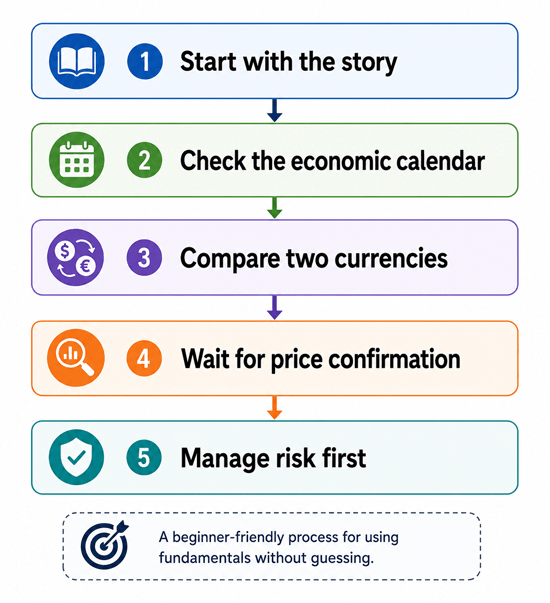
Image. A simple process beginners can follow before placing a forex trade.
7. A practical 5-step method for beginners
Step 1: Start with one currency pair
Do not try to analyze twenty markets. Pick one major pair such as EUR/USD, GBP/USD, USD/JPY, AUD/USD, or USD/CAD. Major pairs usually have more news coverage, tighter spreads, and more educational material. Learn how the two economies behave before adding more pairs.
Step 2: Ask which currency has the stronger story
Write a one-sentence view. Example: “USD looks stronger than EUR because U.S. inflation is sticky and the Fed may stay hawkish while eurozone growth is weak.” This forces you to think in relative terms.
Step 3: Check the economic calendar
Look for upcoming high-impact events for both currencies. If a major release is close, consider waiting. Many experienced traders avoid opening new beginner-level positions right before unpredictable news because spreads and volatility can jump.
Step 4: Look at the chart for confirmation
Fundamentals can be right but early. Price may move against you before the larger story plays out. A chart can help you avoid chasing. Look for trend direction, support and resistance, and whether price is already overextended.
Step 5: Plan the risk before the reward
Decide where your idea is wrong. Use a stop-loss if trading CFDs or spot forex through a platform. Keep position size small enough that one loss is not emotionally or financially damaging. Fundamental analysis should never become an excuse to hold a losing trade forever.
8. Practical example: using fundamentals on EUR/USD
Imagine you are watching EUR/USD. You read that U.S. inflation came in higher than expected, U.S. job growth is still strong, and the Federal Reserve sounds less willing to cut interest rates. At the same time, eurozone growth is weak and the European Central Bank sounds more open to cutting rates.
A beginner might summarize the situation like this: USD has a stronger fundamental story than EUR. That creates a bearish bias for EUR/USD, because EUR/USD falls when the euro weakens against the dollar or when the dollar strengthens against the euro.
But a bias is not a trade. A practical trader may wait for EUR/USD to fail at resistance, break below support, or pull back after an initial move. The trader may also check whether a major ECB speech or U.S. data release is coming soon. If the trade is taken, the stop-loss should be placed where the original idea no longer makes sense, not at a random distance.
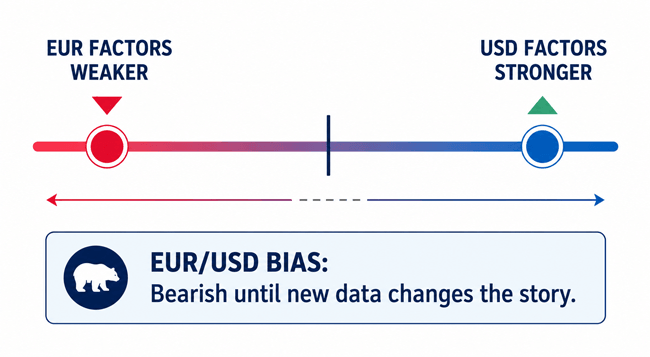
Image. Example of comparing two sides of a currency pair before forming a bias.
9. What beginners often get wrong about forex news
Beginners often believe that good news always makes a currency rise and bad news always makes it fall. Real markets are more complicated. A report can be good but still weaker than expected. A central bank can raise rates but sound dovish about the future. A currency can rise before the news and fall after it because traders “buy the rumor, sell the fact.”
Another mistake is trading the first candle after news. The first move can be emotional and spread-heavy. Price may spike both ways before choosing direction. Many experienced traders wait for the market to settle, then look for a cleaner opportunity.
10. How to read a central-bank decision like a beginner
Start with three questions. First, did the central bank raise, hold, or cut rates? Second, was that decision expected? Third, what did the statement say about the future?
The third question often matters most. If a central bank raises rates but says inflation is cooling and future hikes are unlikely, the currency may fall. If it holds rates steady but warns inflation remains too high, the currency may rise. Forex markets care about the path ahead.
11. How inflation affects currencies
Inflation is the rate at which prices rise. Moderate inflation is normal, but high inflation can hurt consumers and businesses. Central banks often raise interest rates to control inflation. That is why inflation reports can move forex pairs sharply.
A simple beginner rule: inflation that is higher than expected may support a currency if traders believe the central bank will raise rates or delay cuts. But if inflation is seen as damaging the economy or out of control, it can hurt confidence. Context matters.
12. How employment data affects currencies
Jobs data matters because strong employment usually means households have income, spending may remain firm, and inflation pressure may continue. Weak employment can signal economic slowdown and possible rate cuts.
For the U.S. dollar, the nonfarm payrolls report is one of the most watched releases. But beginners should not focus only on the headline jobs number. Wage growth and unemployment can matter too. A strong headline with weak wages may be interpreted differently from a strong headline with rising wages.
13. How GDP and growth affect currencies
GDP shows the size and growth rate of an economy. Strong growth can attract investment, support tax revenues, and make a currency more attractive. But if growth comes with high inflation, the market may focus on central-bank pressure. If growth is weak, traders may expect rate cuts or lower investment returns.
14. Risk sentiment: why currencies move when traders feel fear or confidence
Sometimes currencies move less because of local data and more because of global mood. During market stress, investors may seek currencies seen as safer or more liquid. During optimistic periods, traders may buy higher-yielding or commodity-linked currencies.
This is why forex traders watch stock markets, bond yields, oil prices, geopolitical headlines, and global risk appetite. A beginner does not need to become an expert in everything, but should understand that currency pairs do not move in isolation.
15. Choosing a forex broker and platform responsibly
Because forex trading involves real money and leverage, the choice of forex broker matters. Beginners should look for a regulated forex broker, clear pricing, transparent spreads and commissions, risk warnings, negative balance protection where available, and easy withdrawal policies. Be careful with offshore brokers promoted through social media, especially if they promise guaranteed returns, unusually high bonuses, or pressure you to deposit quickly.
A good forex trading platform should make it easy to see spreads, order types, margin requirements, economic calendar events, and account history. It should not encourage reckless overtrading. High-paying keywords such as best forex broker, forex trading account, online forex trading platform, forex signals, forex education, and currency trading strategy can appear naturally in content, but the article should never pretend that a broker, signal, or strategy can remove risk.
16. Leverage: the tool that can hurt beginners fastest
Leverage allows a trader to control a larger position with a smaller amount of capital. It can increase profits, but it also increases losses. For beginners, leverage is usually the biggest danger because a small market move can create a large account loss.
A simple example: if you use 30:1 leverage, a 1% move against the position can have a much larger impact on your margin than a beginner expects. This is why responsible forex education should explain position size, margin, stop-losses, and worst-case scenarios before discussing profit targets.
17. Can beginners trade using only fundamental analysis?
Some traders focus heavily on fundamentals, but beginners usually do better by combining fundamentals with price behavior and strict risk management. Fundamentals can explain why a currency may be strong or weak, but they do not always provide a precise entry. Markets can remain irrational longer than a small account can survive.
A sensible beginner goal is not to predict every move. It is to avoid obviously careless trades: trading against a strong economic theme without reason, ignoring major news, overleveraging, or believing social media claims without checking data.
18. A beginner checklist before placing a fundamental forex trade
Before entering a trade, ask: What pair am I trading? Which currency is fundamentally stronger? What data or central-bank event supports that view? Is a high-impact event coming soon? Does the chart support the idea or am I chasing? Where is my stop-loss? What percentage of my account is at risk? What would make me change my mind?
If you cannot answer these questions clearly, the trade is probably not ready.
19. Realistic expectations: what experienced traders learn over time
People with real market experience often say the same things in different words: the market does not owe you a clean reaction, news can be priced in before you see it, and being right about the economy is not the same as making money on a trade. A trader can correctly predict that a central bank will become hawkish and still lose money by entering too late, using too much leverage, or placing the stop-loss poorly.
The practical lesson is humility. Fundamental analysis is a decision-making tool, not a crystal ball. Its purpose is to improve your reasoning, filter low-quality trades, and help you understand why markets move.
20. Common beginner mistakes and how to avoid them
- Mistake one: trading every news release. Better approach: choose only the events you understand and wait for cleaner setups.
- Mistake two: reading only one currency. Better approach: compare both currencies in the pair.
- Mistake three: confusing a long-term economic view with a short-term trade. Better approach: match your analysis to your timeframe.
- Mistake four: increasing position size after losses. Better approach: reduce risk when emotions rise.
- Mistake five: trusting guaranteed-profit claims. Better approach: use regulated providers, verify claims, and remember that honest forex trading education discusses losses openly.
21. Final thoughts
Fundamental analysis in forex trading is about understanding the economic story behind currency movement. For beginners, the key is to keep it simple: compare two currencies, watch interest-rate expectations, follow high-impact data, respect central banks, use the economic calendar, and protect your account from excessive leverage.
The best traders are not the ones who know every economic statistic. They are the ones who can build a clear thesis, wait patiently, manage risk, and admit when the market proves them wrong. If you learn fundamentals this way, you will approach forex trading with more discipline, more context, and fewer emotional decisions.
■ Frequently asked questions
1. What is fundamental analysis in forex trading in simple words?
It means studying economic news, interest rates, inflation, jobs, central banks, and political events to understand why one currency may become stronger or weaker than another.
2. Is fundamental analysis good for beginners?
Yes, if it is learned slowly and used with risk management. Beginners should avoid trying to trade every news event and focus first on major themes such as interest rates and central-bank expectations.
10. Which news affects forex the most?
Central-bank rate decisions, inflation data, employment reports, GDP, retail sales, PMI data, and major geopolitical events are often important. The exact impact depends on expectations and market context.
11. Do I need technical analysis too?
Most beginners benefit from using both. Fundamentals help explain the reason for a move, while technical analysis can help with timing, entries, exits, and risk levels.
12. Can forex fundamental analysis guarantee profit?
No. Nothing can guarantee profits in forex trading. The CFTC and other regulators warn that retail forex trading involves significant risk, especially with leverage and unregistered offshore dealers.
13. How much money should a beginner risk?
This is personal and depends on financial situation, but the educational principle is to risk only a small amount that you can afford to lose. Never trade with rent money, emergency savings, borrowed money, or funds needed for daily life.
14. What is the best forex trading platform for fundamental analysis?
The best platform is one that is regulated in your jurisdiction, transparent about costs, reliable during news events, and includes useful tools such as an economic calendar, clear margin information, order history, and risk controls. Avoid judging a platform only by bonuses or high leverage.
Sources and editorial notes
- Bank for International Settlements, 2025 Triennial Central Bank Survey: Reported OTC FX market turnover of about $9.6 trillion per day in April 2025.
- U.S. Commodity Futures Trading Commission, “Eight Things You Should Know Before Trading Forex”: Used for risk and fraud awareness, especially warnings about unregistered offshore forex dealers.
- National Futures Association Forex Regulatory Guide: Used for the principle that retail forex customers should receive understandable written risk disclosures.
- Federal Reserve monetary policy resources: Used for general explanation of how central-bank policy goals and interest-rate communication affect markets.
- Federal Reserve Economic Data (FRED), St. Louis Fed: Recommended as a public source for economic time series beginners can use for research.
Reader Advice: This article is provided for educational and informational purposes only and should not be considered financial, investment, or trading advice. Forex trading involves risk. Before making any trading decisions, take the time to study the forex market thoroughly, understand the risks, and evaluate whether trading is appropriate for your financial situation and experience. Always make informed decisions based on your own research, and consider seeking guidance from a qualified financial professional when needed.