How Central Banks Influence Forex Markets: Interest Rates & Currency Prices
1. Why central banks matter in forex
Forex prices can look confusing at first. A beginner opens a EUR/USD chart, sees the price moving up and down every second, and may think the market is random. But behind many of the biggest currency moves, there is usually one simple question: what is the central bank likely to do next?
A central bank is not just another financial institution. It is the authority that helps manage money, inflation, interest rates and financial stability in a country or region. The Federal Reserve influences the US dollar. The European Central Bank influences the euro. The Bank of England influences the British pound. The Bank of Japan influences the yen. When these institutions change interest rates, speak about inflation, or signal future policy, forex traders react quickly.
For a beginner, the important point is not to memorize every economic theory. The practical point is this: currencies often move because investors are constantly comparing countries. They compare interest rates, inflation, growth, safety, political risk and future expectations. A central bank affects many of those comparisons.
This guide explains central banks in a very easy and natural way. It starts from zero, uses simple examples, and shows how a beginner can use central bank information responsibly. It also avoids the dangerous idea that any one announcement is a guaranteed trading signal. Forex trading involves real risk, and honest education is more useful than hype.
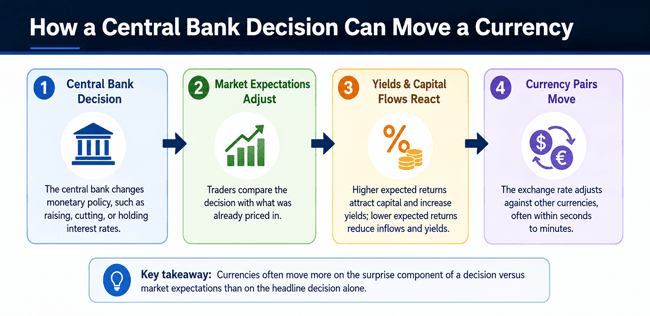
2. What is a central bank?
A central bank is the main monetary authority of a country or currency area. In normal everyday language, it is the institution that helps protect the value and functioning of money. It does not usually serve ordinary customers like a retail bank. You do not normally open a personal savings account at a central bank. Instead, it works with the banking system, financial markets and government framework to keep money and credit conditions stable.
The exact goals differ by country. The Federal Reserve describes its monetary policy role as influencing short-term interest rates and broader financial conditions to help move the economy toward maximum employment and stable prices. The European Central Bank says its main aim is price stability for people in the euro area. The IMF explains monetary policy as a way central banks use tools such as interest rates to adjust money and credit conditions and help stabilize prices and output.
In beginner terms, a central bank is like the thermostat of the economy. If inflation is too hot, it may raise interest rates to cool spending and borrowing. If the economy is too cold, it may lower rates or use other tools to support lending and demand. This thermostat is imperfect, and it works with delays, but the market watches it closely because it changes the reward for holding one currency compared with another.
3. Why do central banks influence forex markets?
A currency is partly a price and partly a confidence signal. When people buy the US dollar, euro, pound, yen, Swiss franc or any other currency, they are not only buying paper or numbers in an account. They are choosing exposure to that economy, its interest rates, its inflation risk, its political stability and its central bank credibility.
Central banks influence forex mainly through five channels:
- Interest rates: Higher rates can make a currency more attractive because cash and short-term assets in that currency may offer better returns. Lower rates can reduce that attraction.
- Expectations: Markets move before decisions. If traders expect a rate hike, the currency may rise before the official announcement. If the announcement simply confirms what everyone expected, the reaction may be small.
- Inflation control: If a central bank is trusted to fight inflation, the currency may be seen as more stable. If inflation looks uncontrolled, confidence can fall.
- Communication: Speeches, meeting minutes, forecasts and press conferences can change the market view even when rates do not change.
- Crisis support: During stress, central banks may provide liquidity, intervene in markets, or coordinate with other institutions. These actions can affect currency supply, demand and confidence.
4. The main tools central banks use
Central banks have several tools. A beginner does not need to know every operational detail, but should understand the basic purpose of each tool.
| Tool | Simple meaning | How it can affect forex |
|---|---|---|
| Policy interest rate | The main rate or target range used to guide short-term borrowing costs. | A higher expected rate can support a currency if other factors are stable; a lower expected rate can weaken it. |
| Open market operations | Buying or selling securities to manage liquidity and keep market rates near the target. | Changes liquidity and short-term rates, which can influence currency demand. |
| Reserve requirements / bank liquidity rules | Rules affecting how much money banks must hold or how easily they can lend. | Can influence credit growth, inflation expectations, and confidence. |
| Quantitative easing (QE) | Large-scale asset purchases, often used when rates are very low. | May weaken a currency if it increases liquidity and lowers yields, although risk sentiment can change the result. |
| Quantitative tightening (QT) | Reducing the central bank balance sheet or letting assets mature. | May support a currency if it tightens financial conditions, but growth concerns can offset it. |
| Forward guidance | Hints or statements about future policy direction. | Can move forex immediately because traders reprice future interest-rate expectations. |
| Currency intervention | Direct buying or selling of currencies, usually by or with official authorities. | Can cause sharp moves, especially if markets believe the intervention will be repeated or backed by policy. |
The Federal Reserve Bank of St. Louis describes modern Fed implementation as relying on administered rates, including interest on reserve balances, the overnight reverse repurchase facility and the discount rate, with open market operations supporting effective rate control. A beginner does not have to trade those tools directly. The practical lesson is that central banks have more than one lever, and the market listens to all of them.
5. Interest rates: the easiest starting point for beginners
Interest rates are the first thing most forex beginners should learn because they connect directly to currency demand. Imagine two countries. Country A offers 5% short-term interest rates. Country B offers 2%. If investors believe both are safe and inflation is similar, many may prefer to hold money in Country A because it pays more. That extra demand can support Currency A.
But the real world is not that clean. Higher rates do not always mean a stronger currency. If rates are high because inflation is out of control, investors may avoid that currency. If a central bank raises rates but signals it is almost finished, the currency may fall. If a lower-rate country is seen as safer during a crisis, its currency may strengthen anyway.
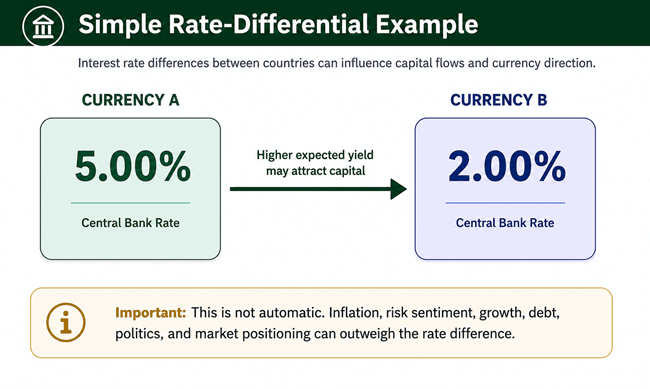
Image: Graphic comparing two currencies with different central bank interest rates and explaining that higher expected yield may attract capital, but other risks matter.
Suppose EUR/USD is trading at 1.0800. Traders expect the Federal Reserve to keep rates unchanged and the ECB to sound more cautious. If the Fed unexpectedly signals higher rates for longer while the ECB sounds ready to cut, the US dollar may strengthen and EUR/USD may fall. The reason is not magic. The market has repriced the future return of holding dollars versus euros.
6. Hawkish vs dovish: simple meaning
Forex traders use two words all the time: hawkish and dovish. They sound complicated, but the idea is simple.
| Word | Easy meaning | Typical forex interpretation |
|---|---|---|
| Hawkish | The central bank sounds more worried about inflation and more willing to raise rates or keep rates high. | Often supportive for the currency, especially if the market was not expecting it. |
| Dovish | The central bank sounds more worried about weak growth and more willing to cut rates or keep rates low. | Often negative for the currency, especially if the market expected a stronger stance. |
| Neutral / balanced | The central bank avoids strong signals and says it will depend on data. | Market reaction may be smaller unless traders expected a clear change. |
A beginner mistake is to treat these words as automatic buy or sell signals. They are not. A hawkish central bank can still see its currency fall if the market was already positioned for an even more hawkish message. A dovish message can still lead to a currency rally if traders had expected something worse.
7. Inflation: why central banks care so much
Inflation means prices are rising over time. A little inflation is normal in many economies. Too much inflation reduces purchasing power, hurts savings, makes planning difficult and can damage confidence in a currency. That is why many central banks focus heavily on price stability.
In forex, inflation matters because it affects both interest-rate expectations and real returns. If a country offers 6% interest but inflation is 8%, the real return is negative. If another country offers 3% interest with inflation near 2%, investors may see it as more stable. This is why traders look at inflation data such as CPI, core CPI, wage growth and inflation expectations.
Central banks also care about credibility. If traders believe the central bank will act firmly to bring inflation down, the currency can gain support. If traders believe the central bank is behind the curve, political pressure is too strong, or inflation expectations are becoming unanchored, the currency can suffer.
8. Economic calendars: where beginners should look
A practical beginner habit is to check an economic calendar before trading. Many big forex moves happen around scheduled events. You do not need to trade the event. In fact, beginners may be safer avoiding the minutes around major announcements until they understand volatility. But you should know when the events are coming.
- Central bank rate decisions and statements
- Central bank press conferences
- Meeting minutes
- Inflation reports such as CPI and PCE inflation
- Employment reports such as nonfarm payrolls or unemployment data
- GDP growth reports
- Retail sales, PMI surveys and wage data
- Speeches from central bank governors or voting members
The key is to compare the result with expectations. For example, if inflation comes in at 3.4% but the market expected 3.0%, that surprise can change rate expectations. If inflation comes in exactly as expected, the reaction may be smaller unless the details are surprising.
9. How central bank announcements move prices in real time
During a major central bank announcement, the market can move in phases. First comes the headline decision: rate hike, rate cut or no change. Then algorithms and traders scan the statement for wording changes. Then the press conference begins, and the currency may reverse if the central bank governor explains the decision differently than expected. Later, bond yields, stock markets and analyst reports can create a second wave of movement.
This is why beginners often feel trapped during news. A candle may jump up, then down, then up again. Spreads can widen, orders may slip, and emotions rise. Professional traders often reduce size around major news or wait until the first reaction settles. Some beginners think the fastest trader wins. In reality, surviving the volatility matters more than catching every move.
10. A practical example: reading a central bank decision
Imagine the Bank of England has a policy meeting today. The market expects rates to stay unchanged. Before the meeting, GBP/USD is quiet because traders are waiting. Here is how a beginner can read the event step by step.
- Check the expectation: Was the market expecting a hold, hike or cut?
- Read the headline: Did the actual decision match the expectation?
- Look at the vote split: Was the decision unanimous or divided? A closer vote can signal future change.
- Read the statement tone: Did the central bank sound more worried about inflation or growth?
- Watch the press conference: Did the governor push back against market expectations?
- Check yields: Did two-year government bond yields rise or fall after the announcement? Short-term yields often reflect policy expectations.
- Check the chart after the first reaction: Did price hold the move, reverse, or form a range?
If the bank holds rates but three members vote for a hike, the market may see the decision as hawkish. If the bank holds rates but says inflation is falling faster than expected, the market may see it as dovish. The same headline can produce different reactions depending on the details.
11. Central banks and currency pairs: what changes when two currencies are involved?
Forex is always relative. EUR/USD is not just about the euro and not just about the dollar. It is the euro compared with the dollar. USD/JPY is the dollar compared with the yen. GBP/USD is the pound compared with the dollar. This is why traders compare two central banks, not just one.
| Currency pair | Main central banks to watch | Beginner focus |
|---|---|---|
| EUR/USD | European Central Bank and Federal Reserve | Compare ECB and Fed rate paths, inflation outlooks, and growth differences. |
| GBP/USD | Bank of England and Federal Reserve | Compare UK inflation and wage pressure with US policy expectations. |
| USD/JPY | Federal Reserve and Bank of Japan | Watch rate differentials, Japanese intervention risk, and global risk sentiment. |
| AUD/USD | Reserve Bank of Australia and Federal Reserve | Watch commodity demand, China-linked sentiment, and relative rate expectations. |
| USD/CAD | Federal Reserve and Bank of Canada | Watch oil prices, Canadian growth, and US-Canada rate spreads. |
| USD/CHF | Federal Reserve and Swiss National Bank | Watch safe-haven demand and inflation differences. |
A simple beginner question is: which central bank is becoming more hawkish relative to the other? If the Fed is turning hawkish while the ECB is turning dovish, the dollar may gain against the euro. If the ECB becomes less dovish while the Fed sounds ready to cut, EUR/USD may rise. Again, this is about expectations and relative change.
12. Why the market sometimes does the opposite of what beginners expect
One of the most confusing forex experiences is when a central bank raises rates and the currency falls. This can happen for several reasons.
- The hike was already priced in, so traders “sell the fact” after buying earlier.
- The central bank raises rates but says future hikes are unlikely.
- The economy looks weak, so the market sees the hike as a policy mistake.
- Inflation is still higher than the rate increase, so real returns remain unattractive.
- Large funds were already heavily positioned in one direction and use the news to take profit.
- Another central bank is expected to move even more aggressively.
This is why professional analysis often says “the reaction function matters.” That means traders are trying to understand what kind of data will make the central bank change policy next. The decision itself matters, but the future path matters even more.
13. How beginners can use central bank information safely
Central bank analysis is useful even if you never trade news directly. It can help you understand the background trend, avoid surprise volatility and build better trading plans. Here are practical ways to use it.
- Build a weekly central bank map: Write down the current policy rate, inflation trend, last meeting tone and next meeting date for each major central bank.
- Mark high-risk events: Add rate decisions, CPI reports and employment data to your trading calendar.
- Avoid blind entries before major news: If a rate decision is minutes away, spreads and volatility can become dangerous.
- Compare two currencies: For each pair, ask which central bank is more likely to tighten or ease.
- Use scenarios, not predictions: Prepare “if this, then that” plans instead of assuming one outcome.
- Respect risk: Use small position sizes, clear invalidation levels and avoid increasing risk after a loss.
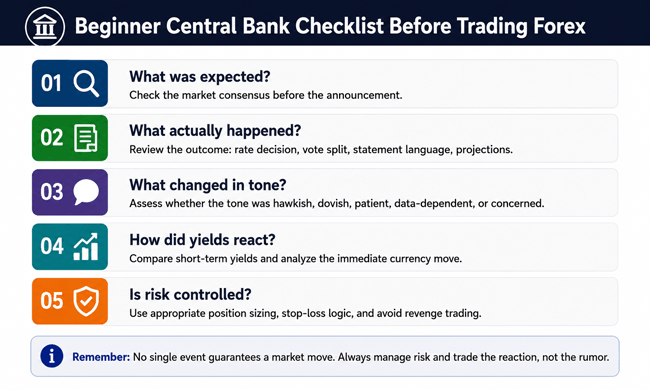
Image: Beginner checklist for reviewing central bank decisions before trading forex.
14. A beginner-friendly central bank worksheet
Readers can copy this worksheet before major central bank events. It encourages preparation instead of emotional trading.
| Question | Your notes |
|---|---|
| Which central bank is meeting? | |
| Which currency pairs can be affected? | |
| What does the market expect? | |
| What are the latest inflation and jobs trends? | |
| What would be hawkish? | |
| What would be dovish? | |
| Where is the nearest major support/resistance? | |
| Will I trade before, during, or after the announcement? | |
| What is my maximum acceptable risk? | |
| What would make me stay out? |
15. Central bank credibility: the hidden force behind currencies
Credibility means the market believes the central bank can and will do what it says. A credible central bank does not need to surprise the market constantly. Its words carry weight because investors believe its framework. A less credible central bank may need stronger action to get the same market reaction.
For example, if inflation rises and a trusted central bank says it will keep policy tight until inflation returns to target, markets may believe it. If a less trusted central bank says the same thing but has a history of giving in to political pressure, traders may doubt it. That doubt can weaken the currency or increase volatility.
Credibility is especially important in emerging-market currencies, where inflation risk, foreign debt, political pressure and reserve levels can play a bigger role. High interest rates may attract traders, but they can also signal high risk. Beginners should be very careful with exotic pairs because spreads, volatility and sudden policy moves can be much larger than in major pairs.
16. Central banks, carry trade and risk sentiment
A carry trade means borrowing or selling a lower-yielding currency and buying a higher-yielding currency to earn the interest-rate difference. This strategy can work for long periods when markets are calm, but it can unwind violently when fear rises. The higher-yielding currency may fall quickly as traders rush to reduce risk.
Central banks influence carry trades through interest rates, but global risk sentiment decides whether traders want the risk. A high-yielding currency can strengthen when markets are calm and weaken sharply during panic. That is why beginners should not look at yield alone. They should also ask: is the market in a risk-on or risk-off mood?
17. Central bank communication: speeches, minutes and forward guidance
Not every important central bank event is a rate decision. Speeches and meeting minutes can also move forex. A single phrase can change expectations. For example, “inflation risks remain elevated” may sound hawkish. “Policy is sufficiently restrictive” may suggest the central bank is closer to pausing or cutting. “Data dependent” means the next decision will rely heavily on upcoming economic reports.
Forward guidance is when a central bank gives hints about future policy. Strong forward guidance can reduce uncertainty, but it can also limit flexibility. Some central banks prefer clear communication, while others prefer more optionality. For forex traders, the practical task is to compare today’s wording with the previous meeting. The change in wording is often more important than the wording alone.
18. Forex broker platforms and central bank tools: what to look for
Many readers searching this topic are also comparing forex broker platforms, trading apps or market analysis tools. A helpful platform is not the one that promises easy profits. A helpful platform gives clean information, transparent costs and risk controls. When reviewing tools, beginners should look for:
- A reliable economic calendar with central bank meetings and inflation data
- Clear spread and commission information
- Risk management tools such as stop-loss, take-profit and position-size calculators
- Educational material that explains risk instead of promising guaranteed returns
- Demo account access for practice
- Regulatory information and transparent company details
- News feeds that separate facts from opinion
High-paying commercial keywords such as best forex broker for beginners, forex trading platform, currency trading account, forex signals, economic calendar, trading education and risk management tools can be used naturally in an article, but they should not be used to push readers into unsafe decisions. A Google-policy-safe finance article should help readers understand risk and make informed choices.
19. Common beginner mistakes with central bank news
- Trading only the headline without reading the statement or press conference.
- Ignoring expectations and assuming a rate hike always strengthens a currency.
- Using too much leverage during high-volatility news.
- Entering after a huge candle because of fear of missing out.
- Moving stop-losses wider when the trade goes wrong.
- Confusing personal opinion with market reaction.
- Following social media claims without checking official sources.
- Trading exotic pairs without understanding liquidity and spreads.
- Thinking one central bank event can replace a complete trading plan.
The safest mindset is simple: central bank knowledge is a decision-support tool, not a profit machine. It helps you understand why the market may move, but it does not remove uncertainty.
20. How to explain central banks to a complete beginner in one minute
A central bank is the institution that helps manage the value and stability of money. It changes interest rates and uses other tools to control inflation, support the economy and keep the financial system working. Forex traders care because currencies are compared against each other. If one central bank is expected to keep rates higher than another, its currency may become more attractive. But the market also watches inflation, growth, risk, expectations and credibility. The biggest currency moves often happen when the central bank surprises the market or changes its future guidance.
21. Practical trading scenarios: what a beginner might do
| Scenario | Possible interpretation | Responsible beginner action |
|---|---|---|
| Central bank raises rates, but says future hikes are unlikely. | Headline hawkish, future guidance dovish. Currency may weaken after the initial spike. | Wait for the press conference and observe whether price holds the move. Avoid chasing. |
| Inflation report is much higher than expected before a rate meeting. | Market may price more rate hikes or fewer cuts. | Mark affected pairs and prepare scenarios. Reduce risk before the announcement. |
| Central bank cuts rates during a crisis. | Could be negative for the currency, but safe-haven flows may complicate the reaction. | Avoid assuming one-directional movement. Watch liquidity and spreads. |
| Central bank sounds unexpectedly hawkish while another sounds dovish. | Rate differential may move in favor of the hawkish currency. | Look for confirmation from yields and price structure before entering. |
| No rate change, no new guidance. | Market may be quiet or focus on other data. | Do not force a trade. Review the next inflation or jobs release. |
22. Helpful facts beginners should know
- The forex market is one of the largest financial markets in the world. The BIS Triennial Central Bank Survey reported that 2025 foreign exchange turnover data were released in stages, with final turnover data released with the December 2025 BIS Quarterly Review and settlement data in June 2026.
- Major currencies often react fastest to the expected path of short-term interest rates.
- Two-year government bond yields are often watched because they are sensitive to central bank expectations.
- A currency pair can move even when a central bank does nothing if traders change expectations about the next meeting.
- Official central bank websites are better sources than social media rumors.
- The best forex education focuses on process, risk and evidence, not guaranteed profit claims.
■ FAQ
1. What is a central bank in simple words?
A central bank is the main institution that helps manage a country’s money, interest rates, inflation and financial stability. It does not usually serve ordinary customers like a normal bank.
2. How do central banks affect forex markets?
They affect forex through interest rates, inflation expectations, economic forecasts, communication, liquidity tools and market confidence. Currency pairs move when traders compare one central bank’s likely policy path with another’s.
3. Does a higher interest rate always make a currency stronger?
No. Higher rates can support a currency, but not always. Inflation, recession risk, political uncertainty, market positioning and future guidance can change the result.
4. What does hawkish mean in forex?
Hawkish means a central bank sounds more likely to raise rates or keep rates high to fight inflation. This can support the currency if the market was not already expecting it.
5. What does dovish mean in forex?
Dovish means a central bank sounds more likely to cut rates or keep rates low to support growth. This can weaken the currency if it surprises the market.
6. Should beginners trade during central bank news?
Many beginners are better off observing first or trading smaller after the first reaction settles. News trading can involve wide spreads, slippage and fast reversals.
7. Which central banks matter most for forex traders?
The Federal Reserve, European Central Bank, Bank of England, Bank of Japan, Swiss National Bank, Bank of Canada, Reserve Bank of Australia and Reserve Bank of New Zealand are closely watched for major currency pairs.
8. How can I use central bank analysis in forex trading?
Use it to understand the bigger market theme, compare currencies, prepare scenarios, avoid surprise volatility and manage risk. It should support a trading plan, not replace one.
■ Conclusion: central banks are the language of forex fundamentals
Central banks influence forex markets because they shape interest rates, inflation expectations, liquidity, confidence and the future path of money. A beginner does not need to become an economist to understand the basics. Start with the simple questions: What is the central bank trying to achieve? What did the market expect? What changed today? How does this compare with the other currency in the pair?
The best traders do not treat central bank decisions as magic signals. They use them as context. They prepare before events, compare expectations with reality, manage risk and accept uncertainty. That honest approach is far more useful than trying to predict every candle. If you understand central banks, you understand one of the most important forces behind forex markets.
References and source notes
- Federal Reserve, The Fed Explained: Monetary Policy - https://www.federalreserve.gov/aboutthefed/fedexplained/monetary-policy.htm
- Federal Reserve Bank of St. Louis, How the Fed Implements Monetary Policy with Its Tools - https://www.stlouisfed.org/in-plain-english/the-fed-implements-monetary-policy
- European Central Bank, Overview of monetary policy and markets - https://www.ecb.europa.eu/mopo/html/index.en.html
- European Central Bank, Explainers - https://www.ecb.europa.eu/ecb-and-you/explainers/html/index.en.html
- Bank for International Settlements, 2025 Triennial Central Bank Survey of Foreign Exchange and OTC Derivatives Markets - https://www.bis.org/statistics/rpfx25.htm
- International Monetary Fund, Monetary Policy: Stabilizing Prices and Output - https://www.imf.org/en/publications/fandd/issues/series/back-to-basics/monetary-policy
Reader Advice: This article is provided for educational and informational purposes only and should not be considered financial, investment, or trading advice. Forex trading involves risk. Before making any trading decisions, take the time to study the forex market thoroughly, understand the risks, and evaluate whether trading is appropriate for your financial situation and experience. Always make informed decisions based on your own research, and consider seeking guidance from a qualified financial professional when needed.