How Interest Rates Affect Forex Markets and Currency Prices?
Quick answer: interest rates affect forex through money flows
Interest rates affect forex markets because currencies are not just money for buying goods. They are also financial assets. When a central bank raises interest rates, deposits, government bonds, and other safe assets in that currency may start offering a better return. Global investors notice this. Some may move money toward that currency to earn the higher return. That extra demand can push the currency price higher.
But the simple rule “higher rates mean a stronger currency” is not always true. Forex prices move on expectations. If traders already expected a rate hike, the currency may not rise much. If the central bank sounds worried about growth, the currency may even fall after a hike. The most useful question is not only “Did rates rise?” but “Was the decision more hawkish or more dovish than the market expected?”
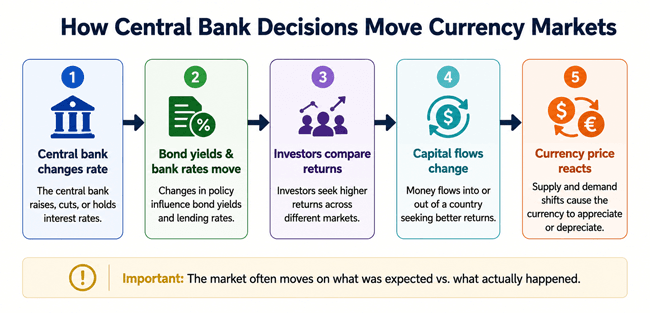
Image: “How interest rate changes can move forex currency prices.”
1. What beginners need to understand first
Forex always compares two currencies. EUR/USD is not just “the euro.” It is the euro priced against the US dollar. GBP/JPY compares the British pound with the Japanese yen. That means interest rates affect both sides of the pair. A currency can look strong on its own, but still fall if the other currency has an even stronger interest-rate story.
Think of a currency pair like a weighing scale. On one side is the first currency. On the other side is the second currency. Interest rates, inflation, economic growth, political risk, central bank guidance, and market fear all add weight to one side or the other. The exchange rate moves when one side becomes more attractive than the other.
How central banks fit into the story
Central banks such as the Federal Reserve, European Central Bank, Bank of England, Bank of Japan, and other national monetary authorities influence short-term interest rates. Their job is usually to keep inflation stable, support financial stability, and, in some countries, support employment or growth. When inflation is too high, a central bank may raise rates to slow borrowing and spending. When the economy is weak, it may lower rates to make borrowing cheaper.
The Bank of England describes monetary policy as action taken to influence how much money is in the economy and how much it costs to borrow. It also says its primary tool is Bank Rate, the interest rate paid on overnight deposits placed with it by eligible firms. This matters for forex because market interest rates often adjust around the central bank’s policy direction.
2. Why higher interest rates can strengthen a currency
Higher interest rates can attract capital. Imagine two countries that are both politically stable and economically healthy. Country A offers a 5% return on safe short-term assets. Country B offers 1%. Many investors would prefer Country A if they believe the currency risk is manageable. To buy Country A’s assets, they first need to buy Country A’s currency. That buying pressure can lift the currency.
This is why forex traders closely follow policy rates, bond yields, inflation reports, wage growth, employment data, central bank speeches, and rate-decision press conferences. These details help traders estimate where interest rates may go next.
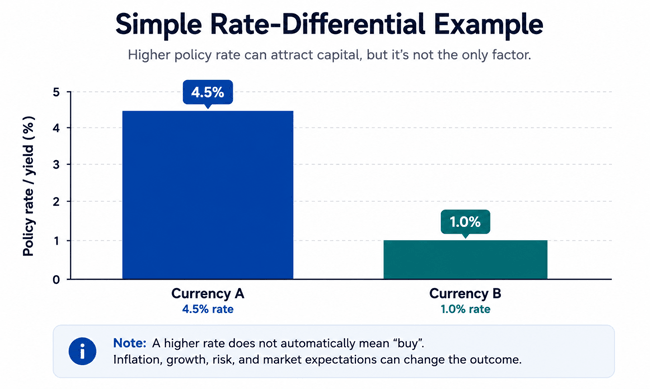
Image: “Interest rate differential between two currencies in forex.”
But higher rates do not guarantee a stronger currency
A high interest rate may be a sign of strength, but it may also be a warning sign. Some countries have high rates because inflation is high, investors are worried, or the currency is already under pressure. In those cases, a high rate can be more like compensation for risk than a clean bullish signal.
Here is the practical beginner rule: rates matter most when they change the market’s view of future returns and risk. A surprise rate hike can strengthen a currency. A fully expected hike may do very little. A hike combined with a weak economic outlook can create confusion or even a sell-off.
3. The role of expectations: the market trades the future
Beginners often think forex moves after the news. In reality, markets often move before the news because traders are constantly pricing what they think will happen. By the time the central bank announces a decision, many large traders may already have positioned for it.
This creates one of the most important forex ideas: the surprise matters more than the headline. If the market expected a 0.25% rate hike and the central bank raises by 0.25%, the currency may barely move. If the central bank raises by 0.50%, or says more hikes are likely, the currency may jump. If it raises by 0.25% but hints that cuts are coming, the currency may fall.
Hawkish vs dovish: two words every forex beginner should know
| Central bank tone | What it usually means | Possible currency effect |
|---|---|---|
| Hawkish | More focused on inflation; more likely to raise rates or keep rates high. | Can support the currency if the market sees higher future returns. |
| Dovish | More focused on weak growth; more likely to cut rates or keep rates low. | Can weaken the currency if expected returns fall. |
| Neutral / data-dependent | The central bank is waiting for more inflation, jobs, or growth data. | Can create choppy movement because traders debate the next step. |
4. Interest rate differentials: the comparison that drives many forex moves
An interest rate differential is the gap between the interest rate or yield available in one currency and the interest rate or yield available in another. Forex traders care about the gap because they are always comparing two currencies.
For example, if US short-term yields are rising while euro-area yields are falling, EUR/USD may face downward pressure because the dollar side of the pair is becoming more attractive. If Australian yields rise while Japanese yields stay low, AUD/JPY may get support because traders can earn more by holding Australian-dollar exposure than Japanese-yen exposure. This does not mean the trade is safe. It only explains why the idea attracts attention.
Carry trade: earning the rate gap, but taking currency risk
A carry trade is a strategy where a trader borrows or sells a lower-interest-rate currency and buys a higher-interest-rate currency. The goal is to earn the interest-rate difference while also hoping the exchange rate does not move against the trade.
In everyday language, it is like this: “I borrow cheap money in a low-rate currency, then hold a currency that pays more.” If the exchange rate stays stable or moves in your favor, the trade can look attractive. If the high-yielding currency falls sharply, the loss can wipe out the interest income quickly.
A recent BIS bulletin explains that carry traders borrow in low-interest-rate funding currencies and invest in high-interest-rate currencies, and that carry trade activity can shape how exchange rates respond to monetary policy. It also notes that when funding currencies are heavily shorted, a monetary tightening shock can lead to sharp appreciation as leveraged positions are unwound.
5. Practical examples beginners can understand
Example 1: A surprise rate hike
Suppose the market expects a central bank to keep rates unchanged at 3.00%. Instead, it raises rates to 3.25% and says inflation is still too high. Traders may quickly buy that currency because future returns now look better than expected. The currency may rise against lower-yielding currencies.
Beginner takeaway: the move happened because of surprise and future guidance, not just because the rate went up.
Example 2: A rate hike that makes the currency fall
Now imagine a central bank raises rates but says the economy is slowing badly and future cuts may be needed. Traders may focus on the weak outlook instead of the hike. The currency can fall because the market starts pricing lower rates in the future.
Beginner takeaway: central bank language can matter as much as the actual rate decision.
Example 3: High-yield currency during market panic
A high-yield currency may be popular when markets are calm. But during panic, investors often reduce risky positions and move into safer, more liquid currencies. A currency with a high rate can fall if traders fear losses more than they want extra yield.
Beginner takeaway: interest rates work together with risk sentiment. They do not work alone.
5. What beginners should watch before trading interest-rate news
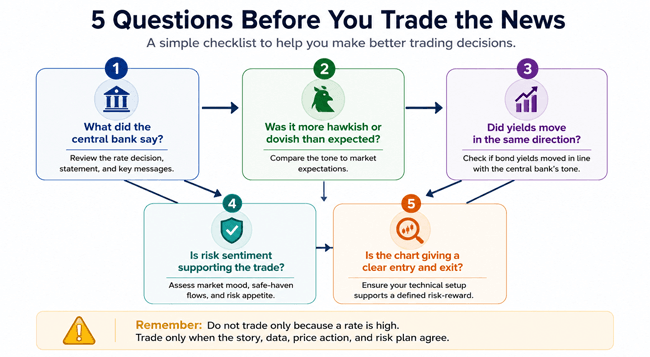
Image: “Beginner forex checklist for interest rate decisions.”
- The actual policy rate decision: Was the rate raised, cut, or held? Was it different from consensus expectations?
- The central bank statement: Did the wording sound hawkish, dovish, or balanced?
- Press conference comments: Did the governor or chair push back against market expectations?
- Inflation data: Higher inflation can increase the chance of rate hikes; falling inflation can increase the chance of cuts.
- Jobs and wage data: Strong labor markets can support higher rates; weakness can pressure central banks to ease.
- Bond yields: If yields rise after the decision, that often confirms a more hawkish market reaction.
- Risk sentiment: A risk-off market can overpower a positive rate story.
- The chart: Even a good macro idea needs a sensible entry, invalidation point, and risk/reward plan.
6. How traders can use interest-rate information responsibly
The safest way to use interest-rate information is not to predict every central bank decision. Beginners usually do better by building a simple process. First, identify the current policy direction. Is the central bank raising rates, cutting rates, or waiting? Second, compare it with the other currency in the pair. Third, check whether the market already expected the move. Fourth, wait for price action to confirm the idea. Fifth, use risk controls before entering.
A practical step-by-step framework
- Pick one currency pair and study both central banks, not only one.
- Write down the current policy rate and recent inflation trend for each economy.
- Read the latest central bank statement summary from an official source or reliable financial news source.
- Check whether the market reaction is visible in bond yields and the currency chart.
- Avoid entering seconds before a major announcement unless you fully understand slippage and volatility.
- Define the amount you are willing to lose before entering.
- Use a stop-loss or another clear exit rule.
- Review the trade afterward and write what the market actually reacted to.
7. Common beginner mistakes
- Only looking at the highest interest rate: A high rate can signal opportunity, but it can also signal inflation, political stress, or currency risk.
- Ignoring the second currency in the pair: EUR/USD depends on both the euro story and the dollar story.
- Trading the headline without reading guidance: The central bank’s future tone can matter more than today’s decision.
- Using too much leverage: Leverage can turn a small move into a large loss. Retail forex can be especially risky when leverage is high.
- Forgetting that spreads can widen during news: During major announcements, execution can be worse than expected.
- Thinking carry trade is passive income: Currency losses can erase interest gains quickly.
- Not keeping a trading journal: Without notes, beginners repeat the same mistakes and do not learn what actually moved the market.
8. Interest rates vs other forex drivers
| Driver | How it affects currencies | When it matters most | Beginner tip |
|---|---|---|---|
| Interest rates | Change expected returns on currency assets. | Central bank cycles, inflation surprises, yield moves. | Compare both currencies, not one. |
| Inflation | Can push central banks toward hikes or cuts. | CPI releases, wage data, energy shocks. | Watch real rates: rates after inflation. |
| Growth data | Affects confidence and future policy. | GDP, PMIs, retail sales, jobs data. | Strong growth can support a currency unless it raises import or inflation concerns. |
| Risk sentiment | Changes demand for safe or risky currencies. | Crises, stock sell-offs, geopolitical stress. | Risk-off can overpower interest-rate logic. |
| Trade balance | Affects natural demand for a currency. | Export/import shifts, commodity cycles. | Commodity currencies often react to resource prices. |
| Government credibility | Changes investor trust. | Fiscal stress, elections, policy uncertainty. | Political risk can weaken a high-rate currency. |
■ FAQ: Interest rates and forex markets
1. Do currencies always rise when interest rates rise?
No. A currency often rises when rates rise more than expected or when future rate expectations improve. If the hike was already priced in, or if the economy looks weak, the currency may not rise.
2. What is the most important interest rate for forex?
The central bank policy rate is important, but traders also watch government bond yields because yields show how the market prices future rates.
3. What is a real interest rate?
A real interest rate is the interest rate adjusted for inflation. A country with 6% interest but 8% inflation may not be as attractive as it looks.
4. What is a carry trade in forex?
It is a strategy where a trader seeks to earn the interest-rate difference by holding a higher-yielding currency and funding it with a lower-yielding currency. It carries exchange-rate risk.
5. Can beginners trade central bank news?
Beginners should be very careful. Central bank announcements can create fast moves, wider spreads, and slippage. It is often better to observe, learn, and trade after the market calms down.
6. Which currencies react most to interest rates?
All currencies can react, but reactions are strongest when there is a surprise, a clear change in future policy, or a large interest-rate gap between the two currencies.
7. How can I follow interest-rate expectations?
Follow central bank calendars, inflation releases, jobs reports, bond yields, and reliable market commentary. Avoid relying only on social media predictions.
8. Is forex trading suitable for everyone?
No. Forex trading involves high risk, especially with leverage. It is not suitable for readers who cannot tolerate losses or who do not understand the product.
References and source notes
- Bank for International Settlements, 2025 Triennial Central Bank Survey: OTC FX market turnover reached about $9.6 trillion per day in April 2025. Source: BIS statistics page on OTC FX turnover.
- Bank for International Settlements, BIS Bulletin 124: Carry trade activity can shape exchange-rate response to monetary policy; carry traders borrow low-interest-rate funding currencies and invest in higher-rate currencies.
- Bank of England, Monetary Policy explainer: Monetary policy influences how much money is in the economy and the cost of borrowing; Bank Rate is its primary tool.
- European Central Bank / Banco de España explainer: The ECB does not set the euro exchange rate directly, but monetary policy can influence it indirectly.
- CFTC, Foreign Currency Trading and OTC Forex advisory: Retail forex involves significant risk; traders should research counterparties, leverage, and disclosures.
Disclaimer & Reader Advice: This article is provided for educational and informational purposes only and should not be considered financial, investment, or trading advice. Forex trading involves risk. Before making any trading decisions, take the time to study the forex market thoroughly, understand the risks, and evaluate whether trading is appropriate for your financial situation and experience. Always make informed decisions based on your own research, and consider seeking guidance from a qualified financial professional when needed.