Price Action Trading in Forex: Complete Beginner's Guide
1. What is price action trading in forex?
Price action trading in forex means making trading decisions mainly by reading the movement of price itself. Instead of filling the chart with many indicators, the trader studies how price moves, where it stops, where it reacts, and how buyers and sellers behave around important areas. In simple words, price action is the story of the market written on the chart.
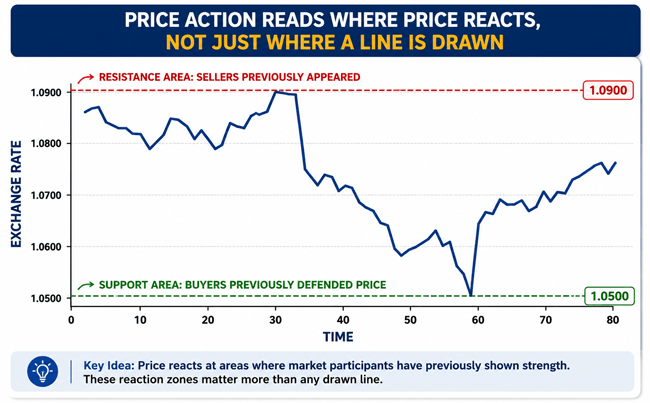
For a beginner, the easiest way to understand it is this: imagine EUR/USD is moving upward, then suddenly stops near the same price area again and again. That area may be resistance because sellers are active there. If price falls to another area and bounces several times, that area may be support because buyers are interested there. Price action traders try to use these repeated reactions to plan trades with clear risk.
Price action does not mean guessing. It also does not mean every candlestick pattern is a magic signal. Good price action trading combines context, location, confirmation, risk control, and review. A pin bar in the middle of a messy chart is usually not as meaningful as a rejection candle at a clean support level after a strong move. The same pattern can be useful in one place and useless in another.
The global foreign exchange market is large and active. The Bank for International Settlements reported that daily global FX turnover reached about $9.6 trillion in April 2025, with spot markets around $3 trillion per day. That size creates many opportunities, but it also creates fast movement, noise, leverage risk, and emotional pressure. Beginners should therefore treat price action as a decision-making framework, not a shortcut to easy money.
2. How price action trading works
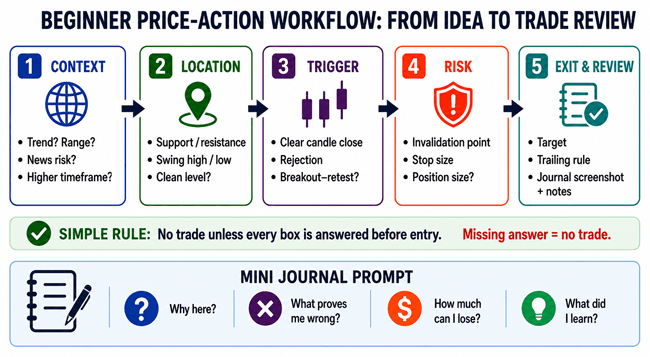
Price action trading works by breaking a chart into a few practical questions. First, what is the market doing right now? It may be trending upward, trending downward, ranging sideways, or moving in a choppy way with no clear direction. Second, where is price located? A trade idea is stronger when price is near a meaningful support, resistance, swing high, swing low, trendline, or breakout area. Third, what has price just done at that location? A strong rejection, breakout, retest, or failure can show how traders are reacting. Finally, where would the idea be wrong? This is where risk management starts.
A beginner often wants to know which candle to buy or sell. Experienced traders usually think differently. They ask, “Is this a good place to do business?” A bullish candle at a random point is just a candle. A bullish rejection candle at a higher-timeframe support area, after sellers failed to push price lower, is a more complete story. Price action is about reading that story.
The workflow is simple but not easy. You mark important areas, wait for price to come there, look for a clear reaction, plan the stop loss before entering, and record the result after the trade. The discipline of waiting is where many beginners struggle. They see movement and feel they must participate. Price action trading improves when the trader learns to ignore average setups and wait for cleaner ones.
3. Price action vs indicator-based trading
| Area | Price action trading | Indicator-heavy trading |
|---|---|---|
| Main focus | Raw price movement, levels, candle closes, swings, trend and range behavior. | Indicator signals such as moving averages, oscillators, bands, or automated alerts. |
| Speed of information | Direct, because it comes from current price. | Often slightly delayed because most indicators are calculated from price. |
| Beginner benefit | Teaches market structure and disciplined chart reading. | Can simplify decisions at first, especially if rules are clear. |
| Beginner danger | Subjective analysis can lead to seeing patterns everywhere. | Too many tools can create confusion and false confidence. |
| Best use | Great as the foundation of analysis. | Useful as confirmation, filtering, or measurement tools. |
The point is not that indicators are bad. Many profitable traders use indicators. The problem begins when a beginner adds more tools because they do not trust their own plan. One moving average may help define trend. An average true range indicator may help estimate volatility. But five overlapping indicators often hide the most important information: where price is reacting and how strong that reaction is.
■ The core building blocks every beginner should know
1. Market structure
Market structure means the shape of price movement. In an uptrend, price usually forms higher highs and higher lows. In a downtrend, it forms lower highs and lower lows. In a range, price moves between a high area and a low area without clear direction. This is the first filter because the same setup has different meaning in different structures.
A common beginner mistake is selling every resistance touch in a strong uptrend or buying every support touch in a strong downtrend. A level can fail when the larger structure is pushing through it. Before looking for a candlestick pattern, ask whether the market is trending, ranging, or unclear.
2. Support and resistance
Support is an area where price has previously found buying interest. Resistance is an area where price has previously found selling pressure. They are better understood as zones, not perfect thin lines. Forex prices can pierce a level by a few pips, trigger stops, and still respect the area overall.
Good support and resistance zones are easy to see without forcing them. They often connect multiple swing points, occur around previous highs or lows, or align with areas where price moved away strongly. If a level only makes sense after you zoom in, change chart settings, and draw several lines, it may not be useful enough for a beginner.
3. Candlestick patterns
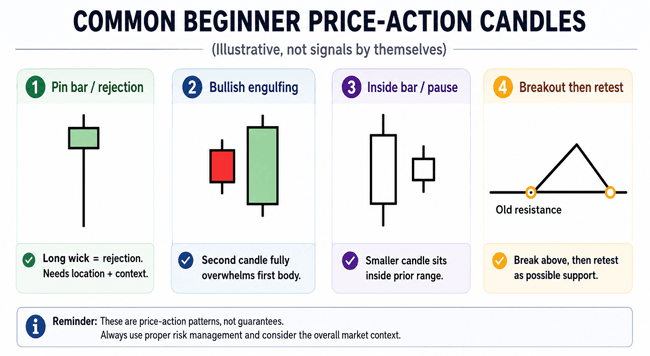
Candlestick patterns show how price behaved during a period of time. A pin bar may show rejection. An engulfing candle may show a shift in control. An inside bar may show pause or compression. But candles are not commands. A pattern needs location and context. The best question is not “Is this a pin bar?” but “What is this candle saying at this place?”
4. Breakouts and retests
A breakout happens when price moves beyond an important level. A retest happens when price returns to that level and checks whether old resistance becomes new support, or old support becomes new resistance. Beginners like breakouts because they look exciting, but false breakouts are common. Waiting for a candle close or a retest can reduce impulsive entries, although it can also mean missing some trades.
5. Momentum and candle close
Momentum is the strength behind a move. Large candles closing near their highs or lows can show strong participation. Small candles with long wicks can show hesitation or rejection. The candle close matters because it shows where price finished after buyers and sellers fought during that period. Many beginners enter before the candle closes and later discover that the signal disappeared.
■ A practical beginner example: EUR/USD support bounce
Suppose EUR/USD has been falling during the London session and reaches a support zone that also acted as support two days earlier. The beginner marks the zone, but does not immediately buy. Price drops slightly below the zone, then closes back above it with a long lower wick. The next candle is bullish and closes higher than the rejection candle. This creates a possible price-action idea: sellers tried to push lower, failed, and buyers stepped in.
A practical plan may look like this: entry above the bullish confirmation candle, stop loss below the rejection wick, and first target near the next visible resistance area. The trader risks only a small fixed percentage of the account, such as 0.5% or 1%, rather than choosing a lot size based on excitement. If the stop is 20 pips and the target is 40 pips, the planned reward-to-risk ratio is 2:1. This does not guarantee the trade will win. It simply means the potential reward is twice the planned risk.
Now imagine a different case. The same rejection candle appears, but it happens in the middle of a range with no clear support, right before a major central bank announcement. That is not the same quality setup. Price action is practical because it teaches the trader to separate a visible pattern from a tradable situation.
■ Step-by-step: how a beginner can use price action
- Choose one or two major currency pairs at first, such as EUR/USD or GBP/USD, instead of jumping between many charts.
- Start with higher timeframes, such as the 4-hour and daily charts, because they usually show cleaner structure and reduce overtrading.
- Mark only the obvious support and resistance zones. Avoid drawing too many lines.
- Identify whether the market is trending, ranging, or unclear. If it is unclear, no trade is a valid decision.
- Wait for price to reach a meaningful area. Do not chase candles in the middle of nowhere.
- Look for a clear reaction, such as rejection, breakout, retest, or failure to continue.
- Plan the entry, stop loss, position size, and target before clicking buy or sell.
- Journal the trade with a screenshot and one honest lesson after it closes.
■ Risk management: the part beginners must not skip
Risk management is more important than finding a perfect setup. Forex trading often uses leverage, which can magnify both gains and losses. The CFTC warns retail forex customers to be careful with offshore or unregistered dealers and to understand risks before depositing money. The NFA, the U.S. self-regulatory organization for derivatives, also emphasizes compliance and investor protection in forex activities. A beginner should verify regulation, understand account terms, and never trade money needed for bills, debt, or emergency savings.
The simplest beginner rule is to decide the maximum loss before entering. Many traders use a small fixed risk per trade, such as 0.5% to 1% of account equity. The exact number depends on personal circumstances, but the principle is universal: a single trade should not be able to damage the account or the trader’s emotions. If losing one trade makes you angry, desperate, or tempted to double the next position, the risk is too high.
Stop losses should be placed where the trade idea is invalid, not where the money feels comfortable. If the setup needs a 35-pip stop but the trader can only afford a 15-pip stop, the answer is not to use a random tight stop. The answer is to reduce position size, wait for a better entry, or skip the trade. Price action trading becomes dangerous when the chart plan and money plan do not match.
| Account size | Risk % | Maximum planned loss | Beginner comment |
|---|---|---|---|
| 1,000 | 1% | 10 | Small loss, easier to review calmly. |
| 1,000 | 5% | 50 | Five losing trades can damage confidence and account balance. |
| 5,000 | 1% | 50 | Same discipline, larger account. |
| 5,000 | 10% | 500 | Too aggressive for most beginners. |
This table is not financial advice. It is a simple demonstration of how percentage risk changes the emotional and financial impact of losses.
■ Common beginner mistakes with forex price action
- Treating every candlestick pattern as a signal, even when it appears in poor location.
- Drawing too many support and resistance lines until the chart becomes unreadable.
- Entering before a candle closes because of fear of missing out.
- Using high leverage because the account is small.
- Moving the stop loss farther away after price goes against the trade.
- Taking trades around major news without understanding the risk of slippage and volatility.
- Changing strategy after every loss instead of reviewing a sample of trades.
- Following social media forex signals without knowing the entry logic, risk, or broker conditions.
- Expecting a forex trading course, funded trading account, or expensive trading platform to replace practice and discipline.
People with real trading experience often say that the hardest part is not learning what support or resistance means. The hard part is doing the simple thing repeatedly: wait, plan, risk small, accept the result, and review honestly. Price action can look clean in screenshots after the move is complete. In live markets, it feels uncertain. That uncertainty is normal. The goal is not to remove uncertainty; the goal is to make decisions that can survive it.
3. What timeframes should beginners use?
Beginners usually do better when they start with higher timeframes. The daily chart helps identify the bigger direction and major levels. The 4-hour chart can help find trade areas and cleaner candles. The 1-hour chart may be useful for timing entries after the bigger picture is clear. Very low timeframes, such as the 1-minute or 5-minute chart, move quickly and can encourage overtrading, especially when spreads and emotions are included.
A practical beginner setup is simple: check the daily chart for structure, mark important zones, use the 4-hour chart for setup quality, and only then consider the 1-hour chart for a more precise entry. If the daily chart says the market is messy, the lower timeframe will usually look even more confusing.
4. Best forex pairs for beginners using price action
Many beginners start with major currency pairs because they usually have tighter spreads and more liquidity than exotic pairs. Examples include EUR/USD, GBP/USD, USD/JPY, AUD/USD, and USD/CAD. This does not mean they are safe or easy. It simply means the trading costs and chart behavior are often more manageable than thinly traded pairs. Exotic pairs can have wider spreads, sharper moves, and more unpredictable gaps.
It is better to know one pair deeply than to scan twenty pairs with shallow attention. Over time, a trader may notice how EUR/USD behaves around London and New York sessions, how GBP pairs can move more sharply, or how JPY pairs react to risk sentiment. These observations come from journaling and screen time, not from memorizing definitions.
5. How to practice without risking real money
A beginner should spend time on a demo forex trading account before trading real money. Demo trading is not perfect because emotions are different, but it is useful for learning the trading platform, placing stop losses, calculating position size, and practicing a written plan. The goal of demo trading is not to make imaginary profit. The goal is to prove that you can follow rules consistently.
A simple 30-day practice plan can work well. In week one, only mark trends, ranges, support, and resistance. In week two, take screenshots of potential setups but do not enter. In week three, place demo trades with fixed risk and written reasons. In week four, review results and identify which setups were clear, which were forced, and which rules were broken. This builds skill faster than randomly taking trades every day.
6. A simple beginner price-action strategy template
The following template is intentionally simple. It is not a guaranteed system, but it gives beginners a structured way to practice.
- Market: one or two major pairs only.
- Timeframes: daily for direction and levels, 4-hour for setup, optional 1-hour for entry.
- Context rule: trade only if the market is trending clearly or reacting at a clean range boundary.
- Location rule: price must be at support, resistance, previous swing point, or breakout-retest area.
- Trigger rule: wait for a candle close showing rejection, strong continuation, or failed breakout.
- Risk rule: risk a small fixed percentage and place stop beyond the invalidation point.
- Exit rule: take partial or full profit at the next clear level, or skip if reward-to-risk is poor.
- Review rule: save a screenshot before and after every trade with one lesson.
The strategy becomes more useful when the trader defines what “clean” means. For example, a clean support area may have at least two previous reactions and enough space to the next resistance for a reasonable target. A clean trigger may require the candle to close back above support after rejecting lower prices. Writing these details removes many emotional decisions.
7. How price action connects with trading psychology
Price action trading looks simple, so beginners may underestimate the mental side. The chart may show a valid setup, but the trader may hesitate because of a previous loss. Or the chart may show no setup, but the trader may enter because they are bored. This is why a written plan matters. It protects the trader from making every decision based on the feeling of the moment.
One practical psychological rule is to limit the number of trades per day or week. Another is to stop trading after a set loss limit. For example, if two planned losses occur in one day, the trader stops and reviews instead of trying to win it back. Revenge trading is one of the fastest ways beginners turn normal losses into account damage.
Choosing tools: broker, platform, journal, and education
A price-action trader does not need a complicated setup, but basic tools matter. A regulated forex broker, a stable forex trading platform, clear spreads and commissions, reliable charting, and easy order placement are more important than flashy promises. Beginners should be cautious with any broker, signal seller, trading course, or funded trading account that uses pressure, unrealistic income claims, or withdrawal stories without transparent risk information.
A trading journal is one of the highest-value tools. It can be a spreadsheet, notebook, or journal software. Record the pair, timeframe, setup type, entry, stop, target, risk percentage, result, screenshot, and emotional state. After 30 to 50 trades, patterns become visible. You may discover that your breakout trades lose money but support-retest trades perform better. Without a journal, most traders rely on memory, and memory is usually biased.
9. Price action myths beginners should ignore
- Myth: Price action always works. Truth: no method always works; losses are part of trading.
- Myth: More screen time always means more profit. Truth: more screen time can also mean more impulsive trades.
- Myth: A clean chart means easy trading. Truth: clean charts help analysis, but execution still requires discipline.
- Myth: You need secret institutional levels. Truth: beginners should first master obvious structure and risk.
- Myth: A high win rate is everything. Truth: risk-to-reward, position size, costs, and consistency also matter.
■ FAQs about price action trading in forex
1. Is price action good for beginners?
Yes, it can be good for beginners because it teaches the basics of market structure, support, resistance, and risk planning. However, beginners should practice slowly and avoid believing that simple means easy.
2. Can I trade price action without indicators?
Yes, but you do not have to. Many traders use a mostly clean chart and add one or two tools for support. The key is that indicators should support the plan, not replace it.
3. What is the best price action pattern?
There is no single best pattern. A rejection candle, engulfing candle, inside bar, or breakout-retest can all be useful when they appear at the right location with good risk-to-reward.
4. How much money do I need to start?
The safer question is how much money can you afford to lose while learning. Start with demo practice, then use small size if moving to live trading. Never use rent, debt money, or emergency savings.
5. Are forex signals useful?
Signals can be educational if they explain logic and risk, but blindly copying forex signals is risky. You may not know the stop loss, spread impact, execution delay, or whether the provider is honest.
6. Can price action be used for scalping?
It can, but scalping is usually harder for beginners because decisions are faster and costs matter more. Higher timeframes are often better for learning.
■ Final thoughts: the honest beginner path
Price action trading in forex is best understood as a practical way to read the market, not a promise of income. It helps beginners focus on what price is doing, where it is reacting, and how to plan risk before entering a trade. The strongest benefit is clarity. A clean price-action plan can keep a trader from chasing every indicator, signal, or social media prediction.
The honest path is slower but safer: learn structure, mark obvious levels, wait for price to come to your area, plan risk first, practice on demo, keep a journal, and review your results without excuses. If you can do that consistently, price action becomes more than a chart technique. It becomes a disciplined process for making decisions under uncertainty.
Sources consulted
- Commodity Futures Trading Commission (CFTC), “Eight Things You Should Know Before Trading Forex.” https://www.cftc.gov/LearnAndProtect/AdvisoriesAndArticles/CustomerAdvisory_MustKnowForex.html
- National Futures Association (NFA), official website and forex regulatory guide. https://www.nfa.futures.org/ and https://www.nfa.futures.org/members/member-resources/files/forex-regulatory-guide.html
- Bank for International Settlements (BIS), Triennial Central Bank Survey 2025: OTC foreign exchange turnover. https://www.bis.org/statistics/rpfx25_fx.pdf
Reader Advice: This article is provided for educational and informational purposes only and should not be considered financial, investment, or trading advice. Forex trading involves risk. Before making any trading decisions, take the time to study the forex market thoroughly, understand the risks, and evaluate whether trading is appropriate for your financial situation and experience. Always make informed decisions based on your own research, and consider seeking guidance from a qualified financial professional when needed.