How Economic News Affects Forex Trading: A Beginner's Guide to Currency Prices
1. What Is Forex Trading?
Forex trading means buying one currency and selling another currency at the same time. The word forex is short for foreign exchange. When a person trades EUR/USD, they are not buying “the euro” by itself. They are trading the euro against the U.S. dollar. If EUR/USD rises, the euro is getting stronger compared with the dollar. If EUR/USD falls, the euro is getting weaker compared with the dollar.
A simple way to understand it is to imagine two sides of a scale. On one side is the first currency in the pair, called the base currency. On the other side is the second currency, called the quote currency. Economic news can add weight to one side of the scale. When the market believes one economy is becoming stronger, safer, or more likely to offer higher interest rates, demand for that currency may increase.
Forex is one of the largest financial markets in the world. The Bank for International Settlements reported global foreign exchange turnover of about $9.6 trillion per day in April 2025, with spot FX turnover around $3 trillion per day. That size does not mean forex is easy. It means the market is deep, fast, global, and highly sensitive to news, expectations, and risk sentiment.
Beginner translation:
Currency prices move because people, banks, companies, investors, hedge funds, and governments constantly decide which currency they want to hold. Economic news changes those decisions.
2. Why Economic News Matters in Forex
Economic news matters because currencies are connected to the health of countries and regions. A currency usually becomes more attractive when investors believe its economy is stable, inflation is under control, interest rates are attractive, and political risk is manageable. A currency can weaken when the economy looks fragile, inflation is unpredictable, central bank policy becomes unclear, or investors move away from risk.
The most important point for beginners is this: the market does not only react to whether news is “good” or “bad.” It reacts to whether the news is better or worse than expected. This is why a currency can fall even after a positive report, or rise after a negative report. If traders expected something even better, the actual number may still feel disappointing.
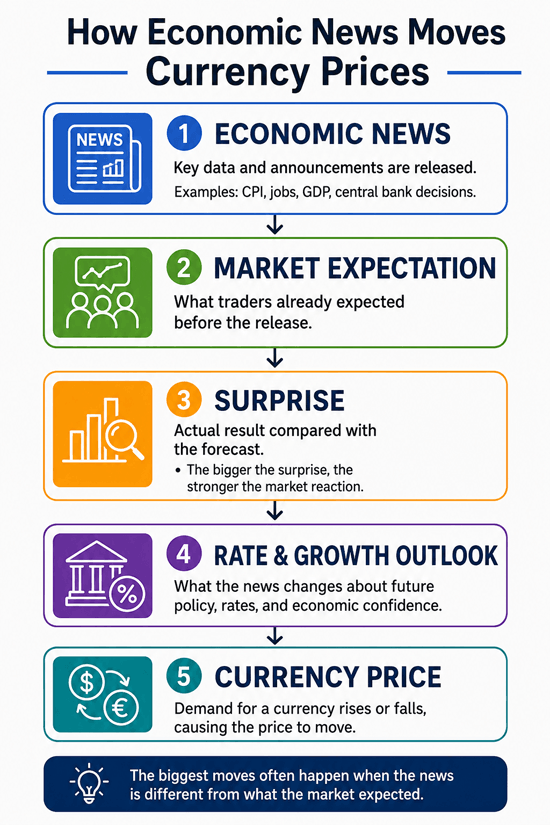
3. The Core Idea: Currencies Move on Expectations
Many new traders look at an economic calendar and think, “If the number is good, I should buy the currency.” That is too simple. Professional traders usually ask four questions before they decide what the news means:
- What was the market expecting before the release?
- Was the actual number higher or lower than the forecast?
- Does this change the central bank’s likely next move?
- Is the market currently focused on growth, inflation, interest rates, or fear?
For example, strong inflation data may support a currency if traders think the central bank will raise rates or delay rate cuts. But the same inflation data may hurt the currency if it suggests household spending will weaken, political pressure will rise, or the central bank is losing control. Context matters.
4. The Biggest Economic News Events That Affect Forex Prices
Not every news event has the same impact. Some reports create only small moves. Others can create sudden spikes, wide spreads, and fast reversals. The table below explains the major types of economic news in beginner-friendly language.
| News event | What it means | Why it moves forex | Typically affected currencies |
|---|---|---|---|
| Interest rate decisions | A central bank sets or changes benchmark interest rates. | Rate expectations drive capital flows. Forward guidance (statement + press conference) often moves markets more than the decision itself. | USD, EUR, GBP, JPY, CAD, AUD, NZD, CHF |
| Inflation data (CPI / PCE) | Measures how fast consumer prices are rising. | High inflation can push central banks toward tighter policy; low inflation increases easing expectations. | All major currencies, especially USD (CPI/PCE) |
| Jobs data | Shows strength of the labor market. | Strong employment supports growth and rates; weak data increases recession and easing expectations. | USD (NFP), GBP, CAD, AUD, NZD |
| GDP growth | Measures overall economic output. | Stronger growth supports currency strength; weak growth pressures it. | All major currencies |
| Retail sales | Tracks consumer spending activity. | Consumer spending drives economic growth and influences policy expectations. | USD, GBP, AUD, CAD |
| PMI / business surveys | Measures business activity and sentiment. | Forward-looking indicator that can signal economic turning points before GDP data. | EUR, GBP, USD, JPY, AUD |
| Trade balance | Difference between exports and imports. | Trade flows influence long-term demand for a currency. | JPY, CNY, EUR, AUD, CAD |
| Commodity news | Price movements in oil, gold, gas, metals, and agriculture. | Commodity-linked currencies move with export revenue expectations. | CAD, AUD, NZD, NOK, selected emerging markets |
| Geopolitical events | Elections, conflicts, sanctions, and major policy shocks. | Increase uncertainty and shift safe-haven demand rapidly. | USD, CHF, JPY, EUR, GBP, emerging market currencies |
5. How Interest Rates Drive Currency Prices
Interest rates are one of the strongest long-term drivers of currency prices. When a country offers higher interest rates, global investors may earn more by holding assets in that currency. This can increase demand for the currency. However, the market looks forward, not backward. What matters most is not only today’s rate, but what traders think the rate will be in the future.
Central banks influence rates through policy decisions and communication. The Federal Reserve, for example, explains that U.S. monetary policy is aimed at maximum employment, stable prices, and moderate long-term interest rates. Traders watch every rate decision, statement, projection, and press conference because a small wording change can shift expectations.
A beginner should understand three central bank tones:
- Hawkish: The central bank sounds more worried about inflation and more likely to raise rates or keep rates high. This can support the currency.
- Dovish: The central bank sounds more worried about weak growth or unemployment and more likely to cut rates. This can pressure the currency.
- Neutral/data-dependent: The central bank gives itself flexibility and says future decisions depend on incoming data. Markets then react strongly to each new data release.
Practical example: U.S. inflation and EUR/USD
Imagine EUR/USD is trading at 1.0840 before U.S. CPI data. The forecast says monthly inflation will be 0.2%, but the actual number comes out at 0.4%. Traders may think the Federal Reserve has less room to cut rates. U.S. bond yields may rise. More investors may want dollars. In that case, EUR/USD can fall because the dollar is the quote currency in the pair.
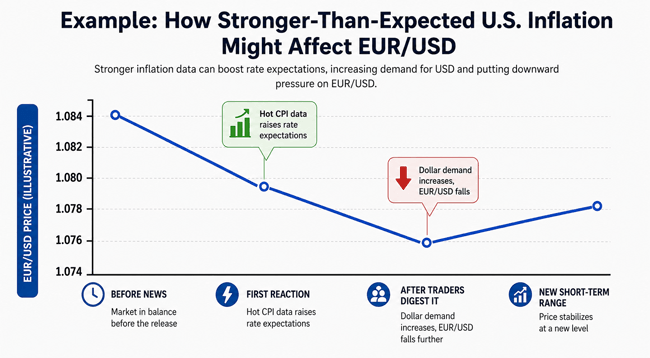
Image. An illustrative EUR/USD chart showing how a stronger-than-expected inflation report can push the pair lower.
6. The “Forecast vs Actual” Rule Beginners Must Know
Every serious forex trader learns to compare forecast and actual numbers. The forecast is what economists expected. The actual is the number released. The difference between them is the surprise. Surprises move prices because traders must quickly adjust their positions.
| Scenario | Example | Possible market reaction |
|---|---|---|
| Actual is better than forecast | Jobs forecast: 170K | Actual: 250K | Currency may strengthen if the data supports expectations of stronger growth or higher interest rates. |
| Actual is worse than forecast | Retail sales forecast: +0.3% | Actual: -0.5% | Currency may weaken due to expectations of slower economic growth or easier monetary policy. |
| Actual matches forecast | CPI forecast: 0.2% | Actual: 0.2% | Market reaction is usually limited unless other details in the report differ from expectations. |
| Headline is strong but details are weak | Jobs beat expectations, but wage growth slows and prior data is revised lower. | Initial move may reverse as traders focus on underlying details. |
| Already priced in | Market widely expects strong inflation and positions accordingly. | Even good data may cause a muted reaction or a “buy the rumor, sell the fact” reversal. |
7. Why Currency Pairs React Differently to the Same News
The same economic news can affect different currency pairs in different ways because every pair has two currencies. When trading EUR/USD, you are comparing Europe and the United States. When trading USD/JPY, you are comparing the United States and Japan. When trading AUD/USD, you are comparing Australia and the United States, but also watching commodity demand and China-related sentiment.
| Currency pair | News that often matters | Beginner-friendly explanation |
|---|---|---|
| EUR/USD | U.S. CPI, Fed decisions, ECB decisions, eurozone PMI, European political developments | The pair moves mainly on differences between U.S. Federal Reserve and European Central Bank expectations. |
| GBP/USD | Bank of England policy, U.K. CPI, wages, GDP, political developments | The pound is sensitive to inflation, wage growth, and fiscal or political uncertainty. |
| USD/JPY | U.S. bond yields, Bank of Japan policy, global risk sentiment, intervention risk | Highly sensitive to interest rate differentials between the U.S. and Japan. |
| AUD/USD | China economic data, iron ore prices, global risk sentiment, Reserve Bank of Australia policy | Closely linked to commodity demand and Asian economic growth expectations. |
| USD/CAD | Oil prices, Bank of Canada policy, U.S. data, Canadian jobs and inflation | CAD is strongly influenced by crude oil prices due to Canada’s role as a major exporter. |
| USD/CHF | Global risk sentiment, Swiss National Bank policy, European financial stability | The Swiss franc is widely viewed as a safe-haven currency during periods of market stress. |
8. Safe-Haven Currencies and Risk Sentiment
Sometimes economic news does not simply make one country look stronger. It changes the whole mood of global markets. When investors feel confident, they may buy riskier assets and higher-yielding currencies. When they feel afraid, they may move toward safer assets and currencies. This is called risk sentiment.
The U.S. dollar, Swiss franc, and Japanese yen are often considered safe-haven currencies, although their behavior can change depending on the situation. For example, during a global scare, traders may buy dollars because the dollar is the world’s main reserve currency and U.S. markets are highly liquid. But if the news specifically damages confidence in the United States, the dollar may not act like a safe haven.
9. How Beginners Can Use an Economic Calendar
An economic calendar is a schedule of upcoming data releases and central bank events. It usually shows the time, country, importance level, previous number, forecast number, and actual number after release. Beginners should use it first as a risk-awareness tool, not as a signal machine.
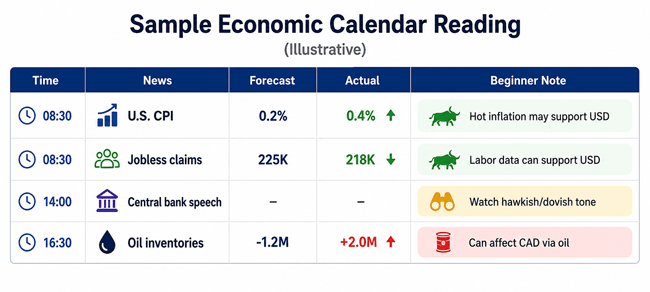
Image: A sample economic calendar with forecast, actual, and a beginner note for each event.
A practical routine for beginners:
- Check the calendar at the start of the day and mark high-impact events for the currencies you trade.
- Write down the forecast and previous number before the release.
- Avoid opening random trades in the final minutes before a major report if you do not have a tested plan.
- After the release, wait for spreads and volatility to calm down before making decisions.
- Review the chart later and ask what actually moved the market: headline number, details, central bank expectations, or risk mood.
10. Should Beginners Trade During News Releases?
For most beginners, trading directly during major news releases is dangerous. Prices can jump, spreads can widen, stop-loss orders can slip, and the first move can reverse quickly. Many experienced traders either reduce position size, close trades before high-impact releases, or wait until the market has chosen a clearer direction.
| Approach | How it works | Pros | Risks |
|---|---|---|---|
| Avoid trading during news | No new positions are opened shortly before major economic events. | Simple approach, reduces volatility exposure, suitable for beginners. | May miss strong directional moves, but avoids unpredictable spikes. |
| Trade after the news | Wait 15–60 minutes after the release, then trade based on confirmed direction. | Cleaner price action and reduced emotional pressure. | Initial move may already be over or partially reversed. |
| Pre-news positioning | Enter positions before the event based on analysis and expectations. | Potential to capture the full move if expectations are correct. | High risk if the actual result deviates from expectations. |
| Straddle / breakout strategies | Pending buy and sell orders are placed around price before news releases. | Can capture strong volatility regardless of direction. | High risk due to slippage, spread widening, and false breakouts. |
Honest beginner advice:
Do not treat news trading as easy money. If a strategy looks profitable only on a clean chart after the fact, but fails during real spreads, slippage, and emotions, it is not a reliable strategy.
11. Practical Example: Non-Farm Payrolls and USD Pairs
Non-Farm Payrolls, often called NFP, is a major U.S. jobs report. It can move USD pairs because employment affects growth, inflation, and Federal Reserve policy expectations. But traders do not only read the headline job number. They also look at unemployment, wage growth, participation rate, and revisions to previous months.
Example: Suppose the headline NFP number is strong, but average hourly earnings are weaker than expected and the previous month is revised lower. The dollar may jump in the first seconds, then fall as traders realize the report is not as strong as it looked. This is why beginners should not trade only from the headline number.
A safer way to study NFP is to replay historical charts. Look at the 5-minute, 15-minute, and 1-hour candles before and after the release. Note how often the first move reverses. This exercise teaches humility, which is one of the most valuable skills in forex trading.
12. Practical Example: Central Bank Decision and GBP/USD
Imagine the Bank of England keeps rates unchanged, which the market expected. At first, GBP/USD barely moves. Then the statement says inflation is falling faster than expected and several members discussed cutting rates soon. Now the message is dovish. Traders may sell the pound because the future path of interest rates looks lower. The lesson is simple: the decision itself may be less important than the explanation and future guidance.
13. Practical Example: Oil News and USD/CAD
Canada is a major oil exporter, so oil prices can influence the Canadian dollar. If crude oil rises sharply because of supply concerns, CAD may strengthen. Since CAD is the quote currency in USD/CAD, a stronger Canadian dollar can push USD/CAD lower. But this relationship is not automatic. If oil rises because of a global crisis, safe-haven demand for USD may also rise, creating a mixed reaction.
14. The Beginner’s News-Trading Checklist
- Do I know which currency in the pair should be affected by the news?
- Do I know the forecast, previous number, and market mood before the release?
- Is this event high impact or low impact?
- Could spreads widen or liquidity disappear around the release?
- Is my position size small enough that I can stay calm?
- Do I have a stop-loss, and do I accept that slippage can happen?
- Am I trading a tested plan, or am I reacting emotionally?
- Would I still take this trade if no one online was talking about it?
15. Risk Management: The Part Beginners Usually Ignore
Risk management is more important than predicting news correctly. A trader can be right about the direction and still lose money if the position is too large, the stop is badly placed, or emotions take over. Forex brokers often offer leverage, which means a small deposit can control a larger position. Leverage can magnify profits, but it can also magnify losses quickly.
The CFTC warns that forex trading is volatile, carries substantial risk, and is not suitable for money a person cannot afford to lose. This warning matters because many beginners are attracted by stories of fast profits and ignore the possibility of fast losses.
| Risk habit | Beginner-friendly meaning | Why it helps |
|---|---|---|
| Use small position sizes | Risk a small percentage of your account per trade. | One bad news spike should not destroy your account. |
| Use a stop-loss | Predefine where the trade idea is wrong. | Reduces emotional decision-making. |
| Avoid over-leverage | Do not use maximum broker leverage just because it is available. | Keeps normal market movement from becoming catastrophic. |
| Avoid revenge trading | Do not immediately trade bigger after a loss. | Protects you from emotional spirals. |
| Keep a trading journal | Write why you entered, what happened, and what you learned. | Turns experience into improvement. |
16. Choosing a Forex Broker Safely
A forex broker is the company that gives retail traders access to trading platforms, currency pairs, charts, and order execution. Because forex involves real money, broker safety is not a small detail. Beginners should research regulation, fees, spreads, execution quality, withdrawal rules, customer support, and risk disclosures before depositing money.
- Regulation: Check whether the broker is regulated in a serious jurisdiction and whether the legal entity matches the website.
- Costs: Compare spreads, commissions, overnight financing, deposit fees, and withdrawal fees.
- Execution: Understand slippage, order types, and how the broker handles volatile news events.
- Platform: A good forex trading platform should be stable, clear, and suitable for your level.
- Demo account: A forex demo account is useful for practice, but demo execution may feel easier than live trading because emotions and real liquidity are different.
17. Common Beginner Mistakes Around Economic News
| Mistake | Why it happens | Better habit |
|---|---|---|
| Trading only the headline | The first number is easy to read. | Check details, revisions, and market expectations. |
| Ignoring the forecast | Beginners think good news always means the currency rises. | Compare actual vs forecast and ask what was already priced in. |
| Using too much leverage | Small account, desire for fast gains. | Reduce position size and think in risk per trade. |
| Following random forex signals | Signals feel easier than learning. | Understand the reason behind every trade. |
| Trading during spread widening | The chart looks exciting. | Check normal spreads and avoid chaotic seconds around releases. |
| No journal | Losses are uncomfortable to review. | Write simple notes after every news-related trade. |
18. How to Build a Simple News-Based Trading Plan
A trading plan does not need to be complicated. It needs to be clear. The goal is to avoid emotional decisions when prices move fast. Here is a simple plan a beginner can adapt for educational practice:
- Choose one or two currency pairs only, such as EUR/USD and GBP/USD.
- Track only high-impact events for those currencies for one month.
- Before each event, write the forecast, previous number, market trend, and key chart levels.
- Do not trade the first five minutes after the release while learning.
- After the release, note whether price followed the economic logic or reversed.
- Take screenshots and record what you learned.
- Only consider live trading after you have tested rules in a demo account and understand the risks.
19. Fundamental Analysis vs Technical Analysis in Forex
Economic news belongs to fundamental analysis because it looks at the real-world forces behind currency value. Technical analysis studies price charts, trends, support, resistance, patterns, and indicators. Many traders use both. Fundamentals may explain why a currency should move. Technicals may help decide where to enter, where to exit, and where risk is clearly defined.
| Method | Focus | Strength | Weakness |
|---|---|---|---|
| Fundamental analysis | Economic data, central banks, politics, interest rates. | Explains the bigger reason behind currency moves. | Timing can be difficult. |
| Technical analysis | Charts, support/resistance, trends, indicators. | Helps plan entries, exits, and risk. | Can ignore important news context. |
| Combined approach | News direction plus chart levels. | More balanced and practical. | Requires patience and practice. |
20. What “Priced In” Means
“Priced in” means the market already expected something and adjusted before the event happened. For example, if traders have expected a rate hike for weeks, the currency may have already risen. When the rate hike finally happens, the currency may not rise further. It may even fall if the central bank sounds less hawkish about the future.
A simple everyday example: if everyone expects a phone company to release a great new phone, the company’s stock may rise before the launch. If the phone is only good, not amazing, the stock may fall after the launch. Forex can behave the same way. The surprise matters more than the obvious headline.
21. How Economic News Affects Short-Term vs Long-Term Currency Prices
Economic news can affect currencies in different time frames. A surprise inflation report can move a pair within seconds. A series of strong inflation reports can change central bank expectations for months. A single data point may create volatility, but a trend in data can create a larger currency trend.
| Time frame | What matters most | Example |
|---|---|---|
| Seconds to minutes | Headline surprise, liquidity, algorithms, order flow. | CPI comes out hotter than expected and EUR/USD drops instantly. |
| Hours to days | Details, analyst interpretation, bond yields, central bank comments. | Initial USD rally fades after traders notice weak wage growth. |
| Weeks to months | Data trend, rate expectations, growth outlook, political stability. | A run of strong U.S. data keeps the dollar supported. |
| Years | Productivity, debt, trade balance, inflation credibility, institutions. | A country with stable policy and strong productivity may attract long-term capital. |
22. Practical Facts Beginners Should Know
- The U.S. dollar is involved in a large share of global forex activity, so U.S. economic news often affects many pairs.
- Major data releases can create slippage, meaning your order may fill at a worse price than expected.
- The first reaction is not always the real reaction. Markets often reverse after traders read the details.
- Central bank press conferences can be more important than the rate decision itself.
- Low-impact news can become high-impact if markets are already nervous.
- A good trading process is more valuable than one lucky prediction.
23. Experience-Based Lessons From Real Traders
Many experienced traders say they learned the hard way that news trading is less about being the fastest and more about being prepared. Common lessons include:
- Preparation beats reaction: The best decisions are usually made before the market becomes emotional.
- Smaller size improves thinking: When the trade is too large, beginners stop analyzing and start hoping.
- The market can be “right” and still confusing: A good data release can cause a currency to fall if the market expected an even better result.
- No setup is mandatory: Missing a trade is not a loss. Taking a bad trade can become a real loss.
- Journals reveal patterns: Many traders discover they lose most during impulsive news trades, not planned trades.
■ FAQs
1. How does economic news affect forex trading?
Economic news affects forex trading by changing expectations about growth, inflation, interest rates, and risk. If a report is stronger or weaker than expected, traders may quickly buy or sell the related currency.
2. Which economic news has the biggest impact on forex?
Central bank decisions, inflation data, jobs reports, GDP, retail sales, PMI surveys, and geopolitical news often have the biggest impact. The exact impact depends on what the market is focused on at the time.
3. Why does a currency sometimes fall after good news?
A currency can fall after good news if the market expected even better news, if the details are weak, or if traders had already bought the currency before the release.
4. Is forex news trading good for beginners?
Direct news trading is usually difficult for beginners because price can move very fast, spreads can widen, and the first move can reverse. Beginners are often better served by using news to manage risk and understand market direction.
5. What is an economic calendar in forex?
An economic calendar is a schedule of upcoming data releases and events. It shows the time, country, forecast, previous result, and actual result after publication.
6. Can forex trading be guaranteed profitable?
No. Forex trading cannot be guaranteed profitable. It involves risk, leverage, volatility, and emotional pressure. Any claim of guaranteed profit should be treated as a warning sign.
7. How can I practice using economic news safely?
Start with a demo account, track one or two currency pairs, write down forecasts before releases, avoid trading the first chaotic minutes, and review charts after the market settles.
■ Final Takeaway
Economic news affects forex trading because currencies are prices of confidence, expectations, interest rates, and risk. A beginner does not need to predict every report. The better goal is to understand what the market expected, how the actual news changed that expectation, and whether the move is worth trading after considering risk.
The safest mindset is not “How can I make money from every news release?” It is “How can I protect my account, understand the market better, and take only the trades that fit a tested plan?” That mindset is more realistic, more honest, and more useful for long-term learning.
Sources and references
- Bank for International Settlements (BIS), Triennial Central Bank Survey 2025, OTC foreign exchange turnover statistics.
- Commodity Futures Trading Commission (CFTC), Fraud Advisory: Foreign Currency (Forex) Fraud.
- Commodity Futures Trading Commission (CFTC), Customer Advisory: Eight Things You Should Know Before Trading Forex.
- Federal Reserve, Monetary Policy and Foreign Exchange Rates resources.
- Federal Reserve Bank of St. Louis FRED, Federal Funds Effective Rate educational notes.
Reader Advice: This article is provided for educational and informational purposes only and should not be considered financial, investment, or trading advice. Forex trading involves risk. Before making any trading decisions, take the time to study the forex market thoroughly, understand the risks, and evaluate whether trading is appropriate for your financial situation and experience. Always make informed decisions based on your own research, and consider seeking guidance from a qualified financial professional when needed.