Early Retirement Explained: Meaning, Benefits, Risks and Strategies
Early retirement sounds simple: stop working earlier than the traditional retirement age and enjoy more freedom. In real life, it is a financial and lifestyle decision that requires careful planning. Retiring early means you may need your savings to last longer, pay for healthcare before Medicare, manage market downturns, and create income before you can comfortably access certain retirement benefits.
The good news is that early retirement is not only for people with very high incomes. Many people reach it by combining steady saving, thoughtful investing, lower expenses, flexible work, and realistic expectations. This guide explains early retirement in plain English, including what it means, how it works, the benefits, risks, and strategies that can help you prepare.
This article focuses mainly on U.S. retirement rules and general planning principles. Readers outside the United States should compare these ideas with their own country’s pension, healthcare, tax, and investment rules.
1. What Is Early Retirement?
Early retirement means leaving full-time work before the age most people normally retire. In the United States, many people think of normal retirement as the mid-to-late 60s because Medicare generally starts at 65 and full Social Security retirement age is 67 for people born in 1960 or later. Early retirement can mean retiring at 60, 55, 50, or even earlier, depending on your goals and finances.
Early retirement does not always mean never working again. Some early retirees leave stressful full-time jobs but continue earning through consulting, freelancing, a small business, seasonal work, or part-time work. For many people, the real goal is financial independence: having enough assets and income options that paid work becomes optional rather than required.
| Term | Simple meaning | Example |
|---|---|---|
| Traditional retirement | Stopping work around the usual retirement age | Retiring at 65 or 67 |
| Early retirement | Leaving full-time work before the traditional age | Retiring at 55 |
| Financial independence | Having enough resources that work is optional | Investments cover basic expenses |
| Semi-retirement | Working less or differently instead of fully stopping | Part-time consulting after leaving a corporate job |
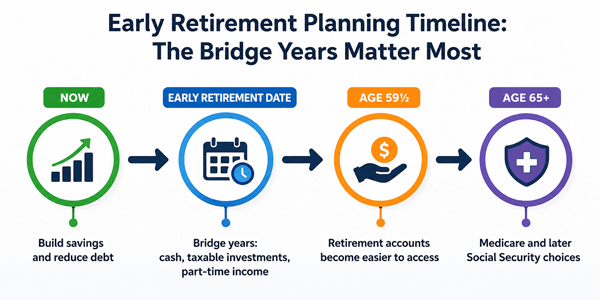
Diagram: Early Retirement Timeline
2. How Early Retirement Works
Early retirement works when your non-job income and savings can support your lifestyle for the rest of your life, with a margin of safety. This usually means building assets, estimating future spending, planning healthcare, understanding taxes, and deciding how to withdraw money without running out too soon.
- Estimate your annual retirement spending, including housing, food, travel, insurance, taxes, hobbies, and emergencies.
- Build a retirement number based on the amount of annual spending your portfolio may need to support.
- Create a bridge plan for the years before age 59½, 62, 65, and full Social Security retirement age.
- Invest in a diversified way so your money has a chance to grow while still managing risk.
- Review the plan regularly because markets, inflation, health, family needs, and laws can change.
Why the Bridge Years Are So Important
The biggest planning challenge is often the gap between your early retirement date and the ages when traditional retirement benefits become available. For example, many U.S. retirement accounts are easier to access after age 59½, Social Security can start as early as 62 with reduced benefits, Medicare generally begins at 65, and full Social Security benefits may not begin until 67 for younger retirees. A person retiring at 50 may need a 15-year healthcare plan before Medicare and a 17-year income plan before full Social Security age.
A strong bridge plan may include taxable savings, cash reserves, Roth IRA contribution access, planned Roth conversions, substantially equal periodic payments where appropriate, spouse or marketplace health coverage, and flexible part-time income. These choices have tax and eligibility rules, so they should be reviewed carefully before use.
| Age or stage | Why it matters for many U.S. retirees |
|---|---|
| Before 59½ | Some retirement account withdrawals may trigger a 10% additional tax unless an exception applies. |
| 62 | Earliest age to claim Social Security retirement benefits, but claiming early usually means reduced monthly benefits. |
| 65 | Typical Medicare eligibility age for most people. |
| 67 | Full Social Security retirement age for people born in 1960 or later. |
| 70 | Latest age when delaying Social Security increases retirement benefits under current rules. |
3. Benefits of Early Retirement
Early retirement can be powerful because it gives you more control over your time. But the benefits are most valuable when the financial plan is strong enough to support them.
- More time freedom: You can spend more time with family, travel, volunteer, learn new skills, or pursue meaningful projects.
- Less work-related stress: Leaving a demanding job may improve your quality of life if work has become physically or emotionally draining.
- Better lifestyle design: Early retirement lets you choose where and how you live instead of planning life around a job schedule.
- More flexibility during healthy years: Retiring earlier may give you more active years for travel, hobbies, and personal goals.
- Opportunity for meaningful work: Some people use early retirement to start a business, teach, consult, write, or work for a cause they care about.
4. Risks and Downsides of Early Retirement
Early retirement also carries serious risks. These risks do not mean early retirement is a bad idea. They mean the plan needs to be realistic, tested, and flexible.
One risk deserves special attention: sequence-of-returns risk. This means poor investment returns in the first years of retirement can be more damaging than the same returns later, because withdrawals during a downturn may permanently reduce the portfolio base.
| Risk | Why it matters | How to reduce it |
|---|---|---|
| Running out of money | Your portfolio may need to last 35 to 50 years instead of 20 to 30 years. | Use conservative spending assumptions, keep cash reserves, and review withdrawals annually. |
| Healthcare costs | Private insurance can be expensive before Medicare eligibility. | Price health coverage before retiring and build it into your budget. |
| Market downturns | Poor returns early in retirement can damage long-term sustainability. | Keep a diversified portfolio and avoid selling too much during downturns. |
| Inflation | Living costs may rise faster than expected. | Include inflation in projections and own assets with growth potential. |
| Tax surprises | Withdrawals, capital gains, conversions, and benefits can affect taxes. | Plan withdrawals by account type and consider professional tax advice. |
| Loss of identity or purpose | Work often provides structure, status, and social connection. | Design a weekly routine and plan relationships, hobbies, service, and goals. |
5. How Much Money Do You Need for Early Retirement?
There is no single number that works for everyone. Your early retirement number depends on your annual spending, age, expected investment returns, taxes, healthcare costs, debt, family responsibilities, and how flexible you are willing to be.
A common starting point is the 25-times-expenses rule, which comes from the idea of withdrawing about 4% of a portfolio in the first year of retirement and adjusting over time. For early retirement, many people use a more conservative approach because the retirement period is longer. Some use 28, 30, or even 33 times annual expenses, especially if they want a larger safety margin.
For a retirement that may last 40 years or more, the 4% rule should be treated as a planning shortcut, not a guarantee. A lower initial withdrawal rate, flexible spending, delayed Social Security, or part-time income can improve the margin of safety.
| Annual spending | 25x estimate | 30x estimate | What it means |
|---|---|---|---|
| $40,000 | $1,000,000 | $1,200,000 | Lean lifestyle or low-cost area |
| $60,000 | $1,500,000 | $1,800,000 | Moderate lifestyle |
| $80,000 | $2,000,000 | $2,400,000 | Comfortable lifestyle |
| $120,000 | $3,000,000 | $3,600,000 | Higher-cost lifestyle or more travel |
These numbers are only rough estimates. They do not replace a full plan. A real early retirement plan should include taxes, healthcare, inflation, investment risk, emergency reserves, and future one-time expenses such as home repairs, college support, or elder care.
■ Practical Early Retirement Strategies
1. Know Your Real Spending
Early retirement planning starts with expenses, not income. Track at least 6 to 12 months of spending and separate needs, wants, and irregular costs. Many plans fail because people forget non-monthly expenses such as insurance premiums, home maintenance, car replacement, dental care, travel, gifts, and taxes.
2. Increase Your Savings Rate
The higher your savings rate, the faster you can reach financial independence. A person saving 10% of income may need several decades to retire comfortably. A person saving 40% to 50% may shorten the timeline significantly, especially if they invest consistently and avoid lifestyle inflation.
- Automate savings before spending the rest of your paycheck.
- Save raises and bonuses instead of immediately upgrading your lifestyle.
- Review subscriptions, housing, transportation, and insurance because these often create the biggest savings opportunities.
- Avoid high-interest debt, which works against your retirement goal.
3. Invest for Long-Term Growth
Cash savings are important for emergencies, but cash alone usually cannot support early retirement because inflation reduces purchasing power over time. Many early retirement plans depend on a diversified investment portfolio that may include stock funds, bond funds, cash reserves, and sometimes real estate or business income.
Beginners should focus on broad principles: diversify, keep costs low, avoid emotional trading, and match the portfolio to the time horizon and risk tolerance. Early retirees often need both stability for near-term withdrawals and growth for the decades ahead.
A practical approach is to separate short-term spending money from long-term growth money. Some retirees keep one to three years of essential expenses in cash or short-term reserves, while leaving the rest invested according to their risk tolerance.
4. Build a Tax-Smart Withdrawal Plan
Early retirees often have money in different account types: taxable brokerage accounts, traditional retirement accounts, Roth accounts, savings accounts, and sometimes HSAs. A tax-smart withdrawal plan decides which accounts to use first and how to avoid unnecessary penalties or high tax bills.
Important tools sometimes discussed for early retirees include Roth conversion ladders, 72(t) substantially equal periodic payments, taxable brokerage withdrawals, and careful capital-gains planning. These tools can be useful, but mistakes may create taxes or penalties.
| Account type | Potential role in early retirement | Key caution |
|---|---|---|
| Taxable brokerage | Useful bridge money before traditional retirement ages. | Capital gains and dividends may be taxable. |
| Traditional 401(k)/IRA | Long-term retirement income source. | Withdrawals are generally taxable and early withdrawals may face penalties. |
| Roth IRA | Flexible source of tax-advantaged money. | Rules differ for contributions, conversions, and earnings. |
| HSA | Can help with qualified medical expenses. | Eligibility and withdrawal rules matter. |
| Cash reserve | Covers emergencies and avoids selling investments at a bad time. | Too much cash may lose purchasing power to inflation. |
5. Plan Healthcare Before You Retire
Healthcare is one of the biggest early retirement planning issues. If you leave work before Medicare eligibility, you may need coverage through a spouse, marketplace plan, private insurance, COBRA, part-time employer benefits, or another option. The cost can vary widely based on location, income, family size, plan type, and health needs.
Before retiring, get real quotes instead of guessing. Include premiums, deductibles, copays, prescriptions, dental, vision, and out-of-pocket maximums. A plan that looks affordable by premium alone may be expensive if it has a high deductible and frequent medical needs.
6. Reduce or Eliminate High-Interest Debt
Debt is not always bad, but high-interest debt is dangerous for early retirement. Credit card balances, personal loans, and expensive car loans can force larger withdrawals and increase stress. Many early retirees aim to enter retirement with no high-interest debt and a clear plan for any mortgage.
7. Create Flexible Income Options
Early retirement becomes safer when you have flexibility. You might not need a full-time job, but optional income can reduce pressure on investments during weak markets. Examples include consulting, freelancing, teaching, rental income, seasonal work, or a small online business.
8. Test Your Retirement Budget Before Quitting
One of the best early retirement strategies is a trial run. Live on your expected retirement budget for 6 to 12 months while still employed. Put the difference into savings. This test shows whether the budget feels realistic and helps reveal missing expenses before you make a permanent decision.
■ Early Retirement Example: A Simple Scenario
Imagine Alex and Jordan are 45 years old and want to retire at 55. They currently spend $70,000 per year and expect to spend $75,000 per year in early retirement because they want more travel. They estimate they need at least 30 times annual expenses, or about $2.25 million, not including any home equity they do not plan to sell.
| Planning item | Their assumption |
|---|---|
| Target retirement age | 55 |
| Expected annual spending | $75,000 |
| Portfolio target using 30x spending | $2,250,000 |
| Healthcare bridge | Private coverage from 55 to 65 |
| Income flexibility | One spouse may consult 10 hours per week during market downturns |
| Safety margin | Two years of essential expenses in cash and short-term reserves |
This example is simplified, but it shows the right thought process. The couple is not only asking, 'Do we have enough?' They are asking, 'How will we cover healthcare, market downturns, taxes, and the years before traditional benefits begin?' That is the difference between a dream and a workable plan.
6. Common Early Retirement Mistakes
- Using a simple online calculator without including healthcare, taxes, inflation, and one-time expenses.
- Assuming investment returns will be smooth every year.
- Retiring with no cash reserve and being forced to sell investments during a market decline.
- Forgetting that a longer retirement means more exposure to inflation and unexpected life events.
- Claiming Social Security early without understanding the lifetime trade-off.
- Ignoring the emotional side of retirement, including purpose, routine, and relationships.
- Overestimating how much spending will fall after leaving work.
7. Early Retirement vs. FIRE: What Is the Difference?
Early retirement and FIRE are related but not identical. FIRE stands for Financial Independence, Retire Early. Early retirement focuses on leaving work before the traditional age. FIRE focuses on becoming financially independent, often through high savings rates, intentional spending, and investing. Some FIRE followers retire completely, while others continue working because they enjoy it.
| Feature | Early retirement | FIRE |
|---|---|---|
| Main idea | Stop full-time work earlier than usual. | Reach financial independence and make work optional. |
| Typical focus | Retirement date and income plan. | Savings rate, investing, and lifestyle design. |
| Work after retiring | May or may not work. | Often flexible; work becomes optional. |
| Best for | People who want to leave a career early. | People who want control over time and money. |
■ Step-by-Step Early Retirement Checklist
- Define what early retirement means to you: full retirement, semi-retirement, career change, or financial independence.
- Calculate your current annual spending and estimate your retirement spending.
- Choose a target retirement age and identify the bridge years before key benefit ages.
- Estimate your retirement number using multiple assumptions, not just one calculator result.
- Build an emergency fund and a separate cash reserve for the first years of retirement.
- Invest consistently in a diversified portfolio that matches your time horizon.
- Understand withdrawal rules, tax consequences, and account access strategies.
- Price healthcare coverage before leaving your job.
- Reduce high-interest debt and decide how to handle your mortgage.
- Create a backup plan: part-time work, lower spending, delayed retirement, or smaller withdrawals.
- Review the plan with a qualified financial or tax professional if your situation is complex.
8. Who Should Consider Early Retirement?
Early retirement may be realistic for people who have a high savings rate, manageable expenses, strong emergency reserves, good health insurance options, diversified investments, and a clear plan for how they want to spend their time. It may also suit people who are willing to live simply, relocate, work part-time, or adjust spending during difficult markets.
It is also helpful to test the non-financial side of the plan: what a normal week will look like, who you will spend time with, and what will give your days structure and meaning after full-time work ends.
9. Who Should Be Careful About Early Retirement?
Early retirement may be risky for people with high-interest debt, unstable spending, no healthcare plan, little emergency savings, dependents with large future costs, or a plan based only on optimistic investment returns. It may also be risky for someone who strongly depends on work for identity and social life but has not planned a replacement routine.
■ Frequently Asked Questions
1. What age is considered early retirement?
There is no universal age, but retiring before the mid-60s is commonly considered early retirement. Retiring in your 50s, early 60s, or earlier usually requires extra planning because some benefits may not be available yet.
2. Can I retire early with little money?
It depends on your expenses, location, health, debt, and income options. Some people retire with modest portfolios by living very simply or working part-time, but retiring early with little money can be risky if there is no emergency cushion.
3. Is early retirement the same as financial independence?
Not always. Early retirement means leaving full-time work early. Financial independence means having enough resources that work is optional. Many people pursue both, but they are not exactly the same.
4. What is the biggest risk of early retirement?
The biggest risk is usually running out of money because the retirement period is longer. Healthcare costs, inflation, market downturns, and unexpected family expenses can also create pressure.
5. How do early retirees pay for healthcare?
Common options include a spouse’s employer plan, marketplace insurance, COBRA, private insurance, part-time work with benefits, or other coverage. The right choice depends on country, location, income, and household situation.
6. Should I pay off my mortgage before retiring early?
It depends. Paying off a mortgage can reduce monthly expenses and stress, but it may also tie up money that could be used for investments or flexibility. Compare the interest rate, liquidity needs, taxes, and peace of mind.
7. Can I work after early retirement?
Yes. Many early retirees work part-time, freelance, consult, or start a small business. Earning even a modest amount can make the plan safer because it reduces the amount withdrawn from investments.
8. Do I need a financial advisor for early retirement?
Not everyone needs one, but professional guidance can be valuable if you have complex taxes, multiple accounts, stock compensation, real estate, a pension, dependents, or uncertainty about withdrawals and healthcare.
■ Final Thoughts: Early Retirement Is a Plan, Not Just a Date
Early retirement can be rewarding, but it should be built on more than hope or a large account balance. A strong plan connects your desired lifestyle with realistic spending, diversified investments, healthcare coverage, tax planning, and emotional readiness. The best early retirement strategy is not necessarily the fastest one. It is the one you can sustain through good markets, bad markets, health changes, inflation, and life surprises.
Start by learning your real expenses, increasing your savings rate, reducing fragile debt, investing for the long term, and creating a bridge plan for the years before traditional benefits begin. With patience and flexibility, early retirement can become less of a fantasy and more of a practical, well-designed life choice.
Editorial Notes and Sources Checked
This article is educational and does not provide personalized financial, legal, or tax advice. Retirement rules vary by country and individual situation. Readers should verify local rules and consider a qualified professional for personal decisions.
- IRS 2026 retirement plan contribution limits: 401(k), 403(b), governmental 457, and TSP elective deferral limit $24,500; IRA limit $7,500; age-50 catch-up rules apply, with a higher catch-up amount for some ages 60 to 63.
- Social Security Administration: full retirement age is 67 for people born in 1960 or later; retirement benefits can start as early as 62 with a reduced monthly amount; delayed benefits may increase up to age 70 under current rules.
- Medicare.gov: Medicare is generally health insurance for people age 65 or older, with certain earlier eligibility exceptions, and the initial enrollment period usually begins before the 65th birthday month.
- IRS early distribution guidance: some retirement account distributions before age 59½ may be subject to an additional 10% tax unless an exception applies.
Reader Advice: This article is for educational and informational purposes only and should not be taken as personal financial, tax, legal, or investment advice. Please check the latest information from official sources and qualified professionals, as rules, policies, and limits can change over time.