Retirement Planning Checklist: Steps to Prepare for Retirement
Quick answer: A strong retirement planning checklist should cover your retirement goals, expected expenses, income sources, Social Security timing, savings rate, debt, healthcare, long-term care, investments, withdrawals, taxes, estate documents, emergency reserves, and an annual review process.
1. Quick Retirement Planning Checklist
Retirement planning is the process of turning your future lifestyle into a clear money plan. The goal is not to predict every detail perfectly. The goal is to make informed decisions early enough that you have options later.
| Checklist step | What to do | Why it matters |
|---|---|---|
| 1. Define your retirement vision | Choose an estimated retirement age, lifestyle, location, and work expectations. | Your target lifestyle drives your savings need. |
| 2. Estimate retirement expenses | List essential, lifestyle, healthcare, housing, tax, and irregular costs. | Spending is the foundation of your retirement number. |
| 3. Inventory income sources | Review Social Security, pensions, retirement accounts, taxable investments, annuities, rental income, and part-time work. | You need to know which bills each income source can cover. |
| 4. Calculate the gap | Compare expected annual spending with guaranteed or reliable income. | The gap shows how much your portfolio may need to provide. |
| 5. Strengthen savings | Increase contributions, use catch-up rules when eligible, and avoid unnecessary withdrawals. | More saving now can reduce pressure later. |
| 6. Manage debt | Create a payoff plan for high-interest debt and decide whether to retire with a mortgage. | Debt can make fixed retirement income feel tight. |
| 7. Plan healthcare | Understand Medicare, insurance before age 65, prescriptions, dental, vision, and long-term care. | Healthcare is one of the largest unknown retirement costs. |
| 8. Design an investment plan | Set an asset allocation that balances growth, income, and risk. | Retirement can last decades, so your money still needs a job. |
| 9. Prepare a withdrawal strategy | Decide which accounts to use first and how to handle market downturns. | Withdrawals affect taxes, longevity, and peace of mind. |
| 10. Review taxes and estate documents | Plan for tax brackets, RMDs, beneficiaries, wills, powers of attorney, and healthcare directives. | Good planning reduces confusion and costly mistakes. |
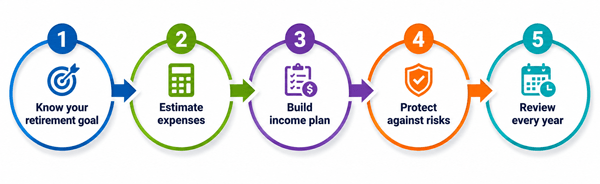
Diagram: A simple retirement planning process. Start with goals, estimate expenses, create an income plan, protect against risks, and review regularly.
Who this guide is for: This checklist is written for people who want a practical retirement planning framework, including workers in their 50s or 60s, beginners who are organizing finances for the first time, and families comparing retirement income, healthcare, taxes, and estate-planning decisions.
2. What Is a Retirement Planning Checklist?
A retirement planning checklist is a step-by-step list of the decisions, calculations, documents, and habits that help you prepare for life after full-time work. It turns a large, emotional topic into manageable actions.
A good checklist helps you answer practical questions: When can I retire? How much will I spend? What income will I have? How will I pay for healthcare? What happens if markets fall, inflation rises, or I live longer than expected?
For beginners, the checklist is especially useful because it prevents a common mistake: focusing only on the account balance. Retirement readiness is not just about how much money you have. It is also about spending, income timing, taxes, healthcare, debt, insurance, family responsibilities, and flexibility.
Step 1: Define What Retirement Means to You
Before you calculate numbers, describe the retirement you are planning for. Retirement is different for everyone. Some people want to stop working completely. Others want part-time work, consulting, a small business, travel, volunteering, or more time with family.
Write down your expected retirement age, where you may live, whether you will work at all, how often you want to travel, whether you may support children or parents, and what a normal month might look like.
Example: A couple planning a quiet retirement in a paid-off home will need a different budget than someone who wants international travel, private health insurance before Medicare, and a second home. Neither goal is wrong. The plan simply needs to match the lifestyle.
Step 2: Estimate Your Retirement Expenses
Your retirement expenses are the most important input in your plan. Many people assume expenses will automatically fall after retirement, but that is not always true. Work-related costs may go down, while healthcare, hobbies, travel, home repairs, and family support may rise.
Start with your current spending. Then adjust each category for retirement. Separate essential costs from flexible costs so you know what must be covered even in a difficult year.
| Expense category | Examples | Planning tip |
|---|---|---|
| Essential living costs | Housing, utilities, groceries, transportation, insurance premiums | These should ideally be covered by reliable income or a conservative withdrawal plan. |
| Healthcare | Medicare premiums, supplemental coverage, prescriptions, dental, vision, out-of-pocket care | Plan separately because healthcare inflation can be higher than general inflation. |
| Lifestyle spending | Travel, restaurants, hobbies, gifts, entertainment | This is where you can adjust spending if markets or income disappoint. |
| Irregular costs | Home repairs, car replacement, appliances, major family events | Create sinking funds so these do not surprise your budget. |
| Taxes | Federal and state income taxes, property taxes, taxes on retirement withdrawals | Retirement income can still be taxable. Model after-tax income, not just gross income. |
Step 3: Create a Realistic Retirement Budget
A retirement budget is a monthly or annual spending plan for your retired life. It should be realistic, not overly strict. The best budget is one you can actually follow.
Use three layers:
- Needs: housing, food, utilities, insurance, healthcare, transportation, and basic taxes.
- Wants: travel, dining, hobbies, entertainment, and upgrades.
- Reserves: emergencies, home repairs, car replacement, medical surprises, and family support.
Practical example: If you expect to spend $5,000 per month, you might classify $3,500 as needs, $1,000 as wants, and $500 as reserves. If markets fall, you may reduce wants temporarily while still covering essentials.
| Monthly retirement budget example | Amount |
|---|---|
| Housing, utilities, and maintenance | $1,600 |
| Food and household items | $800 |
| Healthcare premiums and out-of-pocket costs | $700 |
| Transportation | $500 |
| Insurance and taxes | $600 |
| Travel, hobbies, and entertainment | $900 |
| Emergency and replacement reserves | $400 |
| Estimated monthly total | $5,500 |
Step 4: List Every Retirement Income Source
Next, write down every income source you expect in retirement. Separate guaranteed or highly reliable income from variable income.
| Income source | How it works | Key question to ask |
|---|---|---|
| Social Security | Monthly benefit based on earnings record and claiming age. | Should you claim early, at full retirement age, or later? |
| Pension | Employer-paid lifetime or period-certain income, if available. | Is there a survivor benefit and inflation adjustment? |
| 401(k), 403(b), 457, IRA | Tax-advantaged savings that may be withdrawn over time. | Which accounts should you withdraw from first? |
| Roth accounts | After-tax contributions with potentially tax-free qualified withdrawals. | Can Roth withdrawals help manage taxes later? |
| Taxable investments | Brokerage accounts, mutual funds, ETFs, stocks, bonds. | How much taxable income or capital gains will withdrawals create? |
| Part-time work or business income | Flexible income from work after retirement. | Is this a preference or a financial necessity? |
| Rental or other income | Income from property, royalties, or other assets. | How reliable is it after maintenance, vacancies, and taxes? |
Step 5: Understand Social Security Timing
For U.S. readers, Social Security can be a major part of retirement income. You can generally start retirement benefits as early as age 62, but benefits are reduced if you claim before full retirement age. If you delay after full retirement age, benefits can increase until age 70.
The Social Security Administration states that full retirement age is 67 for people born in 1960 or later. Claiming is not only a math decision. It also depends on health, life expectancy, marital status, need for income, taxes, employment, and whether a surviving spouse may rely on the larger benefit.
| Claiming choice | Potential advantage | Potential drawback |
|---|---|---|
| Claim early | Income starts sooner and may help if you need cash flow or have health concerns. | Monthly benefit is permanently reduced. |
| Claim at full retirement age | You receive your full retirement benefit based on your earnings record. | You give up the higher monthly benefit available from delaying. |
| Delay toward age 70 | Monthly benefit increases, which can help longevity protection. | You need other income while waiting and may not benefit if life expectancy is shorter. |
Step 6: Maximize Savings While You Are Still Working
If retirement is still years away, your strongest tool is often your savings rate. Small increases can matter, especially when combined with employer matching contributions and tax-advantaged accounts.
For 2026, the IRS announced that employees can contribute up to $24,500 to many workplace retirement plans such as 401(k), 403(b), and most 457 plans. The IRA contribution limit is $7,500. Catch-up contribution rules may allow additional savings for eligible older workers, including higher catch-up amounts for some ages 60 through 63. Always confirm current limits for the year you contribute.
Current-rule reminder: For 2026, the basic catch-up contribution for many workplace plans is $8,000 for eligible participants age 50 or older, and a higher catch-up limit of $11,250 applies to some participants ages 60 through 63. Contribution limits, Roth catch-up rules, income thresholds, and plan features can change, so readers should verify the current year’s rules before contributing.
- Contribute enough to receive any full employer match, if available.
- Increase contributions after raises, bonuses, or debt payoff milestones.
- Use catch-up contributions when eligible and appropriate.
- Avoid cashing out retirement accounts when changing jobs unless you fully understand taxes and penalties.
- Keep an emergency fund so short-term problems do not force long-term withdrawals.
Step 7: Calculate Your Retirement Savings Gap
After estimating expenses and income, compare the two. If your expected annual expenses are $72,000 and reliable income such as Social Security and pensions is $42,000, your portfolio may need to provide about $30,000 per year before taxes and adjustments.
Simple retirement gap formula: Estimated annual retirement spending minus reliable annual income equals the amount your savings, investments, or part-time work may need to cover.
A simple rule of thumb is the 4% guideline, which suggests that a diversified portfolio may support an initial withdrawal of about 4% of the balance, adjusted over time for inflation. This is not a guarantee. It is a starting point for discussion. A $30,000 annual gap would suggest a portfolio target of about $750,000 using a 4% starting withdrawal rate. A more conservative 3.5% rate would require about $857,000.
The right number depends on age, health, investment mix, tax situation, guaranteed income, flexibility, inflation, and market returns.
Step 8: Reduce Debt Before Retirement
Debt is not automatically bad, but it affects flexibility. High-interest credit card debt, personal loans, and expensive car loans can make retirement harder because they consume cash flow without building future security.
Prioritize high-interest debt first. For a mortgage, the answer is more personal. Some retirees prefer to enter retirement mortgage-free for peace of mind. Others keep a low-rate mortgage to preserve cash. The best decision depends on interest rate, taxes, liquidity, risk tolerance, and monthly budget.
Step 9: Plan for Healthcare and Insurance
Healthcare planning deserves its own checklist. In the U.S., Medicare generally becomes central at age 65, but it does not cover everything. You may still have premiums, deductibles, copays, prescription costs, dental, vision, hearing, and long-term care expenses.
If you retire before age 65, you need a bridge plan. Options may include employer retiree coverage, a spouse’s plan, marketplace insurance, COBRA, or other coverage. Price this before choosing a retirement date.
Medicare’s initial enrollment period generally starts three months before you turn 65 and ends three months after the month you turn 65. Missing enrollment windows can create late penalties unless you qualify for a special enrollment period.
Step 10: Protect Against Long-Term Care Risk
Long-term care means help with daily activities such as bathing, dressing, eating, mobility, or memory care. It may be provided at home, in assisted living, or in a nursing facility. Medicare generally does not cover extended custodial long-term care.
Planning clarification: Long-term care risk is both a financial issue and a family logistics issue, so the plan should include who may provide care, where care may happen, and how costs would be paid.
Possible approaches include long-term care insurance, hybrid life insurance with long-term care benefits, self-funding, family caregiving plans, home modifications, or Medicaid planning where appropriate. Each option has trade-offs. The key is to discuss the risk before a crisis.
Step 11: Review Your Investment Strategy
Retirement does not mean all money should move to cash. Many retirees need growth because retirement can last 20, 30, or even 40 years. At the same time, too much stock-market risk can make withdrawals stressful during downturns.
A common approach is to divide money by purpose: short-term cash for near expenses, conservative investments for several years of withdrawals, and growth investments for long-term needs. This can reduce the need to sell volatile assets during a market decline.
Step 12: Create a Withdrawal Strategy
A withdrawal strategy explains how you will turn savings into income. It should consider taxes, required minimum distributions, investment risk, and account types.
Many retirees use a mix of taxable accounts, tax-deferred accounts, and Roth accounts. The best order is not the same for everyone. Some people benefit from Roth conversions before RMDs begin. Others need to preserve taxable assets or avoid higher Medicare premiums. This is a good area for professional tax planning.
Step 13: Plan for Taxes in Retirement
Retirement income can still be taxable. Traditional IRA and 401(k) withdrawals are generally taxed as ordinary income. Social Security may be partly taxable depending on income. Pension income may be taxable. Taxable investment accounts may produce dividends, interest, and capital gains.
U.S. required minimum distributions generally begin at age 73 for many traditional retirement accounts under current IRS rules, with some exceptions. RMDs can increase taxable income, so planning before that age may help.
Step 14: Update Estate and Legal Documents
A complete retirement checklist includes legal preparation. Estate planning is not only for wealthy families. It helps loved ones manage decisions if you become incapacitated or pass away.
Review your will, durable power of attorney, healthcare power of attorney, advance healthcare directive, beneficiary designations, trust documents if any, property titles, and digital account instructions. Beneficiary forms on retirement accounts and life insurance often override your will, so keep them updated.
Step 15: Build a Retirement Emergency Plan
Even a strong retirement plan can face surprises. Markets can fall, inflation can rise, healthcare needs can change, adult children may need help, or a spouse may pass away.
Build flexibility into the plan. Keep emergency savings, maintain appropriate insurance, know which expenses can be reduced, avoid overspending early in retirement, and review the plan annually.
| Risk | Why it matters | Possible planning response |
|---|---|---|
| Longevity risk | You may live longer than expected and need income for decades. | Delay some guaranteed income, maintain growth assets, avoid high early withdrawals. |
| Inflation risk | Prices can rise faster than your income. | Use inflation-aware budgeting and investments with long-term growth potential. |
| Market risk | Poor returns early in retirement can damage a portfolio. | Hold cash reserves, diversify, reduce flexible spending during downturns. |
| Healthcare risk | Medical costs can rise with age. | Plan Medicare, supplemental coverage, prescriptions, and long-term care options. |
| Tax risk | Tax rules and personal tax brackets can change. | Diversify account types and review tax strategy annually. |
■ Retirement Planning Timeline by Age
| Time before retirement | Main priorities |
|---|---|
| 20+ years away | Build saving habits, invest for growth, increase income, avoid lifestyle inflation, use tax-advantaged accounts. |
| 10-15 years away | Estimate retirement expenses, increase contributions, reduce high-interest debt, review investment risk, start healthcare assumptions. |
| 5-10 years away | Run detailed retirement projections, consider catch-up contributions, review Social Security estimates, plan mortgage and insurance decisions. |
| 1-5 years away | Finalize retirement budget, build cash reserves, choose healthcare coverage, test retirement spending, review tax strategy and estate documents. |
| First year of retirement | Track real spending, adjust withdrawals, confirm tax withholding, review Medicare and insurance, avoid major irreversible decisions. |
| Every year after retirement | Review spending, investments, taxes, beneficiaries, insurance, income needs, and withdrawal rate. |
■ Benefits of Using a Retirement Planning Checklist
- It reduces overwhelm by turning retirement into clear steps.
- It helps you notice missing items such as healthcare, taxes, and estate documents.
- It makes conversations with a spouse, family, or financial professional more productive.
- It can reveal whether you need to save more, work longer, spend less, or change your investment plan.
- It creates a review habit, which is important because retirement planning is never one-and-done.
■ Common Retirement Planning Mistakes to Avoid
| Mistake | Why it can hurt | Better approach |
|---|---|---|
| Guessing expenses | A vague estimate can lead to overconfidence or fear. | Use actual spending data and adjust for retirement. |
| Ignoring healthcare | Medical and insurance costs can be large and uneven. | Price coverage before retiring, especially before age 65. |
| Claiming Social Security without analysis | The wrong timing can reduce lifetime income or survivor benefits. | Compare claiming ages and household impact. |
| Retiring with no cash reserve | You may be forced to sell investments during a downturn. | Keep a dedicated reserve for near-term spending and emergencies. |
| Taking too much too soon | High early withdrawals can damage long-term sustainability. | Start with a conservative withdrawal plan and adjust annually. |
| Forgetting taxes | Gross income is not spendable income. | Plan after-tax withdrawals and withholding. |
| Outdated beneficiaries | Assets may go to the wrong person. | Review beneficiary forms after major life events. |
■ Printable Retirement Planning Checklist
Lifestyle and goals
- ☐ Choose a target retirement age.
- ☐ Describe your ideal retirement lifestyle.
- ☐ Decide whether you want part-time work.
- ☐ Discuss plans with your spouse or partner if applicable.
Money and budget
- ☐ Track current spending for at least three to six months.
- ☐ Estimate retirement needs, wants, and reserves.
- ☐ List all expected retirement income sources.
- ☐ Calculate the gap between income and expenses.
- ☐ Build a plan to close the gap.
Savings and investments
- ☐ Review current account balances.
- ☐ Increase contributions where possible.
- ☐ Check employer matching contributions.
- ☐ Review asset allocation and diversification.
- ☐ Create a withdrawal strategy.
Debt and housing
- ☐ List all debts and interest rates.
- ☐ Pay down high-interest debt.
- ☐ Decide whether to retire with a mortgage.
- ☐ Estimate future housing repairs and property taxes.
- ☐ Consider whether downsizing or relocating makes sense.
Healthcare and insurance
- ☐ Plan health insurance before Medicare if retiring early.
- ☐ Understand Medicare enrollment timing.
- ☐ Review prescription, dental, vision, and hearing costs.
- ☐ Evaluate long-term care risk.
- ☐ Review life, disability, home, auto, and umbrella insurance.
Taxes, legal, and family
- ☐ Estimate taxes on retirement income.
- ☐ Plan for RMDs where applicable.
- ☐ Update wills and powers of attorney.
- ☐ Review beneficiaries.
- ☐ Organize important documents and account access instructions.
■ Mini Case Study: How a Checklist Changes the Decision
Maria is 61 and wants to retire at 64. She has $720,000 in retirement accounts, expects $2,300 per month from Social Security at full retirement age, and spends about $5,200 per month today. At first, she believes she is ready because her account balance looks large.
After using a checklist, she finds three gaps: she has not priced health insurance before Medicare, she still has a car loan, and she has not planned taxes on 401(k) withdrawals. She decides to work one extra year, increase contributions, pay off the car, and build a healthcare bridge fund. The result is not just more money. It is a clearer, less stressful retirement plan.
■ Frequently Asked Questions
1. What is the first step in retirement planning?
The first step is defining what retirement means to you. Choose a target age, lifestyle, location, and expected spending pattern. Then build the money plan around that lifestyle.
2. How much money do I need to retire?
There is no single number. A practical starting point is to estimate annual retirement expenses, subtract reliable income such as Social Security or pensions, and calculate how much your savings must provide. The answer depends on spending, taxes, healthcare, investment returns, inflation, and retirement length.
3. Is the 4% rule enough for retirement planning?
The 4% guideline can be useful for rough estimates, but it is not a guarantee. It should be adjusted for age, market conditions, taxes, fees, investment mix, and spending flexibility.
4. Should I pay off my mortgage before retirement?
Paying off a mortgage can reduce monthly expenses and increase peace of mind. Keeping a low-rate mortgage can preserve cash and investment flexibility. The best choice depends on your rate, liquidity, taxes, income stability, and comfort with debt.
5. When should I start planning for retirement?
Start as early as possible, even if the first plan is simple. If retirement is close, planning is still valuable because it can improve Social Security timing, taxes, healthcare choices, withdrawals, and spending decisions.
6. How often should I review my retirement plan?
Review it at least once a year and after major life events such as job changes, marriage, divorce, illness, inheritance, market shocks, relocation, or the death of a spouse.
7. What documents should I organize before retirement?
Organize account statements, insurance policies, tax returns, Social Security estimates, pension details, wills, powers of attorney, healthcare directives, beneficiary forms, property records, loan documents, and a list of digital accounts.
8. Can I retire if I still have debt?
Possibly, but the type of debt matters. High-interest debt is usually a serious warning sign. A manageable mortgage may be acceptable if your income plan comfortably supports payments and you have enough reserves.
■ Final Thoughts
A retirement planning checklist is useful because it turns uncertainty into action. You do not need to solve everything in one day. Start with your lifestyle, estimate expenses, list income sources, identify the gap, and then improve one section at a time.
Best next step: Choose one section of the checklist to complete this week, such as estimating expenses, downloading a Social Security statement, reviewing beneficiaries, or pricing healthcare coverage.
The best retirement plans are flexible. They allow for changing markets, changing health, changing tax rules, and changing personal goals. Review your plan every year, keep your documents updated, and get professional advice when decisions involve taxes, estate planning, insurance, or large investment changes.
Sources and Fact Checks
- IRS: 2026 workplace retirement plan and IRA contribution limits, including catch-up contribution information. Official source: irs.gov/newsroom/401k-limit-increases-to-24500-for-2026-ira-limit-increases-to-7500
- Social Security Administration: retirement benefits may start as early as age 62; full retirement age is 67 for people born in 1960 or later; delayed claiming can increase benefits up to age 70. Official source: ssa.gov/benefits/retirement/planner/1960-delay.html
- Medicare.gov and SSA Medicare guidance: Medicare enrollment timing, including the 7-month initial enrollment period around age 65. Official source: medicare.gov/basics/get-started-with-medicare/sign-up/when-does-medicare-coverage-start
- IRS: Required minimum distributions generally begin at age 73 for many traditional retirement accounts under current rules. Official source: irs.gov/retirement-plans/retirement-plan-and-ira-required-minimum-distributions-faqs
Reader Advice: This article is for educational and informational purposes only and should not be taken as personal financial, tax, legal, insurance, or investment advice. Rules, limits, policies, and prices can change over time, so please check the latest official sources or speak with a qualified professional before making important retirement decisions.
Examples use U.S. retirement rules where noted. Rules and limits can change, so readers should verify details with official sources or a qualified professional before making decisions.