How Much Money Do You Need to Retire?
A common retirement question is simple: how much money do you need to retire? The honest answer is that it depends on how much you plan to spend, when you retire, how long retirement may last, what income sources you will have, and how much risk you can handle.
Many people hear rules such as "save $1 million" or "you need 25 times your annual expenses." These rules can be useful starting points, but they are not complete plans. A person who owns a paid-off home, has a pension, and spends modestly may need far less than someone who rents, supports family members, travels often, and pays for private health insurance.
This guide explains how to estimate your retirement number in a practical way. You will learn the most important formulas, how Social Security and pensions change the calculation, how early retirement affects the answer, and how to test whether your plan is realistic. It also includes a simple worksheet, examples, and a reader-friendly checklist so you can turn a broad estimate into a practical retirement planning target.
1. Quick Answer: How Much Money Do You Need to Retire?
A simple starting estimate is:
Retirement savings needed = annual retirement spending not covered by guaranteed income x 25
This is based on the 4% rule, which means a retiree withdraws about 4% of the portfolio in the first year and then adjusts withdrawals over time. For example, if you expect to spend $60,000 per year and Social Security covers $25,000, your portfolio needs to cover $35,000. Using the 25x rule, $35,000 x 25 = $875,000.
For a more conservative estimate, use 28x to 33x annual portfolio-funded spending, especially if you retire early, expect a long retirement, have high health care costs, or want a bigger safety margin.
| Annual spending need from portfolio | 25x estimate (4% rule) | 28.6x estimate (3.5%) | 33.3x estimate (3%) |
|---|---|---|---|
| $20,000 | $500,000 | $572,000 | $666,000 |
| $40,000 | $1,000,000 | $1,144,000 | $1,332,000 |
| $60,000 | $1,500,000 | $1,716,000 | $1,998,000 |
| $80,000 | $2,000,000 | $2,288,000 | $2,664,000 |
| $100,000 | $2,500,000 | $2,860,000 | $3,330,000 |
2. Why Retirement Savings Needs Are Different for Everyone
Retirement is not only an age. It is a financial transition from earning a paycheck to funding your life from several income sources. The amount you need depends mainly on these factors:
- Your expected annual spending in retirement.
- Your retirement age and expected retirement length.
- Social Security, pensions, annuities, rental income, or part-time work.
- Investment returns and inflation.
- Taxes, health care costs, housing costs, and debt payments.
- Your desired lifestyle, travel plans, family support, and legacy goals.
The goal is not to guess a magic number. The goal is to estimate the income your investments must provide after other dependable income sources are considered.
3. Step-by-Step: How to Calculate How Much Money You Need to Retire
Step 1: Estimate Your Annual Retirement Spending
Start with spending, not your current salary. Many retirement calculators use a percentage of pre-retirement income, such as 70% to 85%, but spending is usually more accurate. Some expenses may fall after retirement, while others may rise.
| Expense category | May decrease in retirement | May increase in retirement |
|---|---|---|
| Work costs | Commuting, work clothes, payroll taxes, lunches out | Professional memberships if consulting |
| Housing | Mortgage may end, downsizing possible | Repairs, property taxes, insurance, rent inflation |
| Health care | Employer plan premiums may end if Medicare begins | Premiums, dental, vision, long-term care, out-of-pocket costs |
| Family costs | Children may be independent | Helping adult children, elder care, gifts |
| Lifestyle | Less rushed convenience spending | Travel, hobbies, home projects, leisure |
A practical beginner method is to review the last 12 months of spending and sort it into three groups: essential needs, flexible wants, and occasional large costs. Then adjust each category for retirement.
Step 2: Subtract Reliable Retirement Income
Next, subtract income that is relatively dependable. This may include Social Security, a pension, annuity income, rental net income, or part-time work you are confident you will continue.
| Example calculation | Amount |
|---|---|
| Estimated annual retirement spending | $70,000 |
| Estimated Social Security | $28,000 |
| Pension income | $12,000 |
| Income gap to fund from savings | $30,000 |
In this example, the person does not need a portfolio to cover the full $70,000. The portfolio only needs to cover the $30,000 annual income gap, plus a cushion for taxes, inflation, emergencies, and uncertain expenses.
Step 3: Choose a Withdrawal Rate
A withdrawal rate is the percentage of your retirement portfolio you withdraw in a year. The 4% rule is a popular starting point, but it is not a promise. It was developed from historical market data and is most often used for a roughly 30-year retirement with a diversified portfolio of stocks and bonds.
| Withdrawal rate | Portfolio multiplier | Best used as |
|---|---|---|
| 5% | 20x spending | Aggressive estimate; may require flexibility, shorter retirement, or strong guaranteed income |
| 4% | 25x spending | Common starting point for a 30-year retirement |
| 3.5% | 28.6x spending | More conservative estimate for uncertain markets or longer retirement |
| 3% | 33.3x spending | More cautious estimate for early retirement or high need for safety |
Formula:
Portfolio needed = annual income gap / withdrawal rate
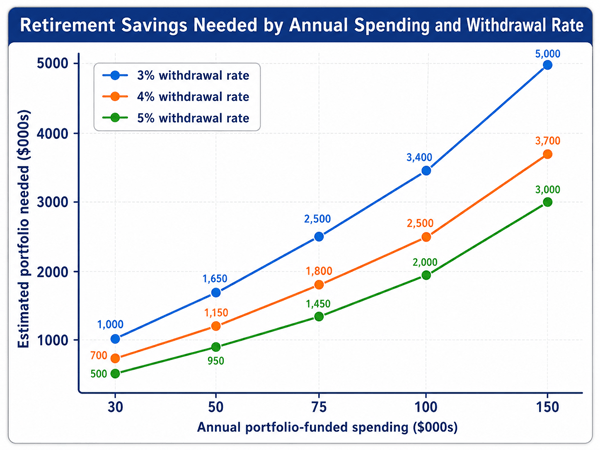
Chart: The lower the withdrawal rate, the more savings you need for the same annual spending. A lower withdrawal rate can provide a larger safety margin, but it also requires saving more before retirement.
Step 4: Adjust for Taxes
Your retirement number should be based on after-tax spending, but withdrawals often create taxes. Traditional 401(k) and traditional IRA withdrawals are generally taxable as ordinary income. Roth withdrawals may be tax-free if qualified. Brokerage accounts may create capital gains or dividend taxes. Social Security may also be taxable depending on your total income.
A simple way to avoid underestimating is to calculate your spending need before tax. For example, if you need $50,000 after tax and expect an average 15% tax rate on withdrawals, you may need about $58,800 before tax because $58,800 minus 15% is roughly $50,000.
Step 5: Add a Safety Cushion
Retirement planning includes uncertainty. A reasonable cushion can protect you from surprise expenses, market downturns, inflation, and changes in family needs.
- Keep an emergency fund, often 6 to 12 months of essential expenses, separate from long-term investments.
- Plan for irregular costs such as a roof replacement, car purchase, dental work, or family emergencies.
- Consider using a lower withdrawal rate if you retire before your 60s.
- Avoid counting every dollar of home equity unless you truly plan to sell, downsize, or borrow against it.
Retirement Number Examples
Example 1: Moderate Retirement at Age 67
| Item | Amount |
|---|---|
| Annual retirement spending | $65,000 |
| Social Security estimate | $30,000 |
| Portfolio-funded gap | $35,000 |
| Using 4% rule | $875,000 |
| Using 3.5% rate | $1,000,000 |
This retiree may target about $875,000 to $1 million, depending on risk tolerance, taxes, health costs, and flexibility.
Example 2: Higher-Cost Retirement
| Item | Amount |
|---|---|
| Annual retirement spending | $110,000 |
| Social Security estimate | $38,000 |
| Small pension | $12,000 |
| Portfolio-funded gap | $60,000 |
| Using 4% rule | $1,500,000 |
| Using 3.5% rate | $1,714,000 |
This person needs more not because retirement is automatically expensive, but because their annual spending gap is larger.
Example 3: Early Retirement at Age 55
| Item | Amount |
|---|---|
| Annual spending | $80,000 |
| Guaranteed income before Social Security | $0 |
| Portfolio-funded gap before Social Security | $80,000 |
| Using 4% rule | $2,000,000 |
| Using 3% rate | $2,667,000 |
Early retirement usually requires a larger portfolio because savings must last longer and because health insurance may be needed before Medicare eligibility in the United States. A person retiring at 55 may also need a bridge plan before Social Security starts.
4. How Social Security Changes Your Retirement Number
For U.S. readers, Social Security can reduce the amount your investment portfolio must provide. However, the claiming age matters. The Social Security Administration says retirement benefits can start as early as age 62, full benefits begin at full retirement age, and delaying beyond full retirement age can increase the monthly benefit until age 70. For people born in 1960 or later, full retirement age is 67, and delayed retirement credits stop increasing after age 70. This does not mean everyone should delay. The best claiming age depends on health, cash needs, marital status, survivor benefits, taxes, and life expectancy.
| Claiming age concept | General effect |
|---|---|
| Age 62 | Earliest claiming age; monthly benefit is reduced |
| Full retirement age | Age when unreduced retirement benefits begin |
| Age 70 | Delayed retirement credits stop increasing the benefit after this age |
Planning tip: Build your retirement estimate twice: once with Social Security at your likely claiming age and once with a lower benefit. This stress test helps you see whether your plan depends too heavily on one assumption.
5. How Much Should You Have Saved by Age?
Age-based savings benchmarks can be helpful, but they are not personal retirement calculations. They compare your savings to income, while your actual retirement need depends on spending, income sources, debt, health costs, and retirement age.
| Age | Common savings checkpoint | What it really means |
|---|---|---|
| 30 | About 1x annual income saved | A useful early target, but not a failure if you started late |
| 40 | About 3x annual income saved | Debt reduction and savings rate become more important |
| 50 | About 6x annual income saved | Catch-up saving and retirement timing matter |
| 60 | About 8x to 10x annual income saved | Start estimating actual retirement income and expenses |
| 67 | Enough to cover your income gap | The true target depends on spending and guaranteed income |
Use benchmarks as a progress check, not as a final answer. A person earning $200,000 but spending $70,000 may need less than income-based benchmarks suggest. A person earning $70,000 but spending $90,000 may need more than expected.
6. How Retirement Age Affects the Amount You Need
| Retirement age | Planning impact |
|---|---|
| Before 55 | Usually requires a much larger portfolio, health insurance bridge, and flexible withdrawals |
| 55 to 59 | Still early; access to accounts, taxes, and penalties need careful planning |
| 60 to 64 | Closer to Social Security and Medicare but still may need bridge income |
| 65 to 67 | Medicare and full retirement age may reduce risk for many U.S. retirees |
| 70+ | More working years, fewer retirement years, and potentially higher Social Security benefits |
Delaying retirement can improve the math in three ways: you save for more years, your existing investments have more time to compound, and your portfolio may need to fund fewer years of retirement.
7. The Role of Inflation
Inflation means prices rise over time, so the same lifestyle costs more in the future. Even moderate inflation can significantly affect a long retirement. If you spend $60,000 today, a 3% annual inflation rate would make that same lifestyle cost about $80,600 in 10 years and about $108,400 in 20 years.
This is why retirement planning should not keep all money in cash for decades. Cash is useful for short-term needs and emergencies, but long-term retirement money usually needs some growth potential to help fight inflation.
8. Health Care and Long-Term Care: Often Underestimated Costs
Health care is one of the biggest uncertainties in retirement. Premiums, deductibles, prescriptions, dental care, vision care, hearing care, and long-term care can all affect how much money you need. Medicare can help U.S. retirees, but it does not make health care free and it does not cover every long-term care need. Medicare generally does not cover most long-term custodial care, so this cost should be planned separately.
- Include health insurance premiums in your retirement budget.
- Estimate out-of-pocket costs, not just premiums.
- Plan separately for long-term care risk, especially if you do not have family support or want to protect a spouse.
- Keep a medical emergency cushion outside your normal annual withdrawal plan.
9. Investment Mix: Why Asset Allocation Matters
Your retirement number depends partly on how your money is invested. A portfolio that is too conservative may not keep up with inflation. A portfolio that is too aggressive may create large losses at the wrong time.
| Portfolio style | Potential benefit | Main risk |
|---|---|---|
| Mostly cash | Stable short-term value | Inflation can reduce purchasing power |
| Mostly bonds | Income and lower volatility than stocks | Interest-rate risk and lower long-term growth |
| Balanced stocks and bonds | Growth plus some stability | Still exposed to market downturns |
| Mostly stocks | Higher long-term growth potential | Large short-term losses can be emotionally and financially difficult |
A common approach is to keep near-term spending needs in safer assets and long-term money invested for growth. This can help reduce the chance that you sell stocks during a market crash to pay normal bills.
10. The Sequence-of-Returns Risk Problem
Sequence-of-returns risk means poor investment returns early in retirement can hurt more than the same poor returns later. If the market falls soon after you retire and you keep withdrawing money, your portfolio may have less capital left to recover.
Ways to manage this risk include holding a cash reserve, reducing withdrawals in bad markets, using a flexible spending plan, maintaining part-time income, delaying large optional expenses, and having a diversified portfolio.
11. Should You Use the 4% Rule?
The 4% rule is useful because it gives a quick estimate: multiply the annual spending gap by 25. But it should not be treated as a guaranteed rule.
| Strengths of the 4% rule | Limitations of the 4% rule |
|---|---|
| Easy to understand and calculate | Based on historical data, not a guarantee |
| Useful for a first retirement estimate | May be too aggressive for early retirement |
| Connects spending directly to savings needed | Does not fully account for taxes, fees, or personal emergencies |
| Encourages disciplined withdrawals | Assumes a reasonably diversified investment portfolio |
A better approach is to use the 4% rule as a starting estimate, then adjust for retirement length, risk tolerance, taxes, health care, investment fees, and flexibility.
12. How Much Money Do You Need to Retire Comfortably?
Comfortable retirement means different things to different people. For some, it means covering basic needs without financial stress. For others, it means travel, hobbies, gifts, dining out, and a paid-off home. Instead of asking for one universal number, define your retirement lifestyle.
| Lifestyle level | Description | Planning note |
|---|---|---|
| Basic | Covers housing, food, utilities, insurance, health care, and transportation | Needs a strong emergency cushion because there is less room to cut spending |
| Moderate | Covers essentials plus hobbies, local travel, gifts, and occasional upgrades | Often works well with a balanced budget and flexible spending |
| Comfortable | Includes more travel, entertainment, home improvements, and financial help to family | Requires a larger portfolio or stronger guaranteed income |
| Luxury | High travel, second home, major gifts, premium health care, legacy goals | Needs detailed tax, estate, and investment planning |
13. How to Catch Up If You Are Behind
Being behind does not mean retirement is impossible. It means you need a clearer plan and possibly a few trade-offs.
- Increase your savings rate gradually. Even a 1% increase every few months can help.
- Use employer matching contributions if available. Not getting the match is usually leaving compensation on the table.
- Reduce high-interest debt before retirement. Debt payments increase the portfolio income you need.
- Consider working longer or part time. Extra working years can improve retirement math dramatically.
- Review housing. Downsizing, relocating, or paying off a mortgage can lower required income.
- Use catch-up contributions if eligible. For 2026, the IRS announced higher limits for several retirement plans. The basic 401(k), 403(b), most 457 plan, and Thrift Savings Plan elective deferral limit is $24,500; the IRA limit is $7,500; and special catch-up rules may apply for eligible older workers. Always confirm current limits on IRS.gov before contributing.
- Avoid taking excessive investment risk to make up for lost time. A risky bet that fails can make the problem worse.
14. Retirement Accounts to Understand
The best savings account depends on your country, employer, income, tax situation, and goals. For U.S. readers, common retirement accounts include 401(k), 403(b), 457(b), traditional IRA, Roth IRA, SEP IRA, SIMPLE IRA, and HSA accounts when eligible. Tax rules and contribution limits change over time, so check current official limits before making decisions.
| Account type | Main benefit | Beginner note |
|---|---|---|
| 401(k), 403(b), 457(b) | High contribution limits and possible employer match | Often a core retirement savings tool for employees |
| Traditional IRA | Potential tax deduction now | Withdrawals are generally taxable later |
| Roth IRA | Qualified withdrawals may be tax-free | Income limits and contribution rules apply |
| HSA | Tax advantages for qualified medical expenses | Available only with eligible high-deductible health plans |
| Taxable brokerage | Flexible access and no retirement account contribution limit | Less tax-sheltered than retirement accounts |
15. Common Mistakes When Estimating Retirement Needs
- Using income instead of spending. Your retirement number should be based on what you need to spend.
- Ignoring taxes. A $1 million traditional IRA is not the same as $1 million in tax-free cash.
- Assuming retirement spending stays flat. Inflation can raise costs over time.
- Forgetting health care and long-term care. These costs can be large and unpredictable.
- Counting home equity without a plan to use it. Home value does not pay monthly bills unless you sell, borrow, or rent part of the property.
- Planning for only average market returns. The order of returns matters, especially early in retirement.
- Retiring with expensive debt. Debt increases required withdrawals and reduces flexibility.
- Relying on one rule of thumb. A rule can start the conversation, but a plan needs personal numbers.
16. A Simple Retirement Readiness Checklist
- You know your estimated annual retirement spending.
- You know your expected guaranteed income sources and claiming ages.
- You have calculated your portfolio-funded income gap.
- You have tested at least two withdrawal rates, such as 4% and 3.5%.
- You have included taxes, health care, insurance, and irregular expenses.
- You have a plan for market downturns in the first 5 years of retirement.
- You understand which accounts to withdraw from first or have professional tax guidance.
- You have an emergency fund and no high-interest debt.
- You have reviewed estate documents, beneficiaries, and insurance coverage.
17. Mini Worksheet: Estimate Your Retirement Number
| Line | Question | Your estimate |
|---|---|---|
| 1 | Expected annual retirement spending | __________ |
| 2 | Annual Social Security or government pension | __________ |
| 3 | Annual employer pension or annuity income | __________ |
| 4 | Other dependable annual income | __________ |
| 5 | Income gap: line 1 minus lines 2-4 | __________ |
| 6 | Savings needed at 4%: line 5 x 25 | __________ |
| 7 | Savings needed at 3.5%: line 5 x 28.6 | __________ |
| 8 | Extra cushion for taxes, health care, and emergencies | __________ |
| 9 | Total target retirement savings | __________ |
18. When to Get Professional Help
You can make a first estimate on your own, but professional advice may be useful if you have a complex tax situation, large investment accounts, stock compensation, rental properties, a pension decision, a business, special-needs planning, divorce or remarriage issues, or concerns about long-term care. A qualified fiduciary financial planner or tax professional can help turn a rough retirement number into a coordinated plan.
Frequently Asked Questions
1. Is $1 million enough to retire?
It can be enough for some people and not enough for others. At a 4% withdrawal rate, $1 million may provide about $40,000 in first-year portfolio withdrawals before taxes. If Social Security, pensions, or low expenses cover the rest, it may work. If your annual spending gap is much higher, $1 million may not be enough.
2. How much money do I need to retire at 60?
Retiring at 60 usually requires more savings than retiring at 67 because your money may need to last longer and you may need health insurance before Medicare eligibility in the United States. Calculate your spending gap before Social Security begins and consider using a more conservative withdrawal rate, such as 3% to 3.5%.
3. How much do I need to retire on $50,000 a year?
If your portfolio must provide the full $50,000, a 4% rule estimate is $1.25 million. At 3.5%, the estimate is about $1.43 million. If Social Security or a pension covers part of the $50,000, your needed savings may be lower.
4. Can I retire with no debt but less savings?
Lower debt can reduce the income you need, which may reduce the required portfolio. However, you still need money for food, utilities, insurance, health care, taxes, transportation, repairs, and emergencies.
5. Should I include my home in my retirement number?
Include home equity only if you have a realistic plan to use it, such as downsizing, selling, renting part of the home, or using a reverse mortgage where appropriate. A paid-off home can reduce expenses, but it does not automatically create spendable income.
6. What is a safe withdrawal rate?
There is no universally safe rate. Many retirees use 4% as a starting point for a 30-year retirement. More conservative planners may use 3% to 3.5%, especially for early retirement, high uncertainty, or less flexible spending.
7. How often should I update my retirement estimate?
Review it at least once a year and after major life changes, such as a new job, marriage, divorce, home purchase, inheritance, market downturn, health change, or change in retirement age.
8. What if I am close to retirement and far behind?
Focus on the biggest levers: work longer if possible, increase savings, reduce high-interest debt, lower housing or lifestyle costs, delay Social Security if suitable, and consider part-time work. Avoid taking reckless investment risk to catch up quickly.
Final Thoughts: Your Retirement Number Should Support Your Life, Not Scare You
The best answer to "how much money do you need to retire?" starts with your life, not with a random headline number. Estimate your spending, subtract reliable income, calculate the portfolio gap, choose a reasonable withdrawal rate, and add a cushion for taxes, health care, inflation, and surprises.
A retirement number is not permanent. It should be reviewed and improved as your income, savings, family situation, health, and goals change. The earlier you start estimating, the more choices you usually have.
Sources and Notes
- Internal Revenue Service (IRS), 2026 retirement plan contribution limit announcement: https://www.irs.gov/newsroom/401k-limit-increases-to-24500-for-2026-ira-limit-increases-to-7500
- Internal Revenue Service (IRS), 401(k) and profit-sharing plan contribution limits: https://www.irs.gov/retirement-plans/plan-participant-employee/retirement-topics-401k-and-profit-sharing-plan-contribution-limits
- Social Security Administration, Retirement Age and Benefit Reduction: https://www.ssa.gov/benefits/retirement/planner/agereduction.html
- Social Security Administration, Delayed Retirement Credits: https://www.ssa.gov/benefits/retirement/planner/delayret.html
- Social Security Administration, Delayed Retirement for people born in 1960: https://www.ssa.gov/benefits/retirement/planner/1960-delay.html
- Medicare.gov, Long-Term Care Coverage: https://www.medicare.gov/coverage/long-term-care
- Trinity Study overview and related withdrawal-rate research summary: https://en.wikipedia.org/wiki/Trinity_study
Reader Advice: This article is for educational and informational purposes only and should not be taken as personalized financial, tax, legal, or investment advice. Please check the latest details from official sources or a qualified professional, as rules, figures, and policies can change over time.