Retirement Budgeting Guide: How to Plan Expenses in Retirement
Retirement budgeting is the process of estimating how much money you will need to spend after you stop working, then matching those expenses with reliable income sources such as Social Security, pensions, retirement accounts, savings, annuities, rental income, or part-time work.
A good retirement budget is not about guessing one perfect number. It is about understanding your basic needs, planning for lifestyle choices, preparing for large irregular expenses, and leaving room for inflation, healthcare, taxes, and unexpected life changes. The goal is simple: help your money support the life you want without running out too soon.
This guide explains retirement budgeting step by step for beginners. You will learn what expenses to include, how spending often changes after retirement, how to estimate monthly costs, and how to build a budget that can adapt over time.
Quick Answer: How Do You Plan Expenses in Retirement?
To plan retirement expenses, list your expected monthly and annual costs, separate needs from wants, estimate healthcare and taxes, adjust for inflation, compare expenses with guaranteed income, and create a withdrawal plan for the gap. Review the budget at least once a year because real spending changes over time.
- Estimate today's spending as your starting point.
- Remove work-related expenses that may disappear, such as commuting or payroll deductions.
- Add retirement-specific costs such as Medicare premiums, travel, hobbies, home repairs, and long-term care planning.
- Group expenses into essential, flexible, and one-time categories.
- Compare total spending with reliable retirement income.
- Build a cash reserve for emergencies and market downturns.
- Review and adjust your budget every year.
Helpful planning note: A retirement budget works best when it connects three items: expected expenses, reliable income, and a flexible withdrawal plan. This keeps the article aligned with search intent for readers looking for a practical retirement expense planning guide, not only a definition.
1. Why Retirement Budgeting Matters
Many people focus heavily on saving for retirement but spend less time planning how they will actually use the money. That can create stress later, even for people who saved well. Retirement changes both sides of your financial life: paychecks may stop or shrink, while some expenses fall and others rise.
A retirement budget gives you a realistic spending framework. It helps answer important questions such as: Can I afford to retire now? How much can I safely spend each month? Which expenses are fixed? Where can I cut back during a weak market? How much should I reserve for healthcare, home repairs, or family support?
Budgeting also protects decision-making. Without a plan, retirees may overspend early, underspend out of fear, ignore taxes, or forget large annual expenses. A practical retirement budget turns a pile of accounts into a usable income plan.
2. Retirement Budgeting Is Different From Working-Life Budgeting
| Area | During Working Years | During Retirement |
|---|---|---|
| Income | Usually comes from paychecks. | May come from Social Security, pensions, withdrawals, annuities, rentals, or part-time work. |
| Taxes | Often withheld from wages automatically. | May require estimated payments or tax withholding from benefits and withdrawals. |
| Healthcare | Often employer-based. | May include Medicare premiums, supplemental insurance, prescriptions, dental, vision, and out-of-pocket costs. |
| Spending pattern | Often tied to work, children, commuting, and saving. | Often tied to housing, healthcare, hobbies, travel, family, and longevity. |
| Risk | You can often earn more through work. | Mistakes are harder to fix because earning years may be limited. |
Step 1: Start With Your Current Spending
Your current spending is the best starting point because it reflects your real habits, not an idealized version of your life. Review the last 6 to 12 months of bank statements, credit card statements, check payments, cash withdrawals, and automatic bills.
Do not start with rules of thumb like “you need 70% to 80% of your pre-retirement income.” Those rules can be useful as rough estimates, but they often fail for real households. A paid-off homeowner with modest hobbies may need much less. A retiree with travel plans, high medical costs, debt, or family support responsibilities may need more.
Current Spending Worksheet
| Category | Current Monthly Cost | Expected Retirement Change | Estimated Retirement Cost |
|---|---|---|---|
| Mortgage or rent | $1,400 | Mortgage paid off in 5 years | $1,400 now; lower later |
| Utilities and internet | $350 | Mostly unchanged | $350 |
| Transportation | $700 | Less commuting, one car later | $450-$600 |
| Groceries | $650 | Slightly more meals at home | $650-$750 |
| Health insurance and care | $500 | May rise after employer coverage ends | $700-$1,000+ |
| Travel and hobbies | $300 | More free time | $500-$1,000 |
| Savings contributions | $1,200 | Usually stop after retirement | $0 |
Step 2: Separate Essential, Flexible, and Irregular Expenses
One of the most useful retirement budgeting methods is to divide expenses into three groups: essential expenses, flexible lifestyle expenses, and irregular or surprise expenses. This makes your plan easier to manage because not all spending has the same priority.
Essential expenses are the bills you must pay to maintain basic living standards. Flexible expenses improve your quality of life but can be reduced if needed. Irregular expenses do not happen every month, but they can damage your plan if you forget them.
| Expense Type | Examples | Budgeting Goal | Planning Tip |
|---|---|---|---|
| Essential | Housing, food, utilities, basic transportation, insurance, healthcare, minimum debt payments | Cover with reliable income when possible | Compare essentials with Social Security, pension, and annuity income. |
| Flexible | Travel, dining out, gifts, hobbies, entertainment, upgrades | Fund with portfolio withdrawals and adjust when needed | Create “must-have” and “nice-to-have” lifestyle levels. |
| Irregular | Home repairs, car replacement, dental work, family emergencies, taxes, insurance deductibles | Reserve money before the expense arrives | Use sinking funds or a separate annual-expense account. |
A Simple Retirement Budget Formula
Essential expenses + Flexible lifestyle expenses + Irregular expenses + Taxes + Inflation cushion = Retirement spending target
Step 3: Estimate Core Retirement Expense Categories
The exact numbers will be personal, but most retirement budgets include the following categories.
Housing
Housing is often the largest retirement expense. Include mortgage or rent, property taxes, homeowners or renters insurance, HOA fees, utilities, maintenance, repairs, and accessibility upgrades.
A paid-off mortgage can lower monthly expenses, but it does not make housing free. Property taxes, insurance, utilities, repairs, and replacements continue. A common mistake is forgetting big repairs such as roofs, HVAC systems, plumbing, appliances, and accessibility changes.
Healthcare
Healthcare deserves its own line item because it can change sharply after leaving work. Include premiums, deductibles, copays, prescriptions, dental, vision, hearing, medical equipment, travel to appointments, and uncovered services.
For U.S. retirees, Medicare can reduce some risks but does not cover everything. The official Medicare information for 2026 lists a standard Part B premium of $202.90 per month, with higher amounts for higher-income beneficiaries, and the 2026 Medicare handbook notes a $2,100 annual out-of-pocket cap for covered Part D drugs.
Also budget for items Medicare may not fully cover, such as routine dental, vision, hearing care, long-term custodial care, and higher-income Medicare surcharges. Check official Medicare figures each year before publishing or making personal decisions.
Food and household supplies
Food spending may stay similar or shift. Some retirees spend less on lunches at work and more on groceries, hosting family, or higher-quality food. Include groceries, household items, personal care products, pet food, and occasional dining out.
Transportation
Transportation may decline if you stop commuting, but it rarely disappears. Include fuel, insurance, repairs, registration, public transit, rideshare, parking, car replacement savings, and travel to medical appointments. Couples should also decide whether they truly need two vehicles in retirement.
Taxes
Taxes are easy to overlook because retirement income comes from different sources. Social Security benefits may be taxable depending on total income. Traditional IRA and 401(k) withdrawals are generally taxable. Pension income may be taxable. Brokerage accounts may create dividends and capital gains.
If you have tax-deferred retirement accounts, required minimum distributions can affect your budget later. IRS guidance says many retirees generally must begin taking RMDs from traditional IRAs and many workplace retirement plans at age 73.
Roth IRAs generally do not require lifetime RMDs for the original owner, but inherited accounts and workplace plan rules can be different. Tax rules can change, so confirm current IRS guidance before relying on any withdrawal schedule.
Insurance
Include Medicare-related coverage, life insurance if still needed, long-term care insurance, homeowners or renters insurance, auto insurance, umbrella liability coverage, and any private policies. Review whether each policy still serves a purpose.
Debt payments
Retiring with debt is not automatically wrong, but it reduces flexibility. Include mortgage payments, car loans, credit cards, personal loans, student loans, and any cosigned obligations. High-interest debt should usually be addressed before retirement if possible.
Travel, hobbies, and lifestyle
Retirement is not only about bills. Many people want to travel, visit family, volunteer, golf, garden, take classes, or pursue creative hobbies. These goals should be in the budget so they are intentional rather than accidental.
Family support and giving
Some retirees help adult children, grandchildren, parents, charities, or community groups. Generosity is meaningful, but it needs boundaries. Decide what you can afford before emotions make the decision for you.
Long-term care and aging support
Long-term care may include help at home, assisted living, adult day care, memory care, or nursing care. Even if you do not buy insurance, your retirement budget should include a plan for how you would handle care needs later in life.
A practical plan may include family support expectations, home safety updates, long-term care insurance review, dedicated savings, or a downsizing strategy. The right option depends on health, location, family situation, and available assets.
■ Example Retirement Budget
Here is a simplified monthly budget for a retired couple. Your own numbers may be very different, but this example shows how to structure the plan.
| Category | Monthly Estimate | Annual Estimate | Notes |
|---|---|---|---|
| Housing | $1,850 | $22,200 | Includes taxes, insurance, utilities, repairs reserve |
| Food and household | $900 | $10,800 | Groceries, supplies, modest dining out |
| Healthcare | $950 | $11,400 | Premiums, prescriptions, out-of-pocket reserve |
| Transportation | $650 | $7,800 | One car payment-free, includes replacement reserve |
| Taxes | $700 | $8,400 | Depends on income sources and location |
| Insurance | $300 | $3,600 | Auto, home, umbrella, life if needed |
| Travel and hobbies | $900 | $10,800 | Flexible spending |
| Gifts, giving, family support | $350 | $4,200 | Set limits in advance |
| Emergency and irregular costs | $500 | $6,000 | Home repairs, dental, deductibles, surprises |
| Total | $7,100 | $85,200 | Before major one-time costs |
Example Budget Allocation Chart
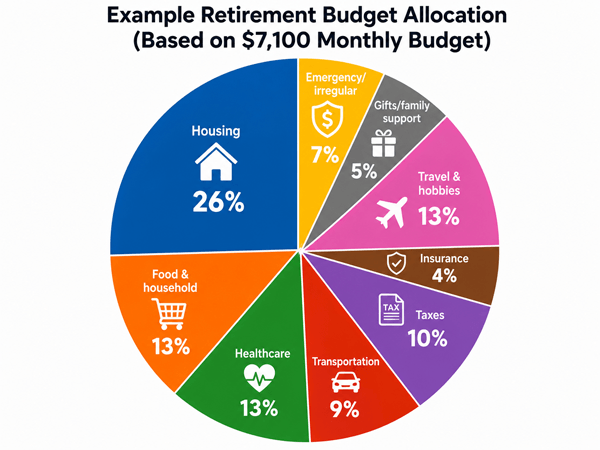
Figure: Example allocation based on the sample $7,100 monthly retirement budget. Percentages are rounded and are not recommendations for every retiree.
Step 4: Match Expenses With Retirement Income
After estimating expenses, compare them with income. Start with reliable income first, then decide how much must come from savings and investments.
Reliable income may include Social Security, pensions, annuity payments, rental income after expenses, and part-time work that you are confident you can maintain. Portfolio income may include withdrawals from IRAs, 401(k)s, Roth accounts, taxable brokerage accounts, savings, CDs, bonds, and other investments.
Think of this as the key question: which income sources are predictable, which are market-dependent, and which can be reduced during difficult years?
| Monthly Income Source | Example Amount | Reliability |
|---|---|---|
| Social Security | $3,800 | High, but may be affected by claiming age and taxes |
| Pension | $1,200 | High if financially secure and inflation terms are understood |
| Part-time work | $800 | Helpful but less guaranteed |
| Portfolio withdrawals | $1,300 | Flexible but affected by markets and withdrawal rate |
| Total income | $7,100 | Matches example budget |
The Retirement Income Gap
Your retirement income gap is the difference between your expenses and reliable income. If your monthly retirement expenses are $6,000 and reliable income is $4,200, the gap is $1,800 per month, or $21,600 per year. That amount must come from savings, investments, work, downsizing, reduced spending, or another source.
Step 5: Plan for Inflation
Inflation means prices rise over time. Even mild inflation can make a retirement budget feel tight after 10, 20, or 30 years. A $5,000 monthly budget today will not buy the same lifestyle decades from now if prices rise.
Build inflation into your plan by increasing future spending estimates, keeping some investments with growth potential, reviewing insurance and property taxes, and avoiding a budget that only works in year one. Social Security may include cost-of-living adjustments, but not every income source does.
Simple Inflation Example
| Today's Monthly Spending | After 10 Years at 3% Inflation | After 20 Years at 3% Inflation |
|---|---|---|
| $4,000 | About $5,376 | About $7,224 |
| $6,000 | About $8,064 | About $10,836 |
| $8,000 | About $10,752 | About $14,448 |
Step 6: Build a Flexible Spending Strategy
A retirement budget should not be rigid. Your spending will likely change in phases. Many retirees spend more early in retirement on travel, hobbies, home projects, and family activities. Spending may slow later, while healthcare and support needs may rise.
A useful approach is to create three versions of your budget: baseline, comfortable, and reduced. This gives you a plan for normal years, good years, and difficult years.
This flexible approach also supports sequence-of-returns risk planning, because retirees may need to reduce discretionary withdrawals when markets are weak.
| Budget Level | Purpose | Example Monthly Spending | When to Use |
|---|---|---|---|
| Baseline | Covers essentials and modest lifestyle | $5,500 | Normal plan |
| Comfortable | Adds more travel, hobbies, gifts, and upgrades | $7,100 | Strong markets or extra income |
| Reduced | Cuts flexible spending while protecting essentials | $4,800 | Market downturn, medical surprise, or income drop |
Retirement Budget Flow Diagram
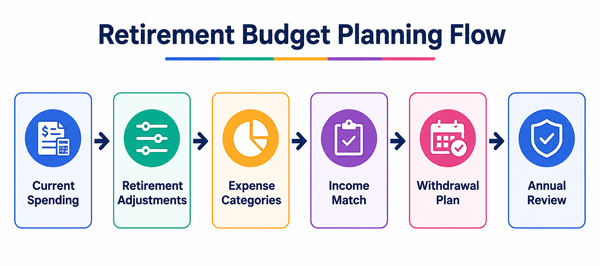
Figure: A simple retirement budget planning flow from current spending to annual review.
Step 7: Include Emergency Funds and Sinking Funds
Retirees still need emergency savings. In fact, cash reserves can be more important after retirement because selling investments during a market decline can lock in losses. A common approach is to keep several months of essential expenses in cash and a separate reserve for known irregular expenses.
A sinking fund is money set aside gradually for a future cost. Instead of being surprised by a $6,000 home repair, you might save $500 per month into a home maintenance fund. This makes large bills less disruptive.
| Reserve Type | What It Covers | Practical Guideline |
|---|---|---|
| Emergency fund | Unexpected urgent expenses | Several months of essential expenses, adjusted for personal risk |
| Home maintenance fund | Repairs, appliances, roof, HVAC | Often 1% to 3% of home value per year as a rough starting point |
| Car replacement fund | Future vehicle purchase | Monthly savings based on expected replacement date |
| Medical reserve | Deductibles, dental, vision, prescriptions | Based on insurance coverage and health needs |
| Family support reserve | Planned help for relatives | Set an annual limit before requests arise |
■ Common Retirement Budgeting Mistakes
1. Using income replacement rules without checking real expenses
A percentage rule may be too high or too low. Build your budget from actual bills and goals.
2. Forgetting taxes
Traditional account withdrawals, pensions, Social Security taxation, capital gains, and state taxes can all affect spending power.
3. Underestimating healthcare
Premiums are only one part of healthcare. Include deductibles, copays, prescriptions, dental, vision, hearing, and uncovered care.
4. Ignoring inflation
A budget that works at age 65 may not work at age 80 unless it grows over time.
5. Treating travel as free time instead of a real cost
More free time can lead to more spending. Budget for travel and hobbies intentionally.
6. Not planning for home repairs
A paid-off home can still be expensive. Repairs and upgrades should be funded.
7. Helping family without limits
Support is generous, but open-ended commitments can weaken retirement security.
8. Never updating the budget
Retirement is long. Review spending, taxes, insurance, and income at least annually.
■ Best Practices for a Strong Retirement Budget
- Use real spending data from bank and card statements, not guesses.
- Separate needs, wants, and irregular expenses.
- Plan healthcare as its own major category.
- Estimate taxes before deciding how much you can spend.
- Create a reduced-spending plan for market downturns.
- Keep cash reserves for emergencies and near-term withdrawals.
- Review the budget every year and after major life events.
- Coordinate your budget with Social Security claiming, pension choices, Medicare decisions, and investment withdrawals.
- Discuss complex tax, estate, insurance, and investment decisions with qualified professionals.
■ Retirement Budget Checklist
- Track current spending for 6 to 12 months.
- Estimate essential monthly expenses.
- Estimate flexible lifestyle expenses.
- List annual and irregular expenses.
- Add healthcare and insurance estimates.
- Add taxes and inflation assumptions.
- Compare expenses with guaranteed income.
- Calculate the income gap to be funded by savings.
- Create emergency and sinking funds.
- Build baseline, comfortable, and reduced budgets.
- Review annually.
■ Frequently Asked Questions
1. How much should I budget for retirement each month?
There is no single amount that works for everyone. Start with your current monthly spending, remove costs that will end after retirement, add retirement-specific costs, and include taxes, healthcare, inflation, and irregular expenses.
2. Is the 80% retirement income rule accurate?
It can be a rough starting point, but it is not a complete plan. Some retirees need less than 80% of pre-retirement income, while others need more because of healthcare, housing, travel, taxes, or debt.
3. What expenses usually go down in retirement?
Commuting, payroll taxes, retirement contributions, work clothing, professional costs, and some childcare or education costs may decline. Transportation may also fall if you drive less or reduce to one car.
4. What expenses usually go up in retirement?
Healthcare, travel, hobbies, home projects, insurance, family support, and long-term care-related costs may rise. Property taxes and insurance can also increase over time.
5. Should I pay off my mortgage before retirement?
It depends on interest rate, cash flow, taxes, investment returns, liquidity, and emotional comfort. Paying off a mortgage can lower required monthly income, but using too much cash may reduce flexibility.
6. How often should I update my retirement budget?
Review it at least once a year. Also update it after major events such as moving, losing a spouse, changing insurance, buying a car, large medical expenses, market changes, or new family responsibilities.
7. How do I budget when investment returns are uncertain?
Separate essential spending from flexible spending. Keep cash reserves, avoid relying only on strong market returns, and create a reduced-spending plan for downturns.
8. What is the biggest hidden retirement expense?
Healthcare and long-term care are common surprises, but home repairs, taxes, and family support can also be major hidden costs.
9. Can I retire without a detailed budget?
You can, but it increases the risk of stress, overspending, or underspending. A simple budget is better than no plan, and it can be improved over time.
10. What is the best retirement budgeting method for beginners?
The easiest method is to build a needs-wants-irregular budget. Cover essential needs first, set a flexible lifestyle amount, and reserve money for annual or surprise expenses.
11. Where should retirees check official retirement budget information?
Use official sources for current Medicare costs, Social Security rules, IRS retirement account rules, and local tax guidance. Financial figures and program rules can change each year, so the most reliable retirement budget is one that is updated with current official information.
■ Final Thoughts
Retirement budgeting is not about predicting the future perfectly. It is about creating a clear, flexible plan that helps you make good decisions as life changes. Start with real spending, add retirement-specific costs, protect essentials, and leave room for healthcare, taxes, inflation, emergencies, and joy.
The best retirement budget is practical enough to use, flexible enough to adjust, and honest enough to show both opportunities and risks. When you understand your expenses, you can retire with more confidence and fewer financial surprises.
Sources and Notes
- U.S. Bureau of Labor Statistics, Consumer Expenditures program, 2024 average annual household expenditures and category shares. https://www.bls.gov/cex/
- Social Security Administration, retirement planning and life expectancy information for people reaching age 65 in 2026. https://www.ssa.gov/benefits/retirement/planner/otherthings.html
- Medicare.gov, Medicare costs and Medicare & You 2026 handbook for Part B premium and Part D drug cost cap information. https://www.medicare.gov/basics/costs/medicare-costs
- Internal Revenue Service, required minimum distribution guidance for retirement accounts. https://www.irs.gov/retirement-plans/retirement-plan-and-ira-required-minimum-distributions-faqs
Reader Advice: This article is for educational and informational purposes only and should not be taken as personalized financial, tax, investment, legal, or insurance advice. Please check the latest official sources and speak with qualified professionals, as rules, costs, information, and policies can change over time.