Retirement Planning in Your 40s: Catch-Up Strategies and Checklist
1. Introduction: Your 40s Are a Critical Retirement Planning Decade
Retirement planning in your 40s can feel stressful, especially if you think you are behind. You may be paying a mortgage, raising children, supporting aging parents, changing careers, or recovering from years when saving was difficult. The good news is that your 40s still give you meaningful time to improve your retirement outcome.
This decade is important because you usually have more earning power than you had in your 20s or 30s, but you also have fewer years for compound growth before retirement. That means your plan needs to become more intentional. Instead of simply saving whatever is left at the end of the month, you need clear goals, a realistic savings rate, a smart investment mix, and a checklist you review every year.
This guide explains how retirement planning works in your 40s, how to catch up if you are behind, which accounts to prioritize, what mistakes to avoid, and how to build a practical checklist you can follow step by step. The examples and account limits are U.S.-focused. If you live in another country, use the same planning principles but replace account names, tax rules, and contribution limits with your local equivalents.
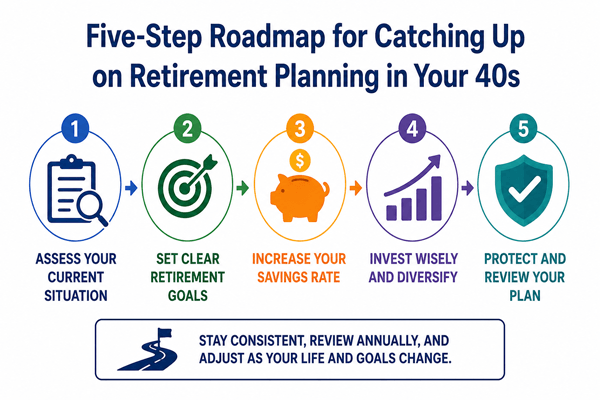
2. Quick Answer: What Should You Do for Retirement in Your 40s?
In your 40s, your retirement plan should focus on six practical priorities:
- Calculate your retirement savings gap instead of guessing.
- Increase your savings rate, ideally toward 15% to 25% of gross income if you are behind.
- Use tax-advantaged accounts such as a 401(k), 403(b), IRA, Roth IRA, HSA, or self-employed retirement plan when eligible.
- Invest for growth while gradually managing risk as retirement gets closer.
- Pay down high-interest debt and avoid lifestyle inflation.
- Protect the plan with insurance, emergency savings, estate documents, and annual reviews.
3. Why Retirement Planning in Your 40s Matters
Your 40s are often the bridge between early wealth-building and serious retirement preparation. You may still have 20 to 25 years before a traditional retirement age, which is enough time for disciplined saving and investing to make a major difference. But it is also late enough that delays become more expensive.
For example, someone who begins saving seriously at 25 may need a smaller monthly contribution because investments have more decades to compound. Someone who starts or restarts at 42 may still succeed, but the plan usually requires a higher savings rate, fewer financial leaks, and more consistent investing.
The goal is not to feel guilty about the past. The goal is to make your next 10 to 20 years more productive. A good plan in your 40s turns vague worry into a clear set of actions.
| If you are in your 40s... | Why it matters | Practical action |
|---|---|---|
| You have not saved enough | You still have time, but need a higher savings rate. | Start with the employer match, then increase contributions automatically. |
| You earn more than before | Higher income can speed up catch-up saving. | Direct raises and bonuses toward retirement before upgrading lifestyle. |
| You have family obligations | Competing goals can delay retirement saving. | Separate retirement, college, emergency, and debt goals. |
| You are worried about market risk | Being too conservative may reduce long-term growth. | Use a diversified allocation that matches your time horizon. |
■ How Much Should You Have Saved by Your 40s?
There is no perfect retirement savings number for everyone. Your target depends on your income, lifestyle, expected retirement age, pension or Social Security benefits, healthcare costs, housing costs, and how long you may live in retirement. Still, simple benchmarks can help you see whether you are broadly on track.
| Age range | Common benchmark | What it means |
|---|---|---|
| Early 40s | Around 2 to 3 times annual income saved | A rough checkpoint, not a rule. If you are below this, focus on increasing your savings rate. |
| Mid-40s | Around 3 to 4 times annual income saved | Your retirement accounts should ideally be growing from both contributions and investment returns. |
| Late 40s | Around 4 to 6 times annual income saved | A stronger position before entering your 50s, when catch-up contributions become available. |
These benchmarks are only starting points. A person earning $60,000 with a modest lifestyle may need less than someone earning $180,000 with expensive housing, travel, and healthcare expectations. The better method is to estimate your future retirement spending and compare it with your expected income sources.
Step 1: Estimate Your Retirement Savings Gap
A retirement savings gap is the difference between what you are likely to have and what you may need. You do not need a perfect forecast to get started. You need a reasonable estimate that helps you choose your next action.
Simple retirement gap formula
| Step | Question | Example |
|---|---|---|
| 1 | How much annual income might you need in retirement? | $70,000 per year |
| 2 | How much may come from Social Security, pension, rental income, or other sources? | $30,000 per year |
| 3 | What annual amount must your savings provide? | $40,000 per year |
| 4 | What portfolio might support that income? | $40,000 ÷ 4% = $1,000,000 |
| 5 | How much do you already have? | $250,000 |
| 6 | What is the approximate gap? | $750,000 before future growth and contributions |
The 4% calculation is a rough planning shortcut, not a guarantee. It assumes a diversified portfolio and a traditional retirement horizon. Early retirement, high inflation, poor market returns, healthcare shocks, or long life expectancy may require a lower withdrawal rate or a larger portfolio.
For a more realistic estimate, review your expected Social Security benefit, pension estimate, or other guaranteed income source before deciding how much your investment portfolio must provide.
Step 2: Increase Your Savings Rate Without Breaking Your Budget
The most powerful catch-up strategy in your 40s is usually not finding a secret investment. It is increasing the amount you save consistently. A higher savings rate gives your investments more fuel and reduces the lifestyle you need to support in retirement.
| Current situation | Catch-up target | How to do it |
|---|---|---|
| Saving less than 5% | Start with 6% to 10% | Contribute enough to get the full employer match, then increase by 1% every 3 to 6 months. |
| Saving 10% | Move toward 15% | Use automatic payroll increases and redirect part of raises or bonuses. |
| Saving 15% | Consider 20% or more if behind | Maximize workplace plans, IRAs, HSAs, or taxable brokerage accounts as appropriate. |
| No retirement savings yet | Start immediately, even small | Open the available account, automate contributions, and build from there. |
Practical ways to find more money for retirement
- Send future raises straight into retirement contributions before you adjust your lifestyle.
- Use part of bonuses, tax refunds, commissions, or side income for lump-sum investing.
- Review subscriptions, insurance premiums, unused memberships, dining out, and impulse spending.
- Pay off high-interest debt, then redirect the old payment into retirement savings.
- Avoid taking on large new fixed expenses that reduce your future flexibility.
- Set a monthly automatic transfer so retirement saving happens before discretionary spending.
Step 3: Use the Right Retirement Accounts
Tax-advantaged accounts can help your money grow more efficiently. In the U.S., common options include employer plans, IRAs, Roth IRAs, HSAs, and self-employed plans. The right order depends on your employer benefits, income, tax bracket, debt level, and emergency savings.
| Account type | Best use | Beginner-friendly notes |
|---|---|---|
| 401(k), 403(b), or 457 plan | Workplace retirement saving, often with payroll deductions and possible employer match. | For 2026, the basic elective deferral limit is $24,500. Workers 50+ can generally add an $8,000 catch-up contribution. |
| Traditional IRA | Extra tax-advantaged saving, possible tax deduction depending on income and workplace plan coverage. | For 2026, IRA contributions are generally limited to $7,500, or $8,600 if age 50+ including catch-up. |
| Roth IRA | After-tax saving with potential tax-free qualified withdrawals. | Income limits apply. Useful if you expect higher tax rates later or want tax diversification. |
| HSA | Healthcare savings for people with eligible high-deductible health plans. | Can be powerful for retirement healthcare costs because contributions, growth, and qualified medical withdrawals can receive tax advantages. |
| SEP IRA, Solo 401(k), SIMPLE IRA | Business owners, freelancers, and self-employed workers. | Rules and limits vary. A tax professional can help choose the best plan. |
| Taxable brokerage account | Flexible investing after tax-advantaged accounts are used or when you need access before retirement age. | No contribution limit, but dividends, interest, and capital gains may be taxable. |
A practical account priority order
- Build a starter emergency fund so you do not raid retirement accounts for every surprise expense.
- Contribute enough to your workplace plan to receive the full employer match, if available.
- Pay down high-interest debt such as credit cards or payday loans.
- Increase contributions to a 401(k), 403(b), IRA, Roth IRA, HSA, or self-employed plan based on eligibility.
- Use a taxable brokerage account for extra long-term investing or early-retirement flexibility.
| 2026 contribution limits to know: The IRS announced that the 2026 elective deferral limit for 401(k), 403(b), most 457 plans, and the federal Thrift Savings Plan is $24,500. The standard age-50 catch-up contribution for those plans is $8,000, and a higher age-60-to-63 catch-up limit of $11,250 may apply if the plan allows it. IRA limits are generally $7,500, or $8,600 for people age 50 or older, subject to compensation and eligibility rules. |
Step 4: Invest for Growth, But Control Risk
Many people in their 40s make one of two mistakes: they invest too aggressively because they feel behind, or they become too conservative because market losses feel scary. A better approach is to choose a diversified investment mix that can still grow while matching your time horizon and risk tolerance.
| Investment approach | Potential benefit | Main risk |
|---|---|---|
| Target-date fund | Simple, diversified, automatically becomes more conservative over time. | May not match your exact risk tolerance or retirement age. |
| Index-fund portfolio | Low cost, broad diversification, easy to manage. | Requires choosing and rebalancing an allocation. |
| Actively managed funds | Professional stock or bond selection. | Higher fees and no guarantee of beating the market. |
| Too much cash | Feels safe in the short term. | Inflation can reduce purchasing power and long-term growth. |
| Concentrated stock bets | Potential for high returns. | Large losses can damage a catch-up plan. |
Beginner example: a balanced 40s portfolio mindset
A person in their early 40s with 20 or more years until retirement may still hold a meaningful stock allocation for growth, along with bonds or stable assets for diversification. The exact mix depends on risk tolerance, income stability, other assets, and whether the person has a pension or other guaranteed income. The key is to avoid random investing. Choose a plan, automate it, rebalance periodically, and keep fees reasonable.
Step 5: Manage Debt Before It Controls Your Retirement
Debt can quietly reduce retirement security because every dollar used for interest is a dollar that cannot be saved or invested. Not all debt is equal. A low-rate mortgage may fit into a long-term plan, while high-interest credit card debt can seriously delay retirement progress.
| Debt type | Retirement planning priority | Suggested approach |
|---|---|---|
| Credit cards and high-interest loans | Very high | Pay aggressively while avoiding new balances. |
| Personal loans | Medium to high | Compare interest rate with expected investment return and cash-flow needs. |
| Student loans | Depends on rate and forgiveness options | Use a repayment strategy that fits your broader plan. |
| Mortgage | Depends on rate, term, and retirement date | Plan whether you want it paid off before retirement or manageable after retirement. |
| Auto loans | Medium | Avoid repeatedly upgrading cars if it blocks saving. |
Step 6: Balance Retirement With College, Parents, and Family Goals
Many people in their 40s are part of the sandwich generation. They may be helping children, parents, relatives, or a spouse while trying to save for themselves. This is emotionally difficult because all goals can feel important.
A useful rule is to protect retirement first. Your children may have scholarships, work-study, community college, student loans, or lower-cost school options. Your retirement has fewer backup options. That does not mean ignoring family needs. It means setting boundaries and funding goals in the right order.
- Do not pause all retirement savings to pay for college unless you fully understand the long-term cost.
- Have clear conversations with children about affordable school choices before applications begin.
- Set a monthly limit for support to parents or relatives so it does not become open-ended.
- Review beneficiary forms and estate documents when family responsibilities change.
Step 7: Protect Your Retirement Plan
Catching up is not only about investing more. It is also about protecting what you are building. A major illness, disability, lawsuit, death of a spouse, or long period without income can damage a retirement plan more than a normal market downturn.
| Protection area | Why it matters in your 40s | Action step |
|---|---|---|
| Emergency fund | Prevents retirement withdrawals during job loss or surprise expenses. | Aim for 3 to 6 months of essential expenses, or more if income is unstable. |
| Health insurance | Medical bills can disrupt savings. | Understand deductibles, out-of-pocket maximums, and HSA eligibility. |
| Disability insurance | Your income is often your biggest retirement asset. | Check employer coverage and whether supplemental coverage is needed. |
| Life insurance | Protects dependents if your income disappears. | Term life insurance may be appropriate while children or a spouse depend on your earnings. |
| Estate documents | Reduces confusion if something happens to you. | Review will, powers of attorney, healthcare directive, and beneficiaries. |
4. Retirement Planning Checklist for Your 40s
Use this checklist once a year, or whenever your income, family situation, job, health, or goals change.
- ☐ List all retirement accounts, balances, fees, beneficiaries, and investment allocations.
- ☐ Estimate your retirement age and expected annual retirement spending.
- ☐ Estimate income from Social Security, pension, rental income, business income, or other sources.
- ☐ Calculate the gap your savings must cover.
- ☐ Increase your retirement contribution rate by at least 1% this year if you are not already on track.
- ☐ Capture the full employer match if available.
- ☐ Review whether Roth, traditional, or a mix of account types makes sense for tax diversification.
- ☐ Check whether you are eligible for an IRA, Roth IRA, HSA, or self-employed retirement plan.
- ☐ Review your investment allocation and rebalance if it has drifted.
- ☐ Compare fund expense ratios and replace high-cost funds when better options are available.
- ☐ Pay down high-interest debt and avoid new consumer debt.
- ☐ Review mortgage payoff plans before retirement.
- ☐ Update emergency savings and insurance coverage.
- ☐ Update beneficiaries, will, healthcare directive, and powers of attorney.
- ☐ Discuss retirement expectations with your spouse or partner, if applicable.
- ☐ Schedule a yearly retirement review with yourself or a qualified advisor.
5. Real-World Catch-Up Examples
Example 1: Starting late at 42
Maya is 42, earns $85,000, and has $35,000 saved. She feels behind, but she has a workplace 401(k) with a 4% employer match. Her first step is to contribute at least 4% to receive the full match. Then she increases her contribution by 1% every quarter until she reaches 15%. She also uses half of every raise for retirement. This does not solve everything overnight, but it creates a repeatable catch-up system.
Example 2: Good income, weak savings discipline
David is 47, earns $150,000, and has $220,000 saved. His problem is not income; it is lifestyle inflation. He upgrades cars often, eats out frequently, and keeps cash in a checking account instead of investing. His catch-up plan is to cap lifestyle upgrades, max out workplace contributions if cash flow allows, invest excess cash, and create a written spending plan.
Example 3: Single parent balancing retirement and college
Angela is 45 and wants to help her child pay for college. She also knows she cannot borrow for retirement the way students can borrow for education. She decides to keep retirement contributions active, save a smaller amount for college, and focus on affordable school choices. Her plan is realistic because it protects both goals without sacrificing retirement completely.
6. Common Retirement Planning Mistakes in Your 40s
| Mistake | Why it hurts | Better approach |
|---|---|---|
| Waiting until your 50s to get serious | You lose years of compounding and may need much larger contributions later. | Start now, even if the first step is small. |
| Saving only what is left over | There may be nothing left after normal spending. | Automate contributions first. |
| Ignoring fees | High fees can reduce long-term growth. | Compare expense ratios and plan costs. |
| Borrowing from retirement accounts | Can interrupt compounding and create taxes or penalties if not repaid properly. | Use emergency savings and debt planning instead. |
| Being too conservative | Cash may not keep up with inflation over decades. | Keep a diversified growth allocation appropriate for your timeline. |
| Taking too much risk to catch up | Large losses can derail confidence and timing. | Avoid concentrated bets and speculation. |
| Forgetting healthcare costs | Medical expenses often rise with age. | Plan for insurance, HSAs if eligible, and out-of-pocket costs. |
7. Pros and Cons of Aggressive Catch-Up Saving
| Pros | Cons or trade-offs |
|---|---|
| Can close a savings gap faster. | May require lifestyle cuts that feel uncomfortable. |
| Creates stronger financial discipline. | Too much saving without emergency cash can create stress. |
| Reduces dependence on working longer. | Overfunding illiquid accounts may limit short-term flexibility. |
| May reduce taxable income when using pre-tax accounts. | Tax rules, income limits, and withdrawal rules can be complex. |
8. A Simple 10-Year Retirement Plan for Your 40s
| Time frame | Main focus | Action steps |
|---|---|---|
| Year 1 | Get organized | List accounts, calculate savings gap, start or increase contributions, review debt. |
| Years 2-3 | Build momentum | Raise savings rate, reduce high-interest debt, improve investment allocation. |
| Years 4-6 | Optimize | Maximize tax-advantaged accounts when possible, review insurance, update estate documents. |
| Years 7-10 | Prepare for your 50s | Enter catch-up contribution years with strong habits, lower debt, and clearer retirement targets. |
■ FAQs About Retirement Planning in Your 40s
1. Is it too late to start retirement planning in your 40s?
No. It is not too late, but you may need to be more intentional. Starting in your 40s often means saving a higher percentage of income, using tax-advantaged accounts wisely, investing consistently, and avoiding major financial mistakes.
2. How much should I save for retirement in my 40s?
A common starting target is 15% of gross income, but people who are behind may need 20% or more. The right number depends on your current savings, retirement age, income, expected spending, and investment returns.
3. Should I pay off debt or save for retirement first?
Do both when possible, but prioritize the full employer match if available and high-interest debt. Low-interest debt may be paid more gradually while you continue retirement contributions.
4. Should I choose Roth or traditional retirement contributions?
Traditional contributions may help reduce taxable income today. Roth contributions use after-tax money but can provide tax-free qualified withdrawals later. Many people benefit from tax diversification, meaning they use both types over time.
5. What if I have no retirement savings at 40?
Start immediately. Open the account available to you, automate a small contribution, capture any employer match, and increase your rate over time. The first goal is consistency, then acceleration.
6. Can I retire early if I start serious planning in my 40s?
It may be possible, but it usually requires a high savings rate, controlled spending, strong investment discipline, and a plan for healthcare and taxes before traditional retirement age. Run the numbers carefully before assuming early retirement is realistic.
7. How often should I review my retirement plan?
Review it at least once per year and after major life events such as marriage, divorce, job changes, inheritance, home purchase, birth of a child, illness, or major market changes.
8. Can I make retirement catch-up contributions in my 40s?
Usually, no. Under U.S. retirement-account rules, the common catch-up contribution window generally starts at age 50. Your best catch-up strategy in your 40s is to raise your regular contribution rate, capture employer matching money, reduce high-interest debt, and enter your 50s with a stronger savings habit.
■ Final Thoughts: Your 40s Can Still Change Your Retirement Future
Retirement planning in your 40s is about taking control while you still have time. You do not need a perfect past. You need a clear plan for the years ahead. Start by knowing your numbers, increasing your savings rate, using the right accounts, investing with discipline, managing debt, and protecting your family from major risks.
The best catch-up strategy is the one you can repeat. Small increases, automated contributions, annual reviews, and better financial decisions can compound into meaningful progress. Your 40s are not the end of the retirement planning story. They can be the decade when your plan becomes serious, practical, and much more effective.
Sources and Notes
Current contribution-limit figures were checked against IRS retirement-plan resources available in 2026. Readers should verify annual limits each year because contribution limits, income phaseouts, and tax rules can change.
- IRS: 401(k) limit increases to $24,500 for 2026; IRA limit increases to $7,500. https://www.irs.gov/newsroom/401k-limit-increases-to-24500-for-2026-ira-limit-increases-to-7500
- IRS: COLA increases for dollar limitations on benefits and contributions. https://www.irs.gov/retirement-plans/cola-increases-for-dollar-limitations-on-benefits-and-contributions
- IRS: Retirement topics - contributions. https://www.irs.gov/retirement-plans/plan-participant-employee/retirement-topics-contributions
- IRS: Retirement topics - IRA contribution limits. https://www.irs.gov/retirement-plans/plan-participant-employee/retirement-topics-ira-contribution-limits
- IRS: Retirement topics - Catch-up contributions. https://www.irs.gov/retirement-plans/plan-participant-employee/retirement-topics-catch-up-contributions
Reader Advice: This article is for educational and informational purposes only and should not be taken as financial, tax, legal, or investment advice. Please check the latest official sources or speak with a qualified professional, as rules, limits, information, and policies can change over time.
Retirement decisions can involve taxes, investments, insurance, and estate planning, so consider speaking with a qualified financial planner or tax professional for advice based on your situation.