Retirement Planning in Your 20s: What to Do First
1. Quick Answer: What Should You Do First?
Retirement planning in your 20s does not mean having every detail of your future figured out. It means building smart money habits early so time can work in your favor. The most important first step is to create a stable cash-flow foundation, then start saving and investing consistently through the right accounts.
- Track your income and spending so you know how much you can save.
- Build a small emergency fund before investing aggressively.
- Contribute enough to your workplace retirement plan to get any employer match.
- Pay off high-interest debt, especially credit card debt.
- Open and fund an IRA if you are eligible and want more retirement savings options.
- Invest in a simple diversified portfolio and avoid trying to time the market.
- Increase contributions gradually as your income grows.
2. Why Retirement Planning in Your 20s Matters
Your 20s are powerful because you have something older savers cannot easily buy: time. Even small amounts invested early can grow meaningfully because investment returns can earn returns of their own. This is called compounding. It is not magic, and it is not guaranteed every year, but over long periods it can make early saving much easier than waiting until later.
For example, someone who invests $200 per month from age 25 to 65 contributes $96,000 over 40 years. If the account earns an average annual return of 7% before inflation and taxes, it could grow to about $525,000. If the same person waits until age 35, they would contribute $72,000 over 30 years, but the account would grow to about $244,000 at the same assumed return. The earlier saver contributes only $24,000 more, but ends with much more because the money has an extra decade to compound.
These numbers are only examples. Real investment returns rise and fall, inflation reduces purchasing power, and taxes and fees matter. The lesson is not that you must save a huge amount immediately. The lesson is that starting early gives you more flexibility later.
Simple compounding example
| Scenario | Monthly investment | Time invested | Total contributed | Estimated balance at 7% average annual return |
|---|---|---|---|---|
| Start at 25 | $200 | 40 years | $96,000 | About $525,000 |
| Start at 35 | $200 | 30 years | $72,000 | About $244,000 |
| Start at 45 | $200 | 20 years | $48,000 | About $105,000 |
This example is for education only and does not predict future results. The actual result depends on market returns, fees, taxes, inflation, and your investment choices.
3. What Is Retirement Planning in Your 20s?
Retirement planning in your 20s is the process of using today’s income to build future financial freedom. It includes saving, investing, managing debt, using tax-advantaged accounts, protecting yourself from emergencies, and creating habits that can last for decades.
At this age, your plan does not need to be perfect. You may change jobs, move cities, start a business, get married, buy a home, or change careers. A good early retirement plan is flexible. It helps you make progress even while life is changing.
Step 1: Build a Basic Money Foundation
Start with cash flow
Before choosing investments, understand your monthly cash flow. Cash flow simply means money coming in and money going out. If you do not know where your money goes, it is hard to save consistently.
- Income: salary, freelance income, bonuses, side income, or business income.
- Fixed expenses: rent, utilities, insurance, subscriptions, loan payments, and phone bills.
- Variable expenses: food, transport, shopping, travel, entertainment, and personal spending.
- Savings and investing: emergency fund, retirement accounts, brokerage accounts, or other goals.
A beginner-friendly rule is to save something first, even if it is small. If you wait to save whatever is left at the end of the month, there may be nothing left. Automating a transfer on payday can make saving easier.
Create a starter emergency fund
An emergency fund protects your retirement plan. Without cash savings, one car repair, medical bill, job loss, or family emergency can force you to use credit cards or withdraw retirement money early.
A practical first target is $500 to $1,000 if money is tight. After that, work toward one month of essential expenses, then three to six months over time. If your income is unstable, you may want a larger cushion.
| Stage | Emergency fund target | Why it matters |
|---|---|---|
| Just starting | $500 to $1,000 | Covers small emergencies and reduces credit card dependence |
| Basic stability | 1 month of essential expenses | Helps with short income gaps |
| Stronger protection | 3 to 6 months of essential expenses | Better protection against job loss or major emergencies |
| Irregular income | 6+ months may be useful | Helpful for freelancers, contractors, or business owners |
Step 2: Use Your Employer Match First
If your employer offers a 401(k), 403(b), or similar workplace retirement plan with a matching contribution, this is often the best place to start. An employer match means your employer adds money to your retirement account when you contribute. For example, your employer might match 50% of your contributions up to 6% of your pay.
If you earn $50,000 and contribute 6%, you contribute $3,000. If your employer matches 50% of that amount, they add $1,500. That is a major benefit you lose if you do not contribute enough to get the match.
Before you rely on the match, check your plan’s vesting schedule. Vesting explains when employer contributions fully belong to you, which matters if you change jobs in your 20s.
How much should you contribute first?
A good first target is enough to receive the full employer match. After that, increase your savings rate gradually. Many people aim for 10% to 15% of gross income for retirement, including employer contributions, but starting smaller is better than waiting for the perfect amount.
Step 3: Know the Main Retirement Account Options
Retirement accounts are not all the same. Some give you a tax break today. Others give you tax-free withdrawals later if rules are met. The right choice depends on your income, employer benefits, taxes, and future plans.
| Account type | Who it is for | Main benefit | Possible limitation |
|---|---|---|---|
| 401(k), 403(b), or similar workplace plan | Employees with access through work | High contribution limit, possible employer match, payroll deductions | Investment menu may be limited; fees vary by plan |
| Traditional IRA | People with earned income | May offer tax-deductible contributions; broad investment choices | Deduction can be limited by income and workplace plan coverage |
| Roth IRA | People with earned income who meet income rules | No tax deduction now, but qualified withdrawals can be tax-free | Income limits apply; contributions are after-tax |
| HSA | People with eligible high-deductible health plans | Can offer tax-deductible contributions, tax-free growth, and tax-free qualified medical withdrawals | Only available if you meet HSA eligibility rules |
| Taxable brokerage account | Anyone who wants flexible investing outside retirement accounts | No retirement withdrawal age rules; flexible use | No special retirement tax shelter; taxable dividends and gains may apply |
For 2026, the IRS employee elective deferral limit for 401(k)-type plans is $24,500, and the IRA limit is $7,500 for people under age 50. Roth IRA eligibility also depends on income; for 2026, the Roth IRA phase-out range begins at $153,000 for single filers and $242,000 for married couples filing jointly. HSA limits for 2026 are $4,400 for self-only coverage and $8,750 for family coverage. These limits can change, so check current IRS rules before making final decisions.
Traditional vs. Roth: Which Is Better in Your 20s?
Many people in their 20s consider Roth accounts because they may be in a lower tax bracket now than they expect to be in later life. With a Roth IRA or Roth 401(k), you contribute after-tax money, but qualified withdrawals in retirement can be tax-free. With a traditional 401(k) or traditional IRA, you may get a tax benefit now, but withdrawals in retirement are generally taxable.
| Option | Tax treatment now | Tax treatment later | May make sense when |
|---|---|---|---|
| Traditional account | You may reduce taxable income today | Withdrawals are generally taxed later | You want the current tax break or expect a lower tax rate in retirement |
| Roth account | No upfront deduction | Qualified withdrawals can be tax-free | You are early in your career, pay relatively low taxes now, or want tax diversification |
| Both | Split contributions between tax treatments | Creates flexibility later | You are unsure about future tax rates and want balance |
There is no one-size-fits-all answer. A Roth account can be attractive in your 20s, but a traditional contribution may be useful if you need the tax deduction or have a higher current income. Some people use both over time.
Step 4: Pay Off High-Interest Debt Strategically
Saving for retirement while carrying high-interest debt can feel confusing. The priority usually depends on the interest rate. Credit card debt at 20% or more is expensive and can erase the benefit of investing. Student loans or low-interest debt may be handled more gradually while still saving for retirement.
| Debt type | Typical concern | Practical approach |
|---|---|---|
| Credit cards and payday loans | Very high interest | Usually prioritize fast payoff after getting employer match and a small emergency fund |
| Private student loans | Often moderate to high | Compare interest rate with expected investment return and refinance options if appropriate |
| Federal student loans | Terms vary | Consider repayment plans, forgiveness eligibility, and cash-flow needs |
| Auto loan or personal loan | Depends on rate | Pay extra if rate is high; keep retirement contributions if rate is manageable |
| Mortgage | Usually lower than credit cards | Often not urgent in your 20s unless the rate or payment is stressful |
Step 5: Choose Simple Investments
A retirement account is only the container. Inside the account, you still need investments. Beginners often overcomplicate this step. You do not need to pick individual stocks, follow market news daily, or predict the next big trend. A diversified portfolio is usually a better starting point.
Beginner-friendly investment options
- Target-date funds: A single fund designed around an estimated retirement year. It usually starts more growth-focused and becomes more conservative over time.
- Index funds or ETFs: Funds that track a broad market index, such as U.S. stocks, international stocks, or bonds.
- Balanced funds: Funds that combine stocks and bonds in one portfolio.
- Robo-advisors: Automated investing platforms that build and manage a portfolio based on your goals and risk tolerance.
In your 20s, you may have decades before retirement, so you can usually accept more short-term market ups and downs than someone retiring soon. However, “more risk” does not mean gambling. It means using a diversified portfolio with a long-term view.
Also review fund fees, often shown as an expense ratio. Lower fees cannot guarantee better results, but high costs can reduce long-term returns over decades.
Simple investment diagram
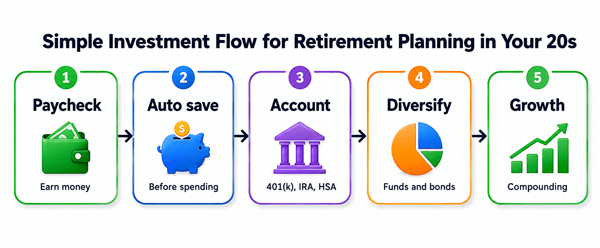
Diagram: A simple flow from paycheck to automatic contribution, retirement account, diversified investments, and long-term growth potential.
| 1 | 2 | 3 | 4 | 5 |
|---|---|---|---|---|
| Paycheck | Automatic contribution | Retirement account | Diversified investments | Long-term growth potential |
| Earn money | Save before spending | 401(k), IRA, HSA, or brokerage | Stocks, bonds, index funds, target-date fund | Compounding over decades |
Step 6: Set a Realistic Savings Target
The best savings rate is one you can actually maintain. If saving 15% feels impossible, start with 3%, 5%, or enough to get your employer match. Then increase your contribution by 1% whenever you get a raise, bonus, promotion, or debt payoff.
A useful beginner path is:
- Save enough to get the full employer match.
- Build your emergency fund to at least one month of expenses.
- Increase retirement contributions to 10% of income.
- Work toward 15% or more if your budget allows.
- Add taxable investing only after your retirement accounts and emergency fund are on track.
Example: starting small and increasing gradually
Suppose Maya is 24 and earns $45,000 per year. Her employer matches 100% of the first 3% she contributes to her 401(k). She starts by contributing 3%, or $1,350 per year. Her employer adds another $1,350. After six months, she increases her contribution to 5%. The next year, after a raise, she increases it to 6%. This is a realistic plan because it grows with her income instead of depending on a sudden lifestyle change.
Step 7: Protect Your Retirement Plan from Common Risks
Market risk
Stocks can fall sharply in some years. This is normal, but it can feel scary. A long time horizon helps, but it does not remove risk. Avoid panic-selling during downturns. Your investment mix should match your ability to stay invested.
Lifestyle inflation
Lifestyle inflation happens when every raise turns into higher spending. Some improvement in lifestyle is normal, but if your spending rises as fast as your income, your savings rate may never improve. One simple rule is to save part of every raise before increasing spending.
Early withdrawals
Retirement accounts are designed for the long term. Early withdrawals can create taxes, penalties, and lost growth. Use emergency savings for emergencies so you do not have to raid your retirement account.
Job changes
Many people in their 20s change jobs. When you leave an employer, do not forget your old retirement plan. You may be able to leave it where it is, roll it into a new employer plan, roll it into an IRA, or in some cases cash it out. Cashing out is usually the weakest option because it can trigger taxes, penalties, and lost compounding.
This is also a good time to review beneficiaries on your retirement accounts. Beneficiary forms can control who receives the account, so keep them updated after major life changes.
■ How Much Should You Have Saved for Retirement in Your 20s?
There is no universal number. A 22-year-old student, a 25-year-old engineer, a 28-year-old parent, and a 29-year-old freelancer may all have different starting points. Instead of comparing yourself to others, focus on progress.
A practical goal is to build the habit first. By your late 20s, having one year of income saved for retirement can be a strong milestone, but many people will be below that because of student debt, low starting wages, family responsibilities, or career changes. The important thing is to start, avoid high-interest debt, and increase contributions as income grows.
If you are behind that benchmark, it does not mean you have failed. A better next step is to choose one realistic action this month, such as raising contributions by 1%, paying down high-interest debt, or opening an IRA if appropriate.
■ Retirement Planning Checklist for Your 20s
| When | Action | Purpose |
|---|---|---|
| Month 1 | Track income and spending | Know your cash flow and find savings opportunities |
| Month 1 | Start a $500 to $1,000 emergency fund | Avoid using credit cards for small emergencies |
| Month 2 | Enroll in employer retirement plan | Capture any available employer match |
| Month 2 | Choose a simple investment option | Avoid leaving retirement contributions sitting in cash unintentionally |
| Months 3-6 | Pay down high-interest debt | Improve financial stability and reduce interest costs |
| Months 3-12 | Open an IRA if appropriate | Add more tax-advantaged retirement saving options |
| Every year | Increase contributions by 1% | Build savings gradually without a major lifestyle shock |
| Every year | Review beneficiaries and old accounts | Keep accounts organized as life changes |
■ Common Mistakes to Avoid
- Waiting until you earn more: Higher income helps, but the habit of saving matters more at the beginning.
- Ignoring the employer match: This can mean leaving valuable compensation unused.
- Investing with no emergency fund: A small emergency can force you to sell investments or use debt.
- Keeping retirement money in cash for decades: Cash is stable, but it may not keep up with inflation over long periods.
- Trying to get rich quickly: Speculation, meme stocks, and high-risk trading can damage long-term progress.
- Cashing out old 401(k)s: This can create taxes, penalties, and lost compounding.
- Forgetting fees: High fees reduce returns over time. Low-cost diversified funds can be a strong default option.
■ What If You Cannot Save Much Right Now?
Start with what you can do. Retirement planning in your 20s is not an all-or-nothing decision. If money is tight, save 1% of income, $25 per month, or enough to get part of an employer match. Then set a calendar reminder to increase it later.
You can also strengthen your future retirement plan by building career skills, improving income, reducing high-interest debt, and avoiding lifestyle commitments that make saving impossible. In your 20s, your earning power is one of your most important financial assets.
■ Should You Save for Retirement or Other Goals First?
Many people in their 20s are also saving for a car, home, education, travel, marriage, relocation, or a business. The answer depends on timing. Money needed within the next few years usually should not be invested aggressively because the market could fall right when you need it. Retirement money has a longer time horizon and can usually be invested for growth.
| Goal | Time horizon | Common place to save | Reason |
|---|---|---|---|
| Emergency fund | Now to 1 year | High-yield savings or safe cash account | High liquidity and safety matter most |
| Car, moving, wedding, or home down payment | 1 to 5 years | Savings, money market, CDs, or conservative options | Avoid taking big market risk with near-term money |
| Retirement | 30+ years for many people in their 20s | Diversified retirement investments | Long time horizon can support growth-oriented investing |
| Education or career development | Varies | Savings or planned cash flow | Can increase future earning power |
■ Beginner-Friendly First Plan
Here is a simple retirement planning blueprint for someone in their 20s:
- Keep one checking account for bills and one savings account for emergencies.
- Automate retirement contributions through your paycheck if you have a workplace plan.
- Contribute enough to get the full employer match.
- Use a target-date fund or diversified index fund portfolio if you do not know what to choose.
- Pay extra toward credit card or other high-interest debt.
- Open a Roth IRA or traditional IRA if it fits your situation and you want to save more.
- Increase your savings rate by 1% each year or whenever income rises.
- Review your plan once or twice a year instead of checking investments every day.
■ Frequently Asked Questions
1. Is 25 too early to start retirement planning?
No. Starting at 25 is a strong advantage because your money has decades to compound. You do not need to save a huge amount immediately. Even small, consistent contributions can build momentum.
2. How much should I save for retirement in my 20s?
A common long-term target is 10% to 15% of income, including employer contributions, but the best starting point is whatever you can sustain. If that is 3% or 5%, start there and increase it over time.
3. Should I open a Roth IRA in my 20s?
A Roth IRA can be a good choice if you have earned income, meet income eligibility rules, and expect your tax rate to be higher later. It can also provide tax diversification. However, a workplace plan with an employer match may come first.
4. Should I pay off student loans or invest for retirement?
It depends on the loan interest rate, repayment options, and your cash flow. Many people do both: contribute enough to get the employer match, build a small emergency fund, and then pay extra toward higher-interest loans.
5. What happens to my 401(k) if I change jobs?
You may be able to leave it in the old plan, roll it into your new employer plan, roll it into an IRA, or cash it out. Cashing out is usually costly because of taxes, possible penalties, and lost future growth.
6. Do I need a financial advisor in my 20s?
Not always. Many beginners can start with a simple workplace plan, IRA, emergency fund, and diversified low-cost investments. An advisor may be helpful if you have complex taxes, stock compensation, business income, inheritance, or major financial decisions.
7. Is retirement planning still important if I do not want to retire early?
Yes. Retirement planning is not only about quitting work early. It is about creating choices later in life, reducing financial stress, and making sure future you has income when work becomes optional or less reliable.
■ Final Thoughts
Retirement planning in your 20s is not about predicting your entire future. It is about taking the first practical steps: manage cash flow, build an emergency fund, capture employer matching contributions, pay down high-interest debt, invest simply, and increase your savings rate over time.
The earlier you start, the less pressure you may feel later. You do not have to be perfect. You just need a system that helps you save consistently, avoid major mistakes, and let time work for you.
Sources and Notes
This article uses general U.S. retirement account rules and publicly available 2026 contribution-limit information from official sources, including the Internal Revenue Service and Social Security Administration. Retirement rules, tax limits, and eligibility requirements can change. Readers should check current IRS, SSA, and plan documents or consult a qualified financial professional before making tax or investment decisions.
- IRS: 2026 401(k) elective deferral limit is $24,500 and IRA contribution limit is $7,500 for people under age 50.
- IRS: Roth IRA phase-out ranges for 2026 begin at $153,000 for single filers and $242,000 for married filing jointly.
- SSA: Full retirement age is 67 for people born in 1960 or later.
- IRS: 2026 HSA contribution limits are $4,400 for self-only coverage and $8,750 for family coverage.
- Official IRS retirement limit reference: https://www.irs.gov/newsroom/401k-limit-increases-to-24500-for-2026-ira-limit-increases-to-7500
- Official IRS HSA limit reference: https://www.irs.gov/pub/irs-drop/n-26-05.pdf
- Official SSA full retirement age reference: https://www.ssa.gov/benefits/retirement/planner/1960.html
Reader Advice: This article is for educational and informational purposes only and should not be taken as financial, tax, legal, or investment advice. Please check the latest official sources, because rules, limits, information, and policies can change over time.