Retirement Planning in Your 50s: Final Preparation Checklist
Your 50s are one of the most important decades for retirement planning. You may still have time to improve your savings, reduce debt, adjust investments, plan health care, and decide when retirement is realistic. At the same time, retirement is close enough that guesses need to become numbers.
This guide explains retirement planning in your 50s in simple terms. It is written for beginners, but it is detailed enough to help you build a clear action plan. The goal is not to make retirement perfect. The goal is to make it informed, flexible, and financially safer. It also works as a step-by-step retirement checklist for your 50s, so you can move from broad intentions to specific decisions.
1. Quick Answer: What Should You Do in Your 50s to Prepare for Retirement?
In your 50s, retirement planning becomes a final preparation process. You should estimate your retirement income needs, increase savings where possible, use catch-up contributions, review your investment risk, reduce high-interest debt, plan for health insurance and Medicare, understand Social Security timing, update estate documents, and test whether your retirement budget works before you stop working.
| Priority | What to Do | Why It Matters |
|---|---|---|
| 1. Know your number | Estimate annual retirement spending and compare it with expected income. | You need a realistic target before you can judge whether you are on track. |
| 2. Increase savings | Use workplace plans, IRAs, HSAs if eligible, and catch-up contributions. | Your 50s may be the last major earning decade before retirement. |
| 3. Manage risk | Review asset allocation and emergency reserves. | A major market decline close to retirement can be harder to recover from. |
| 4. Plan income | Map Social Security, pensions, withdrawals, part-time work, and cash reserves. | Retirement success depends on dependable cash flow, not just account balances. |
| 5. Protect your plan | Review health care, insurance, taxes, estate documents, and long-term care risks. | Unexpected costs can damage even a well-funded plan. |
2. Why Retirement Planning in Your 50s Is Different
Retirement planning in your 20s, 30s, and 40s is mostly about building habits and letting time work for you. In your 50s, the focus shifts to final preparation. You still have time to make changes, but there is less room for vague assumptions.
The biggest difference is that every decision becomes more connected. Your savings rate affects your retirement date. Your retirement date affects health insurance. Health insurance affects your budget. Your Social Security timing affects lifetime income. Debt affects how much income you need. That is why a checklist is useful. It keeps you from focusing on only one piece of the puzzle.
Step 1: Define What Retirement Means for You
Before you calculate numbers, define the life you are planning for. Retirement does not mean the same thing for everyone. Some people want to stop working completely. Others want part-time work, consulting, a small business, volunteering, or a slower career transition.
Ask yourself: Where will I live? Will I still support children, parents, or other family members? Will I travel often or live simply? Do I want to retire at 60, 65, 67, or later? Will my spouse or partner retire at the same time? The answers shape your spending, insurance needs, and income plan.
| Retirement Style | Typical Features | Planning Impact |
|---|---|---|
| Traditional retirement | Stop full-time work and live from savings, Social Security, pension, or other income. | Requires a stronger income plan and larger cash reserve. |
| Semi-retirement | Work part-time or seasonally while drawing less from investments. | Can reduce early withdrawal pressure and delay Social Security. |
| Phased retirement | Gradually reduce hours or responsibilities with the same employer. | May preserve benefits and ease the emotional transition. |
| Encore career | Switch to meaningful, lower-stress, or flexible work. | May trade income for purpose, flexibility, or health benefits. |
Retirement Timeline: Key Ages to Know
The exact timing varies by country, employer plan, and personal situation, but U.S. retirees commonly plan around these milestones. Always verify your own plan rules and current law.
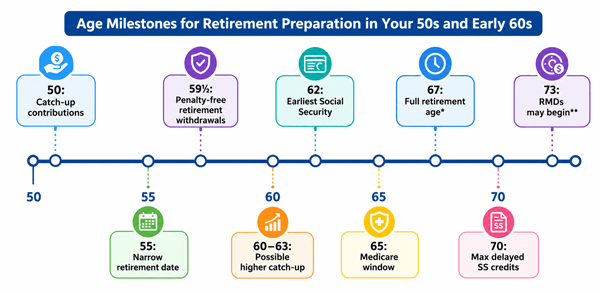
Figure 1. Common U.S. retirement planning milestones. *Full retirement age is 67 for people born in 1960 or later. **RMD rules vary by birth year and account type; verify your personal requirement.
Step 2: Estimate Your Retirement Spending
A retirement plan starts with spending, not investments. If you do not know what retirement may cost, you cannot know whether your savings are enough.
Build a simple retirement budget
| Expense Category | Questions to Ask | Example |
|---|---|---|
| Housing | Will your mortgage be paid off? Will you rent, downsize, relocate, or stay put? | Mortgage, rent, property tax, insurance, maintenance, utilities. |
| Health care | Will you retire before Medicare? How much will premiums and out-of-pocket costs be? | Medicare premiums, Medigap, dental, vision, prescriptions. |
| Food and household | Will your food costs change when you stop working? | Groceries, household supplies, dining out. |
| Transportation | Will you drive less? Will you need a replacement car? | Fuel, insurance, repairs, public transit, vehicle purchase fund. |
| Lifestyle | What makes retirement enjoyable and realistic? | Travel, hobbies, gifts, entertainment, fitness. |
| Family support | Will you help adult children, grandchildren, parents, or relatives? | Tuition help, caregiving, shared housing, cash support. |
| Taxes | Which income sources will be taxable? | Traditional IRA/401(k) withdrawals, pension, Social Security taxation, state taxes. |
A common beginner mistake is assuming expenses will automatically fall sharply in retirement. Some costs may decrease, such as commuting and payroll taxes, but others may rise, especially health care, travel, home repairs, and caregiving.
Also include inflation in your estimate. Even modest price increases can make a comfortable budget feel tight after 10, 20, or 30 years of retirement, so review essential expenses and lifestyle expenses separately.
Example: Maria is 55 and spends $72,000 a year before retirement. She expects her mortgage to be paid off, reducing expenses by $14,000 a year. But she adds $7,000 for travel and $5,000 for higher health care and home maintenance. Her estimated retirement spending is not $58,000; it is closer to $70,000. This more realistic number helps her avoid underplanning.
Step 3: Maximize Savings and Catch-Up Contributions
Your 50s may be your highest-earning decade. If your children are more independent, your mortgage is lower, or your income has grown, this can be a powerful time to increase retirement savings.
For 2026, the IRS announced that the employee contribution limit for 401(k), 403(b), most 457 plans, and the federal Thrift Savings Plan is $24,500. The standard catch-up limit for people age 50 and older is $8,000. Under SECURE 2.0, participants age 60 to 63 may be eligible for a higher catch-up limit of $11,250 if their plan allows it. The IRA contribution limit for 2026 is $7,500, with a $1,100 catch-up contribution for people age 50 and older. See the source notes at the end for official references.
A 2026 SECURE 2.0 rule may also affect some higher earners: if your prior-year wages from the employer sponsoring the plan exceed the IRS threshold, catch-up contributions may need to be made as Roth contributions. Because plan administration can vary, confirm the rule with your employer, plan provider, or tax professional before assuming your catch-up contribution will be pre-tax.
| Account Type | 2026 Base Limit | Age 50+ Catch-Up | Practical Tip |
|---|---|---|---|
| 401(k), 403(b), most 457 plans, TSP | $24,500 employee deferral | $8,000 standard catch-up; age 60-63 may have $11,250 if eligible | Raise contributions after pay increases, bonuses, or debt payoff. |
| Traditional or Roth IRA | $7,500 | $1,100 | Eligibility and deductibility depend on income, filing status, and workplace coverage. |
| HSA, if eligible | Limits vary by coverage type | Age 55+ HSA catch-up may apply | Can help with qualified medical expenses in retirement. |
| Taxable brokerage account | No annual contribution limit | Not applicable | Useful for flexibility before retirement account access ages. |
Savings actions to take in your 50s
- ☐ Increase your workplace retirement contribution by 1% to 3% each year if cash flow allows.
- ☐ Contribute at least enough to receive the full employer match, if available.
- ☐ Use catch-up contributions once eligible.
- ☐ Direct bonuses, raises, tax refunds, or paid-off debt payments toward retirement savings.
- ☐ Compare traditional pre-tax and Roth contributions based on current tax bracket, future tax expectations, and withdrawal flexibility.
- ☐ Avoid borrowing from retirement accounts unless there is no safer alternative.
Step 4: Review Your Investment Risk Before Retirement
In your 50s, you still need growth, but you also need protection from a bad sequence of returns near retirement. This is called sequence-of-returns risk. It means the order of market returns matters. A market decline early in retirement can hurt more if you are withdrawing money at the same time.
| Approach | Pros | Cons | Who It May Fit |
|---|---|---|---|
| Very aggressive portfolio | Higher long-term growth potential. | Greater chance of large losses near retirement. | People with high risk tolerance, long time horizon, or strong guaranteed income. |
| Balanced portfolio | Mixes growth with stability. | May not grow as fast as an all-stock portfolio. | Many people within 5 to 15 years of retirement. |
| Very conservative portfolio | Lower volatility and more short-term stability. | Inflation may erode purchasing power over time. | People close to retirement with enough savings or low spending needs. |
A practical strategy is to keep several years of essential expenses in safer assets as retirement approaches, while leaving longer-term money invested for growth. The right balance depends on your pension, Social Security timing, spending needs, risk tolerance, and health.
This does not mean abandoning growth. It means matching money to time frames: near-term spending money should usually be more stable, while long-term money may still need growth to fight inflation and longevity risk.
Step 5: Reduce Debt Before You Retire
Debt is not automatically bad, but it reduces flexibility. Every required debt payment increases the income you need in retirement. High-interest debt, such as credit cards, is especially dangerous because it can grow faster than your investments can reasonably be expected to earn.
| Debt Type | Priority | Retirement Planning Guidance |
|---|---|---|
| Credit cards and high-interest personal loans | Usually high priority | Pay down aggressively before increasing lifestyle spending. |
| Auto loans | Medium priority | Aim to retire with no car payment or a clear vehicle replacement fund. |
| Mortgage | Depends | Paying it off can lower required income, but do not drain all liquidity or retirement savings without analysis. |
| Student loans or family loans | Depends | Review interest rate, repayment rules, and cash-flow impact. |
Step 6: Build a Retirement Income Plan
A retirement income plan explains where your monthly income will come from after paychecks stop. It should include reliable income, flexible withdrawals, cash reserves, and a tax-aware withdrawal order.
When building this plan, stress-test different withdrawal rates instead of relying on one rule of thumb. A sustainable withdrawal rate depends on market returns, inflation, taxes, age at retirement, guaranteed income, and how flexible your spending can be in weak markets.
| Income Source | How It Works | Key Decision |
|---|---|---|
| Social Security | Monthly inflation-adjusted benefit based on earnings history and claiming age. | Whether to claim early, at full retirement age, or delay. |
| Pension | Employer-provided monthly benefit, sometimes with survivor options. | Single-life vs. joint-and-survivor payout; lump sum vs. annuity if offered. |
| 401(k)/403(b)/IRA withdrawals | You withdraw from retirement accounts as needed. | Withdrawal rate, investment mix, tax impact, and required minimum distributions. |
| Roth accounts | Qualified withdrawals may be tax-free. | Useful for tax flexibility and later-life planning. |
| Taxable investments | Brokerage assets can be sold for cash flow. | Capital gains taxes, dividend income, and flexibility. |
| Part-time work or consulting | Earned income after leaving full-time work. | Can reduce portfolio withdrawals and delay benefit claims. |
Step 7: Understand Social Security Timing
Social Security is often one of the most important retirement income decisions. For people born in 1960 or later, full retirement age is 67. You can claim as early as 62, but claiming early permanently reduces your monthly benefit. Delaying beyond full retirement age can increase your monthly benefit until age 70.
| Claiming Age | General Effect | Main Trade-Off |
|---|---|---|
| 62 | Earliest common claiming age, with a reduced monthly benefit. | More checks sooner, but lower lifetime monthly income. |
| Full retirement age | Receives the full calculated retirement benefit. | Balanced option for many retirees. |
| 70 | Highest delayed-retirement monthly benefit. | Requires other income or savings to bridge the gap. |
The best Social Security claiming age depends on health, life expectancy, marital status, survivor benefits, savings, work plans, taxes, and income needs. Couples should coordinate claiming decisions because one spouse’s decision can affect survivor income.
Step 8: Plan Health Insurance and Medicare Early
Health care is one of the biggest retirement planning issues in your 50s. If you retire before Medicare eligibility, you need a bridge plan. Options may include employer retiree coverage, a spouse’s employer plan, COBRA, Affordable Care Act marketplace coverage, private insurance, or part-time work with benefits.
Before leaving work, compare total annual cost, not only monthly premiums. Deductibles, copays, prescription coverage, provider networks, dental, vision, and out-of-pocket maximums can change the real cost of a pre-Medicare bridge plan.
In the U.S., Medicare eligibility generally begins at age 65. The Initial Enrollment Period usually lasts seven months: the three months before the month you turn 65, your birthday month, and the three months after. Missing enrollment rules can create gaps or penalties, so start learning the process before age 65.
| Health Care Question | Why It Matters |
|---|---|
| Will I retire before 65? | You may need several years of private or employer-based coverage. |
| Will my spouse need coverage? | One spouse retiring can affect the other spouse’s insurance. |
| What prescriptions do I use? | Drug coverage can vary significantly by plan. |
| Do I need dental, vision, or hearing coverage? | Original Medicare has limits; separate coverage may be needed. |
| Could my income affect Medicare premiums? | Higher income can increase Medicare premiums through IRMAA rules. |
Step 9: Prepare for Retirement Taxes
Taxes do not disappear in retirement. Traditional 401(k) and traditional IRA withdrawals are generally taxable as ordinary income. Roth qualified withdrawals may be tax-free. Some Social Security benefits may be taxable depending on income. Pension income is often taxable. State taxes vary.
A tax-aware retirement plan may include a mix of pre-tax, Roth, and taxable accounts. This gives you more flexibility to control taxable income in retirement.
- ☐ Estimate your future tax bracket under different retirement dates.
- ☐ Ask whether Roth conversions before Social Security or required minimum distributions could make sense.
- ☐ Plan for required minimum distributions from traditional retirement accounts when they apply.
- ☐ Consider how large withdrawals could affect Medicare premiums, tax credits, or Social Security taxation.
- ☐ Keep tax records for cost basis in taxable accounts.
Step 10: Protect Your Plan With Insurance and Estate Planning
Retirement planning is not only about growing money. It is also about protecting your household from events that could disrupt the plan.
Also prepare a secure household file that lists account locations, key contacts, insurance policies, passwords or password-manager access instructions, and beneficiary information. This can reduce confusion for a spouse, adult child, or trusted representative during an emergency.
Insurance review
- ☐ Review life insurance needs. You may need less if children are independent and debts are low, but more if a spouse depends on your income or pension decision.
- ☐ Review disability insurance while you are still working. A disability in your 50s can seriously affect retirement savings.
- ☐ Understand long-term care risk, including home care, assisted living, and nursing care costs.
- ☐ Check property, liability, and umbrella insurance if your assets have grown.
Estate planning documents to update
| Document | Purpose |
|---|---|
| Will | States how assets should be distributed and can name guardians where relevant. |
| Durable financial power of attorney | Allows someone to manage finances if you cannot. |
| Health care power of attorney | Allows someone to make medical decisions if you cannot. |
| Advance directive or living will | States medical care preferences. |
| Beneficiary designations | Controls who receives retirement accounts, life insurance, and some financial accounts. |
| Trust, if appropriate | Can help with privacy, control, blended families, special needs planning, or estate complexity. |
■ Final Preparation Checklist for Retirement Planning in Your 50s
| Age/Stage | Checklist Items |
|---|---|
| Age 50-54 | Estimate retirement spending; increase savings; start catch-up contributions; check Social Security earnings record; review investment allocation; reduce high-interest debt; update beneficiaries. |
| Age 55-59 | Choose a target retirement age range; test a retirement budget; review mortgage strategy; compare health insurance bridge options; discuss retirement expectations with spouse or family; consider long-term care planning. |
| Age 59½-62 | Understand retirement account access rules; build a cash reserve; decide whether semi-retirement is useful; model Social Security claiming ages; review tax strategy and Roth conversion possibilities. |
| Age 63-65 | Prepare for Medicare decisions; review income because Medicare premiums can be affected by prior-year income; confirm pension options; refine withdrawal strategy; consider reducing work gradually. |
| Age 65-70 | Enroll in Medicare on time unless covered by qualifying employment-based coverage; coordinate Social Security; rebalance investments; review estate documents; monitor spending and withdrawal rates. |
| Before retiring | Run a final retirement income projection; confirm health insurance; pay down or plan for debt; create a 12-24 month cash-flow plan; document account access and passwords securely; schedule professional reviews. |
3. Common Retirement Planning Mistakes in Your 50s
| Mistake | Why It Hurts | Better Approach |
|---|---|---|
| Guessing instead of calculating | You may retire too early or save too little. | Build a written budget and income projection. |
| Ignoring health insurance | Pre-Medicare coverage can be expensive. | Plan the bridge before leaving work. |
| Taking Social Security without analysis | A lower benefit can affect lifetime and survivor income. | Compare claiming ages and household needs. |
| Becoming too conservative too early | Savings may not keep up with inflation. | Keep an appropriate growth allocation for long-term needs. |
| Staying too aggressive too late | A downturn near retirement can damage income plans. | Create a balanced allocation and cash reserve. |
| Carrying high-interest debt | Debt payments increase retirement income needs. | Prioritize expensive debt before lifestyle upgrades. |
| Forgetting taxes | Withdrawals may create avoidable tax costs. | Coordinate account withdrawals and tax planning. |
| Not updating estate documents | Outdated beneficiaries can override your wishes. | Review legal documents and account beneficiaries regularly. |
4. Real-World Scenarios
Scenario 1: Behind on savings at age 52
David is 52 and has saved less than he hoped. Instead of giving up, he increases his 401(k) contribution, uses catch-up contributions, delays a vehicle upgrade, pays off credit cards, and plans to work until 67. He also considers part-time consulting for the first three years of retirement. The lesson: being behind is serious, but your 50s still offer levers you can pull.
Scenario 2: Good savings but no health care plan
Angela is 58 and wants to retire at 61. Her investments look strong, but she has not priced health insurance before Medicare. After comparing options, she realizes premiums and deductibles could require a much larger cash reserve. The lesson: retirement readiness is not only an account balance; it is also insurance, taxes, and cash flow.
Scenario 3: Couple with different retirement dates
Sam and Priya are both in their 50s. Sam wants to retire at 62, while Priya enjoys work and may continue until 66. Their plan improves when they coordinate health insurance through Priya’s employer, delay one Social Security benefit, and reduce portfolio withdrawals during the transition. The lesson: household coordination can be more valuable than optimizing each person separately.
5. Should You Retire in Your 50s or Keep Working Longer?
| Option | Potential Benefits | Potential Risks |
|---|---|---|
| Retire in your 50s | More free time, less work stress, earlier lifestyle freedom. | Longer retirement to fund, health insurance gap, less time for savings growth, earlier portfolio withdrawals. |
| Retire in early-to-mid 60s | More saving years, closer to Medicare, more time to reduce debt. | May require staying in a job longer than desired. |
| Work until full retirement age or later | Higher Social Security potential, fewer retirement years to fund, more savings time. | Health, job market, or caregiving needs may prevent working that long. |
6. A Simple 12-Month Action Plan
| Month | Action |
|---|---|
| 1 | List all accounts, debts, insurance policies, and income sources. |
| 2 | Estimate retirement spending using current expenses as a baseline. |
| 3 | Check Social Security estimates and earnings record. |
| 4 | Increase retirement contributions if possible. |
| 5 | Review investment allocation and risk tolerance. |
| 6 | Create a debt payoff plan. |
| 7 | Price health insurance and Medicare-related options. |
| 8 | Estimate taxes under different withdrawal strategies. |
| 9 | Review life, disability, property, and long-term care risks. |
| 10 | Update will, powers of attorney, advance directive, and beneficiaries. |
| 11 | Run a retirement income projection or meet with a qualified planner. |
| 12 | Test your retirement budget for three months and adjust the plan. |
■ FAQs About Retirement Planning in Your 50s
1. Is it too late to start retirement planning in my 50s?
No. It is late enough that you need a focused plan, but not too late to improve your situation. Increasing savings, reducing debt, delaying retirement, working part-time, and making smarter Social Security decisions can all help.
2. How much should I have saved for retirement by my 50s?
There is no single correct number. It depends on your spending, retirement age, expected Social Security or pension income, health, debt, and lifestyle. A useful approach is to estimate annual retirement spending and compare it with guaranteed income and likely portfolio withdrawals.
3. Should I pay off my mortgage before retirement?
It depends. Paying off a mortgage can reduce required monthly income and create peace of mind. But using too much cash to pay off a low-rate mortgage can reduce liquidity. Compare the interest rate, tax situation, emergency fund, retirement savings, and emotional comfort.
4. Should I become more conservative with investments in my 50s?
Usually, some risk reduction is wise as retirement approaches, but becoming too conservative can expose you to inflation and longevity risk. Many retirees still need growth because retirement may last 25 to 35 years or more.
5. When should I claim Social Security?
It depends on your health, life expectancy, spouse or survivor needs, savings, taxes, and work plans. Claiming at 62 gives income earlier but permanently reduces monthly benefits. Delaying can increase monthly benefits, but you need other income while waiting.
6. What if I want to retire before Medicare?
Plan carefully for health insurance. Price employer retiree coverage, spouse coverage, COBRA, marketplace plans, private insurance, or part-time work with benefits. Do not leave work until you understand premiums, deductibles, provider networks, and prescription coverage.
7. Do I need a financial advisor in my 50s?
Not everyone does, but this is a good time to consider professional help. A qualified fee-only or fiduciary planner can help with retirement projections, withdrawal strategy, tax planning, Social Security, insurance, and estate coordination.
8. What is the most important retirement planning step in your 50s?
The most important step is turning uncertainty into a written plan. Estimate spending, income, taxes, health care, investment risk, and retirement timing. Once the plan is visible, you can improve it.
9. How often should I review my retirement plan in my 50s?
Review your plan at least once a year and after major life changes such as a job change, health issue, divorce, inheritance, home sale, caregiving need, or large market movement. Retirement planning in your 50s works best when the plan is updated, not filed away.
■ Final Thoughts: Your 50s Are the Decade to Make Retirement Real
Retirement planning in your 50s is not about panic. It is about preparation. This is the decade to replace rough guesses with clear numbers, strengthen savings, reduce financial leaks, protect against major risks, and decide how work, health, family, and lifestyle fit together.
A strong retirement plan does not require perfect timing or perfect markets. It requires a realistic budget, a practical income strategy, sensible investment risk, health care planning, tax awareness, and regular updates. Start with the checklist, improve one area at a time, and review your plan at least once a year.
Source Notes and Data References
- IRS, “401(k) limit increases to $24,500 for 2026, IRA limit increases to $7,500,” published Nov. 13, 2025. Used for 2026 retirement contribution and catch-up contribution figures. Official source: IRS.gov.
- Social Security Administration, “Benefits Planner: Retirement | Born in 1960 or later.” Used for full retirement age and early claiming information. Official source: SSA.gov.
- Medicare.gov and CMS, Medicare Initial Enrollment Period guidance. Used for Medicare eligibility and seven-month Initial Enrollment Period details. Official sources: Medicare.gov and CMS.gov.
- Charles Schwab, “Guide on Taking Social Security: 62 vs. 67 vs. 70.” Used as a practical explanation of delayed retirement credits and claiming trade-offs.
Reader Advice: This article is for educational and informational purposes only and should not be taken as financial, tax, legal, insurance, or investment advice. Please check the latest official sources or speak with a qualified professional, as rules, figures, and policies can change over time.
Retirement decisions depend on your income, health, family needs, location, tax situation, employer plan rules, and risk tolerance. Consider speaking with a qualified financial planner, tax professional, Social Security specialist, Medicare counselor, or estate attorney before making major decisions.