Retirement Income Sources Explained: 11 Ways to Build Reliable Retirement Income
Retirement income sources are the places your money may come from after you stop working full time. For most people, retirement income is not one single paycheck. It is a mix of savings, investment withdrawals, government benefits, pensions, part-time income, rental income, annuities, and sometimes support from business assets or other resources.
The goal is simple: turn your lifetime of saving and planning into reliable cash flow that can pay for housing, food, healthcare, taxes, travel, family support, and the lifestyle you want. The challenge is that every source of income has different rules, risks, taxes, and timing decisions.
This guide explains the main retirement income sources in plain English, how they work, their pros and cons, and how to combine them into a practical retirement income plan.
It is written for readers searching for clear, beginner-friendly retirement income planning information, with practical examples, risk warnings, and source-based notes for U.S. rules where relevant.
1. Quick Answer: What Are the Main Sources of Retirement Income?
| Income source | How it works | Best used for | Main risk |
|---|---|---|---|
| Personal savings | Money kept in bank accounts, money market funds, or cash reserves. | Short-term spending, emergencies, and reducing the need to sell investments during market drops. | Inflation can reduce purchasing power over time. |
| Social Security or government retirement benefits | Monthly benefit based on eligibility rules, work history, contributions, and claiming age. | A predictable lifetime income base. | Claiming too early can reduce lifetime monthly income; rules vary by country. |
| Pensions | Employer-sponsored income, often paid monthly after retirement. | Stable income for essential expenses. | Employer plan rules, inflation protection, survivor benefits, and funding strength matter. |
| Retirement accounts | Tax-advantaged accounts such as 401(k)s, IRAs, or similar plans. | Long-term investment growth and structured withdrawals. | Taxes, required withdrawals, market risk, and early withdrawal penalties. |
| Investment accounts | Brokerage accounts holding stocks, bonds, funds, ETFs, or other assets. | Flexible withdrawals and growth potential. | Market volatility and poor withdrawal timing. |
| Annuities | Insurance contracts that can provide guaranteed payments. | Lifetime income or protection against outliving assets. | Fees, complexity, inflation risk, and limited liquidity. |
| Rental or business income | Cash flow from property, a business, royalties, or ownership interests. | Supplemental income and diversification. | Vacancies, maintenance, business risk, and management effort. |
| Part-time work | Income from consulting, freelance work, seasonal work, or a flexible job. | Bridging income gaps and staying active. | Health, job availability, and burnout risk. |
2. A Simple Retirement Income Diagram
A practical retirement plan usually groups income into three broad buckets: predictable income, flexible portfolio income, and optional or supplemental income.
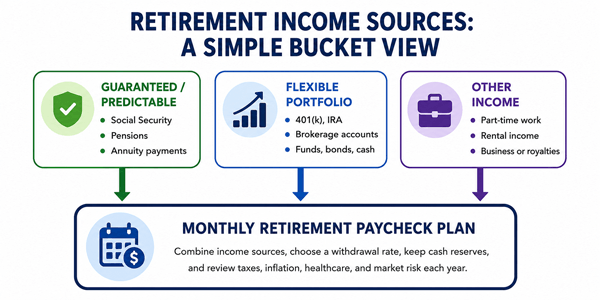
Figure: Retirement income sources can be combined into a monthly paycheck plan.
3. Why Retirement Income Planning Matters
Saving for retirement is only the first half of the job. The second half is deciding how to spend those savings wisely. A good retirement income plan helps you answer five important questions:
- How much income do I need each month?
- Which income sources are guaranteed, and which can change?
- Which accounts should I withdraw from first?
- How will taxes, inflation, and healthcare costs affect my income?
- What happens if markets fall, I live longer than expected, or expenses rise?
Without a plan, retirees may spend too quickly, hold too much cash, take unnecessary taxes, claim benefits at the wrong time, or become too fearful to use the money they saved.
1. Personal Savings and Cash Reserves
Personal savings include checking accounts, savings accounts, certificates of deposit, money market accounts, and other low-risk cash holdings. This money usually does not grow quickly, but it is easy to access.
In retirement, cash is not only for emergencies. It can also protect your investment portfolio. If the stock market falls, a cash reserve may let you pay bills without selling investments at a loss.
Common uses for retirement savings include:
- Three to twelve months of essential expenses in an emergency fund.
- One to three years of planned withdrawals for retirees who want a larger cash cushion.
- Large known expenses, such as a car replacement, home repair, medical deductible, or insurance premium.
- Short-term spending while waiting for Social Security, pension payments, or annuity income to begin.
Pros of cash savings
- Easy to access.
- Low market risk.
- Useful during emergencies and market downturns.
- Helps retirees feel more secure.
Cons of cash savings
- Usually earns less than long-term investments.
- Inflation can reduce its real value.
- Too much cash can make retirement savings run out faster because the money may not grow enough.
Best practice: keep enough cash for stability, but do not rely on cash alone for a retirement that may last 20, 30, or even 40 years.
2. Social Security and Government Retirement Benefits
In the United States, Social Security is one of the most important retirement income sources because it provides monthly income for life. The amount depends on your earnings history, eligibility, and when you claim. In other countries, similar government retirement systems may exist under different names.
A key point for U.S. readers: Social Security retirement benefits can be claimed as early as age 62, but claiming before full retirement age reduces the monthly benefit. Waiting beyond full retirement age can increase the monthly benefit through delayed retirement credits, with the largest retirement benefit available by waiting until age 70. Source: Social Security Administration, “Early or Late Retirement” and “Delayed Retirement Credits.”
This does not mean everyone should wait until age 70. The best claiming age depends on health, life expectancy, marital status, work plans, savings, taxes, and whether you need income immediately.
Questions to ask before claiming benefits
- Can I cover expenses from savings or work if I delay benefits?
- Am I married, divorced, or widowed, and are spousal or survivor benefits relevant?
- Do I expect to keep working after claiming?
- How is my health, and how long might I need income?
- Will delaying benefits reduce pressure on my investment portfolio?
Practical example
Maria is 62 and wants to retire. If she claims Social Security immediately, her monthly benefit will be lower for life. If she works part time for a few years and uses some savings carefully, she may be able to delay claiming and receive a larger monthly benefit later. The right choice depends on her full financial picture, not only the monthly benefit amount.
3. Employer Pensions
A pension is a retirement plan that usually pays income after you retire. Traditional defined benefit pensions often provide a monthly payment based on salary, years of service, and plan rules. Not everyone has a pension, but for those who do, it can be a powerful income source.
Important pension decisions include:
- Single-life vs. joint-and-survivor payments: A single-life pension may pay more while you are alive, but a survivor option can continue income for a spouse.
- Lump sum vs. monthly payments: Some plans offer a one-time lump sum instead of monthly income.
- Inflation adjustment: Some pensions increase with inflation, while others stay flat.
- Start date: Starting earlier may reduce monthly payments; starting later may increase them.
- Employer and plan strength: Pension guarantees and protections vary by country and plan type.
Pension pros and cons
| Pros | Cons |
|---|---|
| Predictable income that can cover essential expenses. | Some pensions do not adjust for inflation. |
| Can reduce pressure on investment withdrawals. | Survivor benefit choices can be confusing. |
| May last for life, depending on plan terms. | Lump-sum decisions are hard to reverse. |
| Useful for budgeting. | Plan rules may be complex and different for each employer. |
4. Retirement Accounts: 401(k), IRA, Roth IRA, and Similar Plans
Retirement accounts are usually the core savings vehicle for people who do not have large pensions. In the U.S., common examples include 401(k), 403(b), traditional IRA, Roth IRA, SEP IRA, and SIMPLE IRA accounts. Other countries have their own tax-advantaged retirement accounts.
These accounts can hold investments such as mutual funds, index funds, target-date funds, ETFs, bonds, and cash. The account itself is not the investment; it is the tax wrapper that holds investments.
Traditional vs. Roth accounts
| Account type | How taxes generally work | Retirement income planning use |
|---|---|---|
| Traditional 401(k) or traditional IRA | Contributions may be pre-tax; withdrawals are generally taxable as ordinary income. | Can provide income, but withdrawals may increase taxable income. |
| Roth IRA or Roth 401(k) | Contributions are made with after-tax dollars; qualified withdrawals are generally tax-free. | Useful for tax flexibility and later-life income. |
| Taxable brokerage account | No special retirement tax shelter; dividends, interest, and gains may be taxable. | Flexible access before or during retirement, with no retirement-account withdrawal age rules. |
Required withdrawals are also important. U.S. taxpayers generally must begin required minimum distributions from traditional IRAs and many workplace retirement plans at age 73 under current IRS guidance. Some workplace plan participants may be able to delay RMDs until retirement if plan rules allow and they are not 5% owners. Roth IRA owner rules are different, so always check the latest IRS guidance. Source: IRS Required Minimum Distributions FAQs and RMD comparison chart.
Common withdrawal approaches
- Spend taxable accounts first to allow retirement accounts to keep growing tax-deferred.
- Use traditional retirement accounts first in lower-tax years before Social Security or RMDs begin.
- Preserve Roth accounts for later years, tax-free flexibility, heirs, or large unexpected expenses.
- Use a blended strategy to manage tax brackets, Medicare premiums, and long-term flexibility.
There is no universal “best” order. A tax-aware withdrawal plan should consider income level, tax brackets, health insurance, estate goals, and whether you expect tax rates to rise or fall.
5. Investment Income From Stocks, Bonds, Funds, and ETFs
Many retirees generate income by withdrawing from an investment portfolio. The portfolio may include stocks, bonds, mutual funds, ETFs, cash, real estate investment trusts, or other assets.
Investment income can come from:
- Dividends from stocks or equity funds.
- Interest from bonds, CDs, money market funds, or bond funds.
- Capital gains from selling investments that have increased in value.
- Planned withdrawals from a diversified portfolio.
A beginner-friendly point: retirement investing is not only about chasing the highest yield. A very high dividend or interest rate may come with higher risk. A balanced portfolio often focuses on total return, which includes income plus long-term growth.
Asset allocation means dividing investments among categories such as stocks, bonds, and cash. The right allocation depends on time horizon and risk tolerance. Diversification spreads money across different investments, but it cannot guarantee against losses. Source: Investor.gov guidance on asset allocation and diversification.
Example retirement portfolio roles
| Asset type | Main role in retirement | Main risk |
|---|---|---|
| Stocks / stock funds | Long-term growth and inflation protection. | Market declines and volatility. |
| Bonds / bond funds | Income and stability compared with stocks. | Interest-rate risk, credit risk, and inflation risk. |
| Cash / money market | Liquidity and short-term spending. | Low long-term returns and inflation risk. |
| Real estate funds / REITs | Potential income and diversification. | Property market risk and interest-rate sensitivity. |
| Balanced or target-date funds | Simple diversified option. | May not match your exact income needs or risk tolerance. |
6. Annuities
An annuity is a contract with an insurance company. In exchange for a lump sum or a series of payments, the insurer may provide income now or later. Some annuities are simple; others are complex.
The main reason retirees consider annuities is longevity risk - the risk of living so long that savings run out. A lifetime income annuity can provide payments for as long as you live, depending on the contract terms.
Common types of annuities
| Type | Basic idea | Best for | Watch out for |
|---|---|---|---|
| Immediate income annuity | You pay a lump sum and income starts soon. | Retirees who want predictable income now. | Limited liquidity and inflation risk. |
| Deferred income annuity | You pay now and income starts later. | Creating income for later retirement years. | Long waiting period and contract terms. |
| Fixed annuity | Pays a stated rate or guaranteed amount. | Conservative income or principal protection goals. | May not keep up with inflation. |
| Variable annuity | Returns depend on investment subaccounts. | People wanting market exposure with insurance features. | Fees and complexity. |
| Indexed annuity | Returns are linked partly to a market index formula. | People seeking some upside with downside limits. | Caps, spreads, surrender charges, and complex formulas. |
Best practice: understand fees, surrender charges, guarantees, inflation protection, beneficiary rules, insurer strength, and whether the annuity is actually solving a problem in your plan. Consider getting independent advice before buying a complex annuity.
7. Rental Income and Real Estate
Rental income can be a valuable retirement income source when a property produces positive cash flow after mortgage payments, taxes, insurance, repairs, vacancies, and management costs.
However, rental income is not passive for everyone. Properties require maintenance, tenant screening, legal compliance, bookkeeping, and sometimes emergency repairs.
Real estate income may come from:
- Long-term residential rentals.
- Short-term rentals, where legal and practical.
- Commercial property.
- Real estate investment trusts (REITs).
- Renting part of a home, parking space, storage space, or vacation property.
Practical example
A retiree receives $1,600 per month in rent. After property tax, insurance, repairs, vacancy allowance, and management costs, the true net income may be closer to $900-$1,100. Retirement planning should use net income, not gross rent.
8. Part-Time Work, Consulting, and Side Income
Retirement does not always mean never working again. Many people use part-time work to reduce withdrawals, delay benefits, stay socially connected, or transition gradually from full-time work.
Possible options include consulting, tutoring, seasonal work, freelance services, online work, bookkeeping, coaching, local service businesses, or working in a field you enjoy.
Benefits of working in retirement
- Reduces pressure on savings.
- Can help delay Social Security or pension claiming.
- May provide purpose, routine, and social connection.
- Can cover discretionary spending such as travel or hobbies.
Risks and trade-offs
- Work may not be available when needed.
- Health issues can reduce earning ability.
- Income can affect taxes, benefits, or health insurance subsidies depending on the rules that apply to you.
- A job can become stressful if it is required rather than optional.
9. Home Equity: Downsizing, Reverse Mortgages, and Renting Space
For many households, the home is one of the largest assets. Home equity can support retirement, but it should be used carefully because housing is also a basic need.
Ways to use home equity include:
- Downsizing to a smaller or lower-cost home.
- Moving to a lower-cost area.
- Selling and renting, if that improves flexibility.
- Renting out a room or accessory dwelling unit.
- Using a reverse mortgage where available and suitable.
A reverse mortgage can provide cash flow while allowing an eligible homeowner to remain in the home, but it has fees, interest, property obligations, and estate consequences. It is not right for everyone, and homeowners should compare alternatives and confirm current rules before applying.
10. Health Savings Accounts and Insurance-Related Resources
Healthcare is one of the biggest retirement planning concerns. In the U.S., Medicare is generally for people age 65 or older, although some people qualify earlier because of disability, End-Stage Renal Disease, or ALS. Initial enrollment timing matters because late enrollment can create coverage gaps or penalties. Source: Medicare.gov enrollment guidance.
Health savings accounts, where available, can be especially useful because they may offer tax advantages for qualified medical expenses. Retirees should also consider Medicare premiums, supplemental coverage, prescription costs, dental and vision expenses, long-term care risk, and out-of-pocket costs.
Planning tip: separate healthcare costs from ordinary lifestyle spending. A retirement budget that ignores healthcare is usually too optimistic.
11. Inheritance, Family Support, and Other Irregular Sources
Some retirees may receive inheritance, family support, legal settlements, royalties, mineral rights, or sale proceeds from a business. These can help, but they should not be the foundation of a retirement plan unless they are certain and legally documented.
Treat uncertain income as a bonus, not a guarantee. A plan based on “I might inherit money” or “my business may sell for a high price” can become risky if the money arrives late, is smaller than expected, or never arrives.
■ How to Build a Retirement Income Plan Step by Step
A retirement income plan does not need to be complicated at the beginning. Start with the basics, then refine the details.
- Estimate essential monthly expenses: housing, food, utilities, insurance, healthcare, taxes, transportation, and debt payments.
- Estimate lifestyle expenses: travel, gifts, hobbies, dining out, home improvements, and family support.
- List guaranteed or predictable income: Social Security, pensions, annuities, and reliable rental income.
- Calculate the income gap: subtract predictable income from total spending needs.
- Decide how much must come from investments and savings.
- Choose a withdrawal strategy that fits your risk level, tax situation, and time horizon.
- Keep a cash reserve for emergencies and market downturns.
- Review the plan at least once a year or after major life changes.
■ Sample Retirement Income Plan
Here is a simplified example. The numbers are only for illustration.
| Category | Monthly amount | Notes |
|---|---|---|
| Essential expenses | $3,800 | Housing, groceries, utilities, insurance, healthcare, transportation, taxes. |
| Lifestyle expenses | $1,200 | Travel, hobbies, gifts, dining out, entertainment. |
| Total monthly spending need | $5,000 | Annual need: $60,000. |
| Social Security | $2,200 | Predictable lifetime income. |
| Small pension | $900 | Employer pension. |
| Rental net income | $600 | After costs and vacancy allowance. |
| Income gap from portfolio | $1,300 | Amount needed from savings and investments. |
In this example, the retiree does not need the entire $5,000 from investments. Predictable income covers $3,700, and the portfolio needs to provide about $1,300 per month. That makes the withdrawal plan more manageable.
■ Common Retirement Withdrawal Strategies
| Strategy | How it works | Good for | Caution |
|---|---|---|---|
| Fixed dollar withdrawal | Withdraw the same dollar amount each year, sometimes adjusted for inflation. | Simple budgeting. | Can be risky if markets fall early in retirement. |
| Percentage withdrawal | Withdraw a set percentage of the portfolio each year. | Adjusting spending to portfolio value. | Income can fluctuate. |
| Bucket strategy | Keep short-term cash, medium-term bonds, and long-term growth investments. | Behavioral comfort and downturn planning. | Needs regular rebalancing. |
| Income floor strategy | Use guaranteed income for essentials and investments for flexible spending. | People who want security for basic needs. | May require annuities or delayed claiming. |
| Guardrails strategy | Increase or reduce withdrawals based on portfolio performance. | Flexible retirees. | Requires monitoring and willingness to adjust spending. |
■ Major Risks That Can Affect Retirement Income
Retirement income planning is not only about finding income. It is also about managing risks that can disrupt income.
| Risk | What it means | Practical way to manage it |
|---|---|---|
| Longevity risk | You live longer than expected and need income for more years. | Use lifetime income sources, avoid overspending early, and keep growth investments. |
| Inflation risk | Prices rise and your money buys less. | Include growth assets, inflation-aware budgeting, and flexible spending. |
| Market risk | Investments fall in value. | Diversify, keep cash reserves, rebalance, and avoid panic selling. |
| Sequence-of-returns risk | Poor market returns early in retirement hurt the portfolio more. | Use cash buckets, flexible withdrawals, and avoid large withdrawals after losses. |
| Tax risk | Withdrawals create higher taxes than expected. | Plan withdrawal order, use Roth accounts strategically, and review RMDs. |
| Healthcare risk | Medical or long-term care costs rise. | Budget separately for healthcare and review insurance options. |
| Spending risk | Lifestyle costs exceed the plan. | Track spending and set guardrails for discretionary expenses. |
■ Common Mistakes to Avoid
- Relying on only one income source.
- Claiming retirement benefits without understanding lifetime consequences.
- Keeping too much money in cash and losing purchasing power to inflation.
- Taking too much investment risk right before or after retirement.
- Ignoring taxes on retirement account withdrawals.
- Forgetting required minimum distributions where they apply.
- Using gross rental income instead of net income.
- Buying complex annuities without understanding fees and restrictions.
- Failing to plan for healthcare and long-term care.
- Never updating the plan after retirement starts.
■ Best Practices for Creating Reliable Retirement Income
- Match reliable income to essential expenses first.
- Use investments for flexible spending and long-term growth.
- Keep a cash reserve so short-term market losses do not force bad selling decisions.
- Diversify across income sources, not only investments.
- Plan taxes before making large withdrawals.
- Review Social Security, pension, and annuity decisions before locking them in.
- Use conservative assumptions for returns, inflation, and life expectancy.
- Update your plan annually and after major events such as marriage, divorce, death of a spouse, home sale, illness, or market decline.
- Get professional advice for complex tax, pension, estate, annuity, or cross-border issues.
■ Retirement Income Sources by Life Stage
| Stage | Main focus | Useful actions |
|---|---|---|
| 10+ years before retirement | Build assets and reduce future pressure. | Increase savings rate, diversify investments, pay down high-interest debt, estimate retirement expenses. |
| 5 years before retirement | Test the plan. | Estimate benefits, review healthcare, reduce concentrated risk, build cash reserves, consider tax planning. |
| 1 year before retirement | Prepare cash flow. | Finalize budget, decide withdrawal order, review insurance, confirm pension and benefit choices. |
| Early retirement years | Protect the portfolio. | Monitor spending, manage sequence risk, delay benefits if useful, rebalance investments. |
| Later retirement years | Simplify and protect income. | Review RMDs, healthcare needs, estate plans, survivor income, and account organization. |
■ How Much Retirement Income Do You Need?
There is no single correct number. Some retirees spend less than they did while working because payroll taxes, commuting, and retirement contributions end. Others spend more because of travel, healthcare, family support, or home projects.
A practical starting point is to build a retirement budget from actual expenses instead of relying only on a percentage of pre-retirement income. Then separate needs from wants.
Beginner formula:
Total retirement spending need - predictable retirement income = amount needed from savings and investments
For example, if you need $60,000 per year and expect $38,000 from Social Security and pension income, your portfolio must provide about $22,000 per year before taxes and adjustments.
■ Frequently Asked Questions
1. What is the best source of retirement income?
There is no single best source. The strongest retirement plans usually combine predictable income, flexible investments, cash reserves, and sometimes part-time or rental income. The best mix depends on your expenses, age, health, taxes, risk tolerance, and family situation.
2. Can I retire with only savings and no pension?
Yes, many people retire without pensions. They usually rely on a mix of retirement accounts, taxable investments, Social Security or government benefits, cash reserves, and careful withdrawal planning.
3. Should I use dividends for retirement income?
Dividends can help, but they should not be the only focus. A total-return approach may be more flexible because it considers dividends, interest, and capital gains together. High dividend yields can also signal higher risk.
4. How much cash should retirees keep?
A common range is several months to a few years of spending, depending on risk tolerance, income stability, and portfolio size. Too little cash can force selling investments during downturns. Too much cash can reduce long-term growth.
5. Are annuities good for retirement income?
Annuities can be useful when they solve a specific problem, such as creating lifetime income. They are not automatically good or bad. The details matter: fees, guarantees, inflation protection, liquidity, surrender charges, and insurer strength.
6. Which retirement account should I withdraw from first?
It depends on taxes, account types, age, required distributions, Social Security timing, and estate goals. Many retirees use taxable accounts first, but others benefit from using traditional retirement accounts earlier in low-tax years. A tax-aware strategy is often better than a fixed rule.
7. How often should I review my retirement income plan?
Review it at least once a year. Also review it after major changes in health, housing, taxes, market performance, marital status, employment, or family responsibilities.
■ Final Thoughts: Build a Retirement Paycheck, Not Just a Portfolio
Retirement income planning is about turning assets into a dependable life plan. Savings, investments, Social Security, pensions, annuities, rental income, part-time work, and home equity can all play a role. The key is to understand what each source can and cannot do.
A strong retirement income plan covers essential expenses, keeps flexibility for lifestyle spending, manages taxes, protects against inflation, and prepares for uncertainty. Start with a clear budget, list every income source, understand the rules, and update the plan as life changes.
The best retirement income strategy is not the one that looks perfect on paper. It is the one you can understand, maintain, and adjust while living the retirement you worked hard to build.
Sources and Notes
- Social Security Administration: Early or Late Retirement; Delayed Retirement Credits; Retirement Age and Benefit Reduction.
- Internal Revenue Service: Required Minimum Distributions FAQs; RMD comparison chart; Publication 590-B.
- Medicare.gov: Sign up for Medicare Part A and Part B enrollment guidance.
- Investor.gov: Asset allocation and diversification investor education resources.
Reader Advice: This article is for educational and informational purposes only and should not be taken as personalized financial, tax, legal, investment, pension, Social Security, or Medicare advice. Rules, benefits, limits, and policies can change over time, so please check the latest official sources or speak with a qualified professional before making decisions.