Retirement Savings Strategies: How Much to Save by Age
Quick answer: A strong retirement savings plan starts with an emergency fund, captures any employer match, automates contributions, uses tax-advantaged accounts when appropriate, invests in a diversified low-cost portfolio, and increases the savings rate over time.
1. What Are Retirement Savings?
Retirement savings are the money and investments you set aside during your working years so you can pay for life after you stop working full time. The goal is simple: build enough assets to cover future expenses such as housing, food, utilities, healthcare, transportation, taxes, travel, hobbies, and family support.
Retirement savings can include workplace retirement plans, individual retirement accounts, taxable investment accounts, pensions, annuities, cash savings, and other long-term assets. For many people, retirement income also includes Social Security or another government pension, but those benefits may not fully cover every expense. That is why personal savings are important.
A good retirement savings plan answers five beginner questions:
This guide focuses on practical retirement savings strategies for beginners, late starters, self-employed workers, and people comparing 401(k), IRA, Roth IRA, HSA, and taxable brokerage accounts.
- How much should I save each month?
- Which accounts should I use first?
- How should I invest the money?
- How do I adjust the plan as my income and life change?
- How do I turn savings into income later?
2. Why Saving for Retirement Matters
Retirement can last 20, 30, or even 40 years. That means your savings may need to support you for a long time. Waiting too long can make retirement harder because your money has less time to grow. Starting earlier gives compound growth more time to work.
Compound growth means your investments can earn returns, and then those returns can earn returns too. This does not guarantee profits, and investment values can fall, but over long periods compounding can be powerful. The earlier you start, the less pressure you may feel later.
| Example | Monthly contribution | Years invested | Approximate value at 7% annual return |
|---|---|---|---|
| Start at age 25, retire at 65 | $300 | 40 | About $789,000 |
| Start at age 35, retire at 65 | $300 | 30 | About $368,000 |
| Start at age 45, retire at 65 | $300 | 20 | About $158,000 |
This example is simplified and assumes steady monthly contributions and a constant 7% annual return. Real returns vary, inflation reduces purchasing power, and taxes or fees may apply. The point is not to predict an exact result, but to show why time matters.
3. How Much Should You Save for Retirement?
There is no single perfect number for everyone. A person who wants a modest retirement in a low-cost area will need less than someone who wants frequent travel, private healthcare, and a large home in an expensive city. The best answer depends on your future spending, retirement age, investment returns, inflation, taxes, and expected income sources.
A practical beginner rule is to aim to save 10% to 15% of gross income for retirement if you start early. If you start late, have no employer match, want to retire early, or have a higher-cost lifestyle, you may need to save more.
| Starting situation | Possible savings target | Why |
|---|---|---|
| You start in your 20s | 10% to 15% of income | You have more years for compounding. |
| You start in your 30s | 15% to 20% of income | You still have time, but catching up may require a stronger savings rate. |
| You start in your 40s | 20% to 25% or more | You may need larger contributions and careful planning. |
| You start in your 50s or later | As much as practical, plus catch-up contributions | You have fewer years before retirement, so account limits and expense control matter more. |
Another common estimate is the retirement income replacement ratio. Many planners suggest that retirees may need roughly 70% to 85% of pre-retirement income, but this is only a starting point. Some retirees spend less because commuting, payroll taxes, and retirement contributions stop. Others spend more because of healthcare, travel, family support, or inflation.
4. A Simple Retirement Savings Formula
Use this beginner-friendly formula to estimate your retirement target:
Before using any formula, subtract reliable income sources such as pensions, Social Security, rental income, or part-time work from your expected annual retirement expenses. The remaining gap is the amount your savings may need to cover.
Annual retirement spending needed from savings x 25 = estimated retirement portfolio target
For example, if you expect to need $40,000 per year from your investments, a 25-times estimate suggests a target of about $1,000,000. This is related to the well-known 4% withdrawal guideline. It is not a guarantee. A safer or more flexible plan may use a lower withdrawal rate, especially for early retirement, uncertain markets, or long life expectancy.
5. Step-by-Step Retirement Savings Strategy for Beginners
Retirement saving becomes easier when you follow a clear order. You do not need to master every account, tax rule, and investment idea on day one. Start with the basics and improve over time.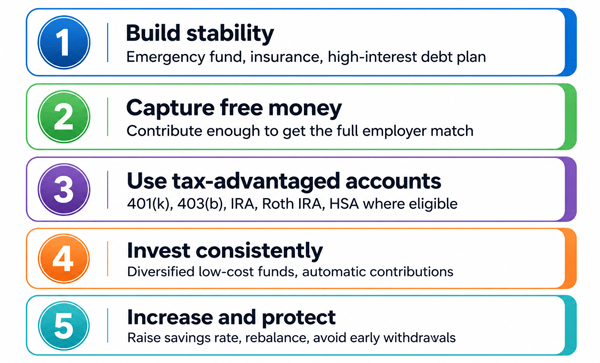
Figure: A practical retirement savings strategy ladder for beginners.
1. Know Your Current Financial Picture
Before choosing investments, understand where your money goes. Write down your income, fixed bills, flexible spending, debts, savings, and employer benefits. This helps you see how much you can realistically save without creating stress.
- Monthly after-tax income
- Rent or mortgage, utilities, insurance, transportation, food, and debt payments
- Current emergency fund
- Retirement accounts and balances
- Employer match or pension details
- Major future expenses such as a home, children, education, or healthcare
2. Build a Small Emergency Fund First
An emergency fund protects your retirement plan. Without one, a car repair or medical bill may force you to use credit cards or withdraw retirement money early. Start with a small emergency fund of at least one month of essential expenses, then build toward three to six months over time.
This does not mean you must delay retirement savings forever. If your employer offers a match, try to contribute enough to get the match while building emergency savings. The match is usually too valuable to ignore.
3. Pay Attention to High-Interest Debt
High-interest debt can cancel out investment progress. If a credit card charges 20% interest, paying it down may be a better guaranteed return than trying to earn market returns. A balanced approach often works best: contribute enough to get any employer match, build a starter emergency fund, and aggressively reduce high-interest debt.
4. Get the Full Employer Match
If your employer offers a retirement plan match, this is often the first major savings opportunity. For example, your employer may match 50% of your contributions up to 6% of salary. If you earn $60,000 and contribute 6%, you put in $3,600. A 50% match would add $1,800 from your employer. That is additional retirement money you would miss if you did not contribute.
Always check the vesting schedule. Vesting determines when employer contributions fully belong to you. Your own contributions are generally yours, but employer contributions may require you to stay with the company for a certain period.
5. Automate Your Contributions
Automation is one of the most effective retirement savings strategies because it removes the need for monthly willpower. Set a fixed percentage of your paycheck to go into your retirement account before you spend the money. If your income rises, increase the percentage before lifestyle spending expands.
A simple automation plan could look like this:
- Start with a contribution you can maintain, even if it is only 3% to 5%.
- Increase by 1 percentage point every 6 to 12 months.
- Add part of every raise or bonus to retirement savings.
- Review your contribution rate once or twice a year.
6. Increase Your Savings Rate Over Time
You do not have to reach the perfect savings rate immediately. The key is to start and improve. Many people fail because they try to save too much too quickly, then stop. A gradual increase is more sustainable.
| Income change | Smart retirement action |
|---|---|
| Pay raise | Save at least 25% to 50% of the raise before increasing lifestyle spending. |
| Bonus or commission | Put a planned percentage into retirement or debt payoff. |
| Debt paid off | Redirect some or all of the old payment into retirement savings. |
| Childcare or education cost ends | Move part of the freed cash flow into long-term savings. |
7. Choose the Right Retirement Accounts
The best account depends on your country and personal tax situation. The examples below focus mainly on common U.S. account types because contribution limits and tax rules are frequently searched and standardized. Readers outside the U.S. should compare local pension plans, employer schemes, retirement savings accounts, tax-free accounts, and national retirement benefits.
A practical account order for many U.S. beginners is: contribute enough to get the employer match, fund an HSA if eligible and suitable, consider an IRA or Roth IRA, then increase workplace plan contributions and use a taxable brokerage account for extra flexibility.
| Account type | Best for | Main advantage | Main limitation |
|---|---|---|---|
| 401(k), 403(b), or 457 workplace plan | Employees with access to an employer plan | High contribution limits and possible employer match | Investment menu and fees depend on the plan |
| Traditional IRA | People who want possible tax deductions now | Contributions may be deductible; growth is tax-deferred | Deduction may be limited by income and workplace plan coverage |
| Roth IRA | People who expect tax-free withdrawals later | Qualified withdrawals can be tax-free | Income limits may restrict direct contributions |
| HSA | People with eligible high-deductible health plans | Potential tax deduction, tax-free growth, and tax-free qualified medical withdrawals | Must be eligible; intended for medical expenses |
| Taxable brokerage account | Extra investing after retirement accounts or early retirement flexibility | No retirement contribution limit and flexible withdrawals | Dividends, interest, and capital gains may be taxable |
■ 2026 U.S. Contribution Limit Snapshot
For 2026, the IRS announced that the employee deferral limit for 401(k), 403(b), most 457 plans, and the federal Thrift Savings Plan is $24,500. The IRA contribution limit is $7,500. The standard catch-up limit for many workplace plans is $8,000 for eligible participants age 50 and older, while a higher catch-up limit of $11,250 applies for certain participants ages 60 to 63 when the plan allows it. The IRA catch-up limit for age 50 and older is $1,100 for 2026. Always verify current limits before publishing or making contributions because these amounts can change.
| Account or limit | 2026 amount |
|---|---|
| 401(k), 403(b), most 457 plans, TSP employee deferral | $24,500 |
| Standard workplace plan catch-up, age 50+ | $8,000 |
| Higher workplace plan catch-up, ages 60-63 | $11,250 |
| IRA annual contribution limit | $7,500 |
| IRA catch-up, age 50+ | $1,100 |
■ Traditional vs. Roth: Which Is Better?
Traditional and Roth accounts are both useful, but they work differently. A traditional account may reduce taxable income today, while withdrawals are generally taxed later. A Roth account uses after-tax money today, but qualified withdrawals can be tax-free later.
| Question | Traditional may fit better if... | Roth may fit better if... |
|---|---|---|
| Tax rate today vs. retirement | You expect your tax rate to be lower in retirement. | You expect your tax rate to be higher in retirement. |
| Need for current tax deduction | You need tax savings now to increase cash flow. | You can afford to pay taxes now. |
| Retirement income flexibility | You want immediate tax relief. | You want tax-free withdrawal flexibility later. |
| Uncertainty | You already have Roth savings and want tax diversification. | You already have mostly traditional savings and want tax diversification. |
Many beginners do not need to choose only one. Using both traditional and Roth accounts can create tax diversification, meaning you may have more flexibility when withdrawing money in retirement.
■ How to Invest Your Retirement Savings
Saving money is only one part of retirement planning. Investing helps your savings grow. For beginners, the goal is usually not to pick hot stocks. A more practical approach is to use diversified, low-cost investments that match your time horizon and risk tolerance.
Also consider inflation. A retirement plan should aim to preserve purchasing power, not just grow the account balance. This is one reason long-term investors often hold some growth assets even after they retire.
Core Investing Principles
- Diversify: Avoid putting all your money into one stock, sector, or asset class.
- Keep costs low: High fees can quietly reduce long-term returns.
- Use an asset allocation: Decide how much to hold in stocks, bonds, and cash.
- Stay consistent: Avoid jumping in and out of the market based on headlines.
- Rebalance: Periodically return your portfolio to your target mix.
Beginner-Friendly Investment Options
| Option | What it is | Why beginners use it | Watch out for |
|---|---|---|---|
| Target-date fund | A diversified fund that adjusts over time based on a target retirement year | Simple one-fund option for many workplace plans | Fees and asset mix vary by provider |
| Index fund or ETF | A fund designed to track a market index | Low-cost diversification | Still rises and falls with the market |
| Balanced fund | A mix of stocks and bonds in one fund | Simplifies allocation | May be too conservative or aggressive for your goals |
| Individual stocks | Shares of specific companies | Potential for high returns | Higher concentration risk and more research required |
Asset Allocation by Time Horizon
The longer you have until retirement, the more time you generally have to recover from market downturns. As retirement gets closer, many people gradually reduce risk by adding more bonds or cash-like assets. The right mix depends on your risk tolerance and income needs.
| Years until retirement | General approach | Example allocation idea |
|---|---|---|
| 30+ years | Growth-focused, but diversified | More stocks, fewer bonds |
| 15-30 years | Growth with increasing stability | Balanced stock-heavy portfolio |
| 5-15 years | Protect against major setbacks | More bonds and cash reserves than earlier years |
| 0-5 years | Retirement income planning becomes critical | Keep near-term withdrawals in safer assets while maintaining long-term growth assets |
These are general ideas, not personalized recommendations. Some investors are comfortable with more risk, while others need a smoother ride to stay invested.
■ Retirement Savings Strategies by Age
Your retirement strategy should change as your life changes. The best plan for a 25-year-old is not the same as the best plan for a 58-year-old.
In Your 20s: Build the Habit
- Start even if the amount is small.
- Get the employer match if available.
- Use Roth accounts if your tax rate is low and you are eligible.
- Avoid lifestyle inflation as income rises.
- Learn basic investing and avoid panic selling.
In Your 30s: Increase the Rate
- Aim for a stronger savings rate as income grows.
- Balance retirement savings with home, children, and debt goals.
- Review insurance and estate basics if you have dependents.
- Avoid cashing out retirement accounts when changing jobs.
- Consider whether traditional, Roth, or both account types fit your tax picture.
In Your 40s: Measure Progress
- Compare your current balance with your estimated retirement target.
- Increase contributions if you are behind.
- Keep investment fees low and avoid overly concentrated bets.
- Plan for college costs without sacrificing retirement security.
- Start thinking about future healthcare and long-term care risks.
In Your 50s and 60s: Catch Up and Protect
- Use catch-up contributions when eligible.
- Review Social Security or government pension timing.
- Reduce high-interest debt before retirement if possible.
- Build a retirement income plan, not just a savings balance.
- Avoid taking too much investment risk to make up for lost time.
■ How to Save for Retirement on a Low Income
Saving for retirement on a tight income is difficult, but small steps still matter. The goal is to create a repeatable system, not to shame yourself for starting small.
- Start with a tiny automatic contribution, such as 1% of income or a fixed amount each payday.
- Take the employer match if available, even if you cannot contribute much more yet.
- Use tax credits or government incentives when available, such as the Saver’s Credit in the U.S. if eligible.
- Reduce one recurring expense and redirect the savings automatically.
- Increase contributions when debt payments, childcare costs, or other temporary expenses end.
- Avoid high-fee products that consume a large part of small contributions.
Even $25 or $50 per month can build the habit. Once the habit exists, raising the amount becomes easier.
Low-income savers should also check whether they qualify for local tax relief, employer auto-enrollment, government matching incentives, or no-fee retirement products. Eligibility rules vary, so verify the latest official requirements before contributing.
■ How to Save for Retirement If You Are Self-Employed
Self-employed people do not have an employer automatically setting up a plan, so they need to be more intentional. Depending on your country and business structure, options may include a solo 401(k), SEP IRA, SIMPLE IRA, personal pension, or taxable brokerage account.
- Pay yourself first by transferring a percentage of each client payment into a retirement account.
- Set aside taxes and retirement money in separate accounts to avoid confusion.
- Use bookkeeping software or a spreadsheet to track income, expenses, taxes, and savings.
- Review contribution limits and deadlines each year.
- Consider working with a tax professional because self-employed retirement plans can be powerful but rule-heavy.
■ Retirement Savings vs. Other Financial Goals
Most people have several goals at once: emergency savings, debt payoff, buying a home, raising children, helping family, education costs, and retirement. The right order depends on urgency and return.
| Goal | Priority guidance |
|---|---|
| Emergency fund | High priority because it prevents debt and early retirement withdrawals. |
| Employer match | Very high priority because it is additional compensation. |
| High-interest debt | High priority because the interest cost may exceed expected investment returns. |
| Retirement savings | Ongoing priority because time in the market matters. |
| Home down payment | Important, but avoid stopping retirement savings for too long. |
| Children’s education | Valuable, but retirement usually comes first because loans may exist for education, not for retirement. |
■ Common Retirement Savings Mistakes to Avoid
| Mistake | Why it hurts | Better approach |
|---|---|---|
| Waiting for the perfect time to start | Lost time is hard to replace. | Start small and improve gradually. |
| Missing the employer match | You leave compensation on the table. | Contribute at least enough to get the full match if possible. |
| Investing too conservatively when young | Cash may not keep up with inflation. | Use an age-appropriate diversified portfolio. |
| Chasing hot investments | Concentration can create big losses. | Use a disciplined, diversified plan. |
| Cashing out when changing jobs | Taxes, penalties, and lost growth can be costly. | Consider rolling over or keeping the account invested. |
| Ignoring fees | Fees compound against you over time. | Compare expense ratios, plan fees, and advisory costs. |
| Stopping contributions during market downturns | You may miss lower-price buying opportunities. | Stay consistent unless your financial situation requires a change. |
| Not planning withdrawals | A large balance can still fail if withdrawals are poorly managed. | Create an income plan before retirement. |
■ Practical Retirement Savings Examples
Example 1: The beginner with an employer match
Sara earns $50,000 per year. Her employer matches 100% of the first 3% she contributes. She starts by contributing 3%, or $1,500 per year. Her employer adds another $1,500. After six months, she increases her contribution to 5%. This strategy helps her build momentum without overwhelming her budget.
Example 2: The late starter
David is 48 and has saved very little. He starts by listing expenses, cutting unused subscriptions, and paying down credit card debt. He contributes enough to get his employer match, then increases contributions each year. At age 50, he uses catch-up contributions where eligible. He also plans to work a few years longer and reduce retirement expenses. His plan is not perfect, but it is practical and much better than doing nothing.
Example 3: The self-employed saver
Aisha is a freelancer with irregular income. She transfers 10% of every payment into a separate retirement savings account and 25% into a tax account. When income is strong, she increases retirement contributions. She reviews her plan quarterly because her income changes month to month.
■ How to Track Your Retirement Progress
Tracking helps you stay realistic. You do not need to check your investments every day. In fact, checking too often can lead to emotional decisions. A quarterly or semiannual review is enough for many people.
- Current retirement account balances
- Monthly or annual contribution amount
- Savings rate as a percentage of gross income
- Employer match received
- Investment allocation and fees
- Progress toward estimated retirement target
- Debt levels and emergency fund balance
A simple progress question is: Am I saving more this year than last year, and is my plan still realistic? If yes, you are moving in the right direction.
■ How Retirement Savings Become Retirement Income
Saving for retirement is the accumulation phase. Retirement income planning is the distribution phase. Before retirement, you should estimate how much income will come from each source: government benefits, pensions, annuities, rental income, part-time work, and withdrawals from investments.
Important retirement income decisions include when to claim Social Security or other government benefits, which accounts to withdraw from first, how much cash to hold, how to manage taxes, and how to protect against running out of money. In the U.S., Social Security retirement benefits can start as early as age 62, full benefits depend on full retirement age, and delaying past full retirement age up to age 70 can increase the benefit amount.
Some retirees may also need to plan for required minimum distributions, healthcare premiums, long-term care costs, sequence-of-returns risk, and tax-efficient withdrawal order. These details can change the best strategy, so review them before retirement rather than after income starts.
■ Best Practices for Long-Term Retirement Saving
- Start now, even if the contribution is small.
- Get the full employer match whenever possible.
- Automate contributions from each paycheck.
- Increase your contribution rate over time.
- Use tax-advantaged accounts before taxable accounts when appropriate.
- Invest in a diversified, low-cost portfolio.
- Avoid early withdrawals unless there is no better option.
- Review your plan annually after major life changes.
- Keep learning, but avoid constantly changing strategies.
- Get professional advice for complex tax, pension, or estate questions.
■ Retirement Savings Checklist
| Task | Done? |
|---|---|
| List your current retirement accounts and balances. | |
| Estimate your monthly retirement contribution. | |
| Check your employer match and vesting schedule. | |
| Set or increase automatic contributions. | |
| Choose a diversified investment option. | |
| Build or maintain an emergency fund. | |
| Make a plan for high-interest debt. | |
| Review fees and account costs. | |
| Update beneficiaries on retirement accounts. | |
| Review progress at least once per year. |
■ Frequently Asked Questions
1. What is the best way to start saving for retirement?
The best way to start is to automate a small contribution into a retirement account, especially a workplace plan with an employer match. Once the habit is in place, increase the amount over time.
2. How much should I save each month for retirement?
A common beginner target is 10% to 15% of gross income if you start early. If you start later or want to retire early, you may need a higher savings rate.
3. Should I pay off debt or save for retirement first?
It depends on the debt. High-interest debt should usually be a priority, but if your employer offers a match, try to contribute enough to receive it while also working on debt.
4. Is a 401(k) better than an IRA?
A 401(k) may offer higher contribution limits and an employer match. An IRA may offer more investment choices. Many people use both.
5. Should I choose Roth or traditional retirement savings?
Traditional accounts may help if you want tax savings now. Roth accounts may help if you expect higher taxes later or want tax-free qualified withdrawals. A mix can provide flexibility.
6. What if I started saving late?
Start immediately, increase contributions, use catch-up contributions if eligible, reduce unnecessary expenses, consider working longer, and avoid taking excessive investment risk.
7. Can I save for retirement without investing?
You can save cash, but cash alone may struggle to keep up with inflation over decades. Many retirement plans use investments to pursue growth, though investing involves risk.
8. How often should I check my retirement account?
Checking quarterly or a few times per year is enough for many long-term investors. Daily checking can encourage emotional decisions.
9. Should I stop saving during a market downturn?
Usually, long-term savers should avoid stopping simply because markets are down. Continuing contributions can buy investments at lower prices. However, adjust if your job, cash flow, or emergency fund is at risk.
10. Do I need a financial advisor?
Not everyone needs an advisor, but professional help can be valuable if you have complex taxes, stock compensation, pensions, self-employment income, inheritance issues, or retirement withdrawal decisions.
11. What is the safest retirement savings strategy?
The safest practical strategy is usually not one single product. It is a balanced system: emergency savings, manageable debt, diversified investments, low fees, realistic withdrawal rates, and regular reviews. Safety also depends on age, income needs, inflation, taxes, and risk tolerance.
■ Conclusion: The Best Retirement Strategy Is the One You Can Sustain
Retirement saving is not about perfection. It is about consistent action over many years. Start with what you can afford, capture any employer match, automate contributions, use the right accounts, invest in a diversified low-cost way, and increase your savings rate as your life improves. Small decisions repeated over time can become a strong retirement plan.
The most useful retirement savings strategy is simple: save regularly, invest wisely, avoid avoidable mistakes, and review your plan as your income, family, and goals change.
For best results, treat this as a living plan. Update your savings rate, investment mix, beneficiaries, and withdrawal assumptions whenever your income, tax rules, family needs, health, or retirement date changes.
Sources and References
- IRS: 401(k) limit increases to $24,500 for 2026, IRA limit increases to $7,500. https://www.irs.gov/newsroom/401k-limit-increases-to-24500-for-2026-ira-limit-increases-to-7500
- IRS: COLA increases for dollar limitations on benefits and contributions. https://www.irs.gov/retirement-plans/cola-increases-for-dollar-limitations-on-benefits-and-contributions
- Social Security Administration: Retirement age and benefit reduction. https://www.ssa.gov/benefits/retirement/planner/agereduction.html
- Investor.gov: Compound Interest Calculator. https://www.investor.gov/financial-tools-calculators/calculators/compound-interest-calculator
Reader Advice: This article is for educational and informational purposes only and should not be taken as personal financial, tax, or legal advice. Please check the latest official sources or speak with a qualified professional, as rules, limits, information, and policies can change over time.
Retirement planning depends on your country, tax rules, employer benefits, age, income, family situation, investment risk tolerance, and health needs. Consider speaking with a qualified financial planner or tax professional before making major decisions.