Retirement Planning in Your 30s: Goals, Savings and Best Practices
1. Quick Answer: What Should You Do for Retirement in Your 30s?
Your 30s are one of the most important decades for retirement planning because you still have time for compound growth, but your financial life is usually more complex than it was in your 20s. You may be growing your income, paying off debt, buying a home, raising children, or supporting family members. The goal is not to be perfect. The goal is to build a system that saves automatically, invests consistently, protects your income, and improves as your earnings rise.
- Aim to save 15% to 20% of gross income for retirement if possible. If that is too much, start with what you can and increase it each year.
- Use tax-advantaged retirement accounts first, especially if your employer offers a match.
- Keep an emergency fund so you do not raid retirement accounts during job loss or unexpected expenses.
- Invest for long-term growth with a diversified portfolio instead of keeping all retirement money in cash.
- Review your plan at least once a year and after major life changes such as marriage, children, a home purchase, divorce, career change, or relocation.
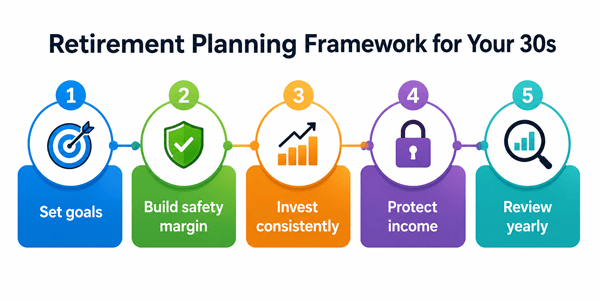
In simple terms, retirement planning in your 30s means setting a savings rate, choosing the right accounts, investing for long-term growth, and protecting your plan from debt, emergencies, and major life changes.
2. Why Retirement Planning in Your 30s Matters
Retirement can feel far away in your 30s, but the decisions you make now can shape your options for decades. Money invested in your 30s has roughly 25 to 35 years to grow before a traditional retirement age. That long runway is powerful because your investment earnings can begin earning their own returns. This is compound growth. For U.S. readers born in 1960 or later, Social Security full retirement age is currently 67, which is another reason to plan well before your 60s.
At the same time, your 30s often bring competing priorities. You may want to buy a home, pay off student loans, build a business, have children, or help parents. Good retirement planning does not ignore these realities. It helps you organize them so you can save for the future without making your present life impossible.
3. A Simple Retirement Planning Framework for Your 30s
- Know your starting point: income, expenses, debts, savings, retirement balances, insurance, and net worth.
- Set a clear retirement direction: when you might want to retire, what lifestyle you want, and what income sources you expect.
- Choose a savings target: a percentage of income, a dollar amount, or both.
- Automate retirement contributions before lifestyle spending absorbs your raises.
- Invest according to your time horizon, risk tolerance, and need for growth.
- Protect the plan with emergency savings, insurance, estate documents, and careful debt management.
- Adjust every year as income, family needs, tax rules, and goals change.
4. Retirement Goals to Set in Your 30s
1. Set a Target Retirement Age
You do not need to know the exact day you will retire. A rough target is enough to guide your savings rate and investment choices. Common targets include traditional retirement around 65 to 67, semi-retirement in your 50s or early 60s, or financial independence where work becomes optional.
| Goal type | What it means | Planning implication |
|---|---|---|
| Traditional retirement | Stop full-time work around 65-67 | Moderate savings rate may work if started early and invested consistently |
| Early retirement | Leave full-time work before 60 | Requires a much higher savings rate and a plan for health insurance and taxes |
| Work-optional life | Keep working by choice, not necessity | Focus on flexibility, diversified accounts, and lower fixed expenses |
| Partial retirement | Shift to part-time, consulting, or lower-stress work | May need less savings than full early retirement but still requires planning |
2. Estimate Your Retirement Lifestyle
A useful retirement plan starts with the life you want, not just a random savings number. Think about housing, travel, healthcare, hobbies, family support, location, and whether you expect to work part-time. A simple beginner estimate is to assume you may need 70% to 85% of pre-retirement income, then adjust based on your lifestyle. This is only a starting point. People with paid-off homes and modest lifestyles may need less, while people with high travel, healthcare, family, or housing costs may need more.
3. Define Your Savings Milestones
Milestones help you see whether you are on track. They are not perfect because income, market returns, debt, and family responsibilities vary. Still, they can provide a useful checkpoint.
| Age | Illustrative retirement savings checkpoint | What to do if you are behind |
|---|---|---|
| 30 | About 1x annual income saved is a common benchmark | Start contributions immediately; capture any employer match |
| 35 | About 2x annual income saved is a common benchmark | Increase savings rate by 1-3 percentage points per year |
| 40 | About 3x annual income saved is a common benchmark | Avoid lifestyle inflation; consider stronger catch-up planning before 50 |
These benchmarks are broad rules of thumb, not personal financial advice. Someone who started late, earns irregular income, supports relatives, or lives in a high-cost city may need a different path. The most important question is whether your current savings rate is strong enough to support your future income goal.
5. How Much Should You Save for Retirement in Your 30s?
A practical target for many people in their 30s is to save 15% to 20% of gross income toward retirement. This can include your own contributions and employer matching contributions. If you started late, want to retire early, or have little saved by your mid-30s, you may need a higher rate. If you are paying off expensive debt or rebuilding after a setback, you may begin lower and raise the percentage over time.
| Situation | Suggested starting target | Why |
|---|---|---|
| Started saving in your 20s and have steady income | 10%-15%+ | You already have time and early savings working for you |
| Starting in your early 30s with little saved | 15%-20%+ | You still have time, but need a stronger habit |
| Starting in your late 30s with little saved | 20%-25%+ if possible | Less time means each missed year matters more |
| Planning early retirement | 25%-50%+ depending on target date | Early retirement requires funding more years with fewer working years |
| High-interest debt or unstable income | Start small, then increase | Protect cash flow first while building the habit |
Example: Why Starting Earlier in Your 30s Helps
The chart below estimates the monthly savings needed to reach $1,000,000 by age 65, assuming a 6% annual return compounded monthly. It is an illustration, not a promise. Actual investment returns will vary.
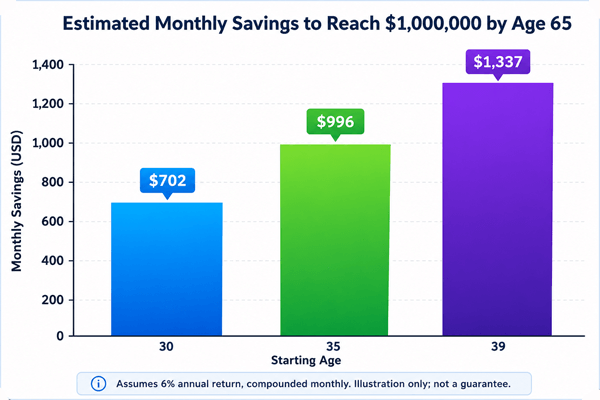
- Starting at 30 requires about $702 per month.
- Starting at 35 requires about $996 per month.
- Starting at 39 requires about $1,337 per month.
The lesson is simple: in your 30s, time is still on your side, but waiting can make the monthly savings requirement much higher.
6. Where to Save: Retirement Accounts and Other Options
The best retirement account depends on your country, employer, tax situation, and income. The examples below use common U.S. account types because they are widely searched and frequently used. If you live outside the U.S., use the same principles: look for tax-advantaged accounts, employer contributions, low fees, diversified investments, and rules that fit your retirement timeline.
| Account or option | Best for | Main benefit | Watch out for |
|---|---|---|---|
| 401(k), 403(b), or 457 plan | Employees with workplace retirement plans | High contribution limits and possible employer match | Investment menu and fees vary by plan |
| Traditional IRA | People who want possible tax-deductible contributions | Tax-deferred growth | Withdrawals are generally taxable; deduction rules depend on income and plan coverage |
| Roth IRA | People who want potential tax-free qualified withdrawals | Tax-free growth if rules are met | Income limits may restrict direct contributions |
| HSA | People with eligible high-deductible health plans | Tax advantages for qualified medical expenses | Must follow eligibility and withdrawal rules |
| Taxable brokerage account | Extra investing beyond retirement accounts or early retirement flexibility | No retirement contribution limit and flexible access | No special retirement tax shelter; taxes may apply annually |
| Real estate or business equity | People with expertise and risk capacity | Can diversify income sources | Can be illiquid, concentrated, leveraged, and management-heavy |
Important 2026 U.S. Contribution Limits
For U.S. readers, the IRS announced that the 2026 employee contribution limit for 401(k), 403(b), most 457 plans, and the federal Thrift Savings Plan is $24,500. The 2026 IRA contribution limit is $7,500. People age 50 and older can usually make catch-up contributions, including a $8,000 catch-up contribution for many workplace plans and a $1,100 catch-up contribution for IRAs, but most people in their 30s are not eligible yet. These limits can change each year, so verify the current limits directly with the IRS before making decisions.
7. Best Order of Operations for Retirement Savings in Your 30s
A common question is: should I pay debt, invest, build savings, or save for a house first? The best answer depends on your interest rates, job stability, family obligations, and goals. For many beginners, this order works well:
- Build a starter emergency fund of at least one month of essential expenses.
- Contribute enough to your workplace plan to get the full employer match if available.
- Pay off high-interest debt, especially credit cards and expensive personal loans.
- Build a fuller emergency fund of three to six months of essential expenses, or more if income is unstable.
- Increase retirement contributions toward 15% to 20% of gross income.
- Fund other goals such as a home down payment, children’s education, business savings, or taxable investing.
- Revisit tax strategy, asset allocation, insurance, and estate planning as your net worth grows.
8. Investing Best Practices for Your 30s
(a) Use Diversification Instead of Guessing Winners
Diversification means spreading your money across different investments so your future does not depend on one company, one sector, one property, or one market. For retirement accounts, many beginners use diversified index funds, exchange-traded funds, or target-date funds. A target-date fund automatically becomes more conservative as the target retirement year approaches, though you should still check its fees, allocation, and risk level.
(b) Keep Enough Growth in the Portfolio
Because retirement money in your 30s may stay invested for several decades, being too conservative can be risky. Holding too much cash may feel safe, but inflation can reduce purchasing power over time. Many long-term retirement portfolios hold a meaningful allocation to stocks for growth, balanced with bonds or cash based on risk tolerance and time horizon.
(c) Avoid Emotional Investing
Market declines are normal. A retirement plan should expect them. The danger is selling long-term investments during a downturn because of fear, then missing the recovery. A written investment plan can help you stay consistent. Decide your contribution rate, asset allocation, and rebalancing schedule before markets become stressful.
| Investment habit | Helpful behavior | Risky behavior |
|---|---|---|
| Contribution timing | Invest automatically every paycheck | Wait for the perfect time to invest |
| Portfolio choice | Use diversified funds that match your risk tolerance | Put most savings into one stock, crypto asset, or trend |
| Market downturns | Continue investing if your plan and emergency fund are intact | Panic sell long-term investments |
| Fees | Choose low-cost options when suitable | Ignore high expense ratios and plan fees |
| Review process | Check allocation once or twice per year | Change strategy every time headlines change |
9. Debt, Housing, and Retirement: How to Balance Them
Your 30s often include major debt and housing decisions. The key is to avoid letting one goal completely crowd out retirement savings for many years.
Paying Off Debt vs. Investing
High-interest debt is usually a financial emergency because the interest rate can be higher than a realistic long-term investment return. Paying off a credit card charging 20% interest is like earning a guaranteed 20% before taxes. Low-interest debt, such as some mortgages or student loans, may not need to be rushed if you are already saving and investing responsibly.
| Debt type | Typical priority | Reason |
|---|---|---|
| Credit cards and payday loans | Very high | Interest can compound against you quickly |
| Personal loans with high rates | High | Often costly and not tax-advantaged |
| Student loans | Depends on rate and forgiveness options | Balance retirement saving with repayment rules |
| Mortgage | Depends on rate and goals | A home can be part of long-term stability but is not a substitute for liquid retirement savings |
| Auto loan | Depends on rate and necessity | Cars depreciate, so avoid overextending |
Buying a Home Without Sacrificing Retirement
Homeownership can support retirement if it leads to stable housing costs and eventual equity. But buying too much house can damage retirement planning. Before buying, test whether you can afford the mortgage, taxes, insurance, repairs, utilities, retirement contributions, emergency savings, and normal life expenses. A house should fit your plan; it should not become the entire plan.
10. Family, Children, and Retirement Planning in Your 30s
Many people in their 30s are raising children or planning to. It is natural to want to prioritize children’s education, activities, and comfort. However, retirement planning still matters because your children can borrow for education in many cases, but you generally cannot borrow for retirement in the same way.
- Keep retirement contributions active even while saving for children’s education.
- Buy adequate life insurance if someone depends on your income.
- Create or update a will, guardian instructions, beneficiary designations, and powers of attorney.
- Avoid using retirement accounts for routine family expenses unless you fully understand taxes, penalties, and lost growth.
11. Insurance and Risk Protection in Your 30s
Retirement planning is not only about investments. It is also about protecting the income and assets that make investing possible.
| Protection area | Why it matters | Action step |
|---|---|---|
| Emergency fund | Prevents retirement withdrawals during setbacks | Keep 3-6 months of essential expenses, or more for unstable income |
| Health insurance | Medical bills can disrupt savings | Choose coverage carefully and understand deductibles |
| Disability insurance | Your future income is often your largest asset | Review employer coverage and consider supplemental coverage if needed |
| Life insurance | Protects dependents if you die early | Term life is often affordable for temporary family needs |
| Estate documents | Reduces confusion during emergencies | Create a will and keep beneficiaries updated |
12. Tax Planning Basics for Retirement in Your 30s
Tax planning can help you keep more of what you earn and create flexibility later. The main idea is to understand whether your retirement savings are taxed now or later.
| Contribution type | How it works | May be useful when |
|---|---|---|
| Traditional/pre-tax | You may reduce taxable income now; withdrawals are usually taxed later | You are in a higher tax bracket now or want current tax relief |
| Roth/after-tax | You contribute after-tax money; qualified withdrawals can be tax-free | You expect higher taxes later or want tax-free retirement income flexibility |
| Taxable brokerage | No retirement tax shelter, but flexible access | You already use retirement accounts or want funds before retirement age |
| HSA | Can offer strong tax benefits for qualified medical expenses | You are eligible and can afford to save for future health costs |
There is no universally best choice between traditional and Roth. Many people benefit from tax diversification, meaning they build a mix of pre-tax, Roth, and taxable assets. This can give more flexibility in retirement.
13. Common Retirement Planning Mistakes in Your 30s
| Mistake | Why it hurts | Better practice |
|---|---|---|
| Waiting until income feels high enough | Lifestyle expenses often rise with income | Start now and increase contributions with raises |
| Only saving what is left over | There may be nothing left | Automate contributions first |
| Ignoring employer match | Leaves compensation on the table | Contribute enough to capture the full match if possible |
| Investing too conservatively | Cash may not outpace inflation | Use a diversified long-term allocation |
| Raiding retirement accounts | Taxes, penalties, and lost compounding can be costly | Use emergency savings and insurance as first lines of defense |
| Buying too much house or car | Large fixed costs reduce savings flexibility | Keep fixed expenses manageable |
| Not updating beneficiaries | Assets may not go where intended | Review after marriage, divorce, children, or death in family |
14. Retirement Planning Checklist for Your 30s
- Calculate your net worth: assets minus debts.
- List all retirement accounts and current balances.
- Know your current retirement savings rate as a percentage of gross income.
- Check whether you receive the full employer match.
- Increase contributions by at least 1 percentage point each year until you reach your target.
- Choose an investment allocation that fits a multi-decade time horizon.
- Build and protect an emergency fund.
- Pay off high-interest debt aggressively.
- Review insurance coverage, especially disability and life insurance if others depend on you.
- Update beneficiaries and estate documents.
- Avoid major lifestyle inflation when income rises.
- Review your plan annually and after major life events.
15. Sample Retirement Plan for a 35-Year-Old Beginner
Here is a simple example. It is not a recommendation for everyone, but it shows how a beginner can turn retirement planning into clear steps.
| Profile | Example details |
|---|---|
| Age | 35 |
| Income | $80,000 per year |
| Current retirement savings | $45,000 |
| Debt | $5,000 credit card balance and $18,000 student loan |
| Employer match | 100% match on first 4% of salary |
| Goal | Retire around 65 with flexibility to reduce work earlier |
Practical Action Plan
- Contribute at least 4% to the workplace plan immediately to get the full match.
- Use a focused repayment plan for the credit card balance while avoiding new credit card debt.
- Build an emergency fund of three months of essential expenses.
- Raise retirement contributions to 10%, then 12%, then 15% over the next few years.
- Use a diversified retirement investment option, such as a suitable target-date fund or low-cost diversified funds.
- Review student loan repayment options and compare the interest rate with expected long-term investment returns.
- Increase contributions whenever income rises, before upgrading lifestyle spending.
16. How to Know If You Are On Track
You are probably making progress if your retirement balance is growing, your savings rate is rising, your debt is becoming more manageable, and your plan can survive normal life surprises. You do not need to compare your life to someone else’s. Compare your current habits to the future you want.
- Your retirement savings rate is at least moving toward 15% to 20% of gross income.
- You are not regularly pausing contributions for avoidable spending.
- Your investment portfolio is diversified and appropriate for your time horizon.
- You have an emergency fund and adequate insurance.
- Your fixed costs leave room for saving, investing, and normal life.
- You have a written plan for debt, retirement, and major goals.
17. When to Get Professional Help
A qualified financial planner or tax professional can be helpful when your situation becomes more complex. Consider professional advice if you have equity compensation, high income, self-employment income, business ownership, rental property, blended family issues, major tax questions, inheritance, divorce, disability, or uncertainty about investment strategy. Look for a fiduciary adviser who explains fees clearly and focuses on your goals rather than selling products you do not understand.
■ Frequently Asked Questions
1. Is it too late to start retirement planning in my 30s?
No. Your 30s are still a strong time to start because you may have decades before retirement. The key is to begin now, automate contributions, invest consistently, and increase your savings rate as income grows.
2. How much should I have saved for retirement by 30 or 35?
Benchmarks vary, but a common rule of thumb is around 1x annual income by age 30 and around 2x by age 35. These are not strict rules. Your personal target depends on income, debt, family responsibilities, retirement age, and lifestyle goals.
3. Should I save for retirement or pay off debt first?
Usually, get any employer match first if possible, then attack high-interest debt. For lower-interest debt, you may be able to repay it while still investing for retirement.
4. Should I use a Roth or traditional retirement account in my 30s?
It depends on your tax bracket now versus later. Traditional contributions may help reduce taxes now, while Roth contributions can create tax-free qualified withdrawals later. Many people benefit from having both types over time.
5. What if I can only save a small amount?
Start with a small automatic contribution and increase it over time. Even 3% to 5% is better than waiting. The habit matters because it becomes easier to raise contributions after raises or debt payoff.
6. Can I retire early if I start in my 30s?
Possibly, but early retirement usually requires a high savings rate, low fixed expenses, diversified investments, and a plan for healthcare, taxes, and withdrawals before traditional retirement age.
7. Should I include my home as part of my retirement plan?
Home equity can support retirement, but it should not replace liquid savings and investments. A paid-off home may reduce expenses, but you still need income for food, healthcare, taxes, insurance, repairs, and daily living.
8. How often should I check my retirement account?
Checking too often can encourage emotional decisions. For many long-term investors, reviewing contributions, fees, beneficiaries, and asset allocation once or twice per year is enough unless there is a major life change.
9. What is the biggest retirement mistake people make in their 30s?
The biggest mistake is often delaying because retirement feels far away. Other common mistakes include ignoring employer matches, taking on too much fixed debt, investing too conservatively, and using retirement savings for non-retirement expenses.
10. Do I need a financial adviser in my 30s?
Not always. Many people can start with basic education, automated savings, diversified funds, and disciplined budgeting. An adviser can help if your taxes, income, family, business, or investment decisions are complex.
■ Final Thoughts: The Best Retirement Plan in Your 30s Is One You Can Repeat
Retirement planning in your 30s is not about predicting every future detail. It is about building repeatable habits: save automatically, invest for long-term growth, control debt, protect your income, and review your plan as life changes. Small decisions made consistently in your 30s can create more freedom, security, and choice later. Start with your next paycheck, not with a perfect plan.
Sources and Notes
- Internal Revenue Service, 2026 retirement contribution limit announcements and retirement plan contribution topics: https://www.irs.gov/
- Social Security Administration, retirement benefits planner and full retirement age information for people born in 1960 or later: https://www.ssa.gov/
- U.S. Bureau of Labor Statistics Consumer Expenditure Surveys, household spending data: https://www.bls.gov/cex/
- General financial planning principles used for educational purposes. This article is not individualized investment, tax, legal, or insurance advice.
Reader Advice: This article is for educational and informational purposes only and should not be taken as personal financial, tax, legal, insurance, or investment advice. Please check the latest details from official sources or a qualified professional, because rules, limits, information, and policies can change over time.