Common Retirement Planning Mistakes and How to Avoid Them
Retirement planning is not only about choosing investments. It is the process of turning your savings, income sources, expenses, taxes, insurance, and life goals into a plan that can support you when you stop working or reduce your work hours.
Many retirement mistakes do not happen because people are careless. They happen because retirement has many moving parts, and small assumptions can compound into large problems over time. The good news is that most mistakes are avoidable when you understand what to watch for and review your plan regularly.
This guide explains the most common retirement planning mistakes in plain English and shows practical ways to avoid them. It is written for beginners, but it also works as a checklist for anyone reviewing an existing plan.
1. Quick Answer: What Are the Biggest Retirement Planning Mistakes?
| Mistake | Why It Hurts | How to Avoid It |
|---|---|---|
| Starting too late | You lose years of compounding. | Start with any affordable amount and increase it over time. |
| Guessing retirement expenses | Your savings target may be too low. | Build a retirement budget before choosing a target number. |
| Ignoring health care costs | Medical expenses can be one of the largest retirement costs. | Plan for premiums, out-of-pocket costs, and long-term care risk. |
| Claiming benefits without analysis | Early claiming may permanently reduce monthly income. | Compare claiming ages and consider longevity, cash flow, and spouse needs. |
| Investing too aggressively or too conservatively | Both can damage long-term security. | Use an age-appropriate, diversified allocation and rebalance. |
| No withdrawal plan | You may spend too fast or too cautiously. | Create a flexible income strategy and update it annually. |
Mistake 1: Waiting Too Long to Start Saving for Retirement
One of the most common retirement planning mistakes is delaying savings until later in life. People often wait because they feel they do not earn enough, have debt, or believe they can catch up once their income rises. Those reasons are understandable, but waiting makes the goal harder because you lose time in the market.
Example: If one person saves $250 per month starting at age 30 and another starts the same amount at age 45, the earlier saver has 15 more years for contributions and investment growth. The second person may need to save much more each month to reach a similar outcome.
How to avoid it: start with a realistic amount, even if it is small. Increase your savings rate when you receive a raise, bonus, debt payoff, or tax refund. If your employer offers a retirement plan match, try to contribute enough to receive the full match because it is part of your compensation.
For U.S. readers, contribution limits can also affect savings targets. For 2026, the IRS increased the 401(k), 403(b), most 457 plans, and Thrift Savings Plan elective deferral limit to $24,500, while the IRA contribution limit increased to $7,500. Workers age 50 or older may qualify for catch-up contributions, and workers age 60 to 63 may have higher catch-up limits in some employer plans. Always confirm current limits with the IRS or your plan provider before contributing.
Mistake 2: Not Having a Clear Retirement Goal
Without a clear goal, retirement planning becomes guesswork. Many beginners ask, “How much should I save?” but the better first question is, “What income will I need and what lifestyle am I planning for?”
A useful goal includes your target retirement age, expected annual expenses, likely income sources, and desired lifestyle. A modest retirement, a travel-heavy retirement, and an early retirement require very different savings plans.
How to avoid it: write a simple retirement goal statement. For example: “I want to retire around age 65, keep my current home, travel modestly, and cover about $55,000 per year in today’s dollars before tax.” This gives you a starting point that can be refined over time.
A helpful goal is specific but not rigid. Use today’s dollars for clarity, then update the number for inflation and taxes during your annual review.
Mistake 3: Underestimating Retirement Expenses
A common misconception is that spending automatically drops sharply after retirement. Some costs may fall, such as commuting or payroll taxes, but others may rise, including health care, home repairs, travel, hobbies, and support for family members.
Beginners often forget irregular expenses. A retirement budget should include both monthly bills and non-monthly costs such as insurance premiums, property taxes, car replacement, dental work, appliance replacement, and gifts.
How to avoid it: create three retirement spending categories: essential expenses, lifestyle expenses, and irregular expenses. Then test your budget against both a comfortable year and a difficult year.
Mistake 4: Ignoring Inflation
Inflation means the cost of goods and services tends to rise over time. Even modest inflation can reduce purchasing power over a long retirement. If retirement lasts 25 to 35 years, today’s budget may not be enough later.
For example, if your expenses are $50,000 today and inflation averages 3% per year, the same lifestyle could cost more than $90,000 in 20 years. This is why retirement planning should focus on future purchasing power, not only today’s account balance.
How to avoid it: include inflation in your projections, keep part of your portfolio invested for growth, and review spending assumptions every year. Retirees often still need growth investments, not just cash and bonds.
Mistake 5: Forgetting Health Care and Long-Term Care Costs
Health care is one of the easiest retirement costs to underestimate. Medicare or a public health system may cover some costs depending on your country, but retirees often still face premiums, deductibles, prescriptions, dental care, vision care, hearing care, and out-of-pocket expenses.
In the United States, Fidelity estimated that a 65-year-old retiring in 2025 may need an average of $172,500 in after-tax savings for health care expenses throughout retirement. This is only an estimate, but it shows why health care should be a separate planning category.
This figure does not replace a personal estimate. Your actual cost may be higher or lower depending on location, insurance, prescriptions, income, Medicare choices, and whether long-term care is needed.
Long-term care is different from ordinary medical care. It may include help with bathing, dressing, eating, or daily living. Not everyone needs long-term care, but those who do can face high costs.
How to avoid it: estimate health care separately, learn what your insurance does and does not cover, keep an emergency reserve, and discuss long-term care options before a crisis.
Mistake 6: Relying on One Income Source
Another mistake is depending on a single source of retirement income, such as Social Security, a pension, rental income, or one investment account. A strong retirement plan usually has multiple income layers.
Common income sources include workplace retirement plans, IRAs or personal retirement accounts, pensions, Social Security or government benefits, taxable investments, annuities, rental income, part-time work, and cash reserves.
How to avoid it: list every expected income source, when it starts, whether it adjusts for inflation, how it is taxed, and what could go wrong. Then build backup options.
Mistake 7: Claiming Social Security or Pension Benefits Without a Strategy
For U.S. readers, Social Security claiming age can have a major effect on lifetime retirement income. Benefits can start as early as age 62, but claiming before full retirement age generally reduces monthly benefits. Delaying beyond full retirement age can increase benefits until age 70.
The Social Security Administration explains that delayed retirement credits increase benefits for each month you delay after full retirement age, and the increase stops at age 70.
For people born in 1943 or later, delayed retirement credits are generally 8% per year after full retirement age until age 70. This does not automatically mean everyone should wait; it simply means the claiming decision deserves careful comparison.
How to avoid it: compare claiming ages before filing. Consider your health, expected longevity, spouse or survivor benefits, other income, tax situation, and whether you need cash immediately. Pension elections also need review because choices such as single-life versus joint-and-survivor payments can affect a spouse’s future income.
Mistake 8: Saving Without an Investment Plan
Saving is essential, but savings alone may not be enough if the money is not invested appropriately for the time horizon. Some people keep too much in cash for decades and lose purchasing power. Others chase risky investments close to retirement and expose themselves to major losses.
How to avoid it: use a diversified investment mix that fits your age, risk tolerance, income needs, and time horizon. Beginners can start by learning the role of stocks, bonds, cash, and broad index funds. The goal is not to predict the market; it is to build a portfolio that can survive different market conditions.
Mistake 9: Being Too Conservative Too Early
Many people become very conservative as soon as retirement approaches. Reducing risk is sensible, but moving too much into cash too early can create inflation risk and longevity risk. A 60-year-old may still need the portfolio to support 25 or more years of spending.
How to avoid it: separate short-term money from long-term money. Money needed in the next one to three years may be held more conservatively, while money needed later can often remain invested for growth.
Mistake 10: Taking Too Much Investment Risk Near Retirement
The opposite mistake is taking large risks late in the journey to “make up for lost time.” This can be dangerous because a market downturn just before or just after retirement can permanently damage a plan if withdrawals continue while investments are down.
How to avoid it: reduce concentrated positions, avoid speculative bets with core retirement money, and create a cash or bond buffer for near-term withdrawals. A good retirement portfolio balances growth with stability.
Mistake 11: Not Understanding Taxes in Retirement
Retirement income can be taxed in different ways depending on account type and local law. Traditional retirement accounts may be taxable when withdrawn. Roth-style accounts may be tax-free if rules are met. Taxable investment accounts may generate interest, dividends, or capital gains.
Tax mistakes can include withdrawing from the wrong account first, ignoring required minimum distributions where applicable, forgetting taxes on pension income, or assuming all retirement income is tax-free.
How to avoid it: map your accounts by tax type: taxable now, tax-deferred, and tax-free. Review withdrawal order, Roth conversion opportunities, and required distribution rules with a qualified tax professional when needed.
Mistake 12: Not Creating a Withdrawal Strategy
Accumulating money and withdrawing money are different skills. In retirement, you need to decide how much to withdraw, from which accounts, and how to adjust when markets or expenses change.
A fixed withdrawal rule may be a starting point, but no rule works perfectly for everyone. A flexible withdrawal plan can reduce spending after weak market years and allow more spending after strong years, within reason.
How to avoid it: create an annual retirement income plan. Include guaranteed income, planned withdrawals, emergency reserves, taxes, and a review trigger if markets fall or expenses rise.
One simple framework is to separate income into short-term cash needs, medium-term stable assets, and long-term growth assets. This can help reduce the need to sell growth investments during a downturn.
Mistake 13: Carrying Too Much Debt Into Retirement
Debt can limit retirement flexibility. A mortgage, credit card balance, car loan, or personal loan creates fixed payments that must be made even if investment returns are poor or income is lower than expected.
Not all debt is equally harmful. A low-rate mortgage may be manageable for some retirees, while high-interest credit card debt is usually dangerous. The key is whether the debt fits your retirement cash flow.
How to avoid it: create a debt payoff plan before retirement, prioritize high-interest debt, avoid taking new lifestyle debt near retirement, and test whether your retirement budget can handle required payments.
Mistake 14: Retiring Before Testing the Budget
Some people retire based on an account balance without testing whether the monthly budget actually works. A trial run can reveal gaps before the decision becomes permanent.
How to avoid it: live on your expected retirement income for six to twelve months before retiring if possible. Save the difference between your current income and retirement budget. This test can show whether your plan feels realistic.
Mistake 15: Forgetting Emergency Savings
Emergency savings still matter after retirement. Without cash reserves, retirees may be forced to sell investments during a downturn or use high-interest debt for unexpected expenses.
How to avoid it: keep a dedicated emergency fund separate from regular monthly spending. The right size depends on job income, pension security, insurance, health, home ownership, and family obligations. Many retirees prefer a larger reserve than workers because replacing income can be harder.
Mistake 16: Not Updating Beneficiaries and Estate Documents
Retirement accounts, life insurance, and some bank accounts often pass by beneficiary designation. These forms can override a will. If you forget to update them after marriage, divorce, births, deaths, or family changes, assets may go to the wrong person.
How to avoid it: review beneficiaries at least once a year and after major life events. Also review your will, power of attorney, health care directive, and estate plan with a qualified professional.
Mistake 17: Planning for Only One Spouse or Partner
Couples sometimes plan around the higher earner or assume both partners will always be alive and healthy. Retirement planning should also consider survivor income, health care needs, caregiving, and how expenses change after one spouse dies.
How to avoid it: run the plan for three scenarios: both partners living, one partner living, and one partner needing care. Review pension survivor options, life insurance, Social Security survivor benefits, account access, and estate documents.
Mistake 18: Falling for Retirement Myths and Sales Pressure
Retirement can attract aggressive sales pitches. Some products may be useful in the right situation, but no product is perfect for everyone. Be cautious with promises of high returns, no risk, guaranteed income without trade-offs, or urgent deadlines.
How to avoid it: ask how the person is paid, what fees apply, what risks exist, what happens if you need money early, and whether there are surrender charges or tax consequences. Consider a second opinion before making large irreversible decisions.
Mistake 19: Never Reviewing the Plan
A retirement plan is not a one-time document. Your health, family, job, markets, tax laws, inflation, and goals can change. A plan that was reasonable five years ago may no longer fit.
How to avoid it: review your plan at least annually. Update expenses, savings rate, investment allocation, beneficiaries, insurance, taxes, and retirement date. A short yearly review can prevent major surprises.
■ Retirement Planning Mistake Checklist
Use this checklist once a year or whenever your life changes.
| Question | Green Flag | Warning Sign | Next Action |
|---|---|---|---|
| Do I know my target retirement expenses? | Budget includes monthly and irregular costs. | Only using a rough guess. | Build or update a retirement budget. |
| Am I saving enough? | Savings rate is linked to a target date and goal. | Saving whatever is left over. | Automate contributions and increase gradually. |
| Is my portfolio diversified? | Mix fits time horizon and risk tolerance. | Too much in one stock, cash, or risky asset. | Rebalance and reduce concentration. |
| Have I planned for health care? | Costs are estimated separately. | Assuming insurance covers everything. | Review premiums, deductibles, and long-term care risk. |
| Do I have a withdrawal strategy? | Income plan covers taxes and downturns. | No plan for account order or spending rate. | Create an annual income plan. |
| Are beneficiaries current? | Reviewed after life changes. | Old spouse, deceased person, or blank form. | Update forms and estate documents. |
Simple Diagram: How to Avoid Retirement Planning Mistakes
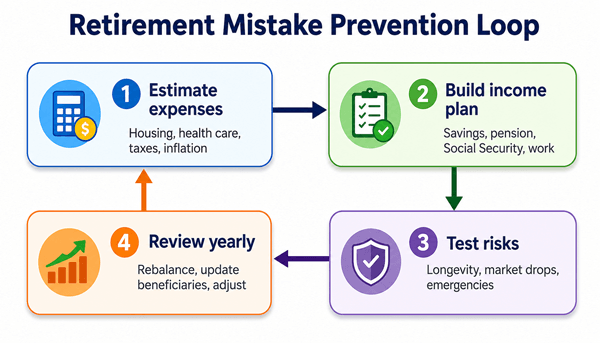
The best retirement plans are reviewed repeatedly. Estimate expenses, build income, test risks, and update the plan every year.
■ DIY Retirement Planning vs. Working With a Financial Professional
| Approach | Best For | Watch Out For |
|---|---|---|
| DIY planning | People with simple finances who enjoy learning and tracking details. | May miss tax, estate, pension, or withdrawal issues. |
| Hourly or project-based advice | People who want help building a plan without ongoing management. | You must implement and maintain the plan yourself. |
| Ongoing advisor relationship | Complex finances, business owners, high assets, or people who want accountability. | Fees, conflicts of interest, and product sales incentives should be understood. |
| Tax or estate specialist | Questions involving taxes, trusts, inheritance, business succession, or legal documents. | A specialist may not provide full investment or retirement planning. |
■ A Practical 7-Step Plan to Avoid Retirement Mistakes
- Calculate your current net worth: list assets, debts, retirement accounts, cash, property, and insurance.
- Estimate retirement expenses: include essentials, lifestyle spending, health care, taxes, and irregular costs.
- Identify income sources: include pensions, Social Security or state benefits, retirement accounts, rental income, and part-time work.
- Choose a target savings rate: automate contributions and increase them after raises or debt payoff.
- Diversify investments: avoid relying on one stock, one property, one account, or one income source.
- Build a withdrawal plan: decide how much you can spend, which accounts to use first, and how to adjust during downturns.
- Review annually: update assumptions, beneficiaries, tax rules, insurance, and retirement date.
Tip: When a decision involves taxes, pensions, Social Security, insurance, or estate documents, use this guide as a starting point and verify the details with official sources or a qualified professional.
■ Frequently Asked Questions
1. What is the biggest retirement planning mistake?
The biggest mistake is not having a written plan. Without a plan, it is easy to save too little, invest poorly, underestimate expenses, claim benefits too early, or retire before your income is secure.
2. Is it too late to start retirement planning in your 40s or 50s?
No. Starting earlier is better, but planning in your 40s or 50s can still make a major difference. You may need a higher savings rate, later retirement date, lower expenses, extra income, or more careful tax and investment planning.
3. How often should I review my retirement plan?
Review your plan at least once a year and after major life events such as marriage, divorce, job change, inheritance, health diagnosis, home purchase, or the birth or death of a family member.
4. Should I pay off my mortgage before retirement?
It depends on your interest rate, cash reserves, taxes, investment returns, and comfort with debt. Paying off a mortgage can lower fixed expenses, but using all your cash to do it may reduce flexibility. Compare both options before deciding.
5. What happens if I retire during a market downturn?
A downturn early in retirement can be harmful if you must sell investments while prices are low. This is called sequence-of-returns risk. A cash reserve, diversified portfolio, flexible spending, and withdrawal plan can help reduce the damage.
6. Do retirees still need stocks?
Many retirees need some growth investments because retirement can last decades and inflation can reduce purchasing power. The right amount depends on risk tolerance, guaranteed income, spending needs, and time horizon.
7. Can I rely only on Social Security or a pension?
Some people do, but relying on one income source creates risk. Benefits may not cover all expenses, may not keep up with your lifestyle, and may be affected by claiming decisions, survivor rules, or policy changes. Multiple income sources usually provide more flexibility.
8. When should I talk to a financial advisor?
Consider professional help if you are close to retirement, have several account types, own a business, expect a pension decision, have tax questions, support family members, or feel unsure about withdrawals, insurance, or estate planning.
9. What is a safe retirement withdrawal rate?
There is no single safe withdrawal rate for everyone. A starting rate depends on age, portfolio mix, guaranteed income, taxes, inflation, spending flexibility, and market returns. Many people use a rule of thumb as a starting point, then adjust withdrawals each year.
10. What documents should I review before retirement?
Review beneficiary forms, wills, powers of attorney, health care directives, insurance policies, pension elections, account statements, tax records, and any trust or estate documents. These documents should match your current family situation and wishes.
Key Takeaways
- Most retirement planning mistakes come from guessing, delaying, or failing to review the plan.
- A useful retirement plan connects expenses, income, investments, taxes, insurance, and estate documents.
- Health care, inflation, taxes, and long life are major risks beginners often underestimate.
- Good planning does not require perfection. It requires realistic assumptions, consistent action, and regular updates.
Sources Consulted
These sources were used to verify current contribution-limit, Social Security, consumer-planning, and health care cost information:
- Internal Revenue Service: 401(k) limit increases to $24,500 for 2026; IRA limit increases to $7,500.
- Internal Revenue Service: COLA increases for dollar limitations on benefits and contributions for retirement plans.
- Social Security Administration: Delayed Retirement Credits and benefit increases up to age 70.
- Consumer Financial Protection Bureau: Planning for retirement.
- Fidelity Investments: 2025 Retiree Health Care Cost Estimate of $172,500 for a 65-year-old retiring in 2025.
Reader Advice: This article is for educational and informational purposes only and should not be taken as personal financial, tax, legal, or investment advice. Rules, limits, costs, and policies can change over time, so please check the latest information from official sources or speak with a qualified professional before making decisions.