Retirement Planning Explained: Complete Guide for Beginners
1. Quick answer: What is retirement planning?
Retirement planning is the process of preparing your money, lifestyle, and risk protection so you can stop working full-time someday without running out of income. A good retirement plan answers five practical questions:
- When do you want to retire?
- How much will your retirement lifestyle cost?
- How much do you need to save and invest?
- Where will your retirement income come from?
- What risks could damage the plan, and how will you manage them?
For beginners, the goal is not to create a perfect plan on day one. The goal is to start with a realistic estimate, take consistent action, and review the plan as your income, family, health, market conditions, and goals change.
In simple words, retirement planning helps you turn today’s income into future financial independence. It is useful whether you are starting in your 20s, beginning later in your 40s or 50s, self-employed, working for an employer, or planning with a pension, provident fund, 401(k), IRA, or local retirement account.
2. Retirement planning at a glance
| Planning question | Beginner-friendly answer | Why it matters |
|---|---|---|
| When should I start? | As early as possible, but today is still useful. | More time gives compounding more room to work. |
| How much do I need? | Estimate annual retirement spending, then calculate the savings needed to support it. | A target helps you know whether you are on track. |
| Where should I save? | Use employer plans, IRAs, pensions, taxable investments, cash savings, or local equivalents. | Different accounts have different tax treatment, access rules, and limits. |
| How should I invest? | Use a diversified portfolio that matches your time horizon and risk tolerance. | Growth matters before retirement; stability matters more as retirement approaches. |
| What can go wrong? | Inflation, market declines, health costs, debt, taxes, longevity, and poor withdrawal choices. | Risk planning can prevent one problem from damaging decades of savings. |
3. Why retirement planning matters
Retirement planning matters because most people cannot rely on one source of income forever. Work income may stop, pensions may be smaller than expected, government benefits may not cover all expenses, and personal savings can be weakened by inflation, debt, or poor investment choices. A plan gives your future self more choices.
Good retirement planning can help you:
- Create a clear savings target instead of guessing.
- Use tax-advantaged accounts effectively where available.
- Avoid depending only on children, relatives, government benefits, or last-minute savings.
- Reduce financial stress as retirement gets closer.
- Prepare for healthcare costs, emergencies, and long life expectancy.
- Choose a retirement age based on numbers, not just hope.
4. How retirement planning works: the simple framework
Retirement planning works by connecting your future spending needs with today’s saving and investing decisions. The basic formula is simple:
Future retirement spending needs - expected guaranteed income = amount your savings must support
For example, if you expect to spend $60,000 per year in retirement and you expect $25,000 per year from a pension or government benefit, your portfolio may need to support the remaining $35,000 per year. That gap is the amount your investments, savings, or other income sources need to cover.
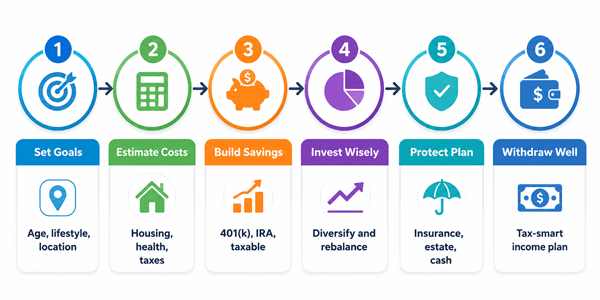
Diagram: A beginner retirement planning lifecycle from goal setting to withdrawal planning.
Step 1: Define what retirement means to you
Retirement does not mean the same thing for everyone. Some people want to stop working completely. Others want part-time work, consulting, a small business, travel, volunteering, or more time with family. Your definition affects how much money you need.
Start with these questions:
- At what age would you like to retire?
- Do you want to retire fully or gradually reduce work?
- Will you stay in the same city, move to a cheaper area, or relocate abroad?
- Will your home be paid off?
- Do you expect to support children, parents, or other family members?
- What kind of lifestyle do you want: basic, comfortable, or luxury?
Practical example: A person who wants a quiet retirement in a paid-off home may need much less than someone who wants frequent international travel, private healthcare, and a second home. Retirement planning starts with lifestyle because lifestyle drives spending.
Step 2: Estimate your retirement expenses
A common beginner mistake is focusing only on income and ignoring expenses. Retirement success depends on how much you spend, not just how much you have saved.
Create a simple retirement budget with three categories:
| Category | Examples | Planning tip |
|---|---|---|
| Essential expenses | Housing, food, utilities, transport, insurance, basic healthcare | These must be covered by reliable income as much as possible. |
| Lifestyle expenses | Travel, hobbies, restaurants, gifts, entertainment | These can be adjusted in weak markets or high-inflation years. |
| Irregular expenses | Home repairs, car replacement, dental work, family support, emergencies | Build a separate cash reserve or sinking fund. |
A practical starting method is to estimate retirement spending as a percentage of your current spending, not your current income. Many people spend less after retirement because payroll taxes, commuting, and retirement contributions may fall. Others spend more because of travel, healthcare, or family support. Use your actual spending as the base whenever possible.
For better accuracy, separate today’s dollars from future dollars. Estimate the lifestyle in today’s prices first, then apply reasonable inflation assumptions when projecting decades into the future.
Step 3: Estimate your retirement income sources
Your retirement income may come from several places. The stronger your mix of income sources, the less pressure you place on one account.
| Income source | How it works | Main advantage | Main risk or limitation |
|---|---|---|---|
| Government benefits | Monthly income based on local rules, work history, age, or contributions. | Can provide lifetime income. | May not cover full expenses; rules can change. |
| Employer pension | A workplace retirement income benefit, often based on salary and years of service. | Can be predictable if well funded. | Not everyone has one; inflation protection may be limited. |
| 401(k), 403(b), IRA, or local equivalents | You save and invest in retirement accounts, often with tax benefits. | Powerful long-term savings vehicle. | Investment risk, fees, taxes, and withdrawal rules. |
| Taxable investments | Brokerage accounts, mutual funds, ETFs, stocks, bonds. | Flexible access before and after retirement. | Tax drag and market volatility. |
| Cash and deposits | Bank savings, money market funds, certificates of deposit. | Stability and emergency access. | Inflation can reduce purchasing power. |
| Rental or business income | Income from property or a business. | Can diversify retirement income. | Requires management and may be irregular. |
Step 4: Calculate how much money you may need to retire
There is no single retirement number that works for everyone. A useful estimate depends on expected spending, guaranteed income, investment returns, inflation, taxes, retirement age, health, and how long you may live.
A simple beginner formula is:
Retirement savings target = annual spending gap x 25
This is often called the 25x rule. It is based on the idea that a diversified portfolio may support withdrawals of about 4% per year in some historical market conditions. It is not a guarantee. It is a rough planning shortcut, not a promise.
Example:
- Expected annual retirement spending: $60,000
- Expected pension or government benefit: $25,000
- Annual gap: $35,000
- Estimated portfolio target using 25x rule: $35,000 x 25 = $875,000
This estimate should be adjusted for your age, investment mix, inflation, taxes, healthcare costs, retirement length, and local rules. A person retiring at 45 may need a more conservative plan than someone retiring at 67 because the money may need to last much longer.
Step 5: Understand retirement accounts and tax treatment
Retirement accounts are special savings or investment accounts designed for long-term retirement savings. They may provide tax benefits, employer contributions, or both. The exact account names and rules depend on the country, but the main concepts are similar.
| Account type | Tax treatment | Best for | Watch out for |
|---|---|---|---|
| Traditional retirement account | Contributions may reduce taxable income now; withdrawals are usually taxed later. | People who expect a lower tax rate in retirement. | Future withdrawals can increase taxable income. |
| Roth-style account | Contributions are made after tax; qualified withdrawals may be tax-free. | People who expect higher tax rates later or want tax diversification. | Income limits or plan rules may apply. |
| Employer plan | Workplace account such as a 401(k), 403(b), pension plan, provident fund, or similar local plan. | Capturing employer match and automatic payroll savings. | Limited investment menu and plan fees. |
| Taxable brokerage account | Regular investment account with no special retirement lockup. | Flexibility, early retirement bridge money, extra savings after maxing retirement plans. | Dividends and gains may be taxable. |
For U.S. readers, IRS-published 2026 limits include $24,500 for employee contributions to many 401(k), 403(b), governmental 457 plans, and the federal Thrift Savings Plan; the IRA contribution limit is $7,500; catch-up limits include $8,000 for eligible 401(k)-type savers age 50 and older and $1,100 for eligible IRA savers age 50 and older. These limits can change, so readers should verify the latest IRS guidance before contributing.
Non-U.S. readers should use the same planning framework, but replace U.S. account names with their local equivalents, such as workplace pensions, provident funds, national savings schemes, personal pensions, tax-free savings accounts, or other country-specific retirement vehicles.
Step 6: Save consistently before investing aggressively
Investment returns matter, but savings behavior matters first. A high return on a tiny savings amount will not build retirement security. Beginners should focus on a sustainable savings rate and increase it over time.
A practical savings order may look like this:
- Build a small starter emergency fund so you are not forced to use retirement savings for every surprise expense.
- Contribute enough to get the full employer match if your workplace offers one.
- Pay off high-interest debt, especially credit card debt or other expensive consumer debt.
- Increase retirement contributions gradually, such as by 1% of income every few months or every raise.
- Use tax-advantaged accounts where appropriate.
- Invest extra savings in a taxable account if retirement accounts are already maximized or if you need flexible access before retirement.
Example: If your employer matches 50% of contributions up to 6% of salary, not contributing enough to get the full match may be leaving part of your compensation unused. Employer matches are not “free money” in a magical sense; they are part of the benefit package you may miss if you do not participate.
Step 7: Choose an investment strategy that matches your timeline
Retirement investing is not about finding the hottest stock. It is about building a diversified portfolio that can grow over decades and still support withdrawals later. Beginners often do best with a simple, low-cost, diversified approach.
| Life stage | Main goal | Typical investment focus | Main risk to manage |
|---|---|---|---|
| 20s to 30s | Build the habit and let compounding work. | Higher growth allocation if risk tolerance allows. | Not starting, overtrading, or cashing out during downturns. |
| 40s to early 50s | Increase savings and reduce major debt. | Growth with more attention to diversification. | Lifestyle inflation and inadequate savings rate. |
| Late 50s to 60s | Prepare for retirement income. | Gradually add stability and cash reserves. | Sequence-of-returns risk near retirement. |
| Retirement years | Generate income and preserve purchasing power. | Balanced mix of growth, income, and liquidity. | Inflation, healthcare costs, and withdrawing too much. |
A beginner-friendly portfolio may include broad stock funds for growth, bond funds or fixed income for stability, and cash for short-term needs. The exact mix should depend on your risk tolerance, time horizon, goals, taxes, and local investment options.
Also pay attention to fees. High fund expenses, advisory charges, transaction costs, and tax drag can quietly reduce long-term returns, especially over a retirement timeline measured in decades.
Step 8: Plan for inflation
Inflation means prices rise over time. Even mild inflation can make retirement more expensive after 20 or 30 years. A retirement plan that ignores inflation may look safe on paper but fail in real life.
For example, if your living costs are $50,000 per year today, they may be much higher decades from now. That does not mean you should panic. It means your plan should include growth investments, periodic reviews, and realistic spending assumptions.
Practical ways to plan for inflation include:
- Investing part of the portfolio for long-term growth instead of holding everything in cash.
- Reviewing your retirement budget every year.
- Keeping some flexible spending categories that can be reduced temporarily.
- Considering inflation-protected income sources where available.
- Avoiding a fixed retirement budget that never changes.
Step 9: Prepare for healthcare and insurance costs
Healthcare is one of the most important retirement planning topics because costs can rise with age and may be unpredictable. Even in countries with public healthcare, retirees may still face insurance premiums, private care, medicines, dental care, vision care, long-term care, or support needs.
Beginner checklist:
- Understand what healthcare coverage you will have after leaving work.
- Estimate premiums, deductibles, medicines, and out-of-pocket costs.
- Consider long-term care risk, especially if you do not have family support nearby.
- Review life insurance needs. Some retirees need less life insurance after children are independent and debts are paid, while others still need coverage for a spouse or dependent family member.
- Keep disability insurance during working years if your income depends on your ability to work.
Step 10: Manage debt before retirement
Debt can make retirement planning harder because it creates fixed payments at the same time income may become less flexible. Not all debt is equally dangerous, but high-interest consumer debt is especially harmful.
| Debt type | Retirement planning concern | Practical action |
|---|---|---|
| Credit card debt | High interest can overwhelm savings progress. | Prioritize payoff before aggressive investing beyond employer match. |
| Auto loans | Payments reduce retirement cash flow. | Avoid oversized loans close to retirement. |
| Mortgage | Can be manageable if affordable, but still affects cash needs. | Compare payoff benefits with liquidity and investment needs. |
| Student loans | May delay savings for younger workers. | Use a payoff plan while still starting small retirement contributions. |
| Family or personal loans | Can be emotionally and financially complex. | Set written repayment terms and avoid risking retirement security. |
Step 11: Build a retirement income and withdrawal plan
Saving for retirement is only half the work. The other half is turning savings into income. A withdrawal plan helps decide which accounts to use first, how much to withdraw, how to manage taxes, and how to reduce the risk of running out of money.
Common withdrawal approaches include:
| Approach | How it works | Pros | Cons |
|---|---|---|---|
| Fixed percentage | Withdraw a set percentage of the portfolio each year. | Adjusts naturally with market value. | Income can fall during market declines. |
| Inflation-adjusted amount | Start with a set amount and increase it with inflation. | Predictable spending plan. | Can stress the portfolio after poor markets. |
| Bucket strategy | Hold short-term cash, medium-term bonds, and long-term growth investments. | Can reduce panic selling during downturns. | Requires maintenance and rebalancing. |
| Guardrails strategy | Increase or decrease withdrawals when portfolio performance crosses set levels. | Flexible and practical. | Spending must adjust when needed. |
A safe withdrawal rate is not universal. It depends on your retirement age, life expectancy, asset allocation, fees, taxes, market returns, inflation, and flexibility. Conservative retirees may use a lower starting withdrawal rate, especially for very early retirement or uncertain markets.
Step 12: Understand the biggest retirement planning risks
Every retirement plan has risks. The goal is not to eliminate risk completely; that is impossible. The goal is to understand the biggest risks and build safeguards.
| Risk | What it means | How to reduce it |
|---|---|---|
| Longevity risk | You live longer than expected and need money for more years. | Plan for a long life, delay some income sources if beneficial, avoid overspending early. |
| Inflation risk | Prices rise faster than expected. | Keep growth assets and update spending assumptions. |
| Market risk | Investments fall in value. | Diversify, rebalance, keep cash reserves, avoid panic selling. |
| Sequence risk | Bad returns early in retirement damage the portfolio more than bad returns later. | Hold near-term spending in safer assets and reduce withdrawals after bad years. |
| Healthcare risk | Medical or care costs are higher than expected. | Plan insurance, emergency reserves, and realistic health spending. |
| Tax risk | Withdrawals or rule changes create higher taxes. | Use tax diversification and plan withdrawals before year-end. |
| Behavior risk | Emotional decisions hurt long-term results. | Use written rules, automate investing, and avoid chasing trends. |
■ Retirement planning example: beginner case study
Meet Sara, age 35. She earns $70,000 per year and currently saves 6% into her workplace retirement plan. Her employer matches part of her contribution. She wants to retire around age 65 with a comfortable but not luxury lifestyle.
Sara’s simple plan:
- She tracks her current spending and estimates she may need about $55,000 per year in retirement, in today’s dollars.
- She checks projected government or pension income and estimates that personal savings may need to cover $30,000 per year.
- Using the 25x shortcut, she estimates a rough target of $750,000 in today’s dollars for the portfolio portion of retirement income.
- She increases her contribution from 6% to 8%, then plans to raise it by 1% each year until she reaches 15%.
- She uses a diversified, low-cost portfolio and avoids changing investments every time the market moves.
- She keeps an emergency fund so she does not raid retirement savings when the car needs repairs.
This is not a perfect plan, but it is a strong beginner plan because it connects goals, spending, income sources, savings rate, investments, and risk management.
5. Common retirement planning mistakes beginners should avoid
- Starting late because the target feels too big. Even small contributions can build habits and momentum.
- Saving only what is left at the end of the month. Pay yourself first through automatic contributions.
- Ignoring employer matches. Capture the full match when possible before focusing on less urgent goals.
- Keeping all retirement money in cash for decades. Cash is stable, but it may not grow enough after inflation.
- Taking too much investment risk close to retirement. A large market decline near retirement can be difficult to recover from.
- Borrowing from retirement accounts without understanding the consequences. Loans and early withdrawals can reduce compounding and may create taxes or penalties.
- Forgetting taxes. Pre-tax accounts, Roth accounts, taxable investments, pensions, and benefits may be taxed differently.
- Planning for average life expectancy only. Many people live longer than expected, so plan for a long retirement.
- Assuming retirement spending will automatically drop. Some costs may fall, but healthcare, travel, and family support may rise.
- Never reviewing the plan. Retirement planning is an ongoing process, not a one-time spreadsheet.
6. Retirement planning by age: what to focus on
| Age range | Main priorities | Practical next step |
|---|---|---|
| 20s | Start early, build habits, avoid lifestyle inflation. | Contribute enough for employer match and invest consistently. |
| 30s | Increase savings as income grows, protect family, manage debt. | Raise contribution rate and build emergency savings. |
| 40s | Balance retirement, children, housing, and debt. | Run a retirement projection and close savings gaps. |
| 50s | Use catch-up opportunities where available, reduce risky debt. | Estimate retirement spending and healthcare costs. |
| 60s | Choose retirement timing, benefits timing, and withdrawal strategy. | Create a detailed income plan before leaving work. |
| Retired | Manage withdrawals, taxes, risk, and estate planning. | Review spending, portfolio, and beneficiaries annually. |
7. Pros and cons of retirement planning
| Benefits | Limitations |
|---|---|
| Creates clarity and reduces guesswork. | Future returns, inflation, health costs, and tax rules are uncertain. |
| Helps you start earlier and save consistently. | Planning can feel overwhelming without simple steps. |
| Improves your ability to handle emergencies and market downturns. | A plan must be reviewed regularly to stay useful. |
| Supports better decisions about work, debt, housing, and lifestyle. | Overly optimistic assumptions can create false confidence. |
| Can reduce family stress and improve long-term financial independence. | Some risks cannot be fully controlled, only managed. |
8. Beginner retirement planning checklist
- Write down your target retirement age and lifestyle.
- Track current monthly spending for at least one to three months.
- Estimate future retirement expenses in today’s money.
- List expected income sources such as benefits, pensions, investments, rentals, or business income.
- Calculate your retirement savings gap.
- Start or increase automatic retirement contributions.
- Capture employer match if available.
- Pay down high-interest debt.
- Choose a diversified investment strategy with reasonable fees.
- Build and maintain an emergency fund.
- Review insurance, healthcare, beneficiaries, and estate documents.
- Revisit the plan at least once a year or after major life changes.
9. How often should you review your retirement plan?
Review your retirement plan at least once a year. You should also review it after major life events such as marriage, divorce, a new child, job change, business sale, inheritance, relocation, major illness, home purchase, or a large market change.
During the review, update:
- Income and savings rate
- Retirement account balances
- Investment allocation and fees
- Debt balances
- Expected retirement spending
- Insurance coverage
- Beneficiary designations
- Basic estate documents, such as a will, power of attorney, healthcare directive, or local equivalents
- Tax and withdrawal assumptions
10. When should you get professional help?
Many beginners can start with basic education, automatic savings, and a simple diversified portfolio. Professional help may be useful when decisions become complex or expensive to reverse.
Consider speaking with a qualified financial planner, tax professional, or retirement specialist if:
- You are within 5 to 10 years of retirement.
- You have a pension decision, business sale, inheritance, divorce, or complex tax situation.
- You are unsure how to withdraw from multiple accounts.
- You want to retire early and need bridge income before benefits or pension access.
- You have concentrated stock, rental properties, or cross-border assets.
- You support dependents or family members and need estate planning.
Look for transparent fees, fiduciary standards where applicable, relevant credentials, and advice that is tailored to your situation rather than product-focused sales.
■ Retirement planning FAQs
1. What is the first step in retirement planning?
The first step is to define your retirement goal: when you want to retire, where you want to live, and what kind of lifestyle you want. Then estimate the annual cost of that lifestyle.
2. How much money do I need to retire?
A common beginner estimate is annual retirement spending minus guaranteed income, multiplied by 25. This gives a rough portfolio target, but it should be adjusted for taxes, inflation, retirement age, health, and risk tolerance.
3. Is it too late to start retirement planning at 40 or 50?
No. Starting earlier is helpful, but starting later is still valuable. You may need a higher savings rate, delayed retirement, lower expenses, catch-up contributions where available, or additional income sources.
4. Should I pay off debt or save for retirement first?
It depends on the interest rate and your employer match. Many people contribute enough to capture an employer match, then prioritize high-interest debt, then increase retirement savings.
5. What is a good retirement savings rate?
A common target is 10% to 15% of income, but the right rate depends on age, income, current savings, retirement age, and desired lifestyle. Someone starting late may need more.
The most useful savings rate is the one that closes your personal gap. A 25-year-old with steady investing may need less than someone starting at 50, while early retirees usually need more savings because withdrawals may last longer.
6. Should retirees invest in stocks?
Many retirees keep some stock exposure because retirement can last decades and inflation can reduce purchasing power. The amount should match risk tolerance, income needs, and time horizon.
7. What is sequence-of-returns risk?
It is the risk that poor investment returns early in retirement cause lasting damage because withdrawals are being taken while the portfolio is down.
8. Can I retire without a pension?
Yes, but you need a stronger personal savings and investment plan. You may rely more on retirement accounts, taxable investments, government benefits, rental income, part-time work, or business income.
9. How much cash should I keep in retirement?
Many retirees keep enough cash or low-risk assets for near-term expenses and emergencies. The exact amount depends on income reliability, risk tolerance, and spending needs.
10. What is the biggest retirement planning mistake?
The biggest mistake is waiting too long without a plan. Even an imperfect plan can be improved, but no plan often leads to under-saving, poor investment choices, and rushed decisions near retirement.
■ Final thoughts: make retirement planning simple enough to follow
Retirement planning can feel complicated because it includes saving, investing, taxes, insurance, healthcare, inflation, and lifestyle decisions. But beginners do not need to master everything at once. Start with a clear goal, estimate your spending, save automatically, invest with discipline, protect against major risks, and review the plan regularly.
A strong retirement plan is not built from one perfect decision. It is built from many ordinary decisions repeated over time: spending less than you earn, saving consistently, investing patiently, avoiding destructive debt, and adjusting when life changes.
Source and notes
For current U.S. retirement account contribution limits, this article referenced IRS guidance published for 2026. Because limits and rules can change, readers should verify current limits directly with the IRS or the relevant authority in their country before making contributions or tax decisions.
Source: IRS, “401(k) limit increases to $24,500 for 2026, IRA limit increases to $7,500,” and IRS retirement plan contribution limit tables.
Reader Advice: This article is for educational and informational purposes only and should not be taken as personal financial, tax, legal, or investment advice. Please check the latest information from official sources and qualified professionals, as rules, policies, limits, and products can change over time.
Retirement rules, tax laws, contribution limits, pension rules, and investment products vary by country and can change. Readers should confirm current rules for their location, use official sources for the latest limits and rules, and consider speaking with a qualified financial or tax professional before making major decisions.