Annual Financial Review Guide: How to Review Your Money Each Year
An annual financial review is a once-a-year checkup for your money. It helps you see what changed, what improved, what needs attention, and what you should adjust before another year passes. You do not need to be wealthy, have a complex investment portfolio, or understand advanced finance to do one. You only need your key money records, a quiet hour or two, and a willingness to look honestly at your numbers.
This guide explains how an annual financial review works, what to review, what questions to ask, and how to turn your review into a practical plan for the next 12 months.
Who this guide is for: beginners, households, freelancers, and anyone who wants a simple annual financial review checklist without complicated jargon. The examples are general and should be adjusted to your country, income pattern, family situation, and risk level.
1. Annual Financial Review at a Glance
| Review area | What to check | Simple action |
|---|---|---|
| Income and cash flow | Salary, business income, side income, irregular income | Update your monthly income estimate |
| Spending and budget | Fixed bills, flexible spending, subscriptions, lifestyle creep | Adjust your budget for real life |
| Savings and emergency fund | Emergency savings, sinking funds, short-term goals | Set a monthly saving target |
| Debt | Credit cards, loans, interest rates, payoff progress | Choose a payoff strategy |
| Investments and retirement | Contributions, asset allocation, fees, performance, risk level | Rebalance if needed |
| Insurance | Health, life, disability, auto, home/renters, umbrella coverage | Close coverage gaps |
| Taxes | Withholding, deductions, estimated payments, tax documents | Prepare early and avoid surprises |
| Estate and documents | Beneficiaries, will, powers of attorney, account access | Update names and records |
2. What Is an Annual Financial Review?
An annual financial review is a structured review of your full financial life at least once every year. It is like a yearly health checkup, but for your money. Instead of only asking, 'How much is in my bank account today?' you look at the bigger picture: your income, expenses, debts, savings, investments, insurance, taxes, goals, and important documents.
- Did my net worth improve or decline this year?
- Did my spending match my priorities?
- Am I saving enough for emergencies and future goals?
- Are my debts getting smaller or more expensive?
- Do my insurance and estate documents still fit my life?
3. Why an Annual Money Review Matters
Money problems often grow quietly. A forgotten subscription, a higher insurance premium, a credit card balance, or an outdated beneficiary form can sit unnoticed for months. A yearly review helps you catch these issues before they become expensive or stressful.
- It gives you a clear picture of where you stand.
- It helps you make better decisions before a crisis happens.
- It turns vague goals into measurable action steps.
- It helps couples or families discuss money calmly and regularly.
- It can reveal wasted spending, underused benefits, and unnecessary risk.
4. Simple Annual Financial Review Process
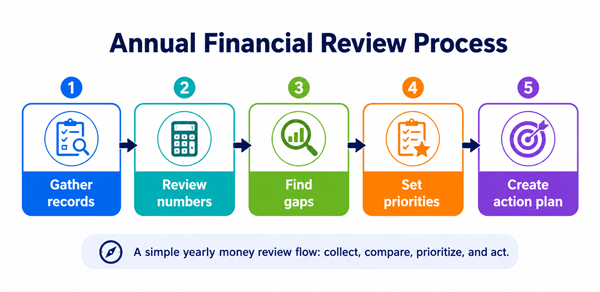
Diagram: A simple five-step annual financial review process.
| 1. Gather records | 2. Review numbers | 3. Find gaps | 4. Set priorities | 5. Create action plan |
|---|
Use this simple flow once a year. The goal is not perfection; the goal is to understand your money clearly and make a few smart adjustments.
Step 1: Gather Your Financial Documents
Start by collecting the information you need. You do not have to print everything. A secure digital folder is fine, as long as you can see the numbers clearly.
- Bank and credit card statements
- Loan and mortgage balances
- Pay stubs or income records
- Retirement and investment statements
- Insurance policy documents
- Tax return from last year
- List of subscriptions and recurring bills
- Estate documents, beneficiary forms, and account logins stored securely
Helpful record tip: keep copies of key documents long enough to support taxes, insurance claims, loan questions, and major financial decisions. Rules vary, so follow official requirements where you live.
| Record type | Simple retention idea |
|---|---|
| Monthly statements and receipts | Keep until reviewed and reconciled; save important proof for tax or warranty needs. |
| Tax documents | Keep according to current official tax rules in your country. |
| Estate, insurance, and loan documents | Keep current versions securely and update after major life changes. |
Step 2: Calculate Your Net Worth
Net worth is what you own minus what you owe. It is one of the simplest ways to measure long-term financial progress. A high income does not always mean strong finances, and a modest income can still build wealth with good habits.
- Add assets: checking, savings, investments, retirement accounts, property value, and valuable items you would realistically sell.
- Add liabilities: credit cards, student loans, personal loans, auto loans, mortgage, unpaid taxes, and other debts.
- Subtract liabilities from assets. The result is your net worth.
Simple formula: Assets - Liabilities = Net Worth. Compare the same formula each year so the trend is meaningful.
| Category | Example | Amount |
|---|---|---|
| Assets | Savings, investments, retirement accounts, car value, home equity | $85,000 |
| Liabilities | Credit cards, student loans, auto loan, mortgage | $42,000 |
| Net worth | Assets minus liabilities | $43,000 |
Step 3: Review Your Income
Look at how much money actually came in during the year. Include salary, business income, freelance work, rental income, bonuses, commissions, and any irregular income. Beginners often budget based on expected income instead of real take-home income, which can create cash flow stress.
- Did your income increase, decrease, or become less predictable?
- Do you need a larger emergency fund because income is irregular?
- Are there benefits at work you are not using?
- Can you negotiate pay, raise prices, or build a more reliable side income?
Step 4: Review Your Spending and Budget
A budget should reflect your real life, not an ideal version of your life. Review 3 to 12 months of spending and group it into clear categories: housing, food, transport, insurance, debt payments, savings, giving, personal spending, subscriptions, and entertainment.
- Which expenses increased the most?
- Which spending made your life better?
- Which spending felt wasteful or automatic?
- Are there seasonal costs you forgot to plan for?
Step 5: Check Your Emergency Fund
An emergency fund is money kept for true surprises such as job loss, urgent repairs, medical costs, or a family emergency. A common beginner target is to start with one month of essential expenses, then build toward three to six months depending on job stability, dependents, health needs, and risk tolerance.
- Keep emergency money separate from daily spending.
- Use a safe, accessible account rather than risky investments.
- Review whether your target should change after major life events.
Step 6: Review Your Debt
Debt review is not just about how much you owe. You also need to check interest rates, minimum payments, payoff dates, and whether any balances are growing. High-interest debt usually deserves faster attention than low-interest, planned debt.
- List each debt with balance, interest rate, minimum payment, and payoff date.
- Check whether you made progress over the year.
- Consider the avalanche method for saving interest or the snowball method for motivation.
Quick comparison: both methods can work when payments are consistent.
| Method | How it works | Best for |
|---|---|---|
| Debt avalanche | Pay extra toward the highest interest rate first. | Reducing total interest cost. |
| Debt snowball | Pay extra toward the smallest balance first. | Building motivation with faster wins. |
- Avoid adding new debt while trying to pay old debt unless it is carefully planned.
Step 7: Review Savings Goals
Savings goals are easier to manage when you separate them by timeline. Short-term goals need safety and access. Long-term goals can usually handle more investment risk, depending on your situation.
- Short-term: emergency fund, travel, insurance premiums, gifts, minor repairs.
- Medium-term: car replacement, home down payment, education costs, major repairs.
- Long-term: retirement, financial independence, long-term care, legacy goals.
Step 8: Review Retirement and Investments
Investment review should focus on whether your plan still matches your goals, timeline, and risk tolerance. Do not judge an entire plan only by one good or bad market year. Instead, check contributions, diversification, fees, asset allocation, and whether your risk level still fits your life.
- Are you contributing regularly?
- Did your allocation drift too far from your target?
- Are fees reasonable?
- Are you taking too much or too little risk for your timeline?
- Are old workplace retirement accounts still organized?
Step 9: Review Insurance Coverage
Insurance protects your financial plan from events that could be too expensive to handle alone. Your coverage should change when your life changes. Marriage, children, a new home, a new job, a business, or a major asset purchase can all affect your needs.
- Health insurance: deductibles, network, prescriptions, out-of-pocket limits.
- Life insurance: dependents, debts, income replacement needs.
- Disability insurance: income protection if you cannot work.
- Auto and home/renters insurance: limits, deductibles, valuables, liability.
- Umbrella insurance: extra liability protection when appropriate.
Step 10: Review Taxes Before Tax Season
A yearly tax review can reduce surprises. Check whether your withholding, estimated tax payments, deductions, credits, and business records still make sense. Tax rules vary by country and can change, so use current official guidance or a qualified tax professional for specific decisions.
For accuracy, check current tax forms, deadlines, contribution limits, and official guidance in your country before making tax decisions.
- Organize income documents and receipts early.
- Review withholding if your income, marriage status, dependents, or job changed.
- Track deductible expenses if you are self-employed or own a business.
- Avoid last-minute tax planning when possible.
Step 11: Review Estate Planning and Beneficiaries
Estate planning is not only for wealthy people. It helps your family know what to do if you die or become unable to manage your affairs. At minimum, review beneficiary forms, a will, powers of attorney, healthcare instructions, and where important documents are stored.
- Confirm beneficiaries on retirement accounts, insurance, and bank accounts.
- Update documents after marriage, divorce, birth, death, or major relationship changes.
- Make sure trusted people know where to find key documents.
Step 12: Set Your Financial Priorities for the Next Year
After reviewing everything, choose a few priorities. Too many goals create frustration. A good annual financial plan usually focuses on the next best actions, not every possible improvement.
- One urgent priority: such as stopping credit card debt growth.
- One stability priority: such as building an emergency fund.
- One future priority: such as increasing retirement contributions.
- One simplification priority: such as closing unused accounts or canceling subscriptions.
5. Annual Review vs. Monthly Budget Review
| Feature | Monthly budget review | Annual financial review |
|---|---|---|
| Main purpose | Manage day-to-day cash flow | Evaluate the full financial picture |
| Best for | Bills, spending, short-term adjustments | Goals, debt, investments, insurance, taxes, documents |
| Frequency | Every month | Once a year, plus after major life changes |
| Key question | Did I stay on budget this month? | Is my money plan still working for my life? |
6. Example: A Beginner Annual Financial Review
Imagine Sara earns a steady salary and has never done a yearly money review. She gathers her statements and finds three important things: her emergency fund covers only two weeks of expenses, she is paying for four subscriptions she rarely uses, and her credit card balance increased during the year.
Sara decides on three actions for the next 12 months: cancel unused subscriptions, send a fixed amount to emergency savings each payday, and use the debt avalanche method to pay extra toward the highest-interest credit card. This is a useful review because it leads to specific actions, not just awareness.
7. Annual Financial Review Checklist
| Area | Task | Done |
|---|---|---|
| Income | Compare annual take-home income with last year | |
| Budget | Update categories based on real spending | |
| Emergency fund | Confirm target and current balance | |
| Debt | List balances, interest rates, and payoff plan | |
| Savings goals | Set short-, medium-, and long-term targets | |
| Investments | Review allocation, fees, contributions, and risk | |
| Retirement | Check progress and contribution rate | |
| Insurance | Review coverage limits, deductibles, and beneficiaries | |
| Taxes | Organize records and review withholding or estimates | |
| Estate planning | Update will, powers of attorney, and beneficiaries | |
| Documents | Store key records safely and securely | |
| Next-year plan | Choose 3 to 5 action steps |
8. Common Mistakes to Avoid
- Reviewing only your bank balance and ignoring debt, insurance, taxes, and documents.
- Making the review too complicated, then avoiding it next year.
- Setting too many goals at once instead of choosing a few priorities.
- Comparing your finances to other people instead of measuring your own progress.
- Ignoring small recurring expenses because each one seems harmless.
- Changing investments emotionally after a bad market year without considering the full plan.
- Forgetting to update beneficiaries after major life changes.
9. Best Practices for a More Useful Yearly Money Review
- Schedule the review at the same time every year, such as January, your birthday month, or before tax season.
- Keep a simple one-page summary of your net worth, debts, goals, and next actions.
- Use exact numbers where possible, but do not let missing details stop you from starting.
- Review as a household if you share money responsibilities with a spouse, partner, or family member.
- Turn review findings into calendar reminders, automatic transfers, or specific monthly tasks.
- Consider professional help for tax planning, estate planning, insurance analysis, or complex investments.
10. Simple Progress Chart: What to Track Each Year
| Metric | Last year | This year | Direction |
|---|---|---|---|
| Net worth | $35,000 | $43,000 | Improved |
| Emergency fund | $1,200 | $3,600 | Improved |
| Credit card debt | $4,800 | $2,900 | Improved |
| Retirement contribution rate | 5% | 7% | Improved |
| Insurance review completed | No | Yes | Improved |
A simple chart like this makes progress visible. You can use a spreadsheet, budgeting app, notebook, or one-page document.
■ FAQs About Annual Financial Reviews
1. How often should I do an annual financial review?
Once a year is a good minimum. You should also review your finances after major life changes such as marriage, divorce, a new child, job loss, a big raise, buying a home, starting a business, or receiving an inheritance.
2. How long does a yearly financial review take?
A simple review may take one to two hours. A more detailed review with investments, insurance, taxes, and estate documents may take several sessions. It is better to complete a basic review than to delay because you want it to be perfect.
3. Do I need a financial advisor?
Not always. Many beginners can review budgets, savings, debt, and documents on their own. Consider a qualified professional when you have complex taxes, significant investments, estate planning needs, business ownership, large debts, or uncertainty about insurance and retirement decisions.
4. What is the most important part of an annual financial review?
The most important part is turning your findings into action. Knowing your numbers is useful, but the real value comes from adjusting your budget, increasing savings, reducing debt, updating coverage, or fixing documents.
5. What if my finances got worse this year?
A difficult year does not mean you failed. The review helps you identify what happened and what to do next. Focus first on urgent issues such as missed payments, high-interest debt, cash flow problems, and rebuilding a small emergency cushion.
6. Should I review investments every year?
Yes, but avoid obsessing over short-term performance. Review whether your contributions, risk level, fees, and asset allocation still match your goals and timeline.
7. What records should I keep after the review?
Keep a yearly summary of net worth, debt balances, emergency savings, goals, insurance policies, tax documents, and major decisions. Store sensitive records securely and back them up when appropriate.
8. What is the best month to do an annual financial review?
The best month is the one you can repeat consistently. Many people choose January, their birthday month, the end of the financial year, or the month before tax season so they can review documents and plan the next 12 months calmly.
■ Final Thoughts
An annual financial review is one of the simplest ways to stay in control of your money. It helps you notice changes, correct problems, and make better decisions for the year ahead. Start with the basics: calculate your net worth, review spending, check savings and debt, update protection, and choose a few realistic next steps. The review does not need to be perfect. It needs to be honest, practical, and repeated every year.
Reader Advice: This article is for educational and information purposes only and should not be taken as personal financial, tax, legal, or investment advice. Please check the latest information from official sources or a qualified professional, as rules, information, and policies can change over time.