How to Create a Personal Financial Plan Step by Step
A personal financial plan is a practical roadmap for your money. It shows where you are today, where you want to go, and what actions you need to take to get there. For beginners, the idea can sound formal or complicated, but a good plan does not have to be perfect, expensive, or full of financial jargon. It simply needs to help you make better decisions with the money you have.
Financial planning is not only for wealthy people. It is useful if you are starting your first job, supporting a family, paying off debt, saving for a home, building an emergency fund, or preparing for retirement. The goal is to give every dollar a clear purpose so you can cover your needs, reduce stress, and build long-term security.
This guide explains how to create a personal financial plan step by step. You will learn how to review your current situation, set realistic goals, create a budget, manage debt, save for emergencies, plan for insurance, start investing, and review your progress over time.
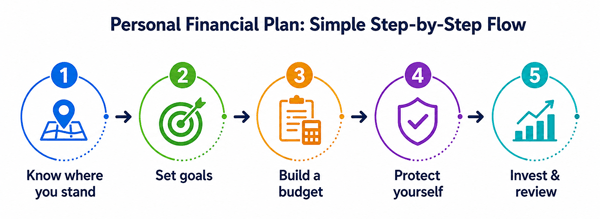
Quick answer: To create a personal financial plan, calculate your net worth, track your income and expenses, set clear goals, build a realistic budget, create an emergency fund, manage debt, protect yourself with suitable insurance, invest for long-term goals, plan for taxes and retirement, and review the plan regularly.
Key takeaway: A simple written plan that you can follow is better than a complicated plan that you never use.
1. What Is a Personal Financial Plan?
A personal financial plan is a written strategy for managing your money. It connects your income, expenses, savings, debt, insurance, investments, taxes, and future goals into one organized plan. Instead of reacting to money problems as they happen, you make planned decisions in advance.
- Your current financial position: income, expenses, assets, debts, and net worth.
- Your short-term, medium-term, and long-term goals.
- Your monthly spending and saving system.
- Your debt payoff strategy.
- Your emergency fund target.
- Your insurance and risk protection needs.
- Your investment and retirement plan.
- Your review schedule so the plan stays useful as life changes.
Think of it like a GPS for your finances. Your current location is your financial starting point. Your destination is your goal. Your plan is the route that helps you get there.
Important note for readers: Because personal finance affects real financial decisions, use this guide as a general framework and adjust it to your income, country, family situation, risk level, and current rules.
2. Why Personal Financial Planning Matters
Without a plan, money can easily disappear into bills, impulse purchases, interest charges, and unexpected expenses. A financial plan gives you structure. It helps you decide what matters most before your money is spent.
| Benefit | How it helps in real life |
|---|---|
| Clarity | You know exactly how much comes in, goes out, and remains for goals. |
| Less stress | You prepare for bills, emergencies, and irregular expenses before they become crises. |
| Better decisions | You can compare choices such as paying debt, saving, investing, or buying something. |
| Goal progress | You turn vague goals like “save more money” into specific monthly actions. |
| Protection | You reduce the damage of job loss, illness, accidents, or major repairs. |
| Long-term wealth | You start building assets instead of only managing expenses. |
3. Before You Start: Gather Your Financial Information
You cannot build a useful plan from guesses. Before you start, collect the basic information that shows your true financial picture. This does not need to be perfect on day one, but the closer you are to reality, the better your plan will be.
Documents and numbers to collect
- Monthly take-home income from salary, business income, freelance work, benefits, or other sources.
- Recent bank and credit card statements.
- Rent or mortgage details.
- Loan balances, interest rates, and minimum payments.
- Utility bills, insurance premiums, subscriptions, and other recurring costs.
- Savings account balances, investment balances, and retirement accounts.
- Insurance policies, including health, life, disability, home, renters, and auto insurance.
- Recent tax return or tax information if available.
Beginner tip: If you do not know your exact spending, review the last 30 to 90 days of transactions. Group them into simple categories such as housing, food, transport, debt payments, insurance, savings, and personal spending.
Step 1: Calculate Your Net Worth
Your net worth is a simple snapshot of your financial health. It is what you own minus what you owe. A positive net worth means your assets are higher than your debts. A negative net worth means your debts are higher than your assets. Both situations are useful to know because your net worth gives you a starting point.
Net worth formula
Net worth = Total assets - Total liabilities
| Assets: what you own | Liabilities: what you owe |
|---|---|
| Cash in bank accounts | Credit card balances |
| Emergency savings | Personal loans |
| Retirement accounts | Student loans |
| Investments | Car loans |
| Home equity or property value | Mortgage balance |
| Valuable personal assets | Buy-now-pay-later balances |
Example
Sara has $3,000 in savings, $8,000 in retirement savings, and a car worth $7,000. Her total assets are $18,000. She owes $4,000 on a credit card and $6,000 on a car loan. Her total liabilities are $10,000. Her net worth is $8,000.
Do not panic if your net worth is low or negative. Many beginners start there, especially after student loans, medical bills, or early career expenses. The purpose is not to judge yourself. The purpose is to measure progress over time.
Step 2: Track Your Income and Expenses
A financial plan works only when it matches your cash flow. Cash flow means the money coming in and going out each month. If you consistently spend more than you earn, your plan must first focus on stabilizing your monthly finances. If you have money left over, your plan should direct that money toward your highest priorities.
Separate needs, wants, and goals
| Category | Examples | Planning question |
|---|---|---|
| Needs | Rent, groceries, utilities, transportation, minimum debt payments | What must be paid to keep life stable? |
| Wants | Dining out, entertainment, upgrades, hobbies, nonessential shopping | What improves life but can be adjusted? |
| Goals | Emergency fund, debt payoff, retirement, home deposit, education fund | What moves me toward a better future? |
Tracking does not mean you have to restrict every small purchase. It means you become aware of your patterns. Awareness gives you control.
Step 3: Set Clear Financial Goals
A personal financial plan should be built around goals, not just numbers. Goals give your money direction. A strong goal is specific, measurable, realistic, and connected to a deadline.
Use short-term, medium-term, and long-term goals
| Goal type | Time frame | Examples |
|---|---|---|
| Short-term | 0 to 12 months | Save a starter emergency fund, pay off a small credit card, catch up on bills. |
| Medium-term | 1 to 5 years | Save for a car, wedding, home deposit, business equipment, or education. |
| Long-term | 5+ years | Retirement, children’s education, financial independence, paying off a mortgage. |
Weak goal vs strong goal
| Weak goal | Stronger goal |
|---|---|
| I want to save money. | I will save $2,400 in 12 months by transferring $200 per month to a separate savings account. |
| I want less debt. | I will pay off my $1,200 credit card balance in 6 months by paying $200 plus interest each month. |
| I want to invest someday. | I will start investing $100 per month after building a starter emergency fund and paying high-interest debt. |
Prioritize goals carefully. You may want to do everything at once, but most people have limited income. A practical order is: cover essentials, build a starter emergency fund, pay high-interest debt, increase emergency savings, then invest for long-term goals.
Step 4: Create a Realistic Budget
A budget is the monthly action plan inside your larger financial plan. It tells your income where to go before the month begins. The best budget is not the strictest one. The best budget is the one you can actually follow.
Popular budgeting methods
| Budget method | How it works | Best for | Possible drawback |
|---|---|---|---|
| 50/30/20 budget | 50% needs, 30% wants, 20% savings and debt payoff. | Beginners who want a simple structure. | May not fit high-cost cities or low-income months. |
| Zero-based budget | Every dollar is assigned a job until income minus expenses equals zero. | People who want detailed control. | Requires more tracking. |
| Envelope method | Money is divided into spending categories, physically or digitally. | People who overspend in certain categories. | Can feel restrictive if too many categories are used. |
| Pay-yourself-first budget | Savings and investing happen first, then you spend what remains. | People who struggle to save consistently. | Needs enough cash flow to cover bills after saving. |
Beginner monthly budget example
| Category | Monthly amount | Notes |
|---|---|---|
| Take-home income | $3,000 | Income after taxes and payroll deductions. |
| Housing | $950 | Rent or mortgage. |
| Utilities and phone | $250 | Electric, water, internet, phone. |
| Groceries | $400 | Meal planning can reduce this. |
| Transportation | $300 | Fuel, fares, car maintenance. |
| Insurance | $180 | Health, auto, renters, or other coverage. |
| Debt payments | $300 | Minimums plus extra if possible. |
| Emergency fund | $250 | Automatic transfer after payday. |
| Retirement or investing | $150 | Start small and increase over time. |
| Personal and fun spending | $220 | Dining out, hobbies, clothing, entertainment. |
A budget should include some fun money. If your plan removes every enjoyable expense, it may fail quickly. A sustainable plan balances discipline with real life.
Step 5: Build an Emergency Fund
An emergency fund is money set aside for unexpected but necessary expenses, such as medical costs, urgent car repairs, job loss, home repairs, or emergency travel. It protects you from using credit cards or loans every time life changes.
How much should you save?
- Starter emergency fund: $500 to $1,000 if you are beginning or living paycheck to paycheck.
- Basic emergency fund: one month of essential expenses.
- Full emergency fund: three to six months of essential expenses for most households.
- Larger emergency fund: six to twelve months if your income is irregular, you are self-employed, or you have dependents.
Keep emergency savings in a safe, easy-to-access account. Do not invest your emergency fund in risky assets because you may need the money when markets are down.
Practical tip: Set the target in your own local currency and update it when rent, food, transport, medical costs, or family responsibilities change.
Step 6: Make a Debt Payoff Plan
Debt can slow down your financial plan because interest charges take money away from your future goals. Not all debt is equally harmful, but high-interest debt, such as credit card debt, should usually be a top priority after basic stability and a starter emergency fund.
Debt snowball vs debt avalanche
| Method | How it works | Best for | Main advantage |
|---|---|---|---|
| Debt snowball | Pay the smallest balance first while making minimum payments on the rest. | People who need motivation and quick wins. | Builds confidence quickly. |
| Debt avalanche | Pay the highest interest rate first while making minimum payments on the rest. | People who want to reduce total interest cost. | Usually saves more money. |
Both methods can work. The best choice is the one you will follow. If motivation is your biggest challenge, the snowball method may help. If saving interest is your main goal and you can stay consistent, the avalanche method may be better.
Safety note: Before making extra debt payments, keep enough cash for essential bills so you do not fall behind and create new debt.
Practical debt payoff steps
- List every debt with balance, interest rate, minimum payment, and due date.
- Keep paying the minimum on every debt to avoid late fees and credit damage.
- Choose one target debt using either snowball or avalanche.
- Pay extra toward the target debt whenever possible.
- When one debt is paid off, roll that payment into the next debt.
Step 7: Plan for Insurance and Risk Protection
Financial planning is not only about saving and investing. It is also about protecting what you are building. One serious accident, illness, lawsuit, or loss of income can damage years of progress if you are not prepared.
| Type of protection | Why it matters | Who may need it |
|---|---|---|
| Health insurance | Helps manage medical costs. | Most people, especially families and anyone without large savings. |
| Auto insurance | Protects against accident costs and legal liability. | Drivers and vehicle owners. |
| Renters or homeowners insurance | Protects personal property and housing-related risks. | Renters, homeowners, and landlords. |
| Disability insurance | Replaces part of income if you cannot work due to illness or injury. | People who rely on earned income. |
| Life insurance | Provides money to dependents if you die. | Parents, spouses, caregivers, and anyone with financial dependents. |
| Liability coverage | Protects against certain claims or lawsuits. | People with assets, property, or higher exposure to risk. |
Do not buy insurance blindly. Match coverage to real risks. A single person with no dependents may not need the same life insurance as a parent with young children. A renter may need renters insurance even if they do not own a home.
Step 8: Start Saving and Investing for the Future
Saving and investing are related, but they are not the same. Saving is for safety and short-term goals. Investing is for long-term growth. Money needed soon should usually be kept safe. Money for long-term goals can often be invested because it has time to recover from market ups and downs.
| Use saving when... | Use investing when... |
|---|---|
| You need the money within the next few months or years. | Your goal is many years away. |
| The money is for emergencies or fixed upcoming costs. | You can accept short-term ups and downs. |
| Safety and access matter more than growth. | Growth matters more than immediate access. |
| Examples: emergency fund, rent deposit, car repair fund. | Examples: retirement, long-term wealth building, education fund. |
Beginner investing principles
- Start with your retirement account if your employer offers a match; a match is part of your compensation.
- Diversify instead of putting all your money into one stock or trend.
- Understand your risk tolerance before investing aggressively.
- Avoid investing money you need for bills or emergencies.
- Use low-cost, broad investments when you do not have the time or experience to pick individual assets.
- Increase contributions gradually as your income grows.
Investing involves risk. Returns are not guaranteed. A beginner should focus less on guessing the next hot investment and more on consistency, diversification, costs, and time in the market.
Step 9: Plan for Taxes and Retirement
Taxes and retirement planning are easy to ignore because they can feel distant or complicated. But both affect your long-term financial results. Even small decisions, such as where you save or whether you contribute to a retirement account, can matter over time.
Retirement planning basics
- Estimate how much income you may need in retirement based on lifestyle, housing, healthcare, and family needs.
- Use retirement accounts available in your country or workplace when they offer tax benefits or employer contributions.
- Start early if possible, because compounding needs time.
- Review your contribution rate at least once a year.
- Avoid withdrawing retirement money early unless absolutely necessary.
Tax planning basics
- Keep records of income, deductions, business expenses, charitable giving, and investment activity.
- Understand whether your savings or retirement accounts have tax advantages.
- Plan for taxes if you are self-employed, freelance, or have irregular income.
- Do not make financial decisions only for tax reasons; the overall benefit should still make sense.
Tax rules vary by country and can change. For complex situations, such as business income, large investments, inheritance, or cross-border income, consider speaking with a qualified tax professional.
Where to verify updates: Check official tax authority, pension or retirement account, insurance regulator, and consumer protection websites in your country for the latest rules before acting.
Step 10: Create an Action Plan
A financial plan becomes useful when it turns into action. Instead of writing a long list of wishes, choose a few specific actions for the next 30, 60, and 90 days.
| Time frame | Action examples |
|---|---|
| Next 7 days | List all debts, calculate net worth, review last month’s spending, open a separate savings account. |
| Next 30 days | Create a monthly budget, set one savings goal, automate a small transfer, cancel unused subscriptions. |
| Next 60 days | Build a starter emergency fund, choose a debt payoff method, compare insurance coverage. |
| Next 90 days | Increase savings rate, begin retirement contributions if appropriate, review your progress and adjust the plan. |
Simple financial plan checklist
- I know my monthly take-home income.
- I know my monthly essential expenses.
- I have calculated my net worth.
- I have written short-term, medium-term, and long-term goals.
- I have a budget I can realistically follow.
- I have an emergency fund target.
- I have a debt payoff strategy.
- I understand my basic insurance needs.
- I have a plan for retirement or long-term investing.
- I have scheduled a regular review date.
Step 11: Review and Adjust Your Plan Regularly
A personal financial plan is not something you create once and forget. Life changes. Income changes, expenses change, goals change, and unexpected events happen. Reviewing your plan keeps it realistic.
| Review frequency | What to check |
|---|---|
| Weekly | Spending, upcoming bills, account balances, and budget categories. |
| Monthly | Savings progress, debt payoff progress, and next month’s budget. |
| Quarterly | Net worth, insurance needs, subscriptions, and goal priorities. |
| Yearly | Retirement contributions, tax planning, major goals, investment allocation, and estate documents. |
A good review is not about blaming yourself. It is about asking: What worked? What did not work? What changed? What is the next best step?
4. Common Financial Planning Mistakes to Avoid
| Mistake | Why it causes problems | Better approach |
|---|---|---|
| Making the plan too complicated | A complicated plan is hard to follow. | Start with income, expenses, goals, emergency fund, and debt. |
| Ignoring small leaks | Subscriptions, fees, and impulse spending add up. | Review recurring charges and set category limits. |
| Saving only what is left over | There may be nothing left at the end of the month. | Automate savings near payday. |
| Investing before basic stability | You may be forced to sell investments during emergencies. | Build emergency savings and manage high-interest debt first. |
| Using debt for lifestyle upgrades | Interest can turn wants into long-term burdens. | Save in advance for nonessential purchases. |
| Never reviewing the plan | An old plan may not match your current life. | Schedule monthly and yearly reviews. |
4. Personal Financial Plan Example for a Beginner
Here is a simple example of how a beginner might turn the steps into a real plan.
Example: Ahmed, age 28
- Monthly take-home income: $2,500.
- Monthly essential expenses: $1,650.
- Credit card debt: $2,400 at a high interest rate.
- Savings: $300.
- Main goals: build a $1,000 starter emergency fund, pay off credit card debt, start investing for retirement.
Ahmed’s first 6-month plan
- Track spending for one month and reduce dining out by $120 per month.
- Save $200 per month until the emergency fund reaches $1,000.
- Pay minimums on all debts while building the starter emergency fund.
- After reaching $1,000, pay $350 per month toward the credit card.
- Once the credit card is paid off, redirect that money to retirement savings and a larger emergency fund.
This plan is not perfect, but it is clear, realistic, and measurable. That is what makes it useful.
6. When Should You Get Professional Financial Advice?
Many beginners can create a basic financial plan on their own. However, professional advice may be helpful when your situation is complex or the cost of mistakes is high.
- You are dealing with large debts, legal issues, inheritance, divorce, or business ownership.
- You have dependents and need life insurance or estate planning.
- You are close to retirement and need withdrawal planning.
- You have multiple income sources or complicated tax questions.
- You feel overwhelmed and need personalized guidance.
Look for a qualified professional who explains fees clearly, avoids pressure, and acts in your best interest. Be cautious of anyone promising guaranteed high returns or pushing products before understanding your goals.
■ Frequently Asked Questions
1. What is the first step in creating a personal financial plan?
The first step is understanding your current financial situation. Calculate your income, expenses, assets, debts, and net worth. You need a clear starting point before choosing goals or strategies.
2. How much money do I need to start financial planning?
You do not need a high income or large savings to start. Financial planning is most useful when money is limited because it helps you decide what should come first.
3. How often should I review my financial plan?
Review your budget monthly and your full financial plan at least once or twice a year. Also review it after major life changes such as marriage, a new job, a child, a move, or a large expense.
4. Should I pay off debt or save money first?
In many cases, build a small starter emergency fund first, then focus on high-interest debt, then expand your emergency fund and invest. The right order depends on your income stability, interest rates, and risk level.
5. Is a budget the same as a financial plan?
No. A budget is part of a financial plan. A budget manages your monthly cash flow, while a financial plan also includes goals, debt, savings, insurance, investing, taxes, retirement, and reviews.
6. What is the biggest mistake beginners make?
One common mistake is trying to do everything at once. A better approach is to stabilize cash flow, build a small emergency fund, handle high-interest debt, and then grow savings and investments over time.
7. Can I create a financial plan without a financial advisor?
Yes. Many people can create a basic plan themselves using income, expenses, goals, debt lists, and simple budgeting tools. A financial advisor can be helpful for complex situations or major decisions.
8. What should a beginner include in a written personal financial plan?
A beginner plan should include current income, essential expenses, net worth, goals, budget categories, emergency fund target, debt payoff method, basic insurance needs, retirement or investment plan, and a review schedule.
■ Final Thoughts
Creating a personal financial plan step by step is not about becoming perfect with money. It is about becoming intentional. Start by understanding where you are, then set clear goals, build a budget, protect yourself from emergencies, reduce costly debt, and invest for the future when you are ready.
Your first plan can be simple. In fact, simple is often better. The most important thing is to write it down, take action, review it regularly, and improve it as your life changes. A good financial plan gives you more than numbers. It gives you direction, confidence, and a stronger foundation for the future.
Reader Advice: This article is for educational and informational purposes only and should not be taken as personalized financial, tax, legal, insurance, or investment advice. Please check the latest information from official sources or a qualified professional, as rules, information, and policies can change over time.