Financial Planning Mistakes to Avoid: Personal Financing
1. Quick Answer: What Are the Biggest Financial Planning Mistakes?
The biggest financial planning mistakes are usually not complicated. They are everyday habits and blind spots: spending without a plan, ignoring emergency savings, carrying expensive debt, underinsuring major risks, delaying investing, failing to review goals, ignoring credit health and basic estate documents, and making financial decisions based on emotion instead of facts.
A good personal financial plan does not need to be perfect. It needs to be clear, realistic, flexible, and reviewed regularly. The goal is to help your money support your life, not to make your life fit an unrealistic spreadsheet.
2. What Is Financial Planning in Personal Financing?
Financial planning is the process of understanding where your money is now, deciding where you want it to go, and creating practical steps to get there. In personal financing, it connects your income, spending, savings, debt, insurance, taxes, investments, and long-term goals into one clear picture.
Think of it as a money roadmap. Without a roadmap, you may still move forward, but you can waste time, take expensive detours, or miss important risks along the way.
For stronger trust and accuracy, review your plan with current local rules, official tax guidance, and qualified professionals when decisions affect taxes, investments, insurance, debt, or legal rights.
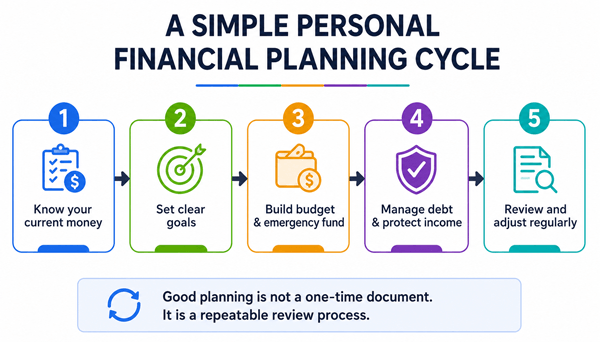
Diagram: A simple personal financial planning cycle for beginners.
3. Why Avoiding Financial Planning Mistakes Matters
Small money mistakes can become large financial problems when they repeat for months or years. For example, spending a little more than you earn each month can slowly turn into credit card debt. Not having an emergency fund can turn one car repair or medical bill into a financial crisis. Delaying retirement saving can make future goals harder because you lose time for compounding.
Avoiding mistakes is powerful because it improves your financial stability without requiring a huge income. Many people do not need a complex strategy at first. They need fewer leaks, clearer goals, and better money habits.
4. Common Financial Planning Mistakes and How to Avoid Them
Mistake 1: Not Knowing Where Your Money Goes
Why it hurts: Many people think they know their spending, but the numbers often tell a different story. Small purchases, subscriptions, delivery fees, and impulse buys can quietly consume money that could be used for savings or debt repayment.
How to avoid it: Track all income and expenses for 30 days. Group spending into needs, wants, debt payments, savings, and irregular expenses. Then decide what to reduce, keep, or redirect.
Mistake 2: Creating a Budget That Is Too Strict
Why it hurts: A budget that ignores real life usually fails. If you plan zero money for fun, family needs, transport changes, or occasional treats, you may abandon the plan after one bad week.
How to avoid it: Build a realistic budget with room for flexible spending. A useful budget should guide decisions, not punish you. Start with broad categories and improve over time.
Mistake 3: Not Having an Emergency Fund
Why it hurts: Without emergency savings, unexpected expenses often become debt. Even a small emergency fund can prevent a minor problem from becoming a long-term burden.
How to avoid it: Start with a starter emergency fund, such as one month of essential expenses if possible, then work toward three to six months depending on your income stability and family responsibilities.
Mistake 4: Confusing Wants With Needs
Why it hurts: Many financial plans fail because lifestyle spending grows faster than income. Wants are not bad, but treating every want as a need leaves little room for future goals.
How to avoid it: Separate essentials from lifestyle choices. Before buying, ask: Do I need this now? Can I afford it without debt? Does it support my bigger goals?
Mistake 5: Ignoring High-Interest Debt
Why it hurts: High-interest debt can grow faster than your savings. Credit cards, payday loans, and costly personal loans can reduce your ability to save, invest, or handle emergencies.
How to avoid it: List debts by balance, rate, and minimum payment. Use the avalanche method for interest savings or the snowball method for motivation. Avoid adding new debt while paying old debt.
Mistake 6: Saving Whatever Is Left Over
Why it hurts: If you wait until the end of the month to save, there may be nothing left. This turns saving into an accident instead of a habit.
How to avoid it: Pay yourself first. Automate savings soon after income arrives, even if the amount is small. Increase the amount when income rises or expenses fall.
Mistake 7: Delaying Long-Term Investing
Why it hurts: Beginners often delay investing because they feel they need a lot of money or perfect knowledge. The bigger risk is waiting so long that long-term goals become harder.
How to avoid it: After building basic emergency savings and managing expensive debt, learn about diversified, long-term investing. Keep it simple and avoid products you do not understand.
Mistake 8: Having Goals That Are Too Vague
Why it hurts: Goals like “save more money” or “be better with finances” are too general. Vague goals are hard to measure and easy to postpone.
How to avoid it: Use specific goals: amount, purpose, deadline, and monthly action. Example: “Save $1,200 for emergency expenses in 12 months by setting aside $100 per month.”
Mistake 9: Not Protecting Against Major Risks
Why it hurts: A financial plan can collapse if one major event is not covered: illness, disability, death of an income earner, property loss, or liability.
How to avoid it: Review insurance needs based on dependents, debts, income, assets, and local risks. Avoid both underinsurance and buying policies you do not need.
Mistake 10: Not Reviewing the Plan Regularly
Why it hurts: Life changes. Income, expenses, family needs, debt, taxes, and goals can shift. A plan that is never reviewed becomes outdated.
How to avoid it: Schedule a monthly money check-in and a deeper annual financial review. Update your budget, goals, net worth, insurance, and debt plan.
Mistake 11: Ignoring Credit Health
Why it hurts: Poor credit habits can increase borrowing costs, reduce approval chances, and create stress when you need a loan, rental, or essential service.
How to avoid it: Pay bills on time, keep debt balances manageable, check credit reports where available, and correct errors quickly.
Mistake 12: Forgetting Beneficiary and Estate Basics
Why it hurts: Outdated beneficiaries, missing records, or no basic estate plan can create confusion for family members during a difficult time.
How to avoid it: Keep beneficiaries current, store key documents securely, and seek legal guidance for wills, guardianship, inheritance, or estate planning needs.
5. Financial Planning Mistakes at a Glance
| Mistake | Why it is risky | Practical fix |
|---|---|---|
| No spending tracking | You cannot control what you cannot see | Track expenses for 30 days |
| No emergency fund | Unexpected costs become debt | Build a starter fund, then expand it |
| Only paying minimum debt payments | Interest costs can stay high for years | Use a structured payoff method |
| No clear goals | Money decisions feel random | Set specific goals with deadlines |
| No insurance review | One event can damage the plan | Review major risks annually |
| No annual review | The plan becomes outdated | Review once a year and after big life changes |
| Ignoring credit health | Borrowing may become more expensive or harder to access | Pay on time and check reports where available |
| No beneficiary or estate review | Family members may face confusion after major events | Update beneficiaries and get legal help when needed |
6. Budgeting Mistakes Beginners Should Avoid
Mistake: Using Someone Else’s Budget Without Adjusting It
Popular budgeting rules can be helpful, but they are not universal. A student, a single parent, a freelancer, and a retiree may all need different budgets. Housing costs, transportation, family obligations, income stability, and location matter.
Mistake: Forgetting Irregular Expenses
Many budgets fail because they only include monthly bills. Real life includes annual fees, school costs, holidays, car maintenance, medical costs, gifts, repairs, and insurance renewals. These should be divided into monthly sinking funds so they do not surprise you later.
Mistake: Not Adjusting After a Bad Month
A budget is not ruined because one month goes wrong. The mistake is ignoring the issue. Review what happened, adjust the next month, and keep going.
7. Debt Planning Mistakes to Avoid
| Debt mistake | Example | Better approach |
|---|---|---|
| Borrowing for lifestyle wants | Using credit for vacations, gadgets, or clothes you cannot pay off quickly | Save before buying or reduce the purchase size |
| Ignoring interest rates | Paying extra on a low-rate loan while high-rate credit card debt grows | Prioritize high-interest debt when possible |
| Taking new loans to feel organized | Consolidating debt but continuing the same spending habits | Fix spending behavior before or during consolidation |
| Missing payments | Late fees, stress, and possible credit damage | Automate minimum payments and keep a bill calendar |
| No debt-free date | Only paying minimums without a target | Calculate a payoff timeline and monthly extra payment |
Saving and Investing Mistakes to Avoid
1. Keeping All Money in One Place
Your checking account, emergency fund, short-term savings, and long-term investments have different jobs. Keeping everything in one account makes it easier to overspend and harder to measure progress.
2. Investing Before You Understand the Risk
Investing can help build wealth, but it involves risk. Avoid investing money you need soon, borrowing to invest, or buying something because of hype. Start by understanding your time horizon, risk tolerance, diversification, fees, and liquidity.
3. Trying to Time the Market
Beginners often wait for the “perfect” time to invest. This can lead to long delays or emotional decisions. A consistent, long-term approach is usually easier to manage than trying to predict short-term market movements.
Also consider inflation, fees, taxes, and account type. Money needed in the next few years usually belongs in safer, more liquid places than long-term investment accounts.
Insurance and Protection Mistakes
Insurance is not exciting, but it protects the financial plan from large losses. The mistake is either ignoring insurance completely or buying too much without understanding what is covered.
- Review health, life, disability, home or renter, auto, and liability coverage where relevant.
- Make sure beneficiaries are current on life insurance and retirement accounts.
- Understand deductibles, exclusions, waiting periods, and coverage limits.
- Do not buy insurance only because of fear or pressure. Match it to a real risk.
- Review your plan after major life changes such as marriage, children, a new job, a home purchase, or starting a business.
8. Tax and Record-Keeping Mistakes
Tax rules vary by country and personal situation, but good record-keeping is useful everywhere. Poor records can cause missed deductions, late filings, penalties, or confusion during loan applications and financial reviews.
- Keep income records, bank statements, debt statements, insurance documents, and tax documents organized.
- Save receipts for deductible or reimbursable expenses where applicable.
- Review withholding, estimated taxes, or business taxes if your income changes.
- Consult a qualified tax professional when your situation becomes complex.
- Keep digital copies secure with strong passwords and backup access for trusted decision-makers where appropriate.
9. Real-World Example: Two People With the Same Income
| Person | Money habits | Likely result |
|---|---|---|
| Aisha | Tracks spending, saves first, keeps an emergency fund, pays extra on high-interest debt, reviews goals twice a year | More control, less stress, better ability to handle surprises |
| Bilal | Spends without tracking, saves what is left, uses credit for wants, ignores insurance and irregular expenses | More financial stress, growing debt risk, fewer choices when emergencies happen |
The difference is not only income. It is structure. A clear plan helps ordinary income work harder.
How to Build a Mistake-Proof Personal Finance Plan
- Calculate your net worth: assets minus debts.
- Track income and expenses for at least one month.
- Build a realistic budget that includes irregular expenses.
- Set three types of goals: short-term, medium-term, and long-term.
- Create or rebuild an emergency fund.
- Make a debt repayment plan, focusing on costly debt first where possible.
- Review insurance and major financial risks.
- Automate savings, bills, and debt payments when practical.
- Keep records organized in one secure place.
- Review the plan monthly and update it annually.
10. Personal Financial Planning Checklist
| Review area | Beginner question to ask | Action step |
|---|---|---|
| Income | Is my income stable or variable? | Base your budget on realistic take-home income |
| Spending | Where did my money go last month? | Track and categorize expenses |
| Savings | Do I have money for emergencies? | Start or increase emergency savings |
| Debt | Which debt costs me the most? | List rates and choose a payoff method |
| Goals | What am I saving for and by when? | Write specific goals with monthly targets |
| Insurance | What event could hurt my finances most? | Review coverage and gaps |
| Investing | What money is for long-term goals? | Learn before investing and diversify |
| Records | Can I find key documents quickly? | Create a simple filing system |
| Review | When will I check progress? | Schedule monthly and annual reviews |
11. Pros and Cons of Financial Planning
| Benefits | Limitations |
|---|---|
| Helps you make intentional money decisions | Requires time and honest tracking |
| Reduces stress by creating a plan for bills, savings, and debt | Cannot predict every emergency or market event |
| Improves progress toward goals | Needs regular updates as life changes |
| Helps identify financial risks early | May require professional help for complex issues |
12. Common Misconceptions About Financial Planning
“Financial planning is only for rich people.”
False. People with limited income often benefit the most from planning because each decision matters. Planning helps prioritize essentials, avoid costly debt, and build stability step by step.
“A budget means I cannot enjoy life.”
A good budget does not remove enjoyment. It gives you permission to spend on what matters after essentials and goals are covered.
“I will start when I earn more.”
Higher income helps, but it does not automatically create good habits. Start with the income you have now, even if the first steps are small.
“Debt consolidation fixes debt.”
Consolidation can reduce payments or interest in some cases, but it does not fix overspending. Without behavior change, debt can return.
13. When Should You Get Professional Help?
Many beginner financial planning tasks can be done on your own. However, professional guidance may be useful when you have complex taxes, major debt problems, business income, inheritance, divorce, estate planning needs, dependents with special needs, or large investment decisions.
Choose professionals carefully. Look for relevant qualifications, transparent fees, clear explanations, and advice that fits your goals and risk tolerance. Avoid anyone who pressures you into products you do not understand.
14. Final Thoughts: The Best Financial Plan Is One You Actually Use
Financial planning mistakes are common because personal finance is personal. Life changes, emotions matter, and money decisions are often made under pressure. The solution is not perfection. It is awareness, structure, and regular review.
Start with the basics: know your numbers, spend less than you earn, save for emergencies, manage expensive debt, protect against major risks, and review your plan often. These simple actions can make personal financing clearer, calmer, and more effective over time.
Frequently Asked Questions
1. What is the most common financial planning mistake?
The most common mistake is not knowing where your money goes. Without tracking income and expenses, it is difficult to budget, save, repay debt, or set realistic goals.
2. How often should I review my financial plan?
Review your budget monthly and do a full financial review at least once a year. Also review your plan after major life changes such as a new job, marriage, birth of a child, relocation, or major debt change.
3. Should I save money or pay off debt first?
It depends on the debt cost and your emergency savings. Many beginners start with a small emergency fund, then focus on high-interest debt while continuing small savings habits. For complex situations, seek professional advice.
4. How much emergency fund should I have?
A common target is three to six months of essential expenses, but beginners can start smaller. The right amount depends on income stability, dependents, health needs, and access to support.
5. Is financial planning useful if I have low income?
Yes. Financial planning can be especially useful on a low income because it helps prioritize essentials, reduce waste, avoid debt traps, and build small but meaningful savings habits.
6. What should beginners include in a personal financial plan?
A beginner plan should include income, expenses, budget categories, emergency savings, debt list, financial goals, insurance needs, basic investing plan, and a schedule for review.
7. What is the difference between budgeting and financial planning?
Budgeting focuses on monthly income and expenses. Financial planning is broader. It includes budgeting, savings, debt, insurance, investing, taxes, goals, and long-term life decisions.
8. Can I create a financial plan without a financial advisor?
Yes, many people can create a simple plan themselves. An advisor may be helpful for complex investments, tax planning, estate planning, business finances, or major life transitions.
9. Does credit health belong in a financial plan?
Yes. Credit health affects borrowing costs, loan approvals, housing options, and financial flexibility. A simple plan should include on-time payments, debt limits, and periodic credit checks where available.
Reader Advice: This article is for educational and information purposes only, not personalized financial, tax, legal, investment, or insurance advice. Please check official sources or qualified professionals for the latest rules and guidance.