Financial Planning in Your 50s: Money Goals, Retirement Planning & Best Practices
Your 50s are one of the most important decades for your money. You may be earning more than you did earlier in life, but retirement is also much closer. Children may still need support, aging parents may need help, housing costs may still be high, and health care becomes a bigger part of the financial picture. This is why financial planning in your 50s is less about vague goals and more about making clear, practical decisions.
The good news is that your 50s can still be a powerful time to improve your financial future. You may have 10 to 20 years before fully retiring, and even small improvements can make a real difference. Increasing retirement contributions, paying down expensive debt, understanding Social Security or pension options, reviewing insurance, and preparing for health care costs can all strengthen your long-term security.
This guide is written for beginners. You do not need to be an investing expert or a financial professional to use it. The goal is to help you understand what to focus on, what mistakes to avoid, and how to build a realistic plan for the years ahead.
Quick Answer: Financial planning in your 50s means knowing your retirement number, increasing savings where possible, reducing high-interest debt, planning for healthcare, reviewing Social Security or pension choices, adjusting investment risk, and updating insurance and estate documents. These steps can help turn your 50s into a practical bridge between peak earning years and retirement.
Key takeaways: Know your numbers, protect your income, reduce expensive debt, plan for medical costs, and review your plan at least once a year.
■ What Is Financial Planning in Your 50s?
Financial planning in your 50s is the process of organizing your money so you can move from your peak working years toward retirement with more confidence. It includes reviewing your income, expenses, savings, investments, debts, insurance, taxes, health care plans, estate documents, and future lifestyle goals.
In your 20s and 30s, financial planning is often about starting good habits. In your 40s, it often becomes more serious as family and career responsibilities grow. In your 50s, the focus shifts toward readiness. You are no longer only building wealth; you are also protecting what you have built and preparing to turn savings into future income.
For a simple starting point, the table below summarizes the main financial questions most people should answer during this decade.
| Financial area | Main question to answer in your 50s |
|---|---|
| Retirement savings | Am I saving enough, and do I need to catch up? |
| Debt | Can I reduce high-interest debt before retirement? |
| Investments | Is my portfolio balanced for growth and protection? |
| Healthcare | How will I pay for health care before and after age 65? |
| Insurance | Do I have the right coverage, and am I overpaying for old policies? |
| Taxes | Can I make smarter tax decisions before retirement? |
| Estate planning | Are my wishes and beneficiaries clearly documented? |
■ The Main Money Goals to Prioritize in Your 50s
Your exact goals will depend on your income, family situation, health, job stability, and retirement plans. Still, most people in their 50s should focus on the following priorities.
1. Know Your Retirement Number
Your retirement number is an estimate of how much money you may need to support your desired lifestyle after you stop working. It is not a perfect number, but it gives you a target. Without a target, it is hard to know whether you are on track or falling behind.
A simple way to start is to estimate your future annual expenses. Think about housing, food, transportation, insurance, medical costs, travel, gifts, taxes, and emergencies. Then subtract expected retirement income such as Social Security, pension payments, rental income, part-time work, or business income. The gap is what your savings and investments may need to cover.
| Example retirement income estimate | Amount per year |
|---|---|
| Estimated retirement spending | $70,000 |
| Expected Social Security or pension income | -$35,000 |
| Income gap to cover from savings | $35,000 |
This example does not mean everyone needs the same amount. A person with a paid-off home and modest lifestyle may need less. Someone with high medical expenses, travel goals, or dependents may need more. The value of the exercise is that it turns retirement from a vague idea into a measurable planning problem.
2. Increase Retirement Contributions and Use Catch-Up Contributions
Your 50s are often the decade when catch-up contributions become available. For U.S. readers, workers age 50 and older can usually make extra contributions to certain retirement accounts. In 2026, the IRS increased the 401(k), 403(b), governmental 457 and Thrift Savings Plan employee contribution limit to $24,500, with a general catch-up contribution limit of $8,000 for people age 50 and older. That means many workers age 50+ can contribute up to $32,500 for the year if their plan allows it. The IRS also lists a higher catch-up contribution limit of $11,250 for ages 60 to 63 in eligible plans. IRA limits for 2026 increased to $7,500, with a $1,100 catch-up contribution for people age 50 and older.
Important 2026 U.S. update: certain higher-earning workers may be required to make catch-up contributions as Roth, after-tax contributions rather than pre-tax contributions. Check your employer plan, income rules, and current IRS guidance before contributing.
These limits are U.S.-specific and can change, so always confirm the current rules for your country and account type before making decisions. The broader lesson applies everywhere: your 50s are a key time to save more if your cash flow allows it.
| Account type | 2026 regular limit | 2026 catch-up note for age 50+ |
|---|---|---|
| 401(k), 403(b), governmental 457, TSP | $24,500 | General catch-up: $8,000; ages 60-63 may qualify for $11,250 in eligible plans |
| IRA | $7,500 | Catch-up contribution: $1,100 for age 50+ |
Practical tip: if you cannot max out your retirement accounts, increase contributions gradually. For example, raise your contribution by 1% every 6 months or direct part of every raise, bonus, or debt payoff into retirement savings.
3. Pay Down High-Interest Debt Before Retirement
Debt is not always bad, but high-interest debt can weaken your retirement plan. Credit cards, personal loans, payday loans, and expensive car loans can drain cash that could otherwise go toward savings or future living expenses. Entering retirement with large debt payments can also force you to withdraw more from investments during market downturns.
A practical approach is to list every debt with its balance, interest rate, minimum payment, and payoff date. Then choose a repayment method. The debt avalanche method focuses on the highest interest rate first and usually saves the most money. The debt snowball method focuses on the smallest balance first and can feel more motivating. Either method can work if it helps you make consistent progress.
| Debt payoff method | How it works | Best for |
|---|---|---|
| Debt avalanche | Pay extra toward the highest interest rate debt first. | Saving the most interest over time. |
| Debt snowball | Pay extra toward the smallest balance first. | Building motivation through quick wins. |
4. Review Your Mortgage Strategy
Many people in their 50s wonder whether they should pay off the mortgage before retirement. There is no one-size-fits-all answer. A paid-off home can reduce monthly expenses and provide emotional peace of mind. But using all your cash to pay off a low-rate mortgage can leave you without enough liquidity for emergencies, health care, or investment opportunities.
| Option | Potential benefit | Potential downside |
|---|---|---|
| Pay extra toward mortgage | Lower future housing costs and possibly less stress in retirement. | Less cash available for retirement savings or emergencies. |
| Keep regular payments | Preserves cash flow and investment flexibility. | Mortgage payment may continue into retirement. |
| Downsize before retirement | May free up equity and reduce maintenance costs. | Moving costs, emotional adjustment, and housing market risk. |
5. Build or Rebuild Your Emergency Fund
An emergency fund protects your plan when life becomes unpredictable. In your 50s, job loss, health issues, home repairs, family needs, and market downturns can have a bigger impact because retirement is closer. A common target is 3 to 6 months of essential expenses, but some people in their 50s prefer 6 to 12 months, especially if they work in an unstable industry, are self-employed, or support dependents.
Keep emergency money in a safe and accessible place, not in risky investments. The purpose is stability, not high returns.
6. Create a Healthcare and Long-Term Care Plan
Healthcare planning becomes more important in your 50s. You may need to bridge coverage if you retire before Medicare eligibility, plan for higher out-of-pocket costs, review health savings account options, and think honestly about long-term care. For U.S. readers, Medicare eligibility generally begins at age 65, and the Initial Enrollment Period is a 7-month window that starts 3 months before the month you turn 65 and ends 3 months after that month.
Long-term care is different from regular medical care. It can include help with bathing, dressing, eating, memory care, home care, assisted living, or nursing home care. Not everyone needs long-term care insurance, but everyone should have a plan for how care would be paid for and who would help make decisions.
- Review current health insurance premiums, deductibles, and out-of-pocket maximums.
- Estimate whether you may retire before age 65 and how you would get coverage.
- Learn how Medicare, supplemental coverage, and prescription drug plans work before enrollment age.
- Discuss long-term care preferences with family before there is a crisis.
- Consider whether an HSA is available and appropriate if you have a qualifying high-deductible health plan.
7. Check Your Social Security, Pension, or Retirement Income Options
Your 50s are a good time to understand future retirement income. For U.S. readers, Social Security full retirement age is 67 for people born in 1960 or later. Benefits can generally start earlier, but claiming early usually reduces the monthly amount. Delaying benefits past full retirement age can increase monthly benefits up to age 70. The best claiming age depends on health, income needs, work plans, marital status, survivor benefits, and life expectancy.
If you have a pension, ask for estimates under different retirement ages and payment options. A single-life pension may pay more while you are alive, but a joint-and-survivor option may protect a spouse after your death. These choices can be difficult to reverse, so review them carefully.
Tax planning reminder: Your 50s can also be a useful time to review tax diversification across taxable, tax-deferred, and Roth-style accounts. Future withdrawal order, required distribution rules, capital gains, and pension or Social Security taxation can affect how long your savings last. A qualified tax professional can help you compare options before retirement.
8. Rebalance Investments for Your Time Horizon
In your 50s, you still need growth because retirement could last 25 to 35 years or longer. At the same time, you may not want the same level of risk you had in your 30s. The goal is not to avoid all market risk. The goal is to take the right amount of risk for your time horizon, income needs, and emotional comfort.
A beginner-friendly way to think about this is to divide money by purpose. Money needed soon should be safer. Money needed many years later can usually accept more investment risk. This can reduce the chance that you must sell investments during a downturn to pay basic expenses.
This bucket approach can also help manage inflation risk and sequence-of-returns risk, which is the risk of poor market returns early in retirement when withdrawals begin.
| Money bucket | Typical time frame | Possible use |
|---|---|---|
| Short-term cash | 0-2 years | Emergency fund and near-term spending needs. |
| Stable income bucket | 2-7 years | Conservative investments, bonds, CDs, or similar lower-risk assets. |
| Growth bucket | 7+ years | Diversified stock funds or growth investments for long-term inflation protection. |
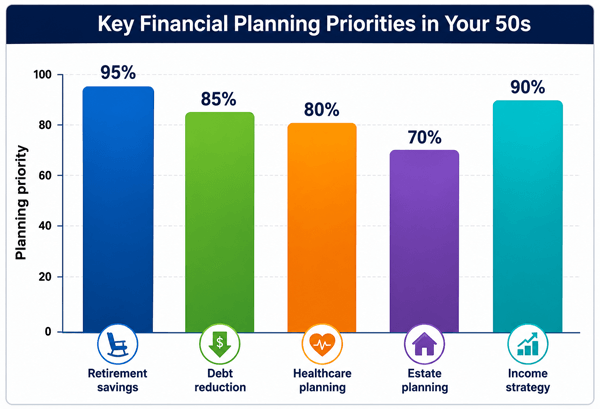
Chart: Common financial planning priorities in your 50s. The exact priority order depends on your personal situation.
■ Best Practices for Financial Planning in Your 50s
1. Create a One-Page Financial Snapshot
Before making big decisions, create a simple financial snapshot. This gives you a clear starting point and helps you track progress.
- Net worth: assets minus debts.
- Monthly income and expenses.
- Retirement account balances and contribution rates.
- Debt balances, interest rates, and payoff dates.
- Insurance policies and premiums.
- Expected retirement income sources.
- Beneficiaries and estate documents.
2. Use a Retirement Cash Flow Projection
A retirement cash flow projection estimates how money may move in and out after you retire. It should include income, expenses, taxes, inflation, investment withdrawals, healthcare costs, and big one-time expenses. You do not need a perfect forecast. You need a reasonable picture that helps you make better decisions.
| Question | Why it matters |
|---|---|
| When do I want to retire? | Affects saving years, health coverage, and withdrawal timing. |
| How much will I spend? | Drives the size of the retirement income need. |
| What income is guaranteed? | Shows how much must come from investments or work. |
| What if markets fall? | Tests whether the plan can handle bad timing. |
| What if I live into my 90s? | Helps reduce the risk of running out of money. |
3. Avoid Lifestyle Creep
Lifestyle creep happens when spending rises every time income rises. In your 50s, lifestyle creep can be especially harmful because the time to recover is shorter. This does not mean you should never enjoy your money. It means you should decide intentionally where extra income goes.
- Put part of every raise into retirement savings automatically.
- Use bonuses to pay debt, build cash reserves, or fund retirement accounts.
- Separate wants from needs before upgrading cars, homes, or vacations.
- Review subscriptions, insurance premiums, and recurring payments twice a year.
4. Protect Your Income While You Are Still Working
Your future retirement plan may depend on your remaining working years. Protecting your income is therefore a major part of financial planning in your 50s. Review disability insurance, emergency savings, job skills, professional network, and backup income options. A job loss in your late 50s can be harder to recover from than one earlier in life, so career resilience matters.
5. Update Your Insurance Coverage
Insurance needs change over time. You may still need life insurance if someone depends on your income, if you have debt, or if your spouse would struggle financially without you. But you may need less coverage if children are independent, debts are lower, and retirement savings are strong. Review policies instead of automatically renewing them.
| Insurance type | What to review in your 50s |
|---|---|
| Life insurance | Do dependents still need income replacement? Is term coverage enough? |
| Disability insurance | Would your plan survive if you could not work? |
| Health insurance | Are premiums, networks, and out-of-pocket costs manageable? |
| Long-term care insurance | Would insurance, savings, or family support cover care needs? |
| Home and auto insurance | Are deductibles, liability limits, and umbrella coverage appropriate? |
6. Get Estate Documents in Order
Estate planning is not only for wealthy people. It is about making decisions easier for your family and making sure your wishes are followed. Basic estate planning often includes a will, financial power of attorney, healthcare power of attorney, living will or advance directive, and updated beneficiary designations.
A common mistake is having old beneficiaries on retirement accounts or life insurance. Beneficiary designations usually pass outside a will, so they should be reviewed after marriage, divorce, death of a spouse, birth of grandchildren, or major family changes.
■ Common Financial Mistakes to Avoid in Your 50s
| Mistake | Why it hurts | Better practice |
|---|---|---|
| Assuming retirement will work out somehow | Without numbers, it is easy to save too little or retire too early. | Estimate expenses, income, and savings gaps. |
| Taking too much investment risk | A major loss close to retirement can delay retirement or force lower spending. | Rebalance based on time horizon and risk tolerance. |
| Taking too little investment risk | Money may not keep up with inflation over a long retirement. | Keep a diversified growth component for long-term needs. |
| Ignoring healthcare costs | Medical expenses can disrupt even a strong plan. | Plan for insurance, Medicare timing, and long-term care. |
| Supporting adult children without boundaries | Generosity can weaken retirement security. | Set limits and protect your own future first. |
| Claiming benefits without analysis | Early claiming or pension choices can permanently affect income. | Compare options before deciding. |
| Failing to update estate documents | Outdated documents can create conflict and delays. | Review documents and beneficiaries regularly. |
■ Should You Help Adult Children or Prioritize Retirement?
Many people in their 50s are caught between helping children and preparing for retirement. This is emotionally difficult. You may want to help with college, weddings, housing, emergencies, or business ideas. But retirement is different from other goals because you cannot borrow your way through it in the same way a student can borrow for school or a younger adult can rebuild savings over decades.
A healthy approach is to be generous within limits. Decide what you can afford without reducing your retirement contributions, taking on high-interest debt, or draining emergency savings. Clear boundaries are not selfish; they help prevent future financial stress for the whole family.
- Do not co-sign loans unless you can afford to repay them yourself.
- Avoid using retirement accounts for non-retirement expenses unless you understand taxes and penalties.
- Offer a fixed amount of help rather than open-ended support.
- Teach budgeting and planning instead of only providing money.
■ A Practical Financial Planning Checklist for Your 50s
- Calculate your net worth and update it at least once a year.
- Estimate your retirement spending and income sources.
- Increase retirement contributions if possible, especially after debts are paid off.
- Use catch-up contributions if eligible and suitable for your budget.
- Pay down high-interest debt aggressively.
- Review your mortgage payoff, refinancing, or downsizing options.
- Keep an emergency fund of at least 3 to 6 months of essential expenses; consider more if your income is unstable.
- Rebalance investments and avoid extreme risk decisions.
- Review health insurance, Medicare timing, and long-term care plans.
- Check Social Security, pension, or retirement income estimates.
- Update life, disability, home, auto, liability, and long-term care coverage.
- Review wills, powers of attorney, advance directives, and beneficiaries.
- Talk with your spouse or family about retirement lifestyle, housing, and care preferences.
- Meet with qualified financial, tax, legal, or insurance professionals when decisions are complex.
■ Example: A 55-Year-Old Couple Gets Back on Track
Consider a couple, both age 55. They have a combined income of $140,000, $420,000 in retirement savings, $18,000 in credit card debt, a mortgage with 12 years remaining, and two adult children. They want to retire around age 67 but are unsure whether they can.
Their first step is to build a financial snapshot. They discover they are spending nearly $900 per month on subscriptions, dining out, and unused services. They reduce that by $500 per month and apply it to credit card debt. They also direct half of future raises into retirement accounts. After the credit card debt is paid off, they redirect that payment into retirement savings.
They review their investments and realize their portfolio is either too aggressive in one account and too conservative in another. They rebalance across all accounts and create a 12-month emergency fund. They also check future Social Security estimates, discuss whether one spouse may work part-time after 67, and update their wills and beneficiaries.
This plan does not magically solve everything, but it gives them direction. Instead of guessing, they now know what actions can improve their retirement readiness.
■ Pros and Cons of Making Big Money Changes in Your 50s
| Action | Pros | Cons or cautions |
|---|---|---|
| Saving more aggressively | Builds retirement security and may reduce taxes in some accounts. | Can feel restrictive if the budget is already tight. |
| Paying off debt faster | Improves cash flow and reduces interest costs. | May reduce available cash if done too aggressively. |
| Downsizing home | Can lower expenses and free up equity. | Moving costs and emotional adjustment can be significant. |
| Delaying retirement | More saving years and fewer withdrawal years. | Health, job availability, and burnout may limit this option. |
| Working part-time in retirement | Adds income and structure. | May affect lifestyle expectations and benefit decisions. |
■ Frequently Asked Questions
1. How much should I have saved for retirement in my 50s?
There is no universal number because income, lifestyle, family support, health, debt, and retirement age all matter. A better approach is to estimate your future expenses, subtract expected guaranteed income, and calculate how much your savings need to provide. If you are behind, focus on increasing contributions, reducing debt, and possibly working longer or adjusting retirement spending.
2. Is it too late to start financial planning at 50?
No. Starting at 50 is much better than waiting until retirement. You may still have 10 to 20 working years ahead, and catch-up contributions, debt reduction, smarter investing, and better benefit decisions can make a meaningful difference.
3. Should I pay off my mortgage before retirement?
It depends. Paying off a mortgage can reduce stress and lower monthly expenses, but it can also reduce liquidity. Compare your mortgage rate, cash reserves, investment opportunities, retirement date, tax situation, and emotional comfort before deciding.
4. Should I invest more conservatively in my 50s?
Often yes, but not too conservatively. You still need growth because retirement may last decades. The best approach is usually a diversified portfolio that balances growth, income, and stability based on when you will need the money.
5. What is the biggest financial risk in your 50s?
One major risk is making decisions without a clear plan. Other big risks include high-interest debt, inadequate retirement savings, large healthcare costs, job loss, poor investment timing, and outdated estate documents.
6. Do I need a financial advisor in my 50s?
Not everyone needs one, but professional guidance can help if you have complex investments, pension decisions, tax questions, estate planning needs, business ownership, divorce, inheritance, or uncertainty about retirement readiness. Look for qualified professionals who act transparently and explain fees clearly.
7. How often should I review my financial plan in my 50s?
Review your plan at least once a year and after major life events such as job changes, divorce, marriage, inheritance, health issues, market downturns, caring for parents, or changes in retirement timing.
■ Final Thoughts: Make Your 50s a Decade of Clarity
Financial planning in your 50s is not about panic. It is about clarity. You are close enough to retirement that your decisions matter, but you still have time to improve your situation. The most helpful steps are often simple: know your numbers, save more where possible, reduce expensive debt, protect your health and income, review retirement benefits, rebalance investments, and update estate documents.
The best financial plan is not the most complicated one. It is the one you understand, use, and update. Start with one action this week: calculate your net worth, increase your retirement contribution, list your debts, review beneficiaries, or estimate retirement spending. Small steps repeated consistently can turn your 50s into a strong foundation for the next stage of life.
Sources and Notes
This article is educational and should be adapted to the reader's country, tax system, account types, health coverage, and personal circumstances. For U.S.-specific figures, the following official sources were checked and updated in July 2026:
- Internal Revenue Service: 2026 retirement contribution limits for 401(k), 403(b), governmental 457 plans, TSP, and IRAs.
- Internal Revenue Service: SECURE 2.0 higher catch-up contribution limit for ages 60 to 63 in eligible plans.
- Social Security Administration: full retirement age for people born in 1960 or later.
- Medicare.gov and CMS: Medicare Initial Enrollment Period timing around age 65.
Reader Advice: This article is for educational and informational purposes only and should not be taken as personal financial, tax, legal, insurance, or investment advice. Please check the latest rules and information from official sources or qualified professionals, because policies and limits can change over time.