Financial Goals Examples and How to Achieve Them
Financial goals are specific money targets you want to reach. They give your income a clear purpose, help you make better spending decisions, and turn vague hopes like “I want to save more” into practical actions you can follow each month.
For beginners, financial goals do not have to be complicated. A good goal can be as simple as saving $500 for emergencies, paying off one credit card, creating a monthly budget, or investing a small amount regularly for retirement. The key is to make the goal clear, realistic, measurable, and connected to your real life.
A useful way to think about financial goals is this: choose the money outcome, attach a number, set a deadline, and decide the next action. This keeps the goal simple enough to follow and specific enough to measure.
1. What Are Financial Goals?
A financial goal is a planned money outcome you want to achieve within a specific time. It may involve saving, debt repayment, investing, increasing income, protecting your family, buying something important, or improving your overall financial habits.
A weak goal says, “I want to be better with money.” A stronger goal says, “I will save $1,200 for an emergency fund within 12 months by automatically transferring $100 each month.” The second goal is easier to act on because it includes an amount, a deadline, and a method.
Financial goals are personal. The right goal for a student, a new worker, a parent, a business owner, or a person close to retirement may be different. Your income, dependents, debts, job stability, local cost of living, and risk tolerance should guide your priorities.
2. Types of Financial Goals: Short-Term, Medium-Term, and Long-Term
| Goal Type | Typical Time Frame | Examples | Best Place to Keep the Money |
|---|---|---|---|
| Short-term goals | 0 to 12 months | Emergency starter fund, holiday savings, small debt payoff, monthly budget | Checking account, savings account, cash reserve |
| Medium-term goals | 1 to 5 years | Car down payment, wedding, home deposit, career training, larger emergency fund | High-yield savings, money market, short-term deposits, conservative options |
| Long-term goals | 5+ years | Retirement, child education, mortgage payoff, financial independence | Retirement accounts, diversified investments, long-term savings plans |
The shorter the timeline, the more important safety and access become. Money needed soon should usually not be exposed to high market risk. Money needed far in the future may have more time to grow through investing, depending on your risk tolerance and local rules.
If a savings product is not available in your country, use the safest suitable local alternative that keeps the money accessible and separate from daily spending.
■ Financial Goals Examples for Beginners
Here are practical financial goals examples you can adapt to your income, family situation, country, and priorities.
1. Build a Starter Emergency Fund
Save a small first cushion, such as $500 to $1,000 or one month of basic expenses. This helps you handle small emergencies without using credit cards or borrowing from family.
Practical action: Save $50 to $100 per month in a separate savings account until you reach your target.
2. Create and Follow a Monthly Budget
A budget is a plan for your income before you spend it. It helps you see where money goes and where you can redirect cash toward your goals.
Practical action: Track income and expenses for 30 days, then assign money to needs, debt, savings, and wants before the month begins.
3. Pay Off High-Interest Debt
Credit cards, payday loans, and other expensive debts can make it harder to build wealth because interest keeps working against you.
Practical action: List debts by interest rate. Pay minimums on all debts, then send extra money to the highest-interest debt first.
4. Save Three to Six Months of Essential Expenses
After your starter fund, aim for a fuller emergency fund that can cover rent or mortgage, food, utilities, transport, insurance, and basic debt payments. People with irregular income or dependents may prefer a larger cushion.
Practical action: Divide your target by the number of months you want to save. For example, $6,000 in 24 months means $250 per month.
5. Start Investing for Retirement
Retirement may feel far away, but starting early gives your money more time to grow. Even small regular contributions can build the investing habit. Investment returns are not guaranteed, so use diversified and suitable options.
Practical action: Contribute a fixed percentage of income or a small monthly amount, and increase it when your income rises.
6. Save for a Home Down Payment
A home deposit is a common medium-term goal. It requires a clear amount, timeline, and separate savings plan. Include closing costs, moving costs, repairs, taxes, and maintenance, not only the deposit.
Practical action: Estimate the needed deposit, closing costs, moving costs, and repairs. Keep the money separate from everyday spending.
7. Improve Your Credit Score
A stronger credit profile can help you qualify for better loan terms, lower interest rates, and more financial options where credit scoring is used.
Practical action: Pay bills on time, reduce credit card balances, avoid unnecessary applications, and check your credit report for errors where available.
8. Build a Sinking Fund for Irregular Expenses
A sinking fund is money set aside for expected but irregular costs, such as car repairs, annual insurance, school fees, or gifts.
Practical action: Estimate the annual cost, divide by 12, and save that amount monthly.
9. Increase Your Income
Sometimes the best financial goal is not only cutting expenses but also earning more through skills, side work, promotion, or a better job.
Practical action: Choose one income skill, complete training, update your CV or portfolio, and apply for better opportunities consistently.
10. Protect Your Finances With Insurance and Basic Estate Planning
Financial goals are not only about growth. Protection matters because one accident, illness, or loss can damage years of progress.
Practical action: Review health, life, disability, property, or vehicle coverage based on your needs. Consider a will and beneficiary updates where appropriate.
■ How to Set SMART Financial Goals
SMART goals are Specific, Measurable, Achievable, Relevant, and Time-bound. This method turns a wish into a clear target.
| SMART Element | What It Means | Example |
|---|---|---|
| Specific | Say exactly what you want to do. | Save money for a $1,500 emergency fund. |
| Measurable | Use numbers so progress is clear. | Save $125 every month. |
| Achievable | Make it realistic for your income. | Start with $50 if $125 is too much. |
| Relevant | Connect it to your real life. | Reduce stress and avoid borrowing during emergencies. |
| Time-bound | Set a deadline. | Reach $1,500 within 12 months. |
Weak goal: “I want to save money.”
SMART goal: “I will save $1,500 in 12 months by transferring $125 to a separate savings account on payday.”
Simple formula: I will save/pay/invest [amount] by [date] by doing [monthly action].
■ Step-by-Step: How to Achieve Your Financial Goals
- List all your goals. Write down everything you want financially, from paying bills on time to retiring comfortably.
- Choose your top three priorities. Too many goals at once can create stress and slow progress.
- Know your starting point. Calculate your income, essential expenses, debt balances, savings, and net worth.
- Turn each goal into a SMART goal. Add a target amount, monthly action, deadline, and reason.
- Break the goal into monthly or weekly steps. A $1,200 goal becomes $100 per month or about $25 per week.
- Automate where possible. Automatic transfers reduce the need for willpower and help you stay consistent.
- Track progress monthly. Review what worked, what failed, and what needs to change.
- Adjust without quitting. If income drops or costs rise, reduce the monthly amount instead of abandoning the goal.
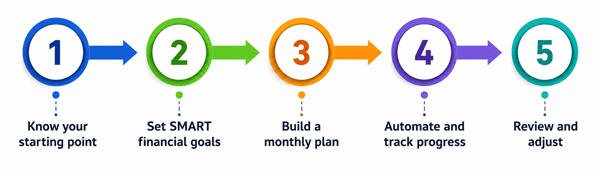
Figure: A simple financial goals roadmap for beginners.
■ Example Financial Goals Plan for a Beginner
Imagine a beginner earns $3,000 per month after tax, has $4,000 in credit card debt, no emergency fund, and wants to start investing. A practical first-year plan could look like this:
| Priority | Goal | Monthly Action | Why It Comes First |
|---|---|---|---|
| 1 | Save a $1,000 starter emergency fund | $200 for 5 months | Prevents small surprises from becoming new debt |
| 2 | Pay off credit card debt | $350 extra per month after starter fund | High-interest debt is expensive and slows progress |
| 3 | Start retirement investing | Begin with 3% to 5% of income | Builds the habit while debt is being reduced |
| 4 | Build full emergency fund | $250 per month after debt payoff | Creates stronger long-term stability |
This example is only a sample. A person with unstable income may need more cash savings first, while someone with an employer match or very low-interest debt may choose a different order.
3. Debt Payoff vs Saving vs Investing: Which Goal Comes First?
Many beginners feel unsure whether to save, pay debt, or invest first. The answer depends on risk, interest rates, and personal stability. A balanced order often works best.
| Situation | Common Priority | Reason |
|---|---|---|
| No emergency savings | Build a small starter emergency fund | Avoids using debt for small emergencies |
| High-interest debt | Pay it down aggressively | Interest costs can be higher than likely investment returns |
| Employer retirement match available | Contribute enough to get the match if affordable | A match is part of compensation and can boost progress |
| Stable income and low-interest debt | Save and invest while making payments | You can build wealth and manage debt together |
| Unstable income | Increase cash reserves first | Flexibility matters when income is unpredictable |
4. Common Mistakes to Avoid
- Setting goals that are too vague, such as “be rich” or “save more.”
- Trying to achieve too many financial goals at the same time.
- Ignoring irregular expenses like annual fees, repairs, school costs, and holidays.
- Relying only on motivation instead of using automatic transfers and reminders.
- Investing money that you may need in the next few months.
- Comparing your progress with people who have different incomes, family support, or responsibilities.
- Quitting after one bad month instead of adjusting the plan.
- Using unrealistic returns or perfect-month assumptions when planning.
5. Benefits of Setting Financial Goals
- You make spending decisions with more confidence.
- You reduce financial stress because your money has a plan.
- You can measure progress instead of guessing.
- You are less likely to depend on debt for predictable expenses.
- You build better habits, such as saving before spending.
- You improve your ability to handle emergencies and opportunities.
6. Limitations and Risks to Understand
Financial goals are powerful, but they do not remove uncertainty. Job loss, inflation, illness, family responsibilities, market changes, and unexpected expenses can affect your plan. That is why your goals should be flexible. A good plan gives direction, but it should be reviewed and adjusted as life changes.
Also, not every goal should involve investing. If you need money soon, protecting the money may matter more than trying to earn a higher return. Long-term goals may benefit from investing, but investments can rise and fall in value.
Avoid promising yourself unrealistic returns. For planning, conservative assumptions are usually safer than depending on best-case outcomes.
7. Best Practices for Reaching Financial Goals Faster
- Use separate accounts for separate goals so the money is not mixed with daily spending.
- Name your accounts after the goal, such as Emergency Fund, Car Fund, or Home Deposit.
- Increase savings when income rises instead of upgrading your lifestyle immediately.
- Use windfalls carefully. Bonuses, tax refunds, gifts, or freelance income can speed up progress.
- Review subscriptions and recurring expenses every few months.
- Create a simple dashboard with goal amount, current balance, monthly contribution, and deadline.
- Celebrate milestones, but keep celebrations affordable.
- Review your goals after major changes such as marriage, a new child, a job change, relocation, or a large medical expense.
8. Simple Financial Goals Worksheet
| Goal | Target Amount | Deadline | Monthly Amount | Why It Matters | Progress Check |
|---|---|---|---|---|---|
| Emergency fund | $1,000 | 5 months | $200 | Avoid new debt | Monthly |
| Credit card payoff | $4,000 | 12 months | $350+ | Reduce interest | Monthly |
| Vacation fund | $1,200 | 10 months | $120 | Travel without debt | Monthly |
| Retirement investing | 10% of income | Ongoing | Start at 3%-5% | Future security | Quarterly |
You can copy this worksheet and replace the examples with your own target amount, deadline, and monthly action.
■ Frequently Asked Questions
1. What are good financial goals for beginners?
Good beginner goals include creating a monthly budget, saving a starter emergency fund, paying off high-interest debt, building a full emergency fund, improving credit, and starting small retirement contributions.
2. How many financial goals should I have at once?
Most beginners do best with one to three main goals at a time. You can list many goals, but focus your money and attention on the few that matter most right now.
3. What is the best financial goal to start with?
For many people, the best first goal is a starter emergency fund. It creates breathing room and helps prevent small problems from becoming new debt.
4. Should I save money or pay off debt first?
It often makes sense to save a small emergency fund first, then focus heavily on high-interest debt while still paying all minimums. The right order depends on your income stability, interest rates, and risks.
5. How do I stay motivated?
Use visible progress tracking, automate transfers, break large goals into smaller milestones, and connect each goal to a personal reason, such as less stress, more freedom, or family security.
6. What if I cannot save much money?
Start very small. Even $5 or $10 per week builds the habit. Then look for ways to reduce one expense, negotiate a bill, sell unused items, or increase income gradually.
7. How often should I review my financial goals?
Review short-term goals monthly, medium-term goals every few months, and long-term goals at least once or twice a year. Review sooner after major life changes.
8. Are financial goals the same as a budget?
No. A budget is a monthly plan for your money. A financial goal is the outcome you want. Your budget is one of the tools that helps you reach the goal.
9. What is a realistic financial goal?
A realistic financial goal fits your income, expenses, timeline, and responsibilities. It should stretch you slightly, but it should not require perfect conditions every month.
■ Final Thoughts
Financial goals help you move from guessing to planning. You do not need a perfect income, perfect timing, or expert knowledge to begin. Start with one clear goal, make it measurable, build it into your monthly budget, and review your progress regularly.
The most useful financial goals are realistic, personal, and flexible. They should help you reduce stress, protect your future, and use money in a way that supports the life you want to build.
Reader Advice: This article is for educational and information purposes only and should not be taken as personal financial, investment, tax, or legal advice. Please check the latest official sources and consider speaking with a qualified professional, because rules, information, and policies can change over time.