Personal Financial Statement Explained: Meaning, Examples and How to Create One
A personal financial statement is a simple snapshot of your money life. It shows what you own, what you owe, and what is left over after subtracting debts from assets. This leftover amount is called your net worth. Some versions also include income and expenses so you can see whether money is coming in faster than it is going out.
You do not need to be wealthy, own a business, or understand complex accounting to create one. A personal financial statement can help a beginner see their financial position clearly, prepare for a loan application, plan for a major goal, or simply make better money decisions.
This guide explains the meaning of a personal financial statement, its main parts, examples, common mistakes, and a practical step-by-step process you can use to create one at home. It also explains how to value assets realistically, protect sensitive information, and avoid mistakes that can make the statement misleading.
Quick Answer
A personal financial statement is a document that summarizes your assets, liabilities, net worth, income, and expenses at a specific point in time. It helps you understand your financial health and is often used for personal planning, borrowing, investing decisions, business loan applications, and annual financial reviews.
1. What Is a Personal Financial Statement?
A personal financial statement is a document that summarizes an individual’s or household’s financial position. It usually includes two core sections:
- Assets: things you own that have financial value, such as cash, bank accounts, investments, property, vehicles, and retirement accounts.
- Liabilities: debts or financial obligations you owe, such as credit card balances, student loans, auto loans, mortgages, personal loans, and unpaid taxes.
The difference between total assets and total liabilities is your net worth:
Net Worth = Total Assets - Total Liabilities
A complete personal financial statement may also include income, expenses, insurance coverage, emergency savings, and notes about financial goals. The level of detail depends on why you are creating it.
For lender or official forms, follow the exact form instructions and use the supporting documents requested by the institution. For example, SBA Form 413 is used to assess the financial situation of applicants for some U.S. Small Business Administration programs and certifications.
2. Why a Personal Financial Statement Matters
A personal financial statement turns scattered financial information into one clear picture. Without it, you may know your bank balance but not your true financial position. For example, someone may have a high salary and still have negative net worth because of heavy debt. Another person may have modest income but strong net worth because they save consistently and carry little debt.
- It shows your true financial position instead of only your monthly cash balance.
- It helps you track whether your net worth is improving over time.
- It makes loan, mortgage, and business financing applications easier.
- It helps you identify risky debt, weak savings, or overconcentration in one asset.
- It supports better goal planning for retirement, education, home buying, travel, or debt payoff.
- It helps couples and families discuss money with more clarity and less guesswork.
3. Personal Financial Statement vs. Budget vs. Net Worth Statement
| Document | Main Focus | What It Shows | Best Used For |
|---|---|---|---|
| Personal Financial Statement | Overall financial position | Assets, liabilities, net worth, and often income/expenses | Annual review, loan application, personal planning |
| Budget | Monthly money plan | Expected income and planned spending | Controlling spending and saving each month |
| Net Worth Statement | Wealth snapshot | Assets minus liabilities | Tracking financial progress over time |
| Cash Flow Statement | Money movement | Income coming in and expenses going out | Finding savings opportunities and avoiding shortfalls |
In simple terms, a budget helps you manage the month, while a personal financial statement helps you understand the bigger picture.
■ Main Parts of a Personal Financial Statement
1. Assets
Assets are things you own that have financial value. For a personal financial statement, list assets at a realistic current value, not what you wish they were worth.
| Asset Category | Examples | How to Value It |
|---|---|---|
| Cash and bank accounts | Checking account, savings account, money market account | Use current balances from bank statements. |
| Investments | Stocks, bonds, mutual funds, ETFs, brokerage accounts | Use current market value. |
| Retirement accounts | 401(k), IRA, pension value, provident fund | Use latest statement value and note if withdrawals may involve taxes or penalties. |
| Real estate | Primary home, rental property, land | Use a reasonable estimate based on recent sales or valuation tools. |
| Vehicles | Car, motorcycle, boat | Use resale value, not purchase price. |
| Personal property | Jewelry, collectibles, valuable equipment | Include only meaningful resale value. |
| Business ownership | Share in a private business | Use conservative estimated value if not easily sellable. |
2. Liabilities
Liabilities are debts or obligations you owe. Use the current outstanding balance, not the original loan amount.
| Liability Category | Examples | Amount to Record |
|---|---|---|
| Credit card debt | Card balances and store cards | Current balance owed |
| Personal loans | Unsecured loans from banks, lenders, or family | Remaining principal balance |
| Student loans | Education loans | Outstanding balance plus unpaid interest if applicable |
| Auto loans | Car or motorcycle financing | Payoff amount |
| Mortgage | Home loan or property loan | Remaining loan balance |
| Taxes owed | Unpaid income tax, property tax, penalties | Amount currently due |
| Medical or other bills | Unpaid bills or installment plans | Current amount owed |
3. Net Worth
Net worth is the number left after subtracting liabilities from assets. It can be positive, zero, or negative. Negative net worth does not mean you have failed; it simply means your debts are currently larger than your assets. This is common for people with student loans, new mortgages, or early-career debt.
4. Income
Income is money you receive. A personal financial statement may show monthly or annual income depending on the purpose. For personal planning, monthly income is often easier to use. For a loan application, the lender may request annual income and supporting documents.
- Salary or wages
- Self-employment or freelance income
- Rental income
- Business income
- Dividends and interest
- Pension, retirement, or government benefits
- Child support or alimony received, where relevant
5. Expenses
Expenses are your regular costs. Including expenses helps you understand cash flow: whether your income comfortably covers your lifestyle, debt payments, savings, and future goals.
| Expense Type | Examples |
|---|---|
| Fixed expenses | Rent or mortgage, insurance, loan payments, subscriptions |
| Variable expenses | Groceries, utilities, fuel, dining out, entertainment |
| Irregular expenses | Car repairs, medical costs, gifts, annual fees, travel |
| Savings and investing | Emergency fund deposits, retirement contributions, brokerage investing |
| Debt payments | Credit cards, loans, mortgage, student loans |
■ Personal Financial Statement Example
Below is a simplified example for one person. The amounts are fictional and used only for learning.
| Item | Amount | Notes |
|---|---|---|
| Assets | ||
| Checking and savings | $12,000 | Liquid cash |
| Retirement account | $45,000 | Long-term savings |
| Brokerage account | $8,000 | Investments |
| Car value | $10,000 | Estimated resale value |
| Home value | $220,000 | Estimated market value |
| Total Assets | $295,000 | |
| Liabilities | ||
| Credit card balance | $3,000 | High-interest debt |
| Auto loan | $7,500 | Remaining balance |
| Mortgage | $170,000 | Remaining balance |
| Total Liabilities | $180,500 | |
| Net Worth | $114,500 | Total assets minus total liabilities |
This example shows why net worth is more useful than looking at one account balance. The person has $12,000 in bank accounts, but their overall financial position is $114,500 after including property, retirement savings, investments, and debts.
■ How to Create a Personal Financial Statement Step by Step
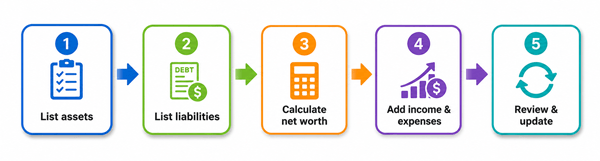
Diagram: A simple process for creating a personal financial statement.
Step 1: Choose the date of the statement
A personal financial statement is a snapshot at a specific point in time. Choose one date, such as December 31, June 30, or the date you are applying for a loan. Use values from that date as much as possible.
Step 2: Gather your documents
Collect bank statements, investment statements, retirement account balances, loan statements, credit card balances, mortgage statements, insurance documents, tax records, and recent pay information. You can use a spreadsheet, notebook, budgeting app, or a simple Word document.
Step 3: List all assets
Write down every meaningful asset and estimate its current value. Be realistic. For example, a car should be valued at resale value, not the amount you paid years ago.
Step 4: List all liabilities
Write down every debt and current balance. Include small debts too, because they affect your net worth and cash flow.
Step 5: Calculate net worth
Add all assets, add all liabilities, and subtract liabilities from assets. This gives your net worth.
Step 6: Add income and expenses
For a more complete statement, list your monthly income and monthly expenses. This helps you see whether you are building wealth, staying flat, or relying on debt.
Step 7: Review the results
Look for patterns. Is your net worth increasing? Is too much of your wealth tied up in one asset? Are high-interest debts growing? Do you have enough liquid cash for emergencies?
Step 8: Update regularly
Update your personal financial statement at least once a year. Some people update it quarterly, especially when paying off debt, saving for a home, preparing for retirement, or running a business.
■ Simple Personal Financial Statement Template
You can copy this structure into a spreadsheet or document and fill in your own numbers.
| Category | Amount | Notes |
|---|---|---|
| A. Assets | ||
| Cash and bank accounts | ||
| Investments | ||
| Retirement accounts | ||
| Real estate | ||
| Vehicles | ||
| Other valuable assets | ||
| Total Assets | ||
| B. Liabilities | ||
| Credit cards | ||
| Loans | ||
| Mortgage | ||
| Taxes or other bills owed | ||
| Total Liabilities | ||
| C. Net Worth | Total Assets - Total Liabilities | |
| D. Monthly Income | ||
| Salary or wages | ||
| Business or freelance income | ||
| Investment or rental income | ||
| Total Monthly Income | ||
| E. Monthly Expenses | ||
| Housing | ||
| Food and groceries | ||
| Transportation | ||
| Insurance | ||
| Debt payments | ||
| Savings and investments | ||
| Other expenses | ||
| Total Monthly Expenses | ||
| Monthly Surplus or Shortfall | Income - Expenses |
4. What Your Personal Financial Statement Can Tell You
| Result | What It May Mean | Practical Action |
|---|---|---|
| Positive net worth | Your assets are greater than your debts. | Keep improving savings, investing, and debt management. |
| Negative net worth | Your debts are greater than your assets. | Focus on debt payoff, emergency savings, and income growth. |
| High income but low net worth | Money may be leaving too quickly or debts may be too high. | Review spending, lifestyle inflation, and savings rate. |
| Strong net worth but little cash | Your wealth may be tied up in property or retirement accounts. | Build a liquid emergency fund. |
| Large high-interest debt | Credit cards or personal loans may be slowing progress. | Create a payoff plan and avoid adding new balances. |
A useful extra measure is the debt-to-income ratio: monthly debt payments divided by gross monthly income. Lenders may use this kind of ratio, along with credit history, income stability, collateral, and other factors, when reviewing applications.
5. Benefits of Creating a Personal Financial Statement
- Clearer decision-making: You can make choices based on facts instead of guesses.
- Better borrowing preparation: Lenders often want to see assets, debts, income, and obligations.
- Improved goal tracking: You can measure progress toward debt freedom, home ownership, retirement, or financial independence.
- Stronger family communication: A shared statement can help couples discuss money honestly.
- Early warning signs: You can spot rising debt, shrinking savings, or overreliance on one income source before it becomes a crisis.
6. Limitations and Risks to Understand
A personal financial statement is useful, but it is not perfect. It is a snapshot, not a complete prediction of the future.
- Asset values can change. Home prices, investments, business values, and vehicles can rise or fall.
- Some assets are hard to sell quickly. A house may have high value but cannot usually be converted to cash overnight.
- Net worth does not measure happiness, job stability, health, or financial stress by itself.
- Incorrect estimates can create a false sense of security.
- A statement is only useful when updated and reviewed honestly.
7. Common Mistakes to Avoid
| Mistake | Why It Matters | Better Approach |
|---|---|---|
| Using purchase price instead of current value | A car bought for $30,000 may now be worth much less. | Use realistic resale or market value. |
| Forgetting small debts | Small balances add up and affect net worth. | Include all debts, even informal or short-term ones. |
| Overvaluing personal items | Most furniture, electronics, and clothing have low resale value. | Include only items with meaningful market value. |
| Ignoring taxes and fees | Selling investments or property may involve taxes or transaction costs. | Add notes where taxes or selling costs may matter. |
| Not separating liquid and illiquid assets | A retirement account is not the same as cash in the bank. | Label assets by liquidity. |
| Creating it once and never updating it | Old numbers become misleading. | Review at least annually. |
8. Personal Financial Statement for Loan Applications
Banks and lenders may ask for a personal financial statement when you apply for a mortgage, business loan, personal loan, or line of credit. They use it to understand whether you have enough assets, income, and financial stability to repay the loan.
A lender may request supporting documents such as bank statements, tax returns, pay slips, investment statements, property records, or loan statements. When preparing a statement for a lender, be accurate and conservative. Do not inflate asset values or hide debts. Misleading information can damage your application and may create legal problems.
For official applications, use the exact form provided by the lender, bank, or government agency. Requirements may vary by country, lender, program, and year.
9. How Often Should You Update It?
| Update Frequency | Best For | Why |
|---|---|---|
| Once a year | Most households | Good for annual financial reviews and long-term tracking. |
| Every quarter | People paying off debt, investing actively, or saving for a major goal | Shows progress more frequently without becoming overwhelming. |
| Before a major financial decision | Home purchase, business loan, retirement planning, divorce, estate planning | Helps you make decisions using current numbers. |
| Monthly | People rebuilding finances or closely tracking debt | Useful if frequent updates motivate better behavior. |
10. Best Practices for Beginners
- Start simple. A basic list of assets, liabilities, and net worth is better than no statement at all.
- Use one consistent date for all balances whenever possible.
- Keep copies of supporting documents in a secure folder.
- Use conservative values for assets that are difficult to sell.
- Separate short-term cash from long-term retirement savings.
- Track net worth over time, not day to day.
- Review your statement with your budget so you understand both wealth and cash flow.
- Protect your personal financial statement because it contains sensitive information.
Security tip: Store the statement in a password-protected file or trusted financial app, and avoid sending it by unsecured email unless the recipient specifically provides a secure upload method.
11. Mini Case Study: How a Statement Helps Real-Life Decisions
Imagine Sara earns a good salary but feels like she is not getting ahead. She creates a personal financial statement and discovers the following:
- $6,000 in savings
- $18,000 in credit card debt
- $25,000 in retirement savings
- $9,000 car value
- $11,000 auto loan balance
At first, Sara thought her main problem was income. After seeing the full picture, she realizes high-interest credit card debt is the biggest obstacle. Her next steps are to build a small emergency buffer, reduce unnecessary spending, and create a debt payoff plan. Six months later, she updates the statement and can clearly see progress because her liabilities are lower and her net worth has improved.
12. Pros and Cons of a Personal Financial Statement
| Category | Details |
|---|---|
| Pros | Gives a clear financial snapshot; helps track net worth; supports loan applications; improves planning; reveals debt and liquidity issues. |
| Cons | Requires accurate information; asset values can be estimates; may feel uncomfortable at first; does not replace a budget, tax plan, or professional advice. |
■ Frequently Asked Questions
1. What is included in a personal financial statement?
A personal financial statement usually includes assets, liabilities, and net worth. A more complete version also includes income, expenses, insurance, and notes about financial goals.
2. Is a personal financial statement the same as a balance sheet?
It is similar to a balance sheet because it lists assets and liabilities at a point in time. The main difference is that a personal financial statement is designed for an individual or household rather than a business.
3. Can my net worth be negative?
Yes. Negative net worth means your liabilities are greater than your assets. This can happen when you have student loans, credit card debt, a new mortgage, or early-career debt. The goal is to improve the trend over time.
4. Should I include my home in my personal financial statement?
Yes, if you own a home, include a realistic current market value as an asset and the remaining mortgage balance as a liability. Avoid using an inflated estimate.
5. Should I include retirement accounts?
Yes. Retirement accounts are assets. However, it is helpful to label them as long-term assets because they may not be easily available for short-term needs without taxes or penalties.
6. Should I include personal belongings?
Only include personal belongings if they have meaningful resale value, such as valuable jewelry, collectibles, or equipment. Everyday furniture, clothing, and electronics are often worth much less than people expect.
7. How do I calculate net worth?
Add all assets, add all liabilities, then subtract total liabilities from total assets. The result is your net worth.
8. How often should I update my personal financial statement?
At least once a year is enough for many beginners. Update it more often if you are paying off debt, applying for a loan, preparing for retirement, or making a major financial decision.
9. Do I need special software?
No. You can create a personal financial statement using a spreadsheet, a notebook, a budgeting app, or a document. The most important part is accuracy and consistency.
10. Is a personal financial statement private?
Yes. It contains sensitive financial information, so store it securely and only share it with trusted professionals or institutions when necessary.
■ Final Thoughts
A personal financial statement is one of the simplest and most useful tools for understanding your money. It shows what you own, what you owe, and whether your overall financial position is improving. For beginners, the best approach is to start with a basic asset and liability list, calculate net worth, then add income and expenses for a fuller view.
You do not need perfect numbers to begin, but you should aim for honest and realistic estimates. Review the statement regularly, compare it with your goals, and use it as a practical guide for saving, debt payoff, investing, and major financial decisions.
Reader Advice: This article is for educational and information purposes only and should not be taken as personal financial, tax, legal, or investment advice. Rules, forms, and policies can change over time, so please check the latest information from official sources or a qualified professional before making important decisions.