Financial Planning in Your 30s: Money Goals and Best Practices
Your 30s can be a powerful decade for your money. You may be earning more than you did in your 20s, but your responsibilities may also be bigger. You might be paying rent or a mortgage, raising a family, supporting parents, building a business, paying off debt, or trying to invest for retirement while still enjoying life today.
Financial planning in your 30s is not about being perfect. It is about creating a clear system for your money so your income supports your real priorities. A good plan helps you spend with less guilt, save with purpose, reduce financial stress, protect your family, and build long-term wealth step by step.
This guide explains the most important money goals and best practices for people in their 30s, using simple language and practical examples. It is especially useful for readers searching for financial planning in your 30s, money goals in your 30s, budgeting in your 30s, debt payoff, emergency funds, and retirement investing basics.
Quick answerIn your 30s, financial planning means organizing your income, spending, savings, debt, insurance, investments, and long-term goals so you can build stability now and wealth for the future. The main priorities are budgeting, emergency savings, debt control, retirement investing, insurance protection, and planning for major life goals such as a home, children, career changes, or business ownership.
1. What Is Financial Planning in Your 30s?
Financial planning is the process of deciding what you want your money to do, then creating a practical plan to make it happen. In your 30s, this usually means moving from “just getting by” to building a more intentional financial life.
A complete financial plan usually includes:
- A monthly budget and cash-flow system
- An emergency fund
- A debt payoff strategy
- Retirement and investment planning
- Insurance and risk protection
- Tax awareness
- Home, family, and education planning
- Estate planning basics
- Regular financial reviews
2. Why Your 30s Are a Critical Financial Decade
Your 30s matter because your choices have enough time to compound, but your financial responsibilities may be large enough that mistakes can become expensive. This decade often includes career growth, higher income, marriage or partnership, children, home buying, business decisions, and more complex financial obligations.
The Power of Starting Before Life Gets More Expensive
Many people wait until their 40s or 50s to take money seriously. The problem is that waiting reduces your time advantage. When you invest earlier, your money has more years to benefit from compound growth. Compound interest means you can earn returns not only on your original money, but also on previous returns. Investor.gov describes this as a way to see how money can grow over time through compounding.
Example: Why Time Matters
| Scenario | Monthly Investment | Years Invested | What It Shows |
|---|---|---|---|
| Start at age 30 | $300 | 35 years | More time allows smaller monthly contributions to grow meaningfully. |
| Start at age 40 | $300 | 25 years | The same monthly amount has less time to compound. |
| Start at age 50 | $300 | 15 years | Late saving can still help, but may require larger contributions. |
The lesson is not that you must invest huge amounts immediately. The lesson is that consistent action matters. Even modest contributions can become powerful when you keep going for many years.
3. Financial Planning Roadmap for Your 30s
The diagram below shows a simple order of priorities. Some steps can happen at the same time, but the general idea is to build a stable base before taking larger risks.
A simple six-step roadmap visual has been added below for readers who prefer a quick visual summary.
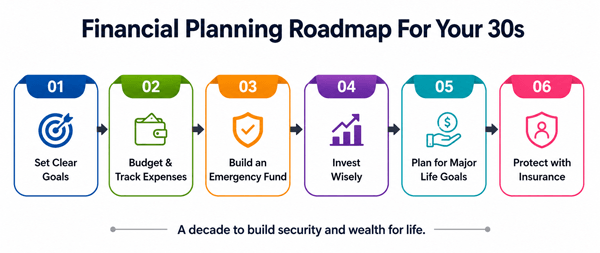
| Stage | Focus | Goal |
|---|---|---|
| 1. Control cash flow | Budget, track spending, automate bills | Know where your money goes each month |
| 2. Build safety | Emergency fund and basic insurance | Protect yourself from financial shocks |
| 3. Reduce pressure | Pay off high-interest debt | Free up cash and lower stress |
| 4. Grow wealth | Retirement accounts, index funds, diversified investing | Use time and compounding |
| 5. Plan big goals | Home, children, business, education, travel | Make major decisions without damaging stability |
| 6. Protect legacy | Will, beneficiaries, estate documents | Protect family and assets |
Simple visual rule
Think of your financial plan like a house: cash flow is the foundation, savings and insurance are the walls, debt control is the support structure, and investing is the roof that helps build long-term wealth.
■ Key Money Goals to Set in Your 30s
Your goals should fit your income, family situation, location, and values. The best goals are specific enough to act on, but flexible enough to adjust when life changes.
| Goal | Why It Matters | Practical Target |
|---|---|---|
| Build an emergency fund | Prevents small problems from becoming debt problems | Start with one month of expenses, then build toward 3-6 months |
| Pay off high-interest debt | Credit card and expensive personal debt can weaken every other goal | Prioritize debts with high interest rates |
| Invest for retirement | Your 30s still give your money decades to grow | Contribute regularly; increase contributions as income rises |
| Improve credit health | Credit can affect loans, housing, and borrowing costs | Pay on time, reduce balances, review reports |
| Protect income and family | A major illness, accident, or death can create financial hardship | Review health, life, disability, and property insurance |
| Plan for major purchases | Homes, cars, education, and business goals need preparation | Create sinking funds and avoid rushed borrowing |
| Start estate basics | Protects dependents and reduces confusion | Update beneficiaries and consider a will |
1. Create a Realistic Budget That Matches Your Life
A budget is not a punishment. It is a plan for your income. In your 30s, budgeting becomes especially important because you may have more categories competing for your money: housing, children, travel, health care, debt, insurance, retirement, and family support.
A Simple Budget Framework
A beginner-friendly starting point is the 50/30/20 style budget:
| Category | Meaning | Example Expenses |
|---|---|---|
| Needs | Essential living costs | Rent or mortgage, groceries, utilities, transport, insurance, minimum debt payments |
| Wants | Lifestyle spending | Restaurants, entertainment, subscriptions, hobbies, upgrades |
| Savings and debt payoff | Future-focused money | Emergency fund, retirement, extra debt payments, home down payment |
This rule is only a guide. If housing is very expensive where you live, your needs may be higher. If you are aggressively paying debt or saving for a house, your wants may need to be lower for a period of time.
Practical example
If your take-home pay is $4,000 per month, a 50/30/20 guide would suggest about $2,000 for needs, $1,200 for wants, and $800 for savings and extra debt payoff. If you have credit card debt, you might temporarily use $400 for savings and $400 for extra debt payments.
Best Budgeting Practices in Your 30s
- Track spending for 30 days before making big changes.
- Automate essential bills to avoid late fees.
- Use separate accounts or sub-accounts for goals like emergencies, taxes, travel, and home repairs.
- Review subscriptions and recurring payments every quarter.
- Build “fun money” into your plan so the budget feels realistic.
- Create a sinking fund for irregular costs such as car repairs, gifts, insurance premiums, school fees, and medical expenses.
2. Build and Protect Your Emergency Fund
An emergency fund is money set aside for unexpected expenses or income disruption. It can protect you from using credit cards or high-interest loans when life happens.
Common emergency fund uses include job loss, urgent medical costs, home repairs, car repairs, family emergencies, or temporary income gaps. It should usually be kept in a safe, easy-to-access account, not in risky investments.
| Life Situation | Suggested Emergency Fund Range | Reason |
|---|---|---|
| Single with stable job | 3 months of essential expenses | Lower household complexity but still needs protection |
| Married or partnered with two incomes | 3-6 months | Two incomes may reduce risk, but obligations may be higher |
| One-income household | 6 months or more | Higher risk if the main income stops |
| Self-employed or commission income | 6-12 months | Income may be irregular |
| Homeowner or parent | 6 months or more | More surprise costs and dependents |
3. Manage Debt Before It Controls Your Future
Debt is not always bad. A mortgage, student loan, or business loan may support a long-term goal. But high-interest consumer debt can slow your progress because interest payments reduce the money available for saving and investing.
Good Debt vs Risky Debt
| Type of Debt | Potential Benefit | Main Risk |
|---|---|---|
| Mortgage | Can help you buy a home and build equity | Too large a payment can strain your budget |
| Student loan | May increase earning power | Payments can limit cash flow if the degree does not improve income |
| Business loan | Can fund income-producing activity | Business risk can become personal financial risk |
| Credit card debt | Convenient short-term payment tool | High interest can grow quickly if not paid in full |
| Car loan | Provides transportation | Cars usually lose value, and long loans can create negative equity |
Debt Payoff Methods
| Method | How It Works | Best For |
|---|---|---|
| Debt snowball | Pay the smallest balance first while making minimum payments on others | People who need motivation and quick wins |
| Debt avalanche | Pay the highest interest rate first while making minimum payments on others | People who want to reduce total interest cost |
| Debt consolidation | Combine debts into one payment, ideally at a lower rate | People with good credit and discipline not to run balances back up |
A strong rule for your 30s is this: avoid using long-term debt for short-term lifestyle spending. Vacations, gadgets, clothes, and parties are usually not worth months or years of interest payments.
4. Start or Increase Retirement Investing
Retirement may feel far away in your 30s, but this is exactly why the decade is so valuable. You still have time for compounding to work. The earlier you build the habit, the less pressure you may feel later.
For U.S. readers, the IRS announced that the 2026 employee contribution limit for 401(k), 403(b), most 457 plans, and the federal Thrift Savings Plan is $24,500. The IRA contribution limit for 2026 is $7,500. These limits change over time, so always check current rules for your country and account type. If you are outside the United States, use the official tax or retirement authority in your country before relying on any contribution number.
| Retirement Account Type | General Purpose | Key Point |
|---|---|---|
| 401(k), 403(b), 457, TSP | Workplace retirement savings | Often funded through payroll; may include employer match |
| Traditional IRA | Individual retirement account | May offer tax benefits depending on income and eligibility rules |
| Roth IRA | Individual retirement account with after-tax contributions | Qualified withdrawals can be tax-free under applicable rules |
| Self-employed retirement plans | Retirement saving for freelancers and business owners | Options vary and may allow larger contributions |
Best practice
If your employer offers a retirement match, try to contribute enough to receive the full match before focusing on other investment goals. An employer match is part of your compensation, not a bonus to ignore.
How Much Should You Invest in Your 30s?
A common target is to work toward investing 10% to 15% of your gross income for retirement, including employer contributions if applicable. If that feels impossible, start smaller. Even 3% to 5% is better than waiting. Increase the percentage by 1% whenever you get a raise, bonus, or debt payoff.
Investment Basics for Beginners
- Diversification means spreading money across different investments instead of relying on one company or asset.
- Asset allocation means deciding how much money goes into stocks, bonds, cash, and other assets.
- Risk tolerance means how much investment fluctuation you can handle emotionally and financially.
- Fees matter because high fees can reduce long-term returns.
- Time horizon matters because money needed soon should not usually be exposed to high market risk.
5. Improve and Protect Your Credit
Good credit can help you qualify for loans, apartments, and sometimes better borrowing terms. In your 30s, credit becomes especially important if you plan to buy a home, refinance debt, start a business, or manage family expenses.
The FTC says AnnualCreditReport.com is the only authorized place to get the free annual credit reports you are entitled to by law in the United States. AnnualCreditReport.com also notes that free weekly online credit reports are available from Equifax, Experian, and TransUnion. Review your credit reports for errors, unfamiliar accounts, and signs of identity theft.
Credit Habits That Help
- Pay every bill on time.
- Keep credit card balances low compared with limits.
- Avoid applying for too many new accounts at once.
- Keep older accounts open when possible, unless fees or risks are high.
- Check reports regularly and dispute errors promptly.
- Use credit cards as payment tools, not as extra income.
6. Plan Carefully Before Buying a Home
Buying a home can be a major milestone, but it is not automatically the best financial move for everyone. A home can provide stability and potential equity, but it also creates ongoing costs.
| Cost to Consider | Why It Matters |
|---|---|
| Down payment | A larger down payment can reduce borrowing needs, but should not empty your emergency fund. |
| Closing costs | These can add thousands to the purchase cost. |
| Mortgage payment | Should fit comfortably within monthly cash flow. |
| Property taxes and insurance | Can rise over time and affect affordability. |
| Maintenance and repairs | Homeowners need cash reserves for unexpected repairs. |
| Moving and furnishing | Often underestimated by first-time buyers. |
A practical rule is to buy less house than the lender says you can afford. Lenders focus on what you can technically repay; your financial plan should also protect your savings, family needs, lifestyle, and future goals.
7. Review Insurance and Risk Protection
Insurance is not the most exciting part of financial planning, but it can protect everything you are building. In your 30s, insurance becomes more important if you have dependents, a mortgage, a business, or people who rely on your income.
| Insurance Type | Who Should Consider It | Purpose |
|---|---|---|
| Health insurance | Almost everyone | Helps manage medical costs |
| Life insurance | People with dependents or shared debts | Protects family if your income disappears due to death |
| Disability insurance | People who rely on earned income | Replaces part of income if illness or injury prevents work |
| Homeowners or renters insurance | Homeowners and renters | Protects property and liability exposure |
| Auto insurance | Vehicle owners and drivers | Protects against accident-related losses |
| Liability umbrella insurance | People with assets or higher risk exposure | Adds extra liability protection above basic policies |
Term Life vs Whole Life Insurance
| Feature | Term Life | Whole Life |
|---|---|---|
| Coverage period | Fixed term, such as 10, 20, or 30 years | Can last for life if premiums are paid |
| Cost | Usually lower for the same death benefit | Usually higher |
| Main purpose | Income replacement during high-need years | Permanent coverage plus cash value features |
| Best for | Many families needing affordable protection | People with specific permanent insurance needs |
8. Plan for Marriage, Children, and Family Responsibilities
Your 30s may bring family changes. Money conversations become more important when your choices affect other people. The goal is not to agree on every small purchase, but to agree on priorities, responsibilities, and boundaries.
Money Conversations Couples Should Have
- How much debt each person has
- How bills will be shared
- Whether accounts will be joint, separate, or mixed
- Savings goals and timelines
- Family support expectations
- Risk tolerance for investing or business ownership
- Spending limits that require discussion
Planning for Children
Children can add joy and meaning, but they also add costs. New parents should plan for medical costs, childcare, school costs, clothing, food, transportation, and time away from work. If education savings is a priority, start small and increase contributions over time.
9. Do Basic Estate Planning
Estate planning is not only for wealthy people. It is about making sure your money, property, dependents, and wishes are handled properly if something happens to you.
Basic estate planning steps include:
- Name or update beneficiaries on retirement accounts and insurance policies.
- Create a will, especially if you have children or property.
- Choose guardians for minor children where legally applicable.
- Consider powers of attorney for financial and medical decisions.
- Keep important documents organized and accessible to trusted people.
10. Become More Tax-Aware
You do not need to become a tax expert, but tax awareness can help you avoid surprises and keep more of what you earn. In your 30s, taxes may become more complex because of marriage, children, homeownership, side income, freelancing, investments, or business ownership.
Consider getting professional tax advice if you have business income, stock compensation, rental property, large capital gains, cross-border income, or major life changes.
11. Invest in Your Career and Earning Power
One of the most overlooked parts of financial planning is income growth. Cutting expenses helps, but increasing your earning power can create more room for saving, investing, and generosity.
- Build skills that are valuable in your field.
- Negotiate salary using market research and documented results.
- Keep your professional network active.
- Consider certifications or training with a clear return on investment.
- Avoid lifestyle inflation when income rises.
- Use raises to increase savings and investing before increasing spending.
■ Financial Planning Priorities by Life Situation
| Situation | Top Priorities |
|---|---|
| Single renter | Emergency fund, retirement investing, credit health, career growth, renter protection |
| Married couple without children | Shared goals, debt plan, retirement contributions, home down payment or travel fund |
| Parents with young children | Emergency fund, life insurance, childcare budget, estate documents, education planning |
| Homeowner | Maintenance fund, mortgage affordability, insurance review, property tax planning |
| Self-employed professional | Tax savings, irregular income buffer, retirement plan, disability coverage, business emergency fund |
| High-interest debt borrower | Starter emergency fund, debt payoff system, spending reset, avoid new debt |
■ Common Financial Planning Mistakes in Your 30s
| Mistake | Why It Hurts | Better Approach |
|---|---|---|
| Lifestyle inflation | Higher income disappears into upgrades | Increase savings automatically when income rises |
| Ignoring retirement | Lost compounding time is hard to replace | Start small and increase annually |
| Buying too much house or car | Fixed payments limit flexibility | Base purchases on total budget, not lender approval |
| Keeping high-interest debt | Interest drains future wealth | Use avalanche or snowball payoff plan |
| No emergency fund | Unexpected costs become debt | Build one month first, then 3-6 months |
| No insurance review | One crisis can damage years of progress | Match coverage to dependents, debts, and income risk |
| Avoiding money conversations | Hidden expectations cause stress | Schedule monthly money check-ins |
■ 30s Financial Planning Checklist
- Calculate your net worth at least once a year.
- Track income and expenses for one full month.
- Build a starter emergency fund, then grow it.
- Pay off credit card and other high-interest debt.
- Contribute to retirement accounts regularly.
- Review investment fees and diversification.
- Check credit reports and correct errors.
- Create sinking funds for irregular expenses.
- Review insurance every year or after major life changes.
- Update beneficiaries after marriage, divorce, children, or major changes.
- Create or update a will if you have dependents or assets.
- Set one short-term, one medium-term, and one long-term money goal.
- Schedule a quarterly financial review.
■ Sample 12-Month Financial Plan for Someone in Their 30s
| Month | Focus | Action Step |
|---|---|---|
| 1 | Money snapshot | List income, expenses, debts, assets, and account balances. |
| 2 | Budget reset | Create a realistic budget and cancel unused subscriptions. |
| 3 | Emergency fund | Save a starter amount and automate monthly transfers. |
| 4 | Debt plan | Choose snowball or avalanche and pay extra consistently. |
| 5 | Credit review | Check credit reports and fix errors. |
| 6 | Retirement | Increase contributions by 1%-2% if possible. |
| 7 | Insurance | Review health, life, disability, auto, home, or renter policies. |
| 8 | Career | Update resume, negotiate, or pursue a valuable skill. |
| 9 | Big goals | Create sinking funds for home, travel, children, or business goals. |
| 10 | Estate basics | Update beneficiaries and consider a will. |
| 11 | Tax planning | Review withholding, deductions, side income, and investment taxes. |
| 12 | Annual review | Measure progress and set next year’s targets. |
■ Frequently Asked Questions
1. How much money should I have saved in my 30s?
There is no single correct number because income, location, debt, family size, and starting point vary. A practical goal is to build an emergency fund first, then steadily increase retirement and goal-based savings. Focus on progress, not comparison.
2. Is it too late to start investing at 30?
No. Starting at 30 still gives you decades to invest before traditional retirement age. The key is to begin consistently and increase contributions as your income grows.
3. Should I pay off debt or invest first?
Usually, keep a small emergency fund, capture any employer retirement match if available, then prioritize high-interest debt. Low-interest debt may be paid off more slowly while you invest, depending on your risk tolerance and goals.
4. How much emergency savings should I keep?
Many people aim for 3-6 months of essential expenses. Self-employed workers, one-income households, homeowners, and parents may want a larger cushion.
5. Should I buy a home in my 30s?
Buy a home only when it fits your budget, lifestyle, job stability, and long-term plans. Renting can be a smart choice if it gives flexibility or prevents overborrowing.
6. How often should I review my financial plan?
Review your budget monthly, your goals quarterly, and your full financial plan at least once a year. Also review it after major life changes such as marriage, a baby, job change, home purchase, or divorce.
7. Do I need a financial advisor in my 30s?
Not everyone needs one, but advice can be helpful if you have complex taxes, business income, stock compensation, major debt, inheritance, estate issues, or uncertainty about investing.
8. What is the biggest financial mistake to avoid in your 30s?
The biggest mistake is letting a higher income create higher fixed expenses without building savings and investments. Avoid lifestyle inflation that makes you look successful but keeps you financially fragile.
■ Final Thoughts: Build a Financial System, Not a Perfect Life
Financial planning in your 30s is about building a system that supports your real life. You do not need to do everything at once. Start with cash flow, build emergency savings, control high-interest debt, invest consistently, protect your income and family, and review your plan regularly.
Your 30s are not just a decade for earning more. They are a decade for becoming more intentional. The habits you build now can give you more freedom, confidence, and options for decades to come.
Editorial note: Because financial rules, account limits, tax treatment, and credit-reporting practices can change, this article uses official sources where specific rules are mentioned and encourages readers to confirm current details before acting.
Sources Consulted
- IRS: 401(k) limit increases to $24,500 for 2026, IRA limit increases to $7,500. https://www.irs.gov/newsroom/401k-limit-increases-to-24500-for-2026-ira-limit-increases-to-7500
- IRS: COLA increases for dollar limitations on benefits and contributions. https://www.irs.gov/retirement-plans/cola-increases-for-dollar-limitations-on-benefits-and-contributions
- FTC: Free Credit Reports. https://consumer.ftc.gov/articles/free-credit-reports
- AnnualCreditReport.com: Free credit reports authorized by federal law. https://www.annualcreditreport.com/index.action
- Investor.gov: Compound Interest Calculator. https://www.investor.gov/financial-tools-calculators/calculators/compound-interest-calculator
- USA.gov: Credit reports and AnnualCreditReport.com official guidance. https://www.usa.gov/credit-reports
Reader Advice: This article is for educational and informational purposes only and should not be taken as personal financial, investment, tax, legal, or insurance advice. Please check the latest information from official sources or a qualified professional, because rules, limits, and policies can change over time.