Financial Planning in Your 40s: Money Goals and Best Practices
Your 40s are often a high-responsibility decade. You may be earning more than before, but your money may also be pulled in many directions: mortgage payments, children, aging parents, college costs, insurance, debt, and retirement. Good financial planning in your 40s is not about being perfect. It is about turning your income into stability, reducing avoidable risks, and making sure your future self has enough options.
Financial planning in your 40s means organizing your income, savings, investments, debts, insurance, and future goals so your money supports both your present life and your long-term security. It is the process of answering practical questions such as: Am I saving enough for retirement? Can I pay off debt without ignoring other goals? Is my family protected if something happens to me? Am I investing with a clear plan instead of reacting to the market?
In practical terms, the goal is to create a written financial checklist for your 40s: protect your cash flow, reduce costly debt, build retirement savings, manage investment risk, and keep important family documents current.
This decade is important because time is still on your side, but it is no longer unlimited. A person in their early 40s may still have 20 to 25 years before traditional retirement age. That is enough time to make meaningful progress, but not enough time to keep postponing major financial decisions. Small improvements in savings rate, debt management, and risk protection can have a large effect by your 60s.
Many people also reach their peak earning years in their 40s. That can be a major advantage, but only if higher income is managed intentionally. Without a plan, lifestyle upgrades, school expenses, housing costs, medical bills, and family obligations can absorb every raise.
■ What Makes Your 40s Different From Your 20s and 30s?
In your 20s, the main goal is usually building habits: budgeting, saving, avoiding harmful debt, and starting to invest. In your 30s, the focus often shifts toward buying a home, growing a family, building a career, and increasing retirement contributions. In your 40s, the planning becomes more serious because you are balancing several major goals at once.
Financial Priorities by Decade
| Area | 20s | 30s | 40s |
|---|---|---|---|
| Savings | Build first emergency fund | Increase emergency fund and automate savings | Protect cash reserves and prepare for larger risks |
| Retirement | Start early, even small | Increase contributions with income | Check if you are on track and raise contributions |
| Debt | Avoid high-interest debt | Manage mortgage, student loans, and credit cards | Pay down expensive debt while still investing |
| Insurance | Basic health and auto coverage | Add life/disability if dependents exist | Review coverage amounts and estate documents |
| Investing | Learn and begin | Diversify and stay consistent | Align risk level with retirement timeline |
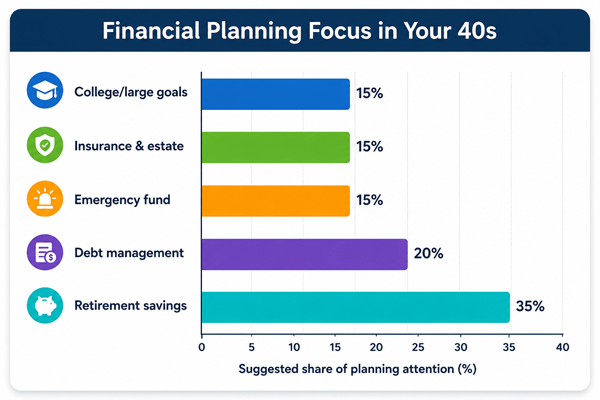
Chart: A simple way to think about financial planning attention in your 40s. Your own percentages may differ depending on your debt, family situation, job security, retirement progress, and country-specific rules.
■ The Main Money Goals to Focus on in Your 40s
A strong financial plan in your 40s does not need to be complicated. It should cover seven core goals: know where you stand, strengthen your emergency fund, reduce expensive debt, increase retirement savings, invest with a suitable level of risk, protect your family with insurance and estate planning, and plan for big upcoming expenses.
The best order depends on your situation. For example, someone with high-interest credit card debt may need to attack that debt before aggressively investing in a taxable brokerage account. Someone with no emergency fund may need to build cash savings before making extra mortgage payments. A good plan is not just mathematically smart; it is also realistic enough to follow.
Goal 1: Know Your Current Financial Position
Before setting new goals, create a simple personal financial snapshot. List what you own, what you owe, what comes in, and what goes out. This gives you a starting point and helps you make decisions based on facts instead of stress.
Your snapshot should include cash, retirement accounts, investment accounts, home equity, vehicles, business interests, loans, credit card balances, mortgage balance, insurance coverage, and monthly spending. Update it at least once a year.
Goal 2: Build or Rebuild a Strong Emergency Fund
An emergency fund is money set aside for unplanned expenses such as job loss, medical bills, urgent home repairs, car repairs, or family emergencies. In your 40s, an emergency fund becomes more important because your responsibilities may be larger and financial disruptions can affect more people.
A common target is three to six months of essential expenses. Consider saving more if your income is irregular, you are self-employed, you support children or parents, you have a single-income household, or your job is vulnerable to layoffs. Keep this money accessible and low risk, such as in a savings account or money market account, not in volatile investments.
Goal 3: Eliminate High-Interest Debt
Debt is not all the same. A fixed-rate mortgage may be manageable if the payment fits your budget. High-interest credit card debt is different because it can grow quickly and reduce your ability to save. In your 40s, high-interest debt can quietly steal money from retirement, education savings, insurance, and future freedom.
Two popular debt payoff methods are the avalanche method and the snowball method. The avalanche method pays extra toward the debt with the highest interest rate first. It usually saves the most money. The snowball method pays the smallest balance first. It can build motivation because you see debts disappear faster.
Goal 4: Increase Retirement Contributions
Retirement planning is usually the biggest financial priority in your 40s. You may still have decades to invest, but the cost of waiting is higher than it was in your 20s or 30s. If you are behind, the answer is not panic. The answer is a structured catch-up plan.
Start by estimating how much income you may need in retirement. Then compare that goal with your current savings, expected future contributions, pension benefits if any, Social Security or government benefits if applicable, and other income sources. A retirement calculator can help, but the assumptions matter. Inflation, investment returns, healthcare costs, and retirement age can all change the result.
Goal 5: Invest With a Clear Strategy
In your 40s, investing should be neither careless nor overly fearful. You likely still need growth because retirement may be 15 to 25 years away. At the same time, you should understand how much risk you are taking and whether your investments match your time horizon.
A simple investment plan usually covers asset allocation, diversification, contribution schedule, rebalancing rules, account types, and what you will do during market declines. The purpose is to reduce emotional decisions. A beginner-friendly approach is to use broadly diversified funds appropriate for your risk tolerance and retirement timeline.
Goal 6: Protect Your Family With Insurance
Financial planning is not only about growing money. It is also about protecting the progress you have already made. In your 40s, insurance needs may increase because people may depend on your income and unpaid work.
Review health insurance, life insurance, disability insurance, homeowners or renters insurance, auto insurance, umbrella liability insurance, and long-term care planning. The right coverage depends on your dependents, debt, assets, employer benefits, health, and location.
Goal 7: Update Estate Planning Documents
Estate planning is often ignored because it feels uncomfortable, but it is a practical act of care. At a basic level, adults in their 40s should consider a will, beneficiary designations, powers of attorney, healthcare directives, guardianship instructions for minor children, and a clear list of key accounts and documents.
Beneficiary designations are especially important because they can override what your will says for accounts such as retirement plans and life insurance. Review them after marriage, divorce, birth or adoption of a child, death of a beneficiary, or major family change.
Personal Financial Snapshot Template
| Category | What to List | Why It Matters |
|---|---|---|
| Assets | Cash, retirement accounts, investments, home equity, business value | Shows what you own and where your wealth is located |
| Debts | Mortgage, credit cards, personal loans, student loans, auto loans | Shows what is reducing your net worth and cash flow |
| Income | Salary, business income, side income, bonuses, rental income | Helps set realistic saving and debt payoff goals |
| Spending | Housing, food, transportation, insurance, childcare, subscriptions | Shows where money is going each month |
| Protection | Insurance policies, beneficiaries, estate documents | Shows whether your family is protected from major risks |
Debt Payoff Methods Compared
| Method | How It Works | Best For | Limitation |
|---|---|---|---|
| Avalanche | Pay minimums on all debts, then put extra money toward the highest interest rate | Saving the most interest over time | Can feel slow if the highest-rate debt has a large balance |
| Snowball | Pay minimums on all debts, then put extra money toward the smallest balance | Building motivation and quick wins | May cost more interest than avalanche |
| Hybrid | Clear one or two small debts, then switch to highest interest rate | People who need motivation and efficiency | Requires discipline to switch methods |
Emergency Fund Targets in Your 40s
| Situation | Suggested Target | Reason |
|---|---|---|
| Stable dual-income household | 3-6 months of essential expenses | Income risk is shared |
| Single-income household | 6-9 months | One job loss can affect the whole household |
| Self-employed or commission-based | 6-12 months | Income may be uneven |
| Supporting children or parents | 6+ months | More people rely on your cash flow |
| High medical or housing risk | 6+ months | Large surprise expenses are more likely |
■ Retirement Planning in Your 40s: A Practical Catch-Up Strategy
Retirement planning in your 40s should become specific. Instead of saying, "I need to save more," turn it into numbers: current retirement balance, monthly contribution, employer match, target retirement age, estimated annual retirement spending, and the gap you need to close.
A practical order is: contribute enough to get any employer match, pay down high-interest debt, increase retirement contributions by 1% to 2% of income each year, invest consistently, and review your progress annually. If you receive raises, bonuses, tax refunds, or side-income, direct a portion to retirement before lifestyle spending expands.
For U.S. readers, 2026 employee salary deferrals for many workplace retirement plans such as 401(k), 403(b), and most 457 plans are limited to $24,500. The general age-50 catch-up amount is $8,000, and eligible workers age 60 to 63 may have a higher catch-up amount of $11,250 in eligible plans. For 2026, the IRA contribution limit is $7,500, with a $1,100 catch-up amount for individuals age 50 and older. Always verify the current limit before contributing.
Even if you cannot max out retirement accounts, increasing the savings rate matters. For example, if a 42-year-old earning $90,000 raises retirement saving from 8% to 12%, that is an extra $3,600 per year before investment growth. Over 20 years, consistent increases can make a meaningful difference.
■ How Much Should You Save for Retirement in Your 40s?
There is no single perfect number because retirement depends on your income, lifestyle, location, family situation, healthcare costs, debt, and desired retirement age. A useful beginner target is to save 15% to 20% of gross income for retirement if you are on track, and potentially more if you started late.
Do not rely only on broad rules of thumb. They can be helpful, but they are not a substitute for a personal estimate. Someone with a paid-off home, pension, and modest lifestyle may need less from investments than someone renting in a high-cost city with no pension. The key is to measure your own gap.
■ Budgeting and Cash Flow Best Practices in Your 40s
A budget in your 40s should not feel like punishment. It is a decision tool. It tells you how much money is available for today, how much must go toward obligations, and how much can be directed toward future goals.
A practical system is to divide income into four buckets: needs, future goals, debt payoff, and lifestyle choices. The exact percentages can vary, but the purpose is to make sure important goals are funded before money disappears into unplanned spending.
Review recurring expenses at least twice a year. Subscriptions, insurance premiums, phone plans, storage units, unused memberships, and convenience spending can quietly grow over time. Cutting waste is often easier than making extreme sacrifices.
Sample Monthly Budget for a 40-Something Household
| Category | Example Share | Notes |
|---|---|---|
| Housing and utilities | 25%-35% | Keep housing affordable enough to still save |
| Food, transportation, essentials | 20%-30% | Track variable costs closely |
| Retirement and investing | 15%-20%+ | Increase if behind or if income rises |
| Debt payoff | 5%-15% | Prioritize high-interest debt |
| Insurance and protection | 5%-10% | Includes health, life, disability, property, liability |
| Lifestyle and giving | Flexible | Enjoy life, but keep it aligned with goals |
■ Investment Risk in Your 40s: Growth vs. Safety
Your 40s are not usually the time to abandon growth completely. Inflation can reduce purchasing power, and retirement may last decades. However, you should also avoid taking risks you do not understand. The right balance depends on when you need the money.
Money needed within one to three years is usually better kept in cash or low-risk savings. Money needed in three to seven years may need a conservative mix. Long-term retirement money can usually accept more market volatility because it has more time to recover, though the exact mix depends on your risk tolerance.
| Goal Time Horizon | Example Goal | Possible Approach | Key Risk |
|---|---|---|---|
| 0-3 years | Emergency fund, home repair fund | Cash, high-yield savings, money market | Inflation may outpace interest |
| 3-7 years | Car replacement, college costs soon | Conservative diversified mix | Market losses close to spending date |
| 7-15 years | Later college costs, business goal | Balanced mix based on need and risk tolerance | Too much or too little risk |
| 15+ years | Retirement savings | Diversified long-term portfolio | Emotional selling during downturns |
■ Planning for College, Parents, and Family Responsibilities
Many people in their 40s are part of the "sandwich generation," supporting children while also helping aging parents. This can create emotional and financial pressure. The best approach is to plan early and communicate clearly.
If you want to help pay for a child’s education, decide how much you can realistically contribute without sacrificing retirement. Your child may have scholarships, work, grants, or loans available. Your retirement has fewer backup options. A balanced approach is often better than funding college at the cost of your own long-term security.
If parents may need support, discuss expectations before a crisis. Ask about healthcare wishes, insurance, legal documents, housing preferences, debts, and whether they have a power of attorney. These conversations can be uncomfortable, but they reduce confusion later.
■ Tax Planning Best Practices in Your 40s
Tax planning is not about avoiding legal responsibilities. It is about arranging your finances efficiently within the rules. In your 40s, review whether you are using the right account types, withholding enough tax, keeping good records, and taking advantage of eligible deductions or credits.
Common areas to review include retirement contributions, health savings accounts if eligible, education savings accounts, charitable giving records, capital gains, business expenses, and the tax impact of selling investments. Because tax rules change and personal situations vary, professional advice can be valuable. Keep copies of official records and avoid relying on outdated limits, because retirement, tax, and benefits rules are updated periodically.
■ Financial Planning Checklist for Your 40s
- Calculate your net worth once or twice a year.
- Track monthly cash flow and identify wasteful recurring expenses.
- Build an emergency fund based on your household risk level.
- Pay off high-interest debt as quickly as possible.
- Contribute enough to retirement accounts to capture any employer match.
- Increase retirement contributions when income rises.
- Review asset allocation and rebalance investments if needed.
- Check life and disability insurance coverage.
- Update beneficiaries on retirement accounts and insurance policies.
- Create or update a will, powers of attorney, and healthcare directives.
- Plan for college costs without weakening retirement security.
- Discuss aging-parent financial and healthcare documents when appropriate.
- Review tax strategy before year-end.
- Protect your credit score and monitor credit reports.
- Set one-year, five-year, and retirement goals in writing.
- Verify contribution limits, tax rules, and benefits information from official sources before making decisions.
■ Common Financial Planning Mistakes to Avoid in Your 40s
- Waiting too long to check retirement progress: Many people avoid the number because they fear it will be discouraging. But knowing the gap gives you power. Even if you are behind, you can adjust contributions, spending, retirement age, or income strategy.
- Letting lifestyle inflation absorb every raise: A bigger income can create bigger spending. Before upgrading your lifestyle, decide what percentage of each raise will go toward savings, investing, or debt payoff.
- Paying for college while ignoring retirement: Helping children is generous, but your retirement security matters too. Avoid borrowing heavily or draining retirement accounts for education expenses without understanding the long-term cost.
- Keeping too much debt: Debt payments reduce flexibility. High-interest debt should be treated as an urgent financial leak.
- Being underinsured: A serious illness, disability, lawsuit, or premature death can damage a family financially. Insurance is boring until it becomes essential.
- Investing emotionally: Market declines are normal. A written investment plan helps prevent panic selling, chasing trends, or making decisions based on headlines.
- Ignoring estate planning: Without basic documents, your family may face stress, delays, and legal complications. Estate planning is not only for wealthy people.
■ Real-World Scenarios
Scenario 1: Behind on retirement but earning well
A 45-year-old earns a good income but has only a small retirement balance. The best first steps are to calculate the retirement gap, capture the employer match, increase contributions gradually, cut low-value expenses, and direct bonuses toward retirement. The goal is steady improvement, not overnight perfection.
Scenario 2: High credit card debt and no emergency fund
A 41-year-old has credit card debt and almost no savings. The first move is to build a small starter emergency fund, then attack the highest-interest debt while avoiding new charges. Once the debt is under control, they can expand emergency savings and increase retirement contributions.
Scenario 3: Supporting children and aging parents
A couple in their late 40s pays for school activities and helps a parent with medical bills. They need a family cash-flow plan, insurance review, clear boundaries, and conversations about parent documents. They should avoid sacrificing retirement savings unless there is no alternative.
■ Pros and Cons of Making Big Financial Changes in Your 40s
| Pros | Cons or Challenges |
|---|---|
| Higher income may make faster progress possible | Family and housing costs may be high |
| You still have time for compounding to work | There is less time to recover from major mistakes |
| Better clarity about life goals and career direction | Lifestyle habits may be harder to change |
| Insurance and estate planning can protect dependents | Professional advice may be needed for complex situations |
| Debt payoff can quickly improve cash flow | Aggressive changes can feel restrictive if not planned well |
■ Best Practices for Financial Planning in Your 40s
- Make your plan measurable. Use numbers, dates, and monthly contribution targets.
- Automate savings and investing so progress does not depend on willpower alone.
- Protect your household from major risks before chasing complex investments.
- Increase retirement savings when income rises rather than only increasing spending.
- Use debt strategically, but eliminate high-interest debt quickly.
- Keep short-term money safe and long-term money invested according to a plan.
- Review your plan annually and after major life events.
- Get professional help for tax, legal, insurance, and investment questions that are beyond your knowledge.
Short: What Should You Do Financially in Your 40s?
In your 40s, focus on increasing retirement savings, paying off high-interest debt, building a strong emergency fund, reviewing insurance, updating estate documents, investing with a clear long-term strategy, and planning for family responsibilities such as college costs or aging parents. The main goal is to convert higher earning years into long-term financial security.
■ Frequently Asked Questions
1. Is it too late to start financial planning in your 40s?
No. It is not too late, but it is important to act. You may still have 20 or more working years ahead. Start with a financial snapshot, reduce expensive debt, build emergency savings, and increase retirement contributions.
2. How much should I have saved by age 40?
There is no universal number. A useful answer depends on income, lifestyle, debt, family needs, retirement age, and location. Instead of comparing yourself to one rule of thumb, estimate your future retirement spending and calculate the gap between your current savings and your goal.
3. Should I pay off my mortgage early or invest more?
It depends on your interest rate, risk tolerance, tax situation, retirement progress, and need for flexibility. High-interest debt usually deserves priority. For a low-rate mortgage, many people choose to invest while making regular payments. Others value the emotional security of being mortgage-free.
4. Should retirement or college savings come first?
Retirement usually comes first because you cannot borrow for retirement in the same way students may access scholarships, grants, work, or loans. A balanced approach can help children without putting your future security at risk.
5. What insurance do I need in my 40s?
Common policies to review include health, life, disability, homeowners or renters, auto, umbrella liability, and sometimes long-term care planning. The right amount depends on dependents, income, debts, assets, and employer benefits.
6. How often should I review my financial plan?
Review your plan at least once a year and whenever life changes, such as marriage, divorce, birth of a child, job change, home purchase, inheritance, major illness, or death in the family.
7. What is the biggest money mistake people make in their 40s?
One of the biggest mistakes is delaying retirement planning while maintaining a lifestyle that consumes most income. Another major mistake is ignoring insurance and estate planning when dependents rely on your income.
8. Do I need a financial advisor in my 40s?
Not everyone needs an advisor, but professional guidance can be useful if you have complex taxes, business income, stock compensation, divorce, inheritance, estate planning needs, or uncertainty about retirement readiness.
9. What is a simple financial planning checklist for your 40s?
A simple checklist is to calculate net worth, build an emergency fund, pay down high-interest debt, increase retirement contributions, review insurance, update beneficiaries and estate documents, invest according to your time horizon, and review your plan once a year.
■ Final Thoughts
Financial planning in your 40s is about turning responsibility into confidence. You do not need a perfect plan, a huge income, or advanced investment knowledge to make progress. You need clarity, consistency, and protection against the biggest risks.
Start with your current numbers. Build cash reserves. Remove high-interest debt. Increase retirement contributions. Invest with a plan. Protect your family. Update legal documents. Then repeat the review every year. These steps may sound simple, but they can create a stronger financial foundation for the rest of your life.
Sources Consulted:
- Internal Revenue Service (IRS), 2026 retirement plan contribution limits: https://www.irs.gov/newsroom/401k-limit-increases-to-24500-for-2026-ira-limit-increases-to-7500
- IRS, COLA increases for dollar limitations on benefits and contributions: https://www.irs.gov/retirement-plans/cola-increases-for-dollar-limitations-on-benefits-and-contributions
- IRS, Retirement topics: catch-up contributions: https://www.irs.gov/retirement-plans/plan-participant-employee/retirement-topics-catch-up-contributions
- Consumer Financial Protection Bureau, emergency fund guidance: https://www.consumerfinance.gov/an-essential-guide-to-building-an-emergency-fund/
- Social Security Administration, retirement age calculator and full retirement age information: https://www.ssa.gov/benefits/retirement/planner/ageincrease.html
Reader Advice: This article is for educational and information purposes only and should not be taken as personal financial, tax, legal, insurance, or investment advice. Please check the latest official sources or speak with a qualified professional, because rules, policies, and limits can change over time.