Financial Planning Checklist: What to Review and Update
A financial plan is not something you create once and forget. Your income changes, expenses rise, debts get paid off, markets move, families grow, and goals shift. A financial planning checklist helps you review the most important parts of your money life so your plan stays realistic and useful.
This guide is written for beginners. You do not need advanced financial knowledge to use it. Think of it as a regular money checkup. The purpose is to spot problems early, update your goals, and make small decisions before they become expensive mistakes.
Quick answer: Review your budget monthly, your progress quarterly, and your full financial plan annually or after a major life event. This simple rhythm helps keep your plan current without making money management feel overwhelming.
1. What Is a Financial Planning Checklist?
A financial planning checklist is a structured list of money areas to review on a regular schedule. It usually covers income, spending, savings, debt, insurance, investments, taxes, retirement, estate planning, and major life changes.
The checklist helps answer practical questions such as: Am I spending more than I earn? Is my emergency fund still enough? Are my insurance policies up to date? Are my beneficiaries correct? Are my investments still aligned with my goals and risk tolerance?
2. Why Reviewing Your Financial Plan Matters
Financial planning is useful because life changes. A budget that worked last year may not fit today. An insurance policy that was enough when you were single may be too small after marriage or children. An investment mix that felt comfortable before may no longer match your timeline.
- It helps you catch overspending before it becomes debt.
- It keeps savings goals visible and measurable.
- It reduces the chance of missed bills, lapsed insurance, or outdated beneficiaries.
- It helps you prepare for taxes, emergencies, and major purchases.
- It gives you confidence because your decisions are based on current information, not guesses.
3. How Often Should You Review Your Financial Plan?
Not every item needs to be reviewed every month. Some money tasks are best checked monthly, while others only need a quarterly or annual review. The table below gives a practical schedule.
| Review Timing | What to Check | Why It Matters |
|---|---|---|
| Monthly | Budget, cash flow, bills, recent spending, savings transfers, debt payments | To stay on track and avoid surprises |
| Quarterly | Net worth, goal progress, investment contributions, insurance needs, subscriptions | To make adjustments before the year gets away from you |
| Annually | Tax planning, retirement progress, estate documents, beneficiaries, policy coverage, major goals | To update the big-picture plan |
| After a life event | Marriage, divorce, new child, job change, home purchase, inheritance, illness, relocation | To make sure the plan still fits your life |
■ The Complete Financial Planning Checklist
Use the following checklist as a step-by-step review. You can complete it in one sitting once a year, or divide it into smaller monthly and quarterly tasks.
Tip for readers: If you are short on time, start with the sections that can create the biggest financial risk: cash flow, emergency savings, high-interest debt, insurance coverage, beneficiaries, and tax deadlines.
1. Review Your Financial Goals
Start with your goals because they guide the rest of your plan. A financial plan should connect your money decisions to real outcomes, such as building an emergency fund, buying a home, paying off debt, saving for education, or preparing for retirement.
What to review
- Short-term goals: goals you want to reach within one year, such as saving for a small emergency fund or paying off a credit card.
- Medium-term goals: goals that may take one to five years, such as buying a car, saving for a wedding, or building a home down payment.
- Long-term goals: goals more than five years away, such as retirement, children’s education, or financial independence.
What to update
- Update the target amount if prices have changed.
- Adjust deadlines if your income or expenses have changed.
- Remove goals that no longer matter and add new ones.
- Rank goals by priority so your money has a clear direction.
Example: If your goal was to save $5,000 for an emergency fund but your monthly expenses increased, your new target may need to be $7,000 or more. The goal is not just a fixed number; it should reflect your current life.
2. Review Your Income
Your income is the starting point for your budget, savings plan, and debt repayment strategy. Review all sources of income, not just your main salary.
- Salary or wages
- Business or freelance income
- Rental income
- Investment income
- Side hustle income
- Government benefits or support payments
Questions to ask
- Is my income stable, increasing, or decreasing?
- Do I rely too much on one income source?
- Do I need to update my budget because of a raise, bonus, job loss, or reduced hours?
- Can I use extra income for savings, debt payoff, or investing instead of lifestyle spending?
3. Review Your Spending and Budget
A budget is not about restricting every choice. It is a plan for how your income will be used. During your financial planning review, compare your actual spending with your planned spending.
| Budget Area | Examples | Review Action |
|---|---|---|
| Fixed needs | Rent or mortgage, utilities, insurance, loan payments | Check whether costs increased and shop around where possible |
| Variable needs | Groceries, fuel, medical costs, transportation | Look for patterns and realistic spending limits |
| Wants | Dining out, entertainment, shopping, travel | Cut or adjust if goals are falling behind |
| Savings and investing | Emergency fund, retirement, sinking funds | Automate transfers where possible |
Common budget updates
- Increase grocery, rent, or utility categories if actual costs have risen.
- Cancel subscriptions you no longer use.
- Create sinking funds for predictable expenses like car repairs, school fees, holidays, or annual insurance premiums.
- Move savings to the beginning of the month instead of waiting to save what is left.
4. Review Your Emergency Fund
An emergency fund is money set aside for unexpected but necessary expenses, such as medical bills, urgent car repairs, job loss, or essential home repairs. It protects you from relying on high-interest debt when life does not go as planned.
What to check
- Current emergency fund balance
- Your essential monthly expenses
- How many months of expenses your fund covers
- Whether the money is easy to access and kept separate from daily spending money
A common beginner target is to build a small starter fund first, then work toward three to six months of essential expenses. The right amount depends on job stability, family responsibilities, health needs, and access to other support.
For irregular income, dependents, business owners, or higher health or housing risk, a larger cushion may be more realistic. Keep this money accessible and separate from investments that can lose value in the short term.
5. Review Your Debt
Debt can be useful or harmful depending on the cost, purpose, and repayment plan. Your review should focus on interest rates, balances, payment progress, and whether the debt is helping or hurting your financial goals.
| Debt Type | Examples | Review Priority |
|---|---|---|
| High-interest debt | Credit cards, payday loans, expensive personal loans | Prioritize payoff because interest can grow quickly |
| Moderate-interest debt | Some personal loans, auto loans | Pay on schedule and consider extra payments if goals allow |
| Lower-interest long-term debt | Mortgage, some student loans | Review affordability, term, and refinancing options if appropriate |
What to update
- List each debt with balance, interest rate, minimum payment, and due date.
- Choose a repayment method, such as debt avalanche for highest interest first or debt snowball for smallest balance first.
- Check whether extra payments are going to the right debt.
- Avoid adding new debt while trying to pay down old debt.
6. Review Your Credit Report and Credit Habits
Your credit history can affect loan approvals, interest rates, rental applications, and sometimes insurance or employment checks depending on your country. A financial planning review should include credit habits even if you are not planning to borrow soon.
- Check for late payments, errors, unfamiliar accounts, or signs of identity theft.
For U.S. readers, AnnualCreditReport.com is the official source for free credit reports from the three nationwide credit bureaus. Readers in other countries should use their official credit bureau or financial regulator websites.
- Keep credit card balances low compared with limits.
- Pay bills on time and set reminders or autopay for minimum payments.
- Avoid applying for too many new credit accounts in a short time.
7. Review Insurance Coverage
Insurance protects your plan from major financial shocks. The goal is not to buy every policy available. The goal is to make sure your biggest risks are covered at a reasonable cost.
| Insurance Type | What It Protects | What to Review |
|---|---|---|
| Health insurance | Medical bills, hospital care, prescriptions | Coverage limits, deductibles, network, family needs |
| Life insurance | Income replacement for dependents | Benefit amount, term length, beneficiaries |
| Disability or income protection | Loss of income due to illness or injury | Waiting period, monthly benefit, policy exclusions |
| Auto insurance | Vehicle damage, liability, accidents | Coverage levels, deductibles, discounts |
| Homeowners or renters insurance | Property loss, liability, belongings | Replacement value, exclusions, updated asset list |
Update insurance after major life events such as marriage, divorce, having a child, buying a home, starting a business, or taking on significant debt.
8. Review Savings Accounts and Cash Management
Good cash management helps you avoid overdrafts, missed payments, and confusion. Your money should have clear jobs: daily spending, emergency savings, short-term goals, and bills.
- Make sure bill money is separate from spending money if you tend to overspend.
- Use separate savings buckets for goals such as travel, repairs, school, or taxes.
- Check account fees and minimum balance requirements.
- Keep emergency savings accessible, not locked into risky or hard-to-access investments.
9. Review Investments
Investing is usually for long-term goals. Your review should focus on whether your investment mix still matches your goal timeline, risk tolerance, and contribution plan. Avoid making emotional decisions based only on short-term market movements.
Avoid any investment that promises guaranteed high returns, uses pressure tactics, or is difficult to understand. A written investment policy or simple target allocation can help you make calmer decisions.
What to review
- Your asset allocation, such as stocks, bonds, cash, or other investments.
- Your contribution amount and whether it is automated.
- Fees and expense ratios where applicable.
- Whether your investments are too risky or too conservative for your timeline.
- Whether your portfolio needs rebalancing.
Example: If your retirement goal is 25 years away, you may accept more short-term ups and downs than someone who needs the money in three years. Money needed soon should usually be kept more stable and accessible.
10. Review Retirement Planning
Retirement planning is part of financial planning even if retirement feels far away. The earlier you start, the more time your money has to grow. During your review, check whether your current savings rate is likely to support your future lifestyle.
- Review retirement account balances and contribution rates.
- Increase contributions after a raise if your budget allows.
- Check employer matching opportunities if available.
- Review your expected retirement age and income needs.
- Make sure your investment risk level fits your retirement timeline.
11. Review Tax Planning
Tax planning means organizing your financial life so you are not surprised at tax time. The details vary by country, so beginners should focus on records, deductions, withholding, and major income changes.
- Keep records of income, deductible expenses, charitable donations, business expenses, and investment tax documents.
- Review tax withholding or estimated tax payments after a raise, job change, side business, marriage, or new child.
Because tax rules change, check current forms, deadlines, and rates from your official tax authority before making decisions.
- Plan ahead before selling investments, property, or business assets.
- Ask a qualified tax professional for guidance when your situation becomes complex.
12. Review Estate Planning Documents
Estate planning is not only for wealthy people. It is about making sure your wishes are clear if you die or become unable to make decisions. The required documents depend on your country and personal situation.
| Document | Purpose | When to Update |
|---|---|---|
| Will | Names who should receive assets and who may care for minor children | After marriage, divorce, child birth, death of a beneficiary, or major asset changes |
| Beneficiary designations | Names who receives accounts such as life insurance or retirement funds | At least annually and after any major relationship change |
| Power of attorney | Names who can handle financial matters if you cannot | When trusted contacts change or laws change |
| Healthcare directive | Explains medical wishes and decision-makers | After health changes or family changes |
13. Review Beneficiaries and Account Ownership
Beneficiary forms can override instructions in other documents in many situations, so they deserve special attention. Outdated beneficiaries are a common financial planning mistake.
- Review life insurance beneficiaries.
- Review retirement account beneficiaries.
- Review bank or investment account transfer-on-death instructions if available.
- Make sure names, percentages, and backup beneficiaries are correct.
- Do not leave an ex-spouse, deceased person, or minor child listed without understanding the consequences.
14. Review Major Life Changes
A financial plan should change when your life changes. Do a special review whenever something important happens.
| Life Event | Financial Items to Review |
|---|---|
| New job or income change | Budget, taxes, retirement contributions, insurance benefits |
| Marriage or divorce | Beneficiaries, insurance, estate documents, joint accounts, debt responsibilities |
| New child | Emergency fund, life insurance, education savings, guardianship documents |
| Home purchase | Insurance, maintenance fund, mortgage plan, emergency fund |
| Starting a business | Taxes, insurance, cash reserves, retirement options, legal structure |
| Health change | Insurance, emergency fund, healthcare directive, disability coverage |
15. Review Your Net Worth
Net worth is what you own minus what you owe. It is not a measure of personal value, but it is a useful financial tracking number. Reviewing it once or twice a year helps you see whether your overall financial position is improving.
Basic formula
Assets - Liabilities = Net Worth
Examples of assets
- Cash and savings
- Investments
- Retirement accounts
- Home equity
- Business value
- Vehicles or valuable property
Examples of liabilities
- Credit card balances
- Student loans
- Auto loans
- Personal loans
- Mortgage balance
- Business debt
16. Review Financial Documents and Password Access
Good records make financial decisions easier and help family members if there is an emergency. Keep important documents organized and secure.
- Recent bank, investment, insurance, loan, and tax documents
- Property documents, lease agreements, vehicle records, and business records
- Copies of wills, powers of attorney, and healthcare directives
- A secure password manager or emergency access plan for trusted people
■ Monthly, Quarterly, and Annual Financial Planning Checklist
Monthly checklist
- Review income received and bills paid.
- Compare actual spending with your budget.
- Check credit card balances and due dates.
- Transfer money to savings and investment goals.
- Review upcoming irregular expenses.
- Make at least the minimum debt payments on time.
Quarterly checklist
- Update your net worth statement.
- Review progress toward savings and debt goals.
- Check subscriptions and recurring charges.
- Review investment contributions and asset allocation.
- Update sinking funds for upcoming expenses.
- Check whether insurance needs have changed.
Annual checklist
- Review all financial goals and target dates.
- Review insurance policies and compare coverage needs.
- Review tax documents and withholding.
- Review retirement contributions and investment strategy.
- Review estate documents and beneficiaries.
- Set a financial calendar for the next year.
■ Printable Financial Planning Review Table
| Area | What to Review | How Often | Done |
|---|---|---|---|
| Goals | Targets, deadlines, priority | Annual or after life event | |
| Budget | Income, expenses, savings rate | Monthly | |
| Emergency fund | Balance and months of expenses covered | Quarterly | |
| Debt | Balances, rates, payoff strategy | Monthly or quarterly | |
| Credit | Reports, errors, payment habits | Annual | |
| Insurance | Coverage, deductibles, beneficiaries | Annual or after life event | |
| Investments | Asset allocation, fees, contributions | Quarterly or annual | |
| Retirement | Savings rate, employer match, timeline | Annual | |
| Taxes | Withholding, records, major changes | Annual and before tax deadlines | |
| Estate plan | Will, power of attorney, healthcare directive | Annual or after life event | |
| Documents | Statements, passwords, account list | Annual |
■ Simple Financial Planning Diagram
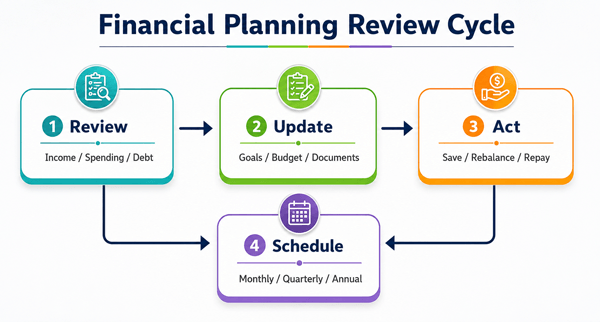
Figure: A simple review cycle for keeping your financial plan current.
■ Common Financial Planning Mistakes to Avoid
- Creating a plan once and never reviewing it again.
- Saving only what is left instead of paying yourself first.
- Ignoring small recurring expenses that quietly reduce cash flow.
- Keeping emergency savings invested in risky assets.
- Forgetting to update beneficiaries after major life changes.
- Buying too little insurance or paying for coverage you no longer need.
- Changing investments too often because of short-term market fear.
- Not keeping tax and legal documents organized.
■ When Should You Get Professional Help?
Many beginner financial planning tasks can be handled on your own, especially budgeting, goal setting, debt tracking, and document organization. However, professional advice can be valuable when decisions are complex or high-impact.
- You have a complicated tax situation, business income, or income from multiple countries.
- You are planning for retirement and are unsure how much you need.
- You recently inherited money or sold a major asset.
- You are going through divorce, estate settlement, or a major legal change.
- You need help choosing insurance or investment strategies.
- You want an objective review of your full financial plan.
A qualified financial planner, tax professional, attorney, or insurance specialist can help with areas that require technical knowledge. Make sure you understand how the professional is paid and whether they are required to act in your best interest.
Before paying for advice, ask about credentials, fees, conflicts of interest, services included, and whether recommendations will be documented in writing.
■ Practical Example: Annual Financial Plan Review
Imagine a couple reviews their finances every January. Last year, they saved $3,000, paid off one credit card, and started contributing to retirement. This year, their rent increased, they had a baby, and one partner changed jobs.
Their checklist shows several updates: increase the emergency fund target, add life insurance, update beneficiaries, review health insurance, adjust the grocery budget, increase retirement contributions after the new job probation period, and create a child-related savings category. Without a checklist, some of these updates could easily be missed.
■ Financial Planning Checklist FAQs
1. What should be included in a financial planning checklist?
A good financial planning checklist should include goals, budget, income, expenses, emergency fund, debt, credit, insurance, savings, investments, retirement, taxes, estate documents, beneficiaries, and financial records.
2. How often should I review my financial plan?
Review your budget monthly, your goals and net worth quarterly, and your full financial plan at least once a year. Also review your plan after major life events such as marriage, divorce, a new child, job change, home purchase, or serious illness.
3. What is the most important part of financial planning?
The most important part is making sure your plan matches your real life. A perfect-looking plan is not useful if it ignores your income, expenses, risks, habits, and goals.
4. Do I need a financial planner to use this checklist?
No. Beginners can use this checklist to organize their finances and make better everyday decisions. Professional help may be useful for taxes, estate planning, investments, insurance, or complex life situations.
5. What financial documents should I review every year?
Review bank statements, loan statements, insurance policies, investment statements, retirement account statements, tax documents, estate documents, beneficiary forms, property records, and any business or employment benefit documents.
6. What should I update after getting married or divorced?
Review your budget, insurance, beneficiaries, estate documents, account ownership, debt responsibilities, tax filing situation, emergency fund, and long-term goals.
7. What should I update after having a child?
Review your emergency fund, health insurance, life insurance, disability coverage, childcare budget, education savings, will, guardianship instructions, and beneficiaries.
■ Final Thoughts
A financial planning checklist helps you stay in control without needing to be a money expert. The key is to review your plan regularly, update it when life changes, and take small actions consistently. Start with the basics: know what comes in, know what goes out, protect yourself from emergencies, reduce costly debt, and keep your goals visible.
Your financial plan does not need to be perfect. It needs to be current, realistic, and useful. A simple checklist reviewed on a regular schedule can make your money decisions clearer and your long-term goals easier to reach.
Reader Advice: This article is for educational and informational purposes only and should not be taken as personal financial, tax, legal, insurance, or investment advice. Please check the latest information from official sources or a qualified professional, as rules, policies, and financial products can change over time.