SMART Financial Goals Explained: Examples and Best Practices
1. Introduction: Why Financial Goals Often Fail
Most people have money goals. They want to save more, pay off debt, buy a home, invest, start a business, or retire comfortably. The problem is that many goals are too vague. “I want to save money” sounds good, but it does not tell you how much to save, by when, or what actions you will take.
SMART financial goals solve this problem. They turn general wishes into clear, measurable plans. A SMART goal gives your money a job, gives you a deadline, and helps you track whether you are moving in the right direction.
This guide explains what SMART financial goals are, how they work, why they matter, and how to create your own. It includes real examples, beginner-friendly templates, best practices, and common mistakes to avoid.
2. What Are SMART Financial Goals?
SMART financial goals are money goals written using five clear standards: Specific, Measurable, Achievable, Relevant, and Time-bound. The SMART framework helps you define exactly what you want to accomplish and how you will measure success.
In personal finance, the SMART method is especially useful because it connects a goal to real cash flow: how much money is needed, how often action is required, and what trade-offs may be necessary to stay on track.
| SMART Element | What It Means | Financial Example |
|---|---|---|
| Specific | The goal clearly states what you want to do. | Save $3,000 for an emergency fund. |
| Measurable | You can track progress with numbers. | Save $250 per month. |
| Achievable | The goal fits your income and expenses. | Save $250 after reducing dining out and subscriptions. |
| Relevant | The goal supports your real priorities. | Build savings so a car repair does not become credit card debt. |
| Time-bound | The goal has a clear deadline. | Reach $3,000 in 12 months. |
3. SMART Financial Goal Formula
A simple formula is: I will [specific action] by [amount or result] by [deadline] by doing [main actions].
Example: I will save $3,000 for an emergency fund in 12 months by automatically transferring $250 per month to a separate savings account or high-yield savings account where available and suitable and reducing nonessential spending by $60 per week.
4. Why SMART Financial Goals Matter
SMART goals are useful because personal finance is not only about knowledge. It is also about behavior, consistency, and decision-making. A clear goal makes it easier to say yes to the right expenses and no to spending that does not match your priorities.
Key benefits of SMART money goals
- They reduce confusion by turning a broad wish into a clear target.
- They make progress visible, which can keep you motivated.
- They help you choose between competing priorities, such as saving, investing, and paying down debt.
- They make your budget more practical because every dollar can be connected to a goal.
- They help you adjust early if your plan is not working.
5. SMART Goals vs. Regular Financial Goals
| Regular Goal | SMART Financial Goal | Why the SMART Version Is Better |
|---|---|---|
| Save money. | Save $1,200 in 6 months by transferring $200 per month into a separate savings account. | It includes an amount, timeline, and action plan. |
| Pay off debt. | Pay off a $2,400 credit card balance in 10 months by paying about $240 toward principal plus any interest and fees each month. | It makes the required monthly payment clear. |
| Start investing. | Invest $100 per month in a diversified retirement account for the next 12 months. | It defines the habit and tracking period. |
| Spend less. | Reduce restaurant spending from $300 to $180 per month for the next 3 months. | It identifies the category and target limit. |
■ The Five Parts of a SMART Financial Goal
1. Specific: Define the Exact Money Goal
A specific goal answers what you want, why it matters, and where the money will go. Vague goals are easy to ignore because they do not create a clear next step.
| Vague Goal | Specific Goal |
|---|---|
| I want to save more. | I want to save $1,000 for a starter emergency fund. |
| I want to get better with money. | I want to create a monthly budget and track spending every Friday. |
| I want less debt. | I want to pay off my $1,800 credit card balance. |
2. Measurable: Use Numbers You Can Track
A measurable financial goal includes a number, such as a dollar amount, percentage, payment amount, or savings rate. Without measurement, you cannot know whether you are on track.
- Total amount: $5,000 saved, $10,000 invested, or $3,500 debt repaid.
- Monthly action: save $300 per month or pay an extra $150 toward debt.
- Percentage: save 15% of income or reduce grocery spending by 10%.
- Deadline-based progress: reach 50% of the goal by month six.
3. Achievable: Make the Goal Realistic
An achievable goal should challenge you without depending on unrealistic assumptions. If your after-tax income is $3,000 per month and your essential expenses are $2,600, saving $1,000 per month may not be realistic unless you increase income or reduce major expenses.
A goal becomes more achievable when you build it from your actual cash flow. Review income, fixed bills, variable spending, debt payments, and irregular expenses before choosing a monthly target.
4. Relevant: Connect the Goal to Your Priorities
A relevant financial goal matters to your life, not someone else’s lifestyle. Buying a new car, saving for a house, investing aggressively, or paying off debt can all be good goals depending on your situation. The right goal supports your values, responsibilities, and next stage of life.
5. Time-Bound: Set a Clear Deadline
A deadline creates urgency and helps you calculate the required monthly action. “Save $2,400” is useful, but “save $2,400 in 12 months” tells you that you need to save $200 per month.
■ Simple SMART Financial Goal Planning Diagram
Use this basic flow to turn a money idea into an action plan:
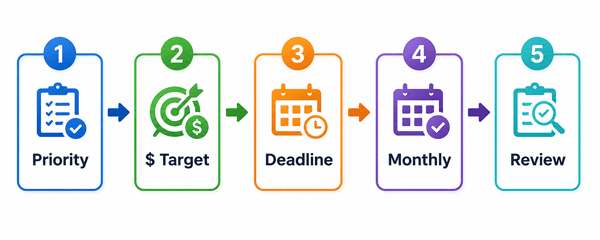
Diagram: A five-step SMART goal flow from choosing a priority to tracking and adjusting progress.
| Step 1 | Step 2 | Step 3 | Step 4 | Step 5 |
|---|---|---|---|---|
| Choose a priority | Set a dollar target | Pick a deadline | Calculate monthly action | Track and adjust |
6. SMART Financial Goals Examples for Beginners
Below are practical examples you can adapt to your own income, expenses, and priorities.
| Goal Type | SMART Financial Goal Example | How to Achieve It |
|---|---|---|
| Emergency fund | Save $1,500 in 10 months for unexpected expenses. | Transfer $150 monthly to a separate savings account; pause nonessential subscriptions until the goal is reached. |
| Debt payoff | Pay off a $3,000 credit card balance in 12 months. | Pay at least the calculated monthly principal amount plus any interest and fees each month; avoid adding new charges; consider a lower-rate balance transfer only if fees and terms make sense. |
| Budgeting | Track all spending for 90 days and keep dining out under $160 per month. | Use a budgeting app, spreadsheet, or notebook; review spending every weekend. |
| Vacation | Save $2,000 for a family trip in 8 months. | Save $250 monthly in a travel fund; compare lodging and transport costs before booking. |
| Home down payment | Save $15,000 for a down payment in 36 months. | Save about $417 monthly; direct bonuses or tax refunds to the fund; keep the money in a safe liquid account. |
| Retirement | Invest 10% of gross income for retirement by the end of the year. | Start at 5%, raise by 1% every two months, and use employer matching if available. |
| Education | Save $4,800 for professional training in 18 months. | Save about $267 monthly; compare course costs and expected career value before enrolling. |
7. Short-Term, Medium-Term, and Long-Term SMART Financial Goals
Financial goals are easier to organize when you group them by timeline. This helps you choose the right strategy and where to keep the money.
| Timeline | Typical Length | Examples | Where the Money Often Belongs |
|---|---|---|---|
| Short-term | 0 to 12 months | Starter emergency fund, holiday spending, small debt payoff. | Checking, savings, money market, or another low-risk liquid account. |
| Medium-term | 1 to 5 years | Car replacement, home down payment, wedding, education. | Savings, certificates of deposit, Treasury bills, or other low-risk options depending on timing and access needs. |
| Long-term | 5+ years | Retirement, financial independence, children’s education, major wealth building. | Retirement accounts, diversified investment accounts, or education savings accounts depending on the goal. |
■ How to Set SMART Financial Goals Step by Step
Step 1: Review Your Current Financial Situation
Before setting goals, understand your starting point. List your monthly income, essential expenses, debt balances, savings, and upcoming irregular costs. This prevents you from choosing goals that look good on paper but fail in real life.
Step 2: Choose One to Three Priorities
Trying to fix everything at once can become overwhelming. Start with the goals that reduce risk or create stability. For many beginners, this means building a starter emergency fund, paying down high-interest debt, and learning to budget.
Step 3: Write Each Goal in SMART Format
Use a clear sentence that includes the amount, deadline, and action plan. A written goal is easier to review and update.
Step 4: Break the Goal Into Monthly or Weekly Actions
Divide the total target by the number of months until the deadline. For example, a $1,200 goal over 12 months requires $100 per month. If that is too high, extend the timeline, reduce the target, increase income, or cut expenses.
Step 5: Automate What You Can
Automation reduces the need for willpower. You can automate savings transfers, retirement contributions, bill payments, or debt payments. Even small automatic transfers can build strong habits.
Step 6: Track Progress Regularly
Review your goal weekly or monthly. Tracking helps you catch problems early, celebrate progress, and make realistic changes.
Step 7: Adjust Without Quitting
Life changes. Income may drop, expenses may rise, or priorities may shift. Adjusting a financial goal is not failure. It is part of responsible planning.
■ SMART Financial Goal Worksheet Template
Use this template to create your own goal:
| Question | Your Answer |
|---|---|
| What exactly do I want to achieve? | |
| How much money is involved? | |
| Why does this goal matter to me? | |
| What is my deadline? | |
| How much must I save, invest, or pay each month? | |
| What spending changes or income actions will support this goal? | |
| How will I track progress? | |
| What could get in the way, and what is my backup plan? |
■ Best Practices for SMART Financial Goals
1. Start With Financial Stability First
If you are a beginner, prioritize stability before complex investing goals. A small emergency fund, on-time bill payments, and control over high-interest debt can protect you from setbacks.
2. Use Separate Accounts for Separate Goals
Separate accounts make progress easier to see. For example, you might have one savings account for emergencies, one for travel, and one for a car replacement fund.
3. Attach Goals to Payday
Schedule savings and debt payments soon after income arrives. This supports the “pay yourself first” approach and reduces the chance that the money gets spent accidentally.
4. Review Goals Monthly
A monthly review helps you compare planned progress with actual progress. Ask: Did I hit my target this month? If not, why? What will I change next month?
5. Keep Goals Visible
Put your goals where you will see them: a budgeting spreadsheet, phone note, planner, or dashboard. Visibility keeps priorities fresh.
6. Build in Flexibility
A good financial plan includes room for irregular expenses and unexpected changes. If your goal requires every dollar to go perfectly, it may be too fragile.
■ Common Mistakes to Avoid
| Mistake | Why It Hurts | Better Approach |
|---|---|---|
| Setting too many goals at once | Your money and attention get spread too thin. | Focus on one to three important goals first. |
| Ignoring irregular expenses | Car repairs, gifts, annual bills, and medical costs can derail the plan. | Create sinking funds for predictable irregular costs. |
| Choosing unrealistic deadlines | You may feel discouraged and quit. | Calculate the monthly amount before committing. |
| Not tracking progress | You cannot fix what you do not measure. | Review progress at least once per month. |
| Copying someone else’s goals | Their income, debt, family needs, and values may be different. | Choose goals based on your own situation. |
| Investing short-term money aggressively | Market drops can hurt money needed soon. | Keep short-term goal money in safer, liquid places. |
8. Real-World Scenario: Turning a Vague Goal Into a SMART Goal
Imagine Sara earns $3,200 per month after taxes. She has $600 in savings and wants to stop using her credit card for emergencies. Her vague goal is: “I want to save more money.”
After reviewing her budget, she finds she can save $175 per month by reducing takeout, canceling two unused subscriptions, and setting up an automatic transfer. Her SMART goal becomes: “I will build a $2,100 emergency fund in 12 months by automatically transferring $175 to a separate savings account every payday and reviewing my spending every Sunday.”
This goal works because it is specific, measurable, realistic for her cash flow, relevant to her need for financial security, and tied to a 12-month deadline.
9. How to Track SMART Financial Goals
Tracking does not need to be complicated. The best system is the one you will actually use. Beginners can start with a notebook, spreadsheet, bank account labels, or a budgeting app.
| Tracking Method | Best For | Simple Tip |
|---|---|---|
| Spreadsheet | People who like numbers and customization. | Create columns for target, current amount, monthly contribution, and deadline. |
| Budgeting app | People who want automatic categorization. | Review categories weekly so errors do not pile up. |
| Separate savings account | Savings goals and sinking funds. | Rename accounts by goal, such as “Emergency Fund” or “Car Fund.” |
| Debt payoff chart | Visual motivation. | Color in progress every time you make a payment. |
| Calendar reminders | Habit-building. | Schedule a 20-minute money review once a week. |
10. Pros and Cons of SMART Financial Goals
SMART goals are powerful, but they are not perfect. Understanding both sides helps you use the framework wisely.
| Pros | Cons or Limitations |
|---|---|
| Clear, measurable, and easy to track. | Can feel rigid if life changes suddenly. |
| Helps turn intentions into action. | May encourage overly narrow thinking if you ignore bigger values. |
| Useful for budgeting, saving, debt payoff, and investing habits. | Requires honest cash-flow review to be realistic. |
| Makes progress visible and motivating. | Not every financial priority can be perfectly measured. |
11. SMART Financial Goals and Budgeting
A budget is the monthly plan for your money. SMART financial goals give that budget direction. Without goals, a budget can feel like restriction. With goals, a budget becomes a tool that helps you pay for what matters most.
For example, cutting entertainment spending by $80 per month may feel frustrating in isolation. But if that $80 goes toward a debt-free vacation, an emergency fund, or a home down payment, the trade-off becomes easier to understand.
12. SMART Financial Goals and Debt Payoff
Debt payoff goals should include the balance, interest rate, minimum payment, extra payment, and deadline. High-interest debt, such as credit card debt, often deserves priority because it can grow quickly and reduce your financial flexibility.
Two common strategies are the debt snowball and debt avalanche. The snowball method focuses on paying the smallest balance first for motivation. The avalanche method focuses on the highest interest rate first to reduce total interest. Either method can work if you apply it consistently.
13. SMART Financial Goals and Investing
Investing goals are usually long-term. A beginner-friendly SMART investing goal might focus on behavior rather than predicting returns. For example: “I will invest $150 per month in my retirement account for the next 12 months and increase my contribution by 1% after my next raise.”
Be careful with short-term goals. Money needed within the next few years usually should not depend heavily on stock market performance, because markets can decline when you need the cash. A safer, more liquid option is usually better for short-term goals.
14. How Often Should You Review SMART Financial Goals?
Review short-term goals weekly or monthly. Review long-term goals quarterly or at least twice a year. Also review goals after major life changes such as a new job, marriage, a child, a move, a medical expense, or a change in income.
15. SMART Financial Goal Checklist
Before finalizing a goal, check whether it passes these tests:
- Can I explain the goal in one clear sentence?
- Does it include a specific dollar amount, payment amount, or percentage?
- Do I know the deadline?
- Have I calculated the monthly or weekly action needed?
- Does the goal fit my current income and expenses?
- Does it support something that truly matters to me?
- Do I have a tracking system?
- Do I have a backup plan if income drops or expenses rise?
■ Frequently Asked Questions
1. What is a SMART financial goal?
A SMART financial goal is a money goal that is Specific, Measurable, Achievable, Relevant, and Time-bound. It includes a clear target, deadline, and action plan.
2. What is an example of a SMART financial goal?
An example is: “I will save $1,200 in 12 months by transferring $100 per month into a separate emergency savings account.”
3. How many financial goals should I have at once?
Most beginners should focus on one to three goals at a time. Too many goals can make progress slow and confusing.
4. Are SMART goals only for saving money?
No. You can use SMART goals for saving, budgeting, debt payoff, investing, increasing income, reducing expenses, and planning major purchases.
5. What should my first SMART financial goal be?
For many beginners, a good first goal is a starter emergency fund, such as saving $500 to $1,000. The best first goal depends on your income, debt, and immediate risks.
6. What if I miss a monthly target?
Do not quit. Review what happened, adjust your spending or deadline, and continue. A missed month is feedback, not failure.
7. How do I make a goal achievable?
Base it on your real budget. Calculate how much you can save, invest, or pay toward debt after essential expenses and realistic living costs.
8. Should I save or pay off debt first?
It depends on your situation. Many people benefit from building a small emergency fund first, then focusing on high-interest debt while keeping minimum payments current.
9. Where should I keep money for short-term goals?
Short-term goal money is usually best kept in safe, liquid accounts such as checking, savings, or money market accounts. Avoid taking large investment risks with money you need soon.
10. How do I stay motivated?
Track progress visually, automate contributions, celebrate small milestones, and connect the goal to a meaningful reason, such as security, freedom, family, or opportunity.
■ Final Thoughts: Make Your Money Goals Clear and Actionable
SMART financial goals help beginners move from vague intentions to practical action. Instead of saying, “I want to be better with money,” you define exactly what better means, how much progress you need, and when you want to achieve it.
Start small if needed. A $25 weekly savings habit, a $50 extra debt payment, or a 30-day spending review can be a strong beginning. The goal is not perfection. The goal is to build a clear plan, follow it consistently, and adjust as your life changes.
The best SMART financial goal is one that is clear enough to guide your daily choices and realistic enough that you can keep going.
Reader Advice: This article is for educational and information purposes only and should not be taken as personal financial, investment, tax, or legal advice. Please check the latest information from official sources or a qualified professional, as rules, policies, account terms, and financial conditions can change over time.