How to Reach Financial Goals Faster: A Step-by-Step Guide
Reaching financial goals faster does not usually require a huge salary, perfect discipline, or risky investments. In most cases, faster progress comes from building a better system: clearer goals, fewer money leaks, automated saving, smart debt decisions, and regular tracking. When these pieces work together, you reduce guesswork and make your money easier to control.
This guide explains how financial goals work, why many people fall behind, and what practical steps can help you move faster. It is written for beginners, so you do not need financial background knowledge to use it. The examples are simple, realistic, and focused on habits you can start applying right away.
Key Takeaways
- A financial goal becomes easier to reach when it is specific, measurable, time-bound, and connected to a clear monthly action.
- The fastest progress usually comes from combining several small improvements: spending less, earning more, paying down expensive debt, and automating good decisions.
- Tracking matters because small leaks, missed transfers, and lifestyle creep can quietly slow down your goal.
- Avoid risky shortcuts. Trying to reach goals faster through speculation, high-interest borrowing, or unrealistic side hustles can create bigger problems.
- A simple monthly review helps you adjust early instead of discovering months later that you are off track.
1. What Does It Mean to Reach Financial Goals Faster?
A financial goal is a specific money result you want to achieve. Examples include saving an emergency fund, paying off credit card debt, buying a car, making a down payment on a home, investing for retirement, or building a vacation fund. Reaching financial goals faster means shortening the time between where you are now and where you want to be without taking unnecessary risk.
For example, imagine you want to save $3,000. If you save $150 per month, it will take about 20 months. If you reduce unused subscriptions, automate savings, and add a small freelance project that increases your goal contribution to $300 per month, the same goal could take about 10 months. The goal did not change. The system changed.
Common Financial Goals and How to Speed Them Up
| Goal | Typical Challenge | Practical Way to Move Faster |
|---|---|---|
| Emergency fund | Money gets spent before it is saved | Automate savings right after payday and start with a small starter fund. |
| Debt payoff | High interest keeps adding up | Prioritize expensive debt and stop adding new balances. |
| Home down payment | Goal feels too large | Break it into monthly targets and keep funds in a separate account. |
| Retirement investing | Delayed start or inconsistent contributions | Increase contributions gradually and invest consistently for the long term. |
| Buying a car | Temptation to overborrow | Set a cash/down-payment target and compare total cost, not only monthly payment. |
Step 1: Turn Vague Wishes Into Clear Financial Goals
A vague goal such as “I want to save more money” is hard to act on because it does not tell you how much, by when, or what action is needed. A clear goal gives your brain and your budget a target.
Use the SMART Goal Method
SMART goals are specific, measurable, achievable, relevant, and time-bound. This method works well for beginners because it turns a general idea into a practical plan.
| SMART Element | Question to Ask | Example |
|---|---|---|
| Specific | What exactly do I want? | Save a $1,500 starter emergency fund. |
| Measurable | How will I track progress? | Track account balance every week. |
| Achievable | Can I realistically do this? | Save $250 per month for 6 months. |
| Relevant | Why does this matter? | Avoid borrowing when surprise bills happen. |
| Time-bound | What is the deadline? | Complete it by December 31. |
Weak goal: “I want to pay off debt.”
Better goal: “I will pay off my $2,400 credit card balance in 12 months by paying $200 per month plus any extra income from overtime.”
Step 2: Know Your Starting Point
You cannot speed up progress if you do not know where your money is going. Before changing anything, take a simple financial snapshot. This gives you a clear picture of income, expenses, debt, savings, and cash flow.
- Monthly take-home income: the money that actually reaches your account after deductions.
- Fixed expenses: rent, loan payments, insurance, utilities, and other regular bills.
- Variable expenses: groceries, fuel, eating out, shopping, entertainment, and personal spending.
- Debt balances and interest rates: especially credit cards, personal loans, and buy-now-pay-later balances.
- Savings and investments: cash savings, retirement accounts, and any other assets.
This does not need to be complicated. A notebook, spreadsheet, or budgeting app can work. The goal is not perfection; the goal is visibility.
Also include irregular expenses that do not happen every month, such as annual insurance premiums, school costs, car maintenance, medical bills, gifts, and repairs. Planning for these costs prevents a realistic goal from being disrupted by predictable surprises.
Step 3: Calculate the Monthly Target
Once your goal has a number and deadline, calculate the monthly amount needed. This simple formula makes the goal easier to manage:
Monthly target = Amount needed ÷ Number of months available
Example: You want to save $4,800 in 12 months. Your monthly target is $400. If $400 is too much, you have four main options: reduce the goal amount, extend the deadline, cut expenses, or increase income. This is where planning becomes practical instead of emotional.
If the monthly target still feels too high after adjustments, it is better to extend the timeline than to use high-interest borrowing or risky investment bets. A slightly slower but safer plan is usually stronger than a fast plan you cannot sustain.
| Goal Amount | Deadline | Monthly Target |
|---|---|---|
| $1,200 | 6 months | $200/month |
| $3,000 | 12 months | $250/month |
| $5,000 | 18 months | About $278/month |
| $10,000 | 24 months | About $417/month |
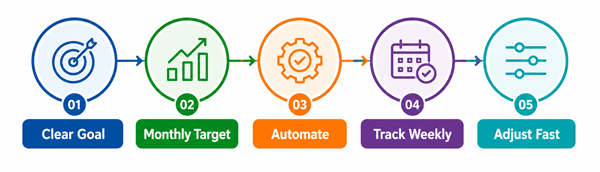
Financial Goal System Diagram
Step 4: Build a Budget Around Your Goals
A budget is not a punishment. It is a plan for how your income will be used. When your budget includes your goal as a fixed priority, progress becomes more predictable.
The Pay-Yourself-First Method
With pay-yourself-first budgeting, you treat saving or debt payoff like a bill. Instead of waiting to see what is left at the end of the month, you move the goal amount first. This is one of the simplest ways to reach financial goals faster because it removes the temptation to spend the money elsewhere.
Example Monthly Budget for Faster Goal Progress
| Category | Example Amount | Purpose |
|---|---|---|
| Income | $3,000 | Monthly take-home pay |
| Goal contribution | $400 | Emergency fund or debt payoff |
| Housing and utilities | $1,100 | Basic living costs |
| Food and household | $500 | Groceries and essentials |
| Transportation | $300 | Fuel, transit, maintenance |
| Insurance and minimum debt payments | $350 | Required payments |
| Personal and entertainment | $250 | Flexible spending |
| Buffer | $100 | Small surprises |
This budget is only an example. The right numbers depend on your income, location, family needs, debts, and priorities. The key lesson is that the goal contribution is planned before flexible spending expands.
Step 5: Find Money Leaks Without Cutting Everything You Enjoy
Many people assume they must give up every enjoyable purchase to reach financial goals faster. That is not realistic for most beginners. A better approach is to look for money leaks: spending that does not improve your life enough to justify its cost.
High-Impact Expense Cuts
- Cancel subscriptions you rarely use and review them every three months.
- Plan meals for the week to reduce expensive last-minute food purchases.
- Compare insurance, phone, and internet plans once or twice a year.
- Use a 24-hour pause before non-essential purchases.
- Set a weekly spending limit for eating out, shopping, and entertainment.
- Avoid upgrading cars, phones, or housing just because your income rises.
The most useful cuts are the ones you can repeat. Saving $80 every month is more powerful than making one extreme cut that you abandon after two weeks.
Step 6: Increase Income Strategically
Cutting expenses has limits. Increasing income can speed up financial goals because it gives you more money to direct toward savings, debt payoff, or investing. The key is to choose income strategies that match your skills, schedule, and risk tolerance.
| Income Strategy | Best For | Pros | Watch Out For |
|---|---|---|---|
| Ask for a raise | People with strong job performance | Can permanently increase income | Requires preparation and timing |
| Overtime or extra shifts | Hourly workers | Simple if available | Can lead to burnout |
| Freelancing | People with marketable skills | Flexible and scalable | Income may be inconsistent |
| Part-time work | People with predictable free time | Clear pay structure | Less personal time |
| Selling unused items | Quick cash needs | Fast and simple | Usually one-time income |
| Small business or side hustle | People willing to learn and test ideas | Can grow over time | May require upfront effort and patience |
A practical beginner approach is to direct all extra income to one goal before increasing lifestyle spending. For example, if you earn an extra $250 from weekend work, transfer it to your emergency fund or debt immediately. This prevents the extra income from disappearing into everyday spending.
Step 7: Pay Down High-Interest Debt First
High-interest debt can slow almost every financial goal because interest charges keep taking money from your future. If you have credit card debt or expensive personal loans, paying them down may be one of the fastest ways to improve your financial position.
Debt Snowball vs. Debt Avalanche
| Method | How It Works | Best For | Main Benefit |
|---|---|---|---|
| Debt snowball | Pay the smallest balance first while making minimum payments on others. | People who need motivation and quick wins. | Builds confidence and momentum. |
| Debt avalanche | Pay the highest interest rate first while making minimum payments on others. | People focused on minimizing interest cost. | Usually saves more money mathematically. |
Both methods can work. The best method is the one you will actually follow. If high interest is costing you a lot, the avalanche method is often financially stronger. If motivation is your biggest problem, the snowball method may help you stay consistent.
Before making extra payments, check whether a loan has prepayment penalties, promotional-rate rules, or fees. For complex debt, tax, or legal situations, personalized advice can prevent costly mistakes.
Step 8: Automate the Right Money Moves
Automation helps you make progress even when you are busy, tired, or tempted to spend. It turns good intentions into default behavior.
- Schedule automatic transfers to savings after payday.
- Set automatic debt payments above the minimum when possible.
- Use separate accounts for emergency savings, short-term goals, and daily spending.
- Automate retirement contributions if you have access to a workplace plan or personal investment account.
- Set calendar reminders for monthly financial reviews.
Automation should match your cash flow. Do not schedule transfers before essential bills clear. If your income is irregular, use a percentage system, such as saving 10% of every payment you receive.
Step 9: Prioritize Goals Instead of Chasing Everything at Once
Many beginners slow themselves down by trying to save for everything at the same time: emergency fund, vacation, car, retirement, debt payoff, and home down payment. Multiple goals are normal, but too many active goals can spread your money too thin.
A Simple Priority Order
- Cover essential bills and avoid new high-interest debt.
- Build a small starter emergency fund.
- Pay down high-interest debt.
- Grow a fuller emergency fund based on your needs and risk level.
- Save for short-term goals such as a car, education, or moving costs.
- Invest consistently for long-term goals such as retirement.
This order can be adjusted. For example, someone with unstable income may need a larger emergency fund earlier. Someone with employer retirement matching may choose to contribute enough to receive the match while still paying down debt. Personal finance is personal, but prioritization is always necessary.
For short-term goals, safety and access usually matter more than chasing returns. For long-term goals, consistency, diversification, fees, and your risk tolerance become more important than trying to time the market.
Example Progress Chart
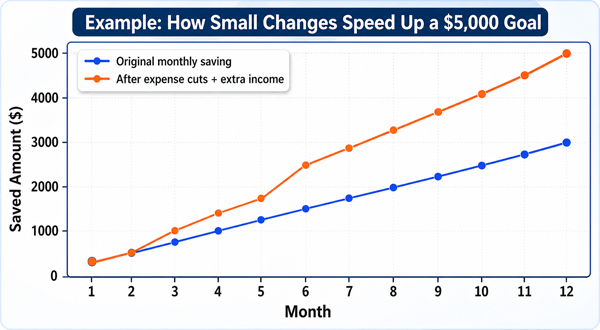
The chart shows a simple idea: progress speeds up when you combine monthly saving with expense cuts and occasional extra income. You do not need one dramatic change. Several small changes can work together.
Step 10: Track Progress Weekly and Review Monthly
Tracking is where many people fall off. They set a goal, feel motivated for a few weeks, and then stop checking. A simple tracking routine helps you notice problems early and stay connected to the goal.
Weekly Check-In
- Check your goal balance or debt balance.
- Review recent spending for surprises.
- Move any leftover money toward the goal.
- Notice one thing that worked well and one thing to improve.
Monthly Review
- Compare your actual progress with your monthly target.
- Update your budget for upcoming bills or income changes.
- Decide whether to adjust the deadline, contribution, or strategy.
- Celebrate progress without using celebration as an excuse to overspend.
■ Real-World Scenarios
Scenario 1: Saving a Starter Emergency Fund Faster
Nadia wants to save $1,200 in six months. Her target is $200 per month. She cancels $35 in unused subscriptions, reduces takeout by $60, and automates $105 from each paycheck. She also sells unused household items and adds $150 in the first month. Her goal becomes realistic because she combines cuts, automation, and one-time income.
Scenario 2: Paying Off Credit Card Debt Faster
Omar has a $3,000 credit card balance. He pays more than the minimum, stops using the card for new purchases, and uses the debt avalanche method because the interest rate is high. He also applies tax refunds, bonuses, or extra income directly to the balance. The important behavior is not only paying more; it is preventing the balance from growing again.
Scenario 3: Building a Down Payment Without Feeling Overwhelmed
Sara wants a $12,000 home down payment. The number feels large, so she breaks it into quarterly targets of $1,500 over two years. She keeps the money in a separate savings account, tracks progress monthly, and avoids investing money she expects to use soon. This protects the goal from market ups and downs.
■ Pros and Cons of Trying to Reach Financial Goals Faster
| Potential Benefit | Possible Risk | How to Manage It |
|---|---|---|
| You build confidence sooner. | You may become too strict and burn out. | Use sustainable cuts and keep small guilt-free spending. |
| You reduce debt interest faster. | You may ignore emergency savings. | Keep at least a starter emergency fund while attacking debt. |
| You gain more control over money. | You may chase risky shortcuts. | Avoid investments or schemes you do not understand. |
| You reach important milestones earlier. | You may compare yourself to others. | Measure progress against your own starting point. |
■ Common Mistakes That Slow Down Financial Goals
- Setting a goal without a deadline or monthly target.
- Trying to cut too much too quickly and then quitting.
- Saving money in the same account used for everyday spending.
- Making only minimum debt payments while continuing to add new debt.
- Using windfalls for lifestyle upgrades before funding important goals.
- Ignoring irregular expenses such as car repairs, annual fees, gifts, and medical costs.
- Taking risky investment bets to make up for a lack of savings.
- Tracking progress only when things are going well.
■ Misconceptions About Reaching Financial Goals Faster
Misconception 1: You Need a High Income
A higher income can help, but it does not guarantee progress. Some high earners struggle because spending rises with income. A lower-income person with a clear plan may make steadier progress than a higher earner without one.
Misconception 2: Budgeting Means You Cannot Enjoy Life
A good budget gives you permission to spend on what matters after your priorities are covered. The goal is not to eliminate enjoyment; it is to stop unplanned spending from stealing money from important goals.
Misconception 3: Investing Is Always the Fastest Path
Investing can be powerful for long-term goals, but it is not ideal for money you need soon. Short-term goals usually need safety and accessibility. Long-term goals can usually tolerate more market movement, depending on your risk level and time horizon.
■ Practical Checklist: How to Reach Financial Goals Faster
- Write one clear financial goal with an amount and deadline.
- Calculate the monthly target needed to reach it.
- Review your income, expenses, debt, and savings balances.
- Choose one primary goal to focus on first.
- Automate transfers or payments as close to payday as possible.
- Cut low-value expenses and redirect the savings immediately.
- Look for realistic ways to increase income.
- Use extra money, bonuses, refunds, or cash gifts intentionally.
- Track progress weekly and review the full plan monthly.
- Adjust the plan when life changes instead of abandoning the goal.
■ Frequently Asked Questions
1. What is the fastest way to reach financial goals?
The fastest safe way is usually to combine clear goal setting, automatic saving, expense reduction, income growth, and debt management. One method alone may help, but several small improvements together often create faster progress.
2. Should I save money or pay off debt first?
It depends on your situation. Many beginners benefit from a small emergency fund first so they do not rely on debt for surprise expenses. After that, high-interest debt often deserves priority because interest can slow other goals.
3. How many financial goals should I work on at once?
Start with one main goal and one supporting goal if needed. For example, you might build a starter emergency fund while making minimum debt payments, then switch your focus to debt payoff. Too many active goals can reduce momentum.
4. How can I stay motivated when progress is slow?
Track small milestones, such as every $100 saved or every debt balance reduction. Review why the goal matters. Motivation often improves when progress is visible.
5. Is it okay to invest money for a short-term goal?
Be careful. Money needed in the next few years is usually better kept in safer, more accessible places because investments can lose value in the short term. Long-term goals may be more suitable for investing.
6. What should I do if I miss a month?
Do not quit. Review why it happened, adjust the next month, and continue. Missing one month is a setback, not a failure.
7. Can a side hustle help me reach goals faster?
Yes, if it is realistic and profitable after costs, taxes, time, and stress are considered. The key is to direct the extra income toward the goal instead of letting spending rise.
8. How big should my emergency fund be?
A common beginner approach is to start with a small starter fund, then build toward a larger fund based on your job stability, family needs, health costs, debt level, and local cost of living. The right number is personal, so avoid copying someone else’s target without checking your own risks.
9. What if prices rise and my goal becomes more expensive?
Review the goal monthly and adjust early. You may need to increase the monthly target, extend the deadline, reduce non-essential spending, or choose a lower-cost version of the goal. Updating the plan is better than ignoring the gap.
■ Final Thoughts
Reaching financial goals faster is not about chasing shortcuts. It is about making your money easier to direct. Clear goals show you where to go. A budget creates room for progress. Automation protects your plan from daily temptation. Expense cuts and extra income add speed. Tracking keeps you honest.
Start with one goal, calculate the monthly target, automate what you can, and review your progress regularly. Small actions repeated consistently can create meaningful financial change over time.
Reader Advice: This article is for educational and informational purposes only and should not be taken as personal financial, tax, legal, or investment advice. Please check the latest information from official sources or a qualified professional, as rules, policies, and financial conditions can change over time.