Short-Term vs Long-Term Financial Goals: Key Differences and Examples
Financial goals give your money a clear purpose. Instead of simply hoping to save more, spend less, or build wealth someday, financial goals help you decide exactly what you want your money to do and when you want it to happen.
The most useful way to organize financial goals is by time frame. Some goals need to be completed soon, such as saving for rent, paying an overdue bill, or building a small emergency fund. Other goals may take years or decades, such as buying a home, paying for a child’s education, or retiring comfortably.
This guide explains the key differences between short-term and long-term financial goals, gives practical examples, and shows you how to balance both without feeling overwhelmed. It is written for beginners who want clear, realistic, and educational personal finance guidance.
1. What Are Financial Goals?
Financial goals are specific money-related targets you plan to achieve. They can involve saving, spending, investing, debt repayment, income growth, insurance, or building long-term financial security.
A vague wish sounds like, “I want to be better with money.” A useful financial goal sounds like, “I want to save $1,000 for emergencies within six months by setting aside about $167 each month.”
Good financial goals usually answer five questions: What do I want? Why does it matter? How much money is needed? When do I want to achieve it? What action will I take each month?
2. Short-Term vs Long-Term Financial Goals: Quick Comparison
| Feature | Short-Term Financial Goals | Long-Term Financial Goals |
|---|---|---|
| Time frame | Usually within a few weeks to 3 years | Usually 5 years or more; some goals take decades |
| Main purpose | Stability, cash flow, near-term needs, and quick wins | Wealth building, independence, major life plans, and future security |
| Common examples | Emergency starter fund, holiday savings, paying small debts, buying a laptop | Retirement, home purchase, college fund, financial independence |
| Best place for money | Checking, savings, money market, short-term deposits, or other low-risk accounts | Retirement accounts, diversified investment portfolios, long-term savings plans |
| Risk level | Low risk is usually best because the money is needed soon | Can usually accept more risk if the time horizon is long and the plan is diversified |
| Progress check | Weekly or monthly | Quarterly, annually, and after major life changes |
| Biggest challenge | Consistency and avoiding impulse spending | Patience, inflation, market changes, and staying committed for years |
3. What Are Short-Term Financial Goals?
Short-term financial goals are money goals you plan to achieve soon. For most beginners, this means goals that can be completed within one year. Some people also include goals that take up to three years, especially larger short-term goals like saving for a car or moving costs.
Short-term goals are important because they create financial stability. They help you handle everyday life, avoid unnecessary debt, and build confidence before moving on to bigger plans.
Examples of Short-Term Financial Goals
- Save $500 to $1,000 as a starter emergency fund.
- Pay off a small credit card balance within six months.
- Save for annual insurance, school fees, taxes, or holiday expenses.
- Create a monthly budget and track spending for 90 days.
- Build one month of essential living expenses in cash savings.
- Stop using credit cards for non-essential purchases.
- Save for a phone, laptop, home appliance, or professional course.
- Reduce food delivery, subscriptions, or impulse purchases by a fixed amount each month.
Why Short-Term Goals Matter
Short-term goals are the foundation of a healthy financial life. They may not feel as exciting as retirement or buying a home, but they solve immediate problems and reduce stress.
For example, a person with no savings may have to borrow money when a car repair or medical bill appears. A small emergency fund can prevent that problem. Similarly, paying off a small high-interest debt can free up monthly cash flow and make future goals easier.
4. What Are Long-Term Financial Goals?
Long-term financial goals are larger money goals that usually take several years to achieve. These goals often require planning, investing, patience, and regular contributions over time.
Long-term goals are important because they shape your future lifestyle. They can help you build wealth, protect your family, prepare for retirement, and reduce dependence on debt later in life.
Examples of Long-Term Financial Goals
- Save and invest for retirement over 20 to 40 years.
- Build a down payment for a home over several years.
- Pay off a mortgage early or become debt-free before retirement.
- Create an education fund for children.
- Build a diversified investment portfolio.
- Start or expand a business with a long-term capital plan.
- Reach financial independence by building enough assets to cover living expenses.
- Create an estate plan, including wills, beneficiaries, and insurance where appropriate.
Why Long-Term Goals Matter
Long-term goals help you make decisions today that support the life you want later. Without long-term goals, it is easy to spend most of your income on immediate wants and leave future needs unfunded.
Long-term goals also benefit from time. When money is invested for many years, growth can compound, meaning returns may begin earning returns of their own. This does not remove investment risk, but it is one reason starting early can be powerful.
5. Financial Goal Timeline Diagram
The diagram below shows how financial goals usually progress from short-term stability to long-term wealth building.
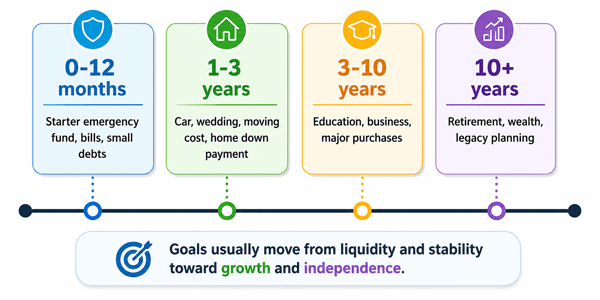
Figure: A simple timeline for matching financial goals to realistic time frames.
6. Key Differences Between Short-Term and Long-Term Financial Goals
1. Time Horizon
The biggest difference is time. Short-term goals need money soon, so the main priority is safety and access. Long-term goals have more time, so the plan can focus more on growth, inflation protection, and future purchasing power.
2. Risk Tolerance
Short-term money should usually not be exposed to major market swings. If you need the money in six months for rent, tuition, or a car repair, losing part of it in a risky investment could create a serious problem. Long-term goals may allow more investment risk because there is more time to recover from ups and downs, but risk should still match your personal situation.
3. Type of Account or Tool
Short-term goals often belong in savings accounts or other low-risk, easy-access places. Long-term goals may use retirement accounts, investment accounts, or structured savings plans. The right tool depends on your country, taxes, income, age, and risk comfort.
4. Motivation and Behavior
Short-term goals provide quick wins. They help beginners feel progress quickly. Long-term goals require patience and discipline because the reward may be many years away. A strong plan usually includes both: short-term wins to build momentum and long-term goals to build security.
5. Measurement
Short-term goals can often be measured weekly or monthly. Long-term goals should be reviewed regularly, but not obsessively. Checking investments every day can lead to emotional decisions. A quarterly or annual review is often enough for many long-term goals.
7. Examples of Short-Term and Long-Term Goals by Life Stage
| Life Stage | Short-Term Goal Examples | Long-Term Goal Examples |
|---|---|---|
| Student or young adult | Build a small emergency fund; avoid unnecessary debt; buy needed study equipment | Start investing early; build career skills; save for relocation or higher education |
| Early career | Create a budget; pay off credit card debt; save 1-3 months of expenses | Increase retirement contributions; save for a home; build a long-term investment habit |
| Growing family | Save for medical costs, school fees, or childcare; improve insurance coverage | Buy a home; fund children’s education; grow retirement savings |
| Mid-career | Pay down expensive debt; build a stronger emergency fund | Maximize retirement planning; invest for financial independence; pay off mortgage strategically |
| Pre-retirement | Reduce debt; increase cash reserves; estimate retirement spending | Create a retirement income plan; protect assets; update estate documents |
8. How to Set Short-Term and Long-Term Financial Goals
Step 1: List Everything You Want Your Money to Do
Start with a simple list. Do not judge the goals yet. Write down needs, wants, debts, future plans, and responsibilities. Examples may include paying bills on time, saving for emergencies, buying a home, supporting parents, investing, traveling, or retiring comfortably.
Step 2: Sort Goals by Time Frame
Put each goal into one of three groups: short-term, medium-term, or long-term. Medium-term goals often fall between short and long-term goals, usually around three to five years. This category is useful for goals like saving for a car, wedding, or down payment.
Step 3: Make Each Goal Specific and Measurable
A goal is easier to achieve when it has a number and deadline. Instead of saying, “I want to save money,” say, “I want to save $2,400 in 12 months by saving $200 per month.”
Step 4: Prioritize the Most Important Goals
Most people cannot fund every goal at once. Start with essentials: basic bills, emergency savings, high-interest debt, and insurance needs. Then add long-term goals like retirement and investing as your cash flow improves.
Step 5: Break Big Goals Into Monthly Actions
Large goals become less intimidating when you divide them into monthly steps. If you need $6,000 in two years, divide $6,000 by 24 months. That means you need to save $250 per month.
Step 6: Automate What You Can
Automation reduces the need for willpower. You can set automatic transfers to savings, automatic debt payments, or automatic investment contributions. Even small automated amounts can create meaningful progress over time.
Step 7: Review and Adjust
Your goals should change when your life changes. Review your plan after major events such as a job change, marriage, new child, relocation, business change, medical issue, or income increase.
| Goal Type | Typical Time Frame | Examples |
|---|---|---|
| Short-term | 0-12 months, sometimes up to 3 years | Starter emergency fund, small debt payoff, annual bills |
| Medium-term | 3-5 years | Car purchase, wedding, house down payment, career training |
| Long-term | 5+ years | Retirement, children’s education, financial independence |
9. Practical Goal-Setting Example
Here is a simple example of how a beginner might balance short-term and long-term financial goals.
| Item | Amount |
|---|---|
| Monthly income after tax | $3,000 |
| Essential expenses | $2,100 |
| Debt payments | $250 |
| Available for goals | $650 |
Instead of putting all $650 toward one goal, this person could divide it based on urgency and importance:
| Goal | Monthly Amount | Purpose |
|---|---|---|
| Emergency fund | $250 | Short-term stability |
| Credit card debt | $200 | Reduce expensive debt |
| Retirement investing | $100 | Long-term growth |
| Vacation or personal goal | $100 | Motivation and balance |
This approach is realistic because it does not ignore the future, but it also handles urgent short-term needs. The exact numbers should be adjusted based on income, debt, family responsibilities, and local cost of living.
10. Where Should You Keep Money for Different Goals?
| Goal | Common Place to Keep Money | Why It May Fit |
|---|---|---|
| Monthly bills and spending | Checking account or current account | Easy access and regular payments |
| Emergency fund | Savings account or money market account | Low risk and quick access |
| Goal within 1 year | High-yield savings or short-term deposit, depending on availability | Protects money needed soon |
| Goal in 3-5 years | Savings, deposits, or conservative investment mix | Balances safety and limited growth potential |
| Retirement or 10+ year goal | Diversified investment portfolio or retirement account | Long time horizon allows growth focus |
| Education or family wealth planning | Education savings plan, investment account, or local tax-advantaged option | Goal-specific planning and possible tax benefits |
This table is educational, not personal investment advice. The best choice depends on your country, taxes, access to financial products, risk tolerance, and whether you may need the money early.
11. Benefits of Setting Both Short-Term and Long-Term Goals
- Better control over spending because every dollar has a job.
- Less stress because you prepare for predictable and unexpected expenses.
- More motivation because short-term goals create quick progress.
- Stronger future security because long-term goals are not ignored.
- Better decision-making because you can compare today’s spending with tomorrow’s priorities.
- Lower dependence on debt when emergencies or major expenses appear.
12. Risks and Limitations to Understand
Financial goals are helpful, but they are not magic. Life can change quickly, and even a good plan may need adjustment. Income loss, inflation, health issues, family responsibilities, market downturns, or unexpected expenses can slow progress.
The main risk is creating goals that are too aggressive. If a plan requires you to cut every enjoyable expense, it may fail. A better plan is realistic enough to follow consistently.
Another limitation is focusing only on one type of goal. Saving only for short-term needs may leave you unprepared for retirement. Investing only for long-term growth while having no emergency fund may force you to sell investments at a bad time. Balance matters.
13. Common Mistakes to Avoid
Mistake 1: Having Goals Without Numbers
A goal without a number is hard to track. “Save more” is not enough. Decide how much you need and by when.
Mistake 2: Investing Money You Need Soon
Money needed in the near future should usually be kept safe and accessible. Chasing high returns with short-term money can backfire.
Mistake 3: Ignoring Emergency Savings
An emergency fund protects your other goals. Without one, every surprise expense can turn into debt or force you to stop investing.
Mistake 4: Trying to Do Too Many Goals at Once
Too many goals can divide your money into amounts so small that nothing moves forward. Choose a few priorities first, then expand.
Mistake 5: Never Reviewing the Plan
Your goals should grow with your life. Review your plan at least once or twice a year and whenever your income or responsibilities change.
14. Best Practices for Beginners
- Start with one short-term goal and one long-term goal so the plan feels manageable.
- Build at least a small emergency fund before taking major investment risk.
- Pay attention to high-interest debt because it can slow every other goal.
- Use automatic transfers to make saving easier.
- Keep short-term money in low-risk accounts.
- Use diversified investments for long-term goals when appropriate.
- Increase contributions when your income rises.
- Track progress monthly for short-term goals and quarterly or annually for long-term goals.
- Make room for reasonable enjoyment so the plan is sustainable.
- Ask a qualified financial professional for personal advice when taxes, investments, insurance, or retirement decisions become complex.
15. Simple Worksheet: Build Your Own Goal Plan
| Worksheet Item | Guidance | Your Answer |
|---|---|---|
| Goal name | Example: Emergency fund | |
| Goal type | Short-term / Medium-term / Long-term | |
| Target amount | Example: $1,500 | |
| Deadline | Example: 10 months | |
| Monthly amount needed | Target amount divided by months | |
| Where money will be kept | Savings, investment account, retirement plan, etc. | |
| First action this week | Open account, automate transfer, reduce expense, etc. |
16. Frequently Asked Questions
1. What is the main difference between short-term and long-term financial goals?
The main difference is the time frame. Short-term goals are usually completed within a year or a few years, while long-term goals often take five years or more. Short-term goals usually focus on stability and immediate needs, while long-term goals focus on future security and wealth building.
2. Is buying a house a short-term or long-term financial goal?
It depends on your deadline. Saving for a home down payment within two or three years may be a medium-term goal. Paying off a mortgage or building long-term home equity is usually a long-term goal.
3. Should I save for retirement if I still have short-term goals?
In many cases, yes, but the balance depends on your situation. If you have no emergency fund or expensive debt, those may need urgent attention. Still, even small retirement contributions can help build the habit early.
4. How many financial goals should I have at one time?
Beginners often do best with two to four active goals. Too many goals can make progress feel slow. A simple starting point is one emergency goal, one debt or savings goal, and one long-term investing or retirement goal.
5. Where should I keep money for short-term goals?
Short-term money is usually best kept in low-risk, easy-access accounts such as checking, savings, money market accounts, or short-term deposits. The goal is safety and access, not maximum return.
6. Can a short-term goal become a long-term goal?
Yes. For example, saving a starter emergency fund is short-term, but building a full emergency fund may take longer. A goal can also change if your income, deadline, or priorities change.
7. What is a good first financial goal for a beginner?
A good first goal is to build a small emergency fund while tracking monthly spending. This creates stability and helps you understand where your money is going.
8. How often should I review my financial goals?
Review short-term goals monthly because they depend on current cash flow. Review long-term goals at least once or twice a year, and after major life changes such as a job change, marriage, new child, or relocation.
17. Conclusion
Short-term and long-term financial goals work best together. Short-term goals help you manage today’s money, reduce stress, and build stability. Long-term goals help you prepare for the future, build wealth, and make bigger life plans possible.
The best financial plan does not require perfection. It requires clarity, realistic numbers, consistent action, and regular review. Start with one small goal you can complete soon, then connect it to a bigger long-term goal that supports the life you want to build.
Reader Advice: This article is for educational and information purposes only and should not be taken as personal financial, tax, legal, or investment advice. Rules, products, and policies change over time, so please check the latest information from official sources or a qualified professional before making important decisions.