Financial Planning in Your 20s: Complete Guide to Budgeting, Saving & Investing
Your 20s are often a decade of big firsts: your first full-time job, first apartment, first serious financial decisions, and sometimes your first major mistakes with money. The good news is that you do not need to be rich, highly experienced, or perfect with numbers to start financial planning. You simply need a clear system for using your money wisely.
Financial planning in your 20s means deciding where your money should go before it disappears. It helps you cover today’s needs, prepare for emergencies, reduce debt, build savings, and start investing early enough to benefit from time. Small choices made in your 20s can become powerful advantages later.
This guide explains the most important money goals and best practices for people in their 20s. It is written for beginners, so the advice is practical, simple, and realistic.
It can also be used as a simple financial planning checklist for beginners who want to organize their money before making bigger decisions such as buying a car, moving, getting married, starting a business, or investing more seriously.
1. What Is Financial Planning in Your 20s?
Financial planning is the process of organizing your income, expenses, savings, debt, insurance, and future goals into one practical plan. In your 20s, the goal is not to create a perfect lifelong plan. The goal is to build a strong foundation.
Because financial products, tax rules, retirement accounts, and consumer protections differ by country, use this guide as a framework and confirm local details with official sources or a qualified professional when needed.
A good financial plan answers questions such as: How much money do I earn? Where is it going? What should I save first? Which debts should I pay faster? How much can I invest? What financial risks should I protect against?
Think of it like a map. You may not know every destination yet, but you still need directions for the next few miles.
2. Quick Answer: The Best Money Goals for Your 20s
The most important financial goals in your 20s are to understand your cash flow, build an emergency fund, avoid high-interest debt, start saving for retirement, improve your earning power, protect your health and income, and learn basic investing. These goals help you create flexibility and reduce financial stress as your life changes.
■ Money Priority Diagram for Your 20s
The chart below shows a simple order of money priorities. You do not have to complete one level perfectly before starting the next, but this order helps you avoid skipping the basics.
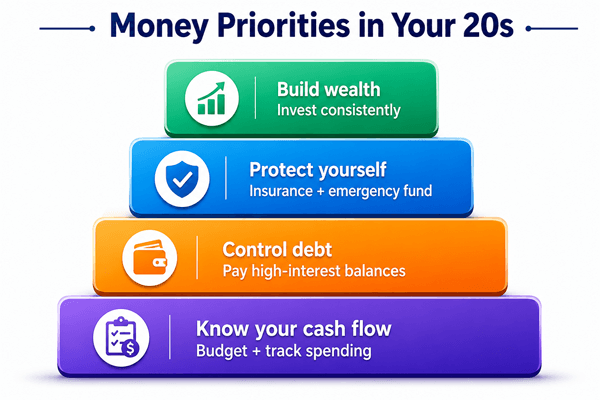
Figure: A practical money priority pyramid for people in their 20s.
1. Know Where Your Money Is Going
Before you can improve your finances, you need visibility. Many people in their 20s feel broke not only because income is limited, but because spending is unplanned. Tracking your money shows the difference between what you think you spend and what you actually spend.
How to track your cash flow
- Write down your monthly income after tax.
- List fixed expenses such as rent, transport, phone, subscriptions, insurance, and loan payments.
- Estimate flexible spending such as groceries, eating out, shopping, entertainment, and travel.
- Compare income minus expenses. The amount left is your margin for saving, investing, and extra debt payments.
Example: If your take-home pay is $2,500 and your monthly expenses are $2,250, your margin is $250. That $250 is not “extra” money. It is the money that can build your emergency fund, pay debt, or start investing.
2. Create a Beginner-Friendly Budget
A budget is not a punishment. It is a spending plan. It tells your money what job to do. The best budget is the one you can actually follow consistently.
| Budget Method | How It Works | Best For | Possible Limitation |
|---|---|---|---|
| 50/30/20 budget | 50% needs, 30% wants, 20% savings and debt payoff | Beginners who want a simple structure | May not fit high-rent or low-income situations |
| Zero-based budget | Every dollar is assigned a purpose before the month starts | People who want tight control | Takes more time to maintain |
| Pay-yourself-first budget | Savings and investments happen first, then you spend what remains | People who overspend easily | Requires discipline with the remaining money |
| Envelope or category budget | Money is divided into categories such as groceries, transport, and fun | People who need spending limits | Can feel restrictive at first |
Practical budgeting tip
Start with a simple rule: save something every payday, even if it is small. A small automatic transfer builds the habit. You can increase the amount when your income rises or expenses fall.
If a 50/30/20 budget does not fit your rent, income, or family responsibilities, adjust the percentages instead of abandoning budgeting. The purpose is to create a realistic plan, not to follow a perfect formula.
3. Build an Emergency Fund
An emergency fund is money set aside for real unexpected costs, such as medical bills, job loss, urgent car repairs, or necessary travel. It helps you avoid using credit cards or loans when life happens.
A beginner goal is to save one month of essential expenses. After that, work toward three to six months of necessary expenses. If your income is unstable, you may need a larger cushion.
| Emergency Fund Stage | Target Amount | Why It Matters |
|---|---|---|
| Starter fund | $500 to $1,000 | Covers small emergencies without borrowing |
| Basic fund | 1 month of essential expenses | Helps with short income gaps or larger bills |
| Strong fund | 3 to 6 months of essential expenses | Provides protection during job loss or major life changes |
Keep your emergency fund in a safe and accessible account. It should not be invested in risky assets because you may need it quickly.
Remember the simple order: first build a starter emergency fund, then strengthen it as your income becomes more stable.
4. Avoid High-Interest Debt
Debt is not always bad, but high-interest debt can slow your progress. Credit card balances, payday loans, and expensive personal loans can grow quickly if you only make minimum payments.
Debt payoff strategies
| Strategy | How It Works | Best For |
|---|---|---|
| Debt avalanche | Pay extra toward the highest-interest debt first | Saving the most money on interest |
| Debt snowball | Pay extra toward the smallest balance first | Building motivation with quick wins |
Example: If one credit card charges 24% interest and another loan charges 8%, the avalanche method would usually focus on the 24% card first because it is the most expensive debt.
Continue making minimum payments on all debts to protect your credit history, then put extra money toward the target debt.
5. Start Building Credit the Right Way
Your credit history can affect your ability to rent an apartment, get a loan, qualify for lower interest rates, or access certain financial products. Building credit does not mean carrying debt. It means using credit responsibly.
- Pay every bill on time.
- Keep credit card balances low compared with your limit.
- Avoid applying for too many credit accounts in a short period.
- Check your credit report for errors when possible.
- Do not use credit cards to buy things you could not afford with cash.
A common misconception is that you need to carry a credit card balance to build credit. In reality, paying the full balance on time is usually healthier and avoids interest charges.
When available, review your credit report through an official or authorized credit reporting source so you can spot errors, fraud, or accounts you do not recognize.
6. Start Investing Early, Even With Small Amounts
Investing in your 20s is powerful because time is on your side. You do not need a large amount to begin. The earlier you start, the more time your money has to potentially grow through compounding.
Compounding means your investment earnings can generate more earnings over time. For example, money invested at age 25 has decades longer to grow than money first invested at age 40.
Where beginners often start
Before choosing any investment, check fees, diversification, risk level, tax treatment, and whether the product matches your time horizon. Low cost and simplicity often matter more than chasing the highest possible return.
- Employer retirement plans, especially if there is a matching contribution.
- Individual retirement accounts where available in your country.
- Low-cost diversified index funds or exchange-traded funds.
- Automatic monthly investing to build consistency.
Investing always involves risk. Values can go down, especially in the short term. That is why money needed soon, such as rent or emergency savings, should usually stay in safer accounts instead of the stock market.
7. Increase Your Income and Career Value
In your 20s, your earning power is one of your biggest financial assets. Cutting expenses helps, but increasing income can open more room for saving, investing, debt payoff, and better life choices.
Ways to improve earning power
- Learn skills that are in demand in your field.
- Ask for feedback and document your work achievements.
- Negotiate salary when changing jobs or taking on more responsibility.
- Build a professional network before you urgently need one.
- Consider side income only if it does not harm your health, studies, or main career path.
Example: A $200 monthly raise can become $2,400 per year before tax. If you save or invest part of that raise instead of increasing lifestyle spending, it can meaningfully improve your financial future.
8. Protect Yourself With Basic Insurance
Financial planning is not only about growing money. It is also about protecting yourself from events that could damage your finances. Insurance needs vary by country, employer, family situation, and lifestyle, but people in their 20s should understand the basics.
| Type of Protection | Why It Matters | Who Should Consider It |
|---|---|---|
| Health insurance | Medical costs can be financially stressful without coverage | Most adults, especially those without public healthcare access |
| Disability or income protection | Replaces part of income if illness or injury prevents work | People who depend on their paycheck |
| Renter’s insurance | Protects personal belongings and may include liability coverage | People renting an apartment or house |
| Life insurance | Supports dependents if you die | People with children, spouse, parents, or others relying on their income |
You may not need every type of insurance immediately. The key is to match protection to real risks.
As a simple rule, insure risks that could seriously harm your finances, and avoid paying for coverage you do not understand or do not need.
9. Set Short-Term, Medium-Term, and Long-Term Goals
Goals make financial planning practical. Without goals, saving can feel vague. With goals, your money has a reason.
| Goal Type | Typical Time Frame | Examples | Where Money Usually Belongs |
|---|---|---|---|
| Short-term | 0 to 12 months | Emergency fund, laptop, moving costs, small trip | Cash or safe savings account |
| Medium-term | 1 to 5 years | Car, wedding, house deposit, career course | Savings account or lower-risk options |
| Long-term | 5+ years | Retirement, financial independence, children’s education | Diversified investments where appropriate |
SMART goal example
Instead of saying, “I want to save more,” say, “I will save $150 every month for 10 months to build a $1,500 starter emergency fund by December.” This is specific, measurable, realistic, and time-based.
10. Avoid Lifestyle Inflation
Lifestyle inflation happens when your spending rises every time your income rises. Some lifestyle improvement is normal, but if every raise becomes a new subscription, car payment, apartment upgrade, or shopping habit, your financial progress may stay stuck.
How to control lifestyle inflation
- Decide in advance what percentage of each raise will go to savings or investing.
- Wait before upgrading major expenses such as housing or vehicles.
- Keep one or two lifestyle treats, but avoid upgrading everything at once.
- Review subscriptions and recurring expenses every few months.
A helpful rule is to save part of every income increase before you get used to spending it.
11. Learn Basic Taxes and Benefits
Taxes are part of adult financial life. You do not need to become a tax expert, but you should understand how your paycheck works, whether you need to file a return, which deductions or credits may apply, and how retirement or investment accounts are taxed in your country.
Also learn your workplace benefits. Employer retirement contributions, health coverage, education support, paid leave, transportation benefits, and insurance can be worth real money.
Keep copies of important tax documents, payslips, benefit summaries, loan agreements, insurance policies, and investment statements in a secure place. Good records make future decisions easier.
12. Create a Simple Monthly Money Routine
A financial plan only works if you review it. A monthly money routine helps you stay aware without obsessing over every purchase.
- Check your income and bills for the month.
- Review last month’s spending categories.
- Pay bills and debt payments on time.
- Transfer money to savings and investments.
- Update your goal progress.
- Choose one improvement for the next month.
This routine can take 30 to 60 minutes once a month. The goal is consistency, not perfection.
■ Best Practices for Financial Planning in Your 20s
- Automate savings so you do not rely only on willpower.
- Build an emergency fund before taking major investment risk.
- Pay off high-interest debt as a priority.
- Start investing early, even with small amounts, after basic protections are in place.
- Keep fixed expenses manageable, especially housing and transportation.
- Review your finances after major life changes such as a new job, move, marriage, or child.
- Learn before buying complex financial products.
- Avoid comparing your money situation with social media lifestyles.
■ Common Financial Mistakes to Avoid in Your 20s
| Mistake | Why It Hurts | Better Approach |
|---|---|---|
| Ignoring money because it feels stressful | Small problems can become larger | Use a simple monthly review |
| Living on credit cards | Interest can trap future income | Spend based on actual cash flow |
| Not saving for emergencies | Unexpected costs become debt | Build a starter fund first |
| Waiting too long to invest | You lose valuable time for compounding | Start small and increase gradually |
| Buying too much car or rent | Fixed costs reduce flexibility | Keep major expenses affordable |
| Following risky trends blindly | You may lose money you cannot afford to lose | Understand risks before investing |
| Not negotiating income | Lower pay can compound over years | Research market rates and track achievements |
■ Example Financial Plan for a 25-Year-Old
Here is a simple example. Adjust the numbers to your own income, city, and responsibilities.
| Category | Monthly Amount | Notes |
|---|---|---|
| Take-home income | $2,800 | Income after tax and payroll deductions |
| Rent and utilities | $900 | Keep housing realistic for income |
| Food and groceries | $400 | Includes eating out limit |
| Transportation | $250 | Fuel, public transport, rides, insurance |
| Debt payments | $250 | Minimums plus extra toward highest-interest debt |
| Emergency fund | $250 | Automatic transfer after payday |
| Retirement/investing | $200 | Started after basic emergency savings plan |
| Personal and fun spending | $350 | Planned spending without guilt |
| Remaining buffer | $200 | Covers irregular expenses or extra savings |
This example is not a rule. It shows how a plan gives each part of income a purpose.
■ Pros and Cons of Starting Financial Planning Early
| Pros | Cons or Challenges |
|---|---|
| More time for savings and investments to grow | Income may be low at the start of your career |
| Fewer bad habits become permanent | Expenses can feel unpredictable |
| Easier to recover from beginner mistakes | Student loans or family responsibilities may slow progress |
| Builds confidence and financial independence | Requires patience because results are gradual |
The benefits are usually worth the effort. You do not need to do everything at once. Progress in your 20s is about direction, habits, and consistency.
■ When Should You Get Professional Financial Advice?
Many people in their 20s can start with basic self-education and simple tools. However, professional advice may be helpful if you have complex taxes, inherited money, business income, major debt, dependents, disability planning needs, or uncertainty about investing.
Look for qualified professionals who explain fees clearly, act in your best interest, and do not pressure you into products you do not understand.
For extra trust, ask whether the advisor is licensed or registered in your location, how they are paid, whether they have conflicts of interest, and whether they can explain recommendations in plain language.
■ Financial Planning Checklist for Your 20s
- Track income and expenses for at least one full month.
- Create a realistic budget you can follow.
- Save a starter emergency fund.
- Pay bills on time and build credit carefully.
- Create a debt payoff plan for high-interest debt.
- Start retirement saving or long-term investing when ready.
- Review workplace benefits and insurance coverage.
- Set short-term, medium-term, and long-term goals.
- Increase earning power through skills and career growth.
- Review your plan every month and after major life changes.
■ FAQs About Financial Planning in Your 20s
1. How much should I save in my 20s?
A common goal is to work toward saving 15% to 20% of income, but the right amount depends on your income, debt, and cost of living. If that is not possible, start smaller. Saving $25 or $50 consistently is better than waiting until you can save a perfect amount.
2. Should I pay debt or invest first?
High-interest debt usually deserves priority because the interest cost can be higher than realistic investment returns. However, if your employer offers a retirement match, contributing enough to receive the match may also be valuable. Balance depends on your interest rates, emergency fund, and job stability.
3. Is it too early to think about retirement in my 20s?
No. Your 20s are a strong time to start because retirement money has decades to grow. You do not need to save huge amounts immediately, but starting early can reduce pressure later.
4. Do I need a financial advisor in my 20s?
Not always. Many beginners can start with budgeting, emergency savings, debt payoff, and basic investing education. An advisor may help if your situation is complex or you need personalized guidance.
5. What is the biggest money mistake people make in their 20s?
One of the biggest mistakes is building a lifestyle that depends on debt or every dollar of income. This leaves no room for emergencies, opportunities, or future goals.
6. How can I plan financially if my income is irregular?
Base your budget on your lowest realistic monthly income, not your best month. Save extra during higher-income months to cover slower months. An emergency fund is especially important when income is irregular.
7. Should I invest in risky assets to get rich quickly?
Be careful. High-risk investments can lose value quickly. Before investing in anything risky, build an emergency fund, understand what you are buying, and never invest money you need for bills or short-term goals.
■ Final Thoughts: Build the Foundation, Not a Perfect Life
Financial planning in your 20s is not about becoming perfect with money. It is about building habits that give you more choices. Track your money, spend with intention, save for emergencies, manage debt, invest early when possible, and keep learning.
You may make mistakes, and your plan will change as your career, income, family, and goals change. That is normal. The important thing is to start now, review often, and make steady progress.
Reader Advice: This article is for educational and informational purposes only and should not be taken as personal financial, tax, legal, or investment advice. Please check the latest information from official sources or a qualified professional, as rules, policies, and financial products can change over time.