Assets vs Liabilities Explained: Meaning, Differences and Examples
Understanding assets vs liabilities is one of the most important first steps in personal finance. These two words may sound like accounting terms, but they describe something very practical: what you own and what you owe. Once you understand the difference, it becomes easier to build wealth, reduce debt, make smarter buying decisions, and track your financial progress.
An asset is something you own or control that has economic value. A liability is something you owe to another person, bank, lender, company, or institution. Your assets can help increase your financial strength, while liabilities reduce your net worth because they represent future payments you must make.
This guide explains assets and liabilities in simple language, with examples, comparison tables, beginner-friendly formulas, common mistakes, and practical tips you can use in everyday life.
In accounting and everyday money management, these terms are often shown on a personal balance sheet: assets on one side, liabilities on the other, and net worth as the difference between them.
Quick Answer: Assets vs Liabilities
| Term | Simple meaning | Basic example | Effect on net worth |
|---|---|---|---|
| Asset | Something you own that has value | Cash in a bank account, investments, vehicle, home equity | Usually increases net worth |
| Liability | Money you owe or an obligation you must pay | Credit card debt, personal loan, student loan, mortgage | Decreases net worth |
The basic formula is simple:
Net Worth = Total Assets - Total Liabilities
Simple tip: use current realistic values, not purchase prices, so your net worth estimate is closer to your actual financial position.
1. What Is an Asset?
An asset is anything you own or control that has measurable value. In personal finance, assets are the resources that can help you meet goals, handle emergencies, invest for the future, or improve your financial position.
Assets do not always produce income. Some assets simply store value, such as cash. Others may grow in value over time, such as investments or real estate. Some assets may lose value over time but can still be sold, such as a car, phone, or furniture.
Common Types of Personal Assets
| Type of asset | Examples | Why it matters |
|---|---|---|
| Cash and cash equivalents | Checking accounts, savings accounts, emergency fund, money market accounts | Easy to access and useful for bills, emergencies, and short-term goals |
| Investments | Stocks, bonds, mutual funds, ETFs, retirement accounts | Can grow over time and support long-term wealth building |
| Real estate | Home, rental property, land | Can store value, create equity, or generate rental income |
| Personal property | Car, jewelry, electronics, furniture | May have resale value, though many items depreciate |
| Business assets | Business cash, equipment, inventory, ownership interest | Can support income and business value |
| Receivables or money owed to you | Security deposit due back, money someone legally owes you | Can become cash if collected |
Current Assets vs Long-Term Assets
Assets can also be grouped by how quickly they can be turned into cash.
- Current or liquid assets are easy to convert into cash, usually within a short time. Examples include cash, savings, and short-term deposits.
- Long-term assets are held for several years and may take more time to sell. Examples include a home, retirement investments, land, or a business ownership stake.
2. What Is a Liability?
A liability is money you owe or a financial obligation you must pay in the future. Liabilities reduce your net worth because they represent claims against your income or assets.
Some liabilities are short-term, such as a credit card balance due this month. Others are long-term, such as a mortgage or student loan. A liability is not automatically bad, but it must be understood, managed, and repaid.
Common Types of Personal Liabilities
| Type of liability | Examples | Why it matters |
|---|---|---|
| Credit card debt | Unpaid card balances, cash advances | Often carries high interest and can grow quickly |
| Personal loans | Bank loans, online loans, family loans | Creates fixed repayment obligations |
| Student loans | Education loans from government or private lenders | May support future earning potential but still reduces net worth |
| Auto loans | Car financing or vehicle installment plans | Tied to an asset that often loses value over time |
| Mortgage debt | Home loan balance | Usually long-term and secured by property |
| Medical bills | Unpaid healthcare expenses | Can affect cash flow and credit if ignored |
| Taxes owed | Income tax, property tax, business tax balances | Legal obligations that should be handled promptly |
Current Liabilities vs Long-Term Liabilities
- Current liabilities are due soon, often within one year. Examples include credit card balances, bills due, short-term loans, and taxes owed.
- Long-term liabilities are paid over several years. Examples include mortgages, student loans, and auto loans.
3. Assets vs Liabilities: Key Differences
| Point of difference | Assets | Liabilities |
|---|---|---|
| Meaning | Things you own or control that have value | Money you owe or obligations you must pay |
| Financial effect | Increase net worth | Decrease net worth |
| Cash flow effect | May create income, savings, or future value | Usually require regular payments |
| Examples | Cash, investments, home equity, rental property | Credit card debt, loans, mortgage, unpaid bills |
| Goal | Build, protect, and grow useful assets | Reduce, manage, or use carefully |
| Risk | Can lose value or be hard to sell | Can create interest costs, stress, and reduced flexibility |
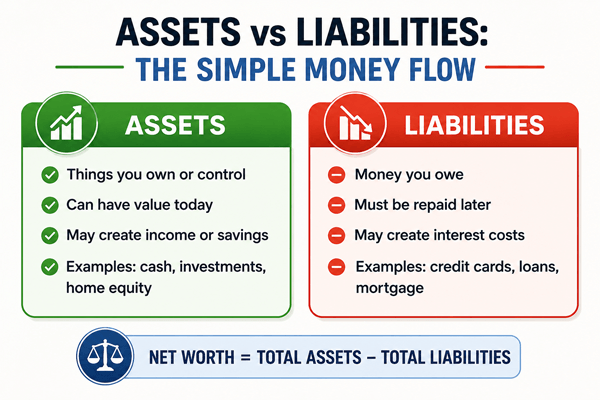
Image: Assets add value to your financial position; liabilities represent claims against your future money.
How Assets and Liabilities Affect Net Worth
Net worth is a simple snapshot of your financial position. It shows what would be left if you sold or counted all your assets and paid off all your liabilities.
- List everything you own that has value.
- Estimate the current value of each asset.
- List everything you owe.
- Add up all liabilities.
- Subtract total liabilities from total assets.
| Example item | Amount |
|---|---|
| Cash and savings | $8,000 |
| Investments | $22,000 |
| Car value | $12,000 |
| Home value | $250,000 |
| Total assets | $292,000 |
| Credit card debt | $3,000 |
| Auto loan | $7,000 |
| Mortgage | $190,000 |
| Total liabilities | $200,000 |
| Net worth | $92,000 |
In this example, the person owns $292,000 in assets and owes $200,000 in liabilities. Their net worth is $92,000.
6. Are All Assets Good and All Liabilities Bad?
No. This is one of the biggest beginner misconceptions. Assets and liabilities are not automatically good or bad. Their impact depends on value, cost, risk, income, and your overall financial situation.
When an Asset May Not Be Helpful
- A car is an asset, but it usually loses value and can be expensive to maintain.
- A large house may be valuable, but high property taxes, repairs, and mortgage payments can strain cash flow.
- Collectibles may have value, but they can be hard to sell quickly at the price you expect.
When a Liability May Be Useful
- A mortgage can help you buy a home and build equity if the payment is affordable.
- A student loan may support education that improves long-term earning power, though borrowing should be reasonable.
- A business loan can help fund growth if the business produces enough cash flow to repay it.
The key question is not just whether something is an asset or liability. The better question is: does it improve or weaken your overall financial position?
7. Appreciating Assets vs Depreciating Assets
An appreciating asset is expected to increase in value over time, although there is never a guarantee. A depreciating asset usually loses value as it gets older or is used.
| Category | Meaning | Examples | Important note |
|---|---|---|---|
| Appreciating asset | May rise in value over time | Diversified investments, real estate, business ownership | Can still fall in value and should be evaluated carefully |
| Depreciating asset | Usually loses value over time | Cars, phones, furniture, appliances | Can still be useful, but may not build wealth |
| Income-producing asset | Creates regular income | Rental property, dividend investments, business assets | Income should be compared with expenses and risk |
| Non-income asset | Has value but does not pay income | Personal home, jewelry, collectibles | May help net worth but not monthly cash flow |
8. Secured vs Unsecured Liabilities
Liabilities can also be classified by whether they are connected to collateral.
| Type | Meaning | Examples | Risk |
|---|---|---|---|
| Secured liability | Debt backed by an asset the lender can claim if you do not pay | Mortgage, auto loan | You may lose the asset if payments are missed |
| Unsecured liability | Debt not tied to a specific asset as collateral | Credit cards, personal loans, medical bills | Can damage credit and may lead to collection activity |
9. Real-Life Examples of Assets and Liabilities
Example 1: Buying a Car
A car is an asset because it has resale value. If you take an auto loan, the loan is a liability. Suppose your car is worth $18,000 and your auto loan balance is $14,000. Your car adds $18,000 to assets, but the loan adds $14,000 to liabilities. The net effect is $4,000 of equity.
Example 2: Owning a Home With a Mortgage
A home is an asset. The mortgage is a liability. If your home is worth $300,000 and the mortgage balance is $220,000, your home equity is $80,000. Equity is the part of the asset you truly own after subtracting debt linked to it.
Example 3: Credit Card Spending
If you buy a laptop for $1,000 using a credit card and do not pay the balance, the laptop may be an asset, but the credit card balance is a liability. If the laptop loses value quickly while interest grows, your financial position can weaken.
Example 4: Starting a Small Business
Business equipment, inventory, and cash in the business can be assets. A business loan, unpaid supplier bill, or tax balance is a liability. A business owner should track both sides to understand whether the business is building value or simply creating obligations.
How to Identify Whether Something Is an Asset or Liability
Use these questions when you are unsure:
- Do I own or control it? If yes, it may be an asset.
- Can it be sold, used, invested, or converted into cash? If yes, it likely has asset value.
- Do I owe money because of it? If yes, that amount is a liability.
- Does it require future payments to someone else? If yes, it is a liability or creates one.
- Does it improve my net worth or reduce it? This shows the net financial effect.
Simple Personal Balance Sheet Template
A beginner-friendly balance sheet can be as simple as four lines: total liquid assets, total long-term assets, total current liabilities, and total long-term liabilities. Add the asset lines, add the liability lines, then subtract liabilities from assets to estimate net worth.
10. Practical Asset and Liability Checklist
| Assets to list | Liabilities to list |
|---|---|
| Cash, checking, and savings balances | Credit card balances |
| Emergency fund | Personal loans |
| Investment and retirement accounts | Student loans |
| Home value and home equity | Mortgage balance |
| Vehicle resale value | Auto loan balance |
| Business ownership value | Business debts |
| Valuable personal property | Taxes owed or unpaid bills |
11. Common Mistakes Beginners Make
- Confusing income with assets. A salary is income, not an asset. The money you save from income becomes an asset.
- Ignoring small debts. Small balances can become expensive if interest and fees build up.
- Counting items at purchase price instead of current value. A used car or electronic device is usually worth less than what you paid.
- Forgetting hidden liabilities. Taxes owed, unpaid bills, family loans, and medical balances still count.
- Thinking all debt is bad. Some debt can be useful if it is affordable, purposeful, and tied to long-term value.
- Thinking all assets build wealth. Some assets lose value, cost money to maintain, or are difficult to sell.
Best Practices for Managing Assets and Liabilities
- Track your net worth at least once or twice a year. This helps you see progress beyond monthly income.
- Build liquid assets first. An emergency fund can protect you from relying on high-interest debt.
- Pay attention to interest rates. High-interest liabilities usually deserve faster repayment.
- Avoid buying depreciating assets with expensive debt. This can create a gap between what something is worth and what you owe.
- Grow productive assets over time. Examples include retirement investments, diversified portfolios, business skills, and income-producing assets.
- Keep debt payments affordable. A liability is easier to manage when it fits comfortably within your monthly budget.
- Review insurance and risk protection. Valuable assets may need protection against loss, damage, illness, or legal risk.
Benefits of Understanding Assets and Liabilities
- You can calculate your net worth accurately.
- You can make better borrowing decisions.
- You can tell the difference between looking wealthy and building wealth.
- You can focus on assets that improve long-term financial stability.
- You can reduce liabilities that drain monthly cash flow.
- You can explain your financial position when applying for loans or planning major goals.
Limitations and Risks to Keep in Mind
Asset and liability tracking is useful, but it is not perfect. Asset values can change, and some items are hard to price. A home may appraise differently depending on the market. Investments can rise or fall. A car may sell for less than expected. Personal items often have lower resale value than people assume.
Liabilities can also change because of interest, fees, missed payments, or refinancing. That is why your net worth statement should be updated regularly rather than treated as a one-time calculation.
Simple Monthly Action Plan
- Write down your main assets and liabilities in one place.
- Update account balances at the end of each month or quarter.
- Pay at least the minimum on every debt to avoid late fees and credit damage.
- Target high-interest debt first when possible.
- Set an automatic transfer to savings or investments, even if the amount is small.
- Review large purchases by asking: will this improve my net worth, cash flow, or quality of life enough to justify the cost?
Assets vs Liabilities in Personal Financial Planning
A strong financial plan usually aims to increase useful assets, control liabilities, and improve cash flow. This does not mean you should never borrow money or never buy things that depreciate. It means every major decision should be made with awareness of both sides of your personal balance sheet.
For example, a family may decide to buy a reliable car because it helps with work and daily life. That can be reasonable even if the car depreciates. The financially smart approach is to avoid over-borrowing, compare financing costs, choose an affordable payment, and keep the total debt manageable.
Frequently Asked Questions
1. What is the main difference between assets and liabilities?
Assets are things you own that have value. Liabilities are debts or obligations you owe. Assets generally increase net worth, while liabilities reduce it.
2. Is a house an asset or a liability?
A house is an asset because it has value. If you have a mortgage, the mortgage is a liability. Your home equity is the home value minus the mortgage balance.
3. Is a car an asset or a liability?
A car is an asset because it can be sold, but it is usually a depreciating asset. If you have an auto loan, the loan is a liability.
4. Is rent a liability?
Monthly rent is usually an expense, not a liability after it is paid. However, unpaid rent or a legal obligation to pay future rent may be treated as a liability in certain financial statements.
5. Is a credit card an asset or liability?
The card itself is not an asset. Any unpaid balance on the card is a liability. Available credit is not the same as money you own.
6. Can something be both an asset and a liability?
The same purchase can involve both. A home is an asset, while the mortgage used to buy it is a liability. A car is an asset, while the auto loan is a liability.
7. Why do assets and liabilities matter?
They help you understand your net worth, debt burden, financial flexibility, and ability to reach goals such as buying a home, retiring, or starting a business.
8. How often should I update my assets and liabilities?
For most people, updating them every three to six months is enough. You may update monthly if you are paying down debt, applying for a loan, or actively tracking financial progress.
Conclusion
Assets and liabilities are the foundation of personal finance. Assets are what you own, while liabilities are what you owe. The difference between them determines your net worth and gives you a clearer picture of your financial health.
The goal is not to avoid every liability or own only perfect assets. The goal is to make thoughtful decisions: build useful assets, manage debt wisely, protect cash flow, and track your progress over time. When you understand assets vs liabilities, you can make money decisions with more confidence and less guesswork.
Reader Advice: This article is for educational and informational purposes only and should not be taken as financial, legal, tax, accounting, or investment advice. Please check the latest information from official sources or qualified professionals, as rules, policies, and personal circumstances can change over time.