How Millionaires Build Wealth: Habits, and Strategies
Millionaires usually do not build wealth through one lucky decision. Most build it through a repeatable system: earning well, spending less than they earn, investing in assets, managing risk and staying consistent for many years. Some inherit wealth or build fast-growing companies, but many ordinary millionaires become wealthy through habits that look simple from the outside and powerful over time.
This guide explains how millionaires build wealth in practical terms. You will learn the habits, strategies, mistakes to avoid and lessons a beginner can apply even with a modest starting income.
Quick answer: millionaires build wealth by widening the gap between income and expenses, buying productive assets, avoiding destructive debt and staying consistent long enough for compounding to work.
1. What Does It Mean to Be a Millionaire?
A millionaire is commonly someone whose net worth is at least $1 million. Net worth means what you own minus what you owe:
Net worth = assets - liabilities
Assets include cash, investments, retirement accounts, real estate, business equity and valuable property. Liabilities include mortgages, credit card balances, student loans, personal loans, car loans and other debts.
Being a millionaire does not always mean living a flashy lifestyle. A person may have a $1 million net worth mostly in a paid-off home and retirement account but still drive an older car and follow a budget. In fact, quiet wealth is common because long-term wealth often requires delayed gratification.
Important context: global millionaire counts change with asset prices, exchange rates and inflation. The UBS Global Wealth Report 2026 reported that the number of USD millionaires rose by 1.5% in 2025, equivalent to nearly one million new millionaires globally. The report also shows why net worth is a stronger wealth measure than income alone, because wealth depends on assets, debts, savings, investments and ownership over time. In the United States, Federal Reserve Survey of Consumer Finances data include families' balance sheets, pensions, income and demographic characteristics.
2. The Core Formula: How Millionaires Actually Build Wealth
Most wealth-building stories can be simplified into five moving parts: income, saving, investing, ownership and time.
| Wealth Driver | What Millionaires Often Do | Beginner Action Step |
|---|---|---|
| Income | Increase earning power through skills, business, career growth or specialized expertise. | Choose one skill that can raise your income and practice it weekly. |
| Saving rate | Keep a meaningful gap between income and lifestyle spending. | Automate savings on payday before spending begins. |
| Investing | Buy assets that can grow or produce income over time. | Learn the basics of diversified funds, retirement accounts and real estate. |
| Ownership | Own equity in businesses, real estate or financial markets instead of only earning wages. | Start with accessible ownership such as broad-market funds or a small business idea. |
| Time | Let compounding work over years, not weeks. | Think in 5-, 10- and 20-year time frames. |
The key lesson is that millionaires usually do not rely on income alone. High income helps, but wealth grows when income is converted into assets that can rise in value or generate cash flow.
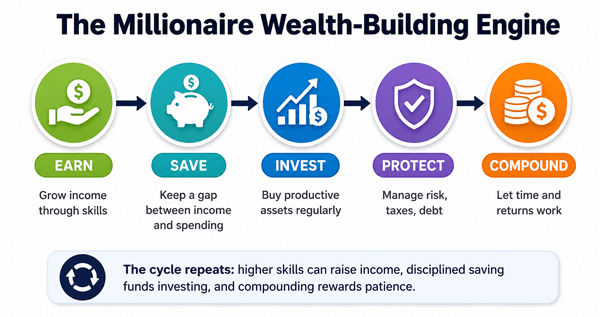
Figure: The millionaire wealth-building engine shows how income, saving, investing, protection and compounding work together.
Habit 1: They Track Net Worth, Not Just Income
Income tells you how much money comes in. Net worth tells you how much money stays and grows. A person earning $250,000 per year can still have little wealth if they spend everything. A person earning $70,000 can build wealth steadily if they save, invest and avoid destructive debt.
Millionaires often track:
- Total assets, including cash, investments, real estate and business interests.
- Total debts, including credit cards, loans and mortgages.
- Savings rate, which is the percentage of income saved and invested.
- Investment allocation, meaning how money is spread across assets.
- Progress toward financial independence, retirement or business goals.
Practical example: If your assets are $120,000 and your debts are $45,000, your net worth is $75,000. If you raise that by $1,000 per month through debt reduction and investing, your net worth could improve by $12,000 in one year before market growth.
Habit 2: They Live Below Their Means Without Feeling Poor
Living below your means does not mean avoiding every enjoyable purchase. It means building a lifestyle that leaves room for saving and investing. Many future millionaires avoid lifestyle inflation, which happens when every raise turns into a bigger house, newer car, more subscriptions or more expensive habits.
A useful rule is to increase your lifestyle more slowly than your income. For example, if your income rises by $1,000 per month, you might invest $500, save $300 for goals and use $200 for lifestyle upgrades. This lets you enjoy progress while still building wealth.
| Spending Choice | Poor Wealth Habit | Millionaire-Style Habit |
|---|---|---|
| Pay raise | Upgrade everything immediately. | Invest part of the raise automatically. |
| Car purchase | Buy the maximum payment the lender approves. | Buy reliable transportation that fits the total budget. |
| Housing | Stretch the budget until savings disappear. | Keep housing affordable enough to maintain investing. |
| Shopping | Buy to impress others. | Buy based on value, use and priorities. |
Habit 3: They Turn Savings Into Productive Assets
Saving cash is important for emergencies and short-term needs, but cash alone rarely builds long-term wealth because inflation can reduce purchasing power. Millionaires typically move beyond saving into asset ownership.
Common wealth-building assets include:
- Stock and bond funds for diversified market exposure.
- Retirement accounts or tax-advantaged investment accounts where available.
- Real estate that is affordable, well-financed and maintained.
- Business ownership, including side businesses, partnerships or equity compensation.
- Professional skills and credentials that increase lifetime earnings.
Vanguard summarizes timeless investing principles as setting clear goals, maintaining balance and diversification, minimizing costs and staying disciplined. These principles are useful because they focus on factors investors can control rather than predictions they cannot control. For readers, this means any wealth plan should be simple, diversified, affordable and aligned with personal risk tolerance.
Habit 4: They Understand the Power of Compounding
Compounding happens when returns begin earning returns of their own. It is why starting early and staying consistent can matter more than trying to find the perfect investment.
| Monthly Investment | Years Invested | Example Annual Return | Approximate Future Value |
|---|---|---|---|
| $300 | 20 years | 7% | $157,000 |
| $500 | 25 years | 7% | $405,000 |
| $750 | 30 years | 7% | $918,000 |
| $1,000 | 30 years | 7% | $1.22 million |
These are simplified examples, not guarantees. Real investment returns vary, and markets can decline. Taxes, fees and inflation can also reduce real-world results. The lesson is that consistent investing plus time can create large results even without dramatic monthly contributions.
Habit 5: They Avoid Bad Debt and Use Good Debt Carefully
Debt can either support wealth or destroy it. Millionaires are often careful about the type, cost and purpose of debt they use.
| Debt Type | Why It Can Help or Hurt | Better Approach |
|---|---|---|
| Credit card debt | High interest can overwhelm savings and investments. | Pay in full when possible; treat balances as urgent. |
| Car loans | Cars usually lose value while payments reduce cash flow. | Keep payments modest and avoid frequent upgrades. |
| Mortgage debt | Can help buy a home, but too much house creates pressure. | Buy within a budget that still allows saving and investing. |
| Business debt | Can fund growth, but failure can damage finances. | Use only with a clear plan, cash-flow forecast and risk limit. |
| Student or skill debt | Can pay off if it raises earning power. | Compare total cost with realistic income benefit. |
Strategy 1: Build a High-Value Skill Stack
Many millionaires build wealth by becoming more valuable in the marketplace. A skill stack is a combination of abilities that makes you more useful than someone with only one skill. For example, a software developer who also understands sales, communication and project management can earn more than a developer who only writes code.
Useful skill stacks can include:
- Technical skill + communication skill.
- Industry knowledge + sales ability.
- Financial literacy + business operations.
- Creative skill + marketing skill.
- Leadership + data analysis.
Beginner action: choose one income-building skill and one communication skill. Spend 30 to 60 minutes per day improving them for six months. The goal is not perfection; it is higher earning power.
Strategy 2: Automate Wealth-Building Decisions
Millionaires often reduce the need for daily motivation. They use systems. Automation helps because it makes good decisions happen before emotions, distractions or impulse spending interfere.
Examples of automation:
- Automatic transfers to savings on payday.
- Automatic contributions to investment or retirement accounts.
- Automatic debt payments to avoid late fees.
- Automatic sinking funds for annual expenses such as insurance, taxes or holidays.
- Calendar reminders for quarterly net worth reviews.
A simple starter system is the 24-hour rule for nonessential purchases, automatic savings first and one monthly money review.
Strategy 3: Invest Simply Before Investing Cleverly
Beginners often believe millionaires use complex investments. Some do, but many successful investors use simple, diversified strategies. Complexity can create higher fees, confusion and emotional decisions.
A beginner-friendly investment mindset:
- Know your goal before choosing an investment.
- Diversify instead of betting everything on one company, property or trend.
- Keep fees low because costs reduce returns over time.
- Avoid investments you cannot explain in plain English.
- Use a long-term plan rather than reacting to daily headlines.
Speculation can be exciting, but wealth usually grows from repeatable discipline. A person who invests consistently in broad, low-cost assets may outperform someone constantly chasing hot tips.
Strategy 4: Create Multiple Income Streams, But Not Too Early
Multiple income streams can help, but trying to build five streams at once can dilute focus. Many millionaires first master one strong income source, then add others.
| Income Stream | Example | Best When |
|---|---|---|
| Primary job or profession | Salary, consulting, freelancing | You are still building stable income. |
| Investments | Dividends, interest, capital growth | You have regular surplus cash to invest. |
| Business income | Online business, agency, local service | You understand customers and can manage risk. |
| Real estate income | Rental property or real estate funds | You can handle financing, maintenance and vacancies. |
| Intellectual property | Books, courses, licensing | You have expertise or creative assets. |
For beginners, the order often matters: stabilize income, build emergency savings, reduce high-interest debt, invest consistently, then explore additional income streams.
Strategy 5: Protect Wealth With Risk Management
Building wealth is only half the job. Keeping it matters too. Millionaires often protect wealth through insurance, emergency funds, legal planning, tax awareness and diversification.
Key protection habits include:
- Maintaining an emergency fund for job loss, health issues or repairs.
- Having appropriate insurance such as health, disability, property, liability and life insurance when needed.
- Avoiding overconcentration in one stock, one business customer or one property.
- Keeping important documents organized.
- Planning for taxes instead of being surprised by them.
Risk management may feel boring, but one uninsured event, lawsuit, bad loan or tax problem can erase years of progress.
■ Common Misconceptions About Millionaires
| Misconception | Reality |
|---|---|
| Millionaires are always high earners. | Income helps, but saving rate, investing and time are often more important than status spending. |
| You need to be born rich. | Inheritance helps some people, but many build wealth through career growth, ownership and disciplined investing. |
| Millionaires take huge risks. | Some do, but durable wealth usually comes from calculated risk, diversification and downside protection. |
| Luxury means wealth. | Luxury spending can signal high consumption, not high net worth. |
| It is too late to start. | Starting earlier helps, but improving savings, income and debt habits can still change your financial path. |
■ Mistakes That Stop People From Becoming Millionaires
- Waiting for a perfect time to start. Wealth-building rewards early action and consistency.
- Confusing income with wealth. A high salary can disappear through high spending.
- Carrying high-interest debt while trying to invest aggressively. Debt interest can quietly beat investment returns.
- Following hype instead of a plan. Hot tips, trends and fear of missing out can lead to poor decisions.
- Ignoring taxes, fees and inflation. Small leaks can become large over decades.
- Quitting during market downturns. Selling in panic can turn temporary declines into permanent losses.
- Failing to increase earning power. Frugality alone has limits if income stays too low.
■ A Practical Beginner Plan to Build Wealth Like a Millionaire
You do not need to copy a millionaire lifestyle. Copy the system behind the wealth.
Step 1: Calculate your starting net worth.
List what you own, list what you owe and subtract liabilities from assets. This gives you a financial starting point.
Step 2: Build a small emergency fund.
Start with a basic cushion, such as one month of essential expenses, then gradually build toward a larger reserve based on job stability, family needs and risk.
Step 3: Attack high-interest debt.
Credit card and payday-style debt can block wealth-building. Consider paying it down aggressively while avoiding new balances.
Step 4: Automate saving and investing.
Set up automatic transfers so wealth-building happens before discretionary spending. Increase contributions when income rises.
Step 5: Invest in diversified assets.
Learn the basics of asset allocation, funds, retirement accounts and risk tolerance. Keep the plan simple enough to follow.
Step 6: Grow your income.
Negotiate, change roles, freelance, start a small business or improve skills. Higher income can speed up wealth-building if lifestyle spending stays controlled.
Step 7: Review quarterly.
Every three months, review net worth, savings rate, debt balances, investment contributions and major spending patterns.
■ Example: How an Ordinary Person Could Build Millionaire Wealth
Assume a person starts at age 30 with no investments, invests $750 per month and earns a hypothetical 7% average annual return. By age 60, the account could grow to about $918,000 before taxes and fees. If that person also builds home equity, increases income and raises contributions over time, a $1 million net worth becomes more realistic. The exact result will depend on returns, inflation, taxes, debt, income and life events, but the example shows the power of steady behavior.
■ Pros and Cons of Common Millionaire Wealth Strategies
| Strategy | Main Benefit | Main Risk or Limitation |
|---|---|---|
| Index fund investing | Simple diversification and low cost. | Market downturns require patience. |
| Real estate | Leverage, rental income and potential appreciation. | Vacancies, repairs, debt and local market risk. |
| Business ownership | High upside and control. | Failure risk, stress and inconsistent income. |
| High-income career | Strong cash flow for saving and investing. | Burnout or dependence on one income source. |
| Frugal living | Creates investable surplus. | Can feel restrictive if taken too far. |
■ Key Lessons From How Millionaires Build Wealth
- Wealth is built from the gap between what you earn and what you spend.
- Assets, not appearances, create long-term financial strength.
- A high savings rate can matter more than a high-status lifestyle.
- Diversification protects against being wrong about one investment.
- Compounding rewards patience, not constant action.
- Risk management is part of wealth-building, not an optional extra.
- The best strategy is one you understand and can follow consistently.
■ Frequently Asked Questions
1. How do most millionaires build wealth?
Most build wealth by increasing income, living below their means, investing consistently, owning assets and staying disciplined for many years. Some build wealth through business ownership, real estate or inheritance, but habits still matter for preserving wealth.
2. Do you need a high income to become a millionaire?
A high income helps, but it is not enough by itself. The important question is how much income becomes savings, investments and asset ownership. A moderate earner with discipline can build more wealth than a high earner who spends everything.
3. What is the biggest habit of millionaires?
The biggest habit is converting income into assets. They do not let every raise become lifestyle spending. They save, invest and track progress over time.
4. Is real estate necessary to become a millionaire?
No. Real estate can help, but it is not required. Many people build millionaire net worth through retirement accounts, diversified funds, business equity or a combination of assets.
5. How long does it take to become a millionaire?
It depends on starting point, income, savings rate, investment returns, debt, taxes and inflation. For many people, it is a multi-decade process. Higher savings rates and income growth can shorten the timeline.
6. What should beginners do first?
Start by calculating net worth, building a small emergency fund, eliminating high-interest debt and automating savings. Then learn simple diversified investing and work on increasing income.
7. Do millionaires budget?
Many do, even if they do not use a detailed spreadsheet. They usually know their cash flow, avoid wasteful debt and make intentional spending decisions.
8. What is the safest way to build wealth?
There is no risk-free path, but a safer approach usually includes emergency savings, low-interest debt, diversification, appropriate insurance, low costs and a long-term plan.
■ Conclusion: Build Wealth Quietly, Repeatedly and Patiently
Millionaires build wealth by repeating practical decisions: earn more, spend intentionally, invest in assets, avoid destructive debt, manage risk and give compounding enough time to work. The process is not always exciting, but it is powerful because small good decisions can accumulate into major financial progress.
The best place to start is not with a complex investment. Start with your next paycheck. Decide how much will go toward savings, debt reduction, investing and skill-building. Then repeat the process until it becomes normal.
Sources and notes
- UBS Global Wealth Report 2026, reporting that USD millionaires rose by 1.5% in 2025, equivalent to nearly one million new millionaires globally.
- Federal Reserve, 2022 Survey of Consumer Finances, which tracks U.S. family balance sheets, pensions, income and demographic characteristics.
- Vanguard, Principles for Investing Success: goals, balance, cost and discipline.
Reader Advice:This article is for educational and informational purposes only and should not be taken as personalized financial, tax, legal or investment advice. Rules, policies and market information can change over time, so please check the latest official sources or speak with a qualified professional before making important decisions.