How to Calculate Your Net Worth Step by Step

Net worth is one of the simplest ways to measure your overall financial position. It answers one practical question: after adding up what you own and subtracting what you owe, what is left?
Many people focus only on income, but income alone does not show the full picture. A person can earn a high salary and still have a weak financial position if they carry large debts, spend more than they earn, or own few valuable assets. Another person may have a modest income but a strong net worth because they save consistently, invest carefully, and keep debt under control.
Calculating your net worth helps you see where you stand today, track progress over time, and make better decisions about saving, borrowing, investing, and spending. The calculation is simple, but doing it carefully matters because small omissions can make your number misleading.
1. What Is Net Worth?
Net worth is the difference between your total assets and your total liabilities. Assets are things you own that have financial value. Liabilities are debts and financial obligations you owe to others.
In plain English, net worth is what you would roughly have left if you sold your assets and paid off your debts. It is not the same as your income, cash balance, credit score, or lifestyle. It is a snapshot of your financial position on a specific date.
Net Worth Formula
Net Worth = Total Assets - Total Liabilities
For example, if your assets are worth $180,000 and your liabilities total $95,000, your net worth is $85,000.
Quick search intent answer: To calculate your net worth, add the current value of your assets, add the current balance of your debts, and subtract debts from assets. The result can be positive, zero, or negative.
What Net Worth Tells You
Your net worth can show whether you are building financial strength over time. A rising net worth usually means your assets are growing, your debts are falling, or both. A falling net worth may signal overspending, high-interest debt, poor investment performance, or a major life change that needs attention.
Net worth should not be used to judge your personal value. It is a financial measurement, not a measure of character, effort, intelligence, or future potential.
| Quick Answer | Simple Explanation |
|---|---|
| How do you calculate net worth? | Add up everything you own, add up everything you owe, then subtract total liabilities from total assets. The result is your net worth. |
2. How to Calculate Your Net Worth Step by Step
Follow these steps in order. You can use a notebook, spreadsheet, budgeting app, or the worksheet table included below.
Step 1: Choose a Calculation Date
Net worth is a snapshot, so begin by choosing a specific date. For example, you might calculate it on the last day of every month, the first day of every quarter, or once a year during your financial review.
Using the same schedule makes your numbers easier to compare. Avoid mixing old account balances with new debt balances because that can distort the result.
Step 2: List All Your Assets
Assets are things you own that can reasonably be given a dollar value. Start with the easiest items: cash, checking accounts, savings accounts, investments, retirement accounts, real estate, vehicles, and valuable business interests.
Use realistic values. For bank and investment accounts, use the current balance. For property, vehicles, and collectibles, use a conservative market estimate rather than an emotional or overly optimistic value.
Accuracy tip: Use values from the same date for every account, and keep screenshots or notes if you want a clean month-to-month record.
| Asset Category | Examples | How to Estimate the Value |
|---|---|---|
| Cash and bank accounts | Checking, savings, money market accounts | Use the current account balance. |
| Investments | Brokerage accounts, stocks, bonds, mutual funds, ETFs | Use current market value. |
| Retirement accounts | 401(k), IRA, pension balance, superannuation-style accounts | Use current vested balance if available. |
| Real estate | Primary home, rental property, land | Use a reasonable market estimate minus selling costs if you want a conservative number. |
| Vehicles | Car, motorcycle, boat | Use trade-in or private-sale value, not the original purchase price. |
| Business ownership | Small business equity, partnership interest | Use a conservative estimate or professional valuation if material. |
| Other valuable property | Jewelry, art, collectibles | Include only if it has meaningful resale value and you can estimate it realistically. |
Step 3: Add Up Your Total Assets
Once you have listed each asset, add the values together. This gives you your total assets. Be careful not to count the same item twice. For example, if your home is included as real estate, do not also count your home equity separately in the asset column. Equity is calculated after subtracting the mortgage on the liability side.
Step 4: List All Your Liabilities
Liabilities are debts and financial obligations you owe. Include short-term debts, long-term debts, loans, credit card balances, unpaid bills, and any other amounts you are legally or practically responsible for paying.
Include joint debts, co-signed loans, unpaid taxes, and any overdue bills you are responsible for, because leaving them out can make your net worth look stronger than it really is.
| Liability Category | Examples | Balance to Use |
|---|---|---|
| Credit cards | Personal cards, store cards | Use the current outstanding balance, not only the minimum payment. |
| Student loans | Federal/private education loans | Use the payoff balance or current principal balance. |
| Auto loans | Car, motorcycle, boat loans | Use the remaining loan balance. |
| Mortgage | Home loan, second mortgage | Use the outstanding mortgage balance. |
| Personal loans | Bank loans, family loans, installment loans | Use the remaining amount owed. |
| Medical or tax debt | Unpaid medical bills, tax balances | Use the full amount owed, including known penalties or interest. |
| Buy now, pay later | Installment purchases, consumer finance plans | Use the unpaid balance. |
Step 5: Add Up Your Total Liabilities
Add every debt balance together. This gives you total liabilities. Do not use monthly payments as the liability amount. A $400 monthly car payment is not the liability; the full remaining loan balance is.
Step 6: Subtract Liabilities From Assets
Now apply the formula: Total Assets - Total Liabilities = Net Worth. If assets are greater than liabilities, your net worth is positive. If liabilities are greater than assets, your net worth is negative.
Step 7: Review What the Number Means
The number itself is useful, but the trend is more important. One calculation tells you where you stand today. Repeated calculations show whether your financial position is improving, staying flat, or getting weaker.
For personal finance planning, many readers also track liquid net worth separately by excluding home equity and other assets that cannot be sold quickly.
After calculating your net worth, ask: Are my debts shrinking? Are my emergency savings improving? Are my investments growing over time? Am I relying too much on one asset, such as my home? Do I have too much high-interest debt?
3. Net Worth Worksheet Template
Use this simple worksheet to calculate your own net worth. Replace the example amounts with your numbers.
Download or copy the table into a spreadsheet so you can update the same template each month or quarter.
| Assets | Example Amount |
|---|---|
| Checking account | $2,500 |
| Savings account | $12,000 |
| Retirement accounts | $65,000 |
| Investment account | $18,000 |
| Home market value | $250,000 |
| Vehicle resale value | $14,000 |
| Other assets | $3,500 |
| Total Assets | $365,000 |
| Liabilities | Example Amount |
|---|---|
| Credit card balances | $4,000 |
| Student loans | $22,000 |
| Auto loan | $8,500 |
| Mortgage balance | $190,000 |
| Personal loan | $3,500 |
| Other debts | $1,000 |
| Total Liabilities | $229,000 |
| Calculation | Amount |
|---|---|
| Total Assets | $365,000 |
| Minus Total Liabilities | -$229,000 |
| Net Worth | $136,000 |
4. Net Worth Examples for Beginners
Example 1: Young Professional With Student Loans
Aisha has $8,000 in savings, $12,000 in retirement savings, and a car worth $9,000. Her assets total $29,000. She owes $24,000 in student loans and $5,000 on her car loan, so her liabilities total $29,000. Her net worth is $0.
This does not mean Aisha is failing. It means her assets and debts currently balance out. If she keeps saving and paying down debt, her net worth can become positive.
Example 2: Homeowner With a Mortgage
Daniel owns a home worth $320,000, has $40,000 in retirement savings, $15,000 in cash, and a vehicle worth $10,000. His assets total $385,000. He owes $245,000 on his mortgage, $6,000 on his car loan, and $3,000 on credit cards. His liabilities total $254,000. His net worth is $131,000.
Most of Daniel's net worth comes from home equity. That is useful, but it is not the same as cash. He should still keep an emergency fund and avoid becoming house-rich but cash-poor.
Example 3: Negative Net Worth
Mina has $4,000 in cash and $6,000 in retirement savings. Her total assets are $10,000. She owes $18,000 in credit card debt and $12,000 in student loans. Her liabilities total $30,000. Her net worth is negative $20,000.
Negative net worth is common early in adult life or after periods of debt, medical bills, unemployment, divorce, or business loss. The practical goal is to stabilize, reduce high-interest debt, and rebuild assets gradually.
| Situation | Assets | Liabilities | Net Worth | Main Lesson |
|---|---|---|---|---|
| Young professional | $29,000 | $29,000 | $0 | A neutral starting point can improve with saving and debt repayment. |
| Homeowner | $385,000 | $254,000 | $131,000 | Home equity helps, but liquidity still matters. |
| Negative net worth | $10,000 | $30,000 | -$20,000 | Focus first on high-interest debt and cash stability. |
■ What Should You Include and Exclude?
A common beginner mistake is including items that do not have real resale value or excluding debts that feel uncomfortable. A good net worth calculation should be honest, consistent, and conservative.
1. Include These Items
Include cash, savings, investment balances, retirement accounts, property, vehicles, business equity, and valuable possessions that could realistically be sold. Include all debts, even if they are interest-free or owed to family.
2. Be Careful With These Items
Personal belongings such as clothing, furniture, electronics, and household items usually lose value quickly. Unless they are unusually valuable, it is often better to leave them out. This keeps your calculation clean and prevents overestimating your financial position.
3. Should You Include Your Home?
Yes, most people include the estimated market value of their home as an asset and the mortgage balance as a liability. The difference contributes to home equity. However, remember that home equity is not instantly spendable cash. Selling a home involves time, costs, taxes in some situations, and the need for another place to live.
4. Should You Include Retirement Accounts?
Yes, retirement accounts are assets. For a more conservative calculation, some people also estimate taxes or penalties that may apply if money is withdrawn early. For a simple beginner calculation, using the current account balance is acceptable as long as you are consistent over time.
■ Positive, Negative, and Zero Net Worth
Positive net worth means assets exceed liabilities. Negative net worth means liabilities exceed assets. Zero net worth means the two are equal. None of these numbers should cause panic or overconfidence by themselves. Context matters.
A negative net worth may be temporary for a medical student, new graduate, entrepreneur, or person recovering from a financial setback. A positive net worth may still be risky if most assets are illiquid, debt payments are too high, or there is no emergency fund.
5. Net Worth vs Income: What Is the Difference?
Income is money you earn over a period of time, such as wages, business income, rental income, or investment income. Net worth is what you own minus what you owe at a point in time. Income is a flow. Net worth is a snapshot.
| Comparison | Income | Net Worth |
|---|---|---|
| Meaning | Money earned during a period | Assets minus liabilities on a specific date |
| Example | $5,000 monthly salary | $80,000 total net worth |
| Main use | Budgeting and cash flow planning | Measuring financial progress and stability |
| Can it be high while the other is low? | Yes. High earners can have low net worth if they overspend. | Yes. Retirees may have low income but high net worth. |
6. Why Calculating Net Worth Is Useful
Calculating net worth gives you a clear starting point. Without a starting point, it is hard to know whether your financial choices are helping or hurting you.
Key Benefits
It helps you track progress, identify debt problems, understand whether assets are growing, make better decisions before borrowing, and prepare for major goals such as buying a home, starting a business, retiring, or helping children with education costs.
Limitations
Net worth does not show monthly cash flow, job security, insurance coverage, health, family responsibilities, or how easy it is to access your money. A person can have a high net worth but poor cash flow. Another person can have low net worth but strong income and excellent habits.
7. Common Net Worth Calculation Mistakes
| Mistake | Why It Is a Problem | Better Approach |
|---|---|---|
| Using purchase price instead of current value | Assets such as cars and electronics often lose value. | Use realistic current resale or market value. |
| Ignoring small debts | Small balances add up and make the number inaccurate. | Include every debt balance. |
| Counting monthly payments as liabilities | Payments are cash flow, not total debt. | Use the full remaining balance owed. |
| Overvaluing personal items | Most household items sell for far less than expected. | Exclude ordinary personal items or value them conservatively. |
| Mixing dates | Old asset values and new debt balances distort the result. | Use balances from the same date. |
| Comparing yourself unfairly | Age, location, family situation, and starting point vary widely. | Compare your current number with your past numbers. |
8. How Often Should You Calculate Net Worth?
For most people, monthly or quarterly tracking is enough. Monthly tracking is useful if you are actively paying down debt or building savings. Quarterly tracking is often better if market swings make you anxious. Annual tracking is better than not tracking at all, but it may be too infrequent to catch problems early.
The best schedule is one you can maintain. Use the same date each period and keep notes about major changes, such as a home purchase, job loss, inheritance, business sale, market decline, or large debt payoff.
■ How to Improve Your Net Worth Over Time
You can improve net worth in two main ways: increase assets or reduce liabilities. The strongest plans usually do both.
1. Practical Ways to Increase Assets
Build an emergency fund, contribute consistently to retirement accounts, invest according to your risk tolerance and time horizon, increase income through skills or business growth, and protect assets with appropriate insurance.
2. Practical Ways to Reduce Liabilities
Pay off high-interest debt first, avoid taking on consumer debt for lifestyle purchases, refinance only when the total cost makes sense, make extra principal payments when appropriate, and stop adding new debt while you are trying to recover.
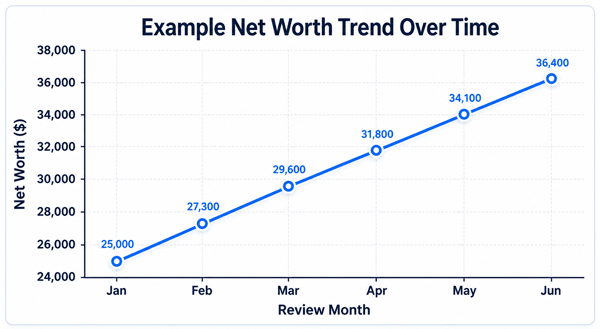
3. Best Practice: Focus on the Trend
A single month may look worse because of market changes, a large bill, or seasonal spending. What matters most is the direction over six months, one year, and several years. A steadily rising net worth is usually a sign that your plan is working.
■ Beginner-Friendly Net Worth Checklist
| Task | Done? |
|---|---|
| Choose a calculation date | |
| List all cash and bank balances | |
| List investment and retirement balances | |
| Estimate property and vehicle values conservatively | |
| List every debt balance | |
| Add total assets | |
| Add total liabilities | |
| Subtract liabilities from assets | |
| Save the result and date | |
| Review what changed since last time |
■ Simple Net Worth Tracking Tips
Keep your method simple. A basic spreadsheet with columns for date, assets, liabilities, and net worth is enough for most beginners. Add notes so you remember why the number changed.
Separate liquid assets from illiquid assets. Liquid assets include cash and investments that can be accessed relatively quickly. Illiquid assets include homes, vehicles, private business interests, and collectibles. This helps you understand not only what you are worth on paper, but also how flexible your finances are.
Do not let market changes discourage you. Investment and real estate values can rise and fall. Your behavior matters most: saving consistently, managing debt, keeping cash reserves, and avoiding emotional decisions.
Visual example: a net worth trend line helps you focus on long-term direction instead of one monthly result.
■ Mini Case Study: Using Net Worth to Make a Better Decision
Suppose Omar wants to buy a new car. His net worth calculation shows $20,000 in cash, $45,000 in retirement savings, a car worth $7,000, and $15,000 in student loans. His net worth is $57,000. At first, he feels comfortable buying a $35,000 car with a loan.
After reviewing his net worth, he notices that most of his financial progress comes from retirement savings and cash reserves. Taking on a large car loan would increase liabilities, reduce monthly flexibility, and slow his progress. He chooses a reliable used car instead and keeps more cash available for emergencies. The net worth calculation helped him see the full impact before making the purchase.
■ Frequently Asked Questions
1. What is the easiest way to calculate net worth?
The easiest way is to list everything you own, list everything you owe, add each side, and subtract total liabilities from total assets. A simple spreadsheet or worksheet is enough.
2. Is net worth the same as savings?
No. Savings are one type of asset. Net worth includes all assets and subtracts all debts.
3. Can my net worth be negative?
Yes. Negative net worth means your debts are greater than your assets. This can happen because of student loans, credit card debt, medical bills, business losses, or early-career borrowing. The solution is to improve the trend over time.
4. Should I include my car in my net worth?
Yes, if the car has resale value. Use a realistic current value, not the amount you paid for it. Also include any auto loan balance as a liability.
5. Should I include my mortgage?
Yes. Include your home value as an asset and the outstanding mortgage balance as a liability. The difference is your home equity.
6. What is a good net worth?
A good net worth depends on age, income, location, family responsibilities, debt level, and goals. Instead of focusing only on comparisons, track whether your own net worth is improving over time.
A more useful question is whether your net worth is moving in the right direction while your cash flow, insurance, emergency savings, and debt payments remain manageable.
7. How often should I update my net worth?
Monthly or quarterly works well for many people. Annual tracking is also useful, especially during a year-end financial review.
8. Does net worth include income?
Income is not directly included in net worth. However, income can help you build net worth if you save, invest, and pay down debt.
■ Conclusion: Your Net Worth Is a Starting Point, Not a Score
Calculating your net worth is one of the most practical personal finance habits you can build. It turns a vague feeling about money into a clear number. More importantly, it helps you see patterns: whether your savings are growing, debts are shrinking, and long-term financial position is improving.
Start with a simple calculation today. List your assets, list your liabilities, subtract what you owe from what you own, and save the result. Then repeat the process regularly. Over time, the trend can guide better decisions and help you build a stronger financial future.
Reader Advice: This article is for educational and information purposes only and should not be taken as personal financial, tax, investment, or legal advice. Please check the latest information from official sources or a qualified professional, as rules, policies, and financial details can change over time.